Act I
The courtroom was silent when Cassandra Vale leaned toward the old woman’s ear.
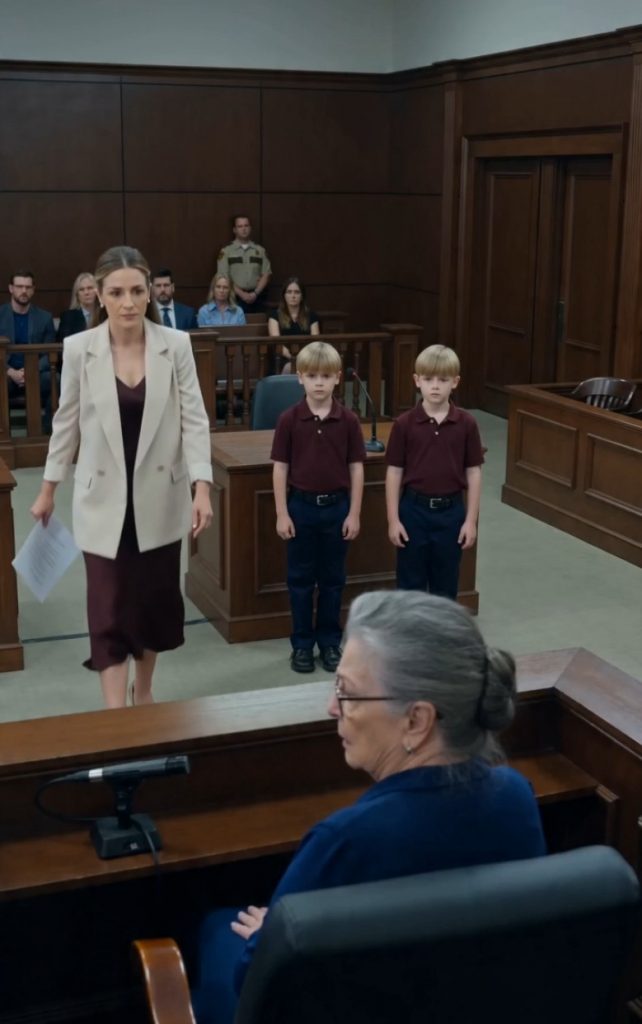
She did it slowly, elegantly, with one manicured hand resting on the defense table and a stack of legal papers tucked beneath her arm. Her ivory suit was flawless. Her brown hair was pinned into a professional bun. Pearls gleamed at her ears like she had dressed for victory, not justice.
Across from her, Eleanor Vale sat with both hands folded in her lap.
She was seventy-one, grey-haired, and wearing a navy blouse she had ironed herself at dawn because she could not sleep. Her rectangular glasses sat low on her nose. Her eyes were red from the kind of exhaustion that comes not from one bad night, but from months of fear.
Cassandra bent lower.
“Now we’ll see who wins this case,” she whispered.
Eleanor did not move.
She stared down at the table, at the polished oak surface reflecting the lights above, and tried not to let the tears fall in front of the boys.
The twins stood near the aisle behind Cassandra.
Noah and Oliver Vale.
Eight years old. Blonde. Identical enough that strangers guessed wrong even after being corrected. They wore matching dark red shirts and navy slacks, their hands clasped firmly in front of them, backs straight, faces pale and serious.
They had been silent all morning.
Too silent.
Cassandra had counted on that.
The case was supposed to be simple. She was suing Eleanor for custody of the boys and control over the late Adrian Vale’s company shares. Cassandra claimed Eleanor was too old, too unstable, and too emotionally dependent on the children to raise them properly.
But that was not what she wanted.
What she wanted was Vale Precision, the family manufacturing company Adrian had inherited from his father and rebuilt into a national supplier. What she wanted was the trust that held the twins’ future. What she wanted was the power Eleanor had refused to hand over.
Cassandra’s whisper sharpened.
“Since you didn’t give me half of the company,” she murmured, “I will take the children.”
Eleanor closed her eyes.
That was when Oliver moved.
The twin on the right broke his perfect stillness and stepped forward.
His small shoes sounded against the courtroom floor.
“Your Honor,” he said, voice loud and clear, “everything she is about to say is a lie!”
The courtroom froze.
Cassandra spun around so quickly the papers in her hand bent against her side.
Her eyes widened.
Not in anger.
In panic.
Judge Mercer leaned forward from the bench.
The observers behind them began whispering. A bailiff shifted beside the wall. Eleanor looked up as if she had heard a voice return from somewhere she thought grief had stolen.
Oliver stood alone in the aisle, trembling now, but refusing to step back.
Cassandra recovered first.
“Your Honor, he’s a child. He’s upset. This entire situation has been confusing for them.”
Noah stepped beside his brother.
“No,” he said quietly. “She told us to be confused.”
Cassandra’s face went white.
And for the first time since the case began, Eleanor Vale realized her grandsons had not been silent because they were afraid.
They had been waiting.
Act II
Before Cassandra entered the family, the Vale house had been loud.
Not grand loud. Not careless loud.
Alive loud.
The twins ran through the halls in socks. Adrian burned pancakes on Sundays and pretended the smoke alarm was applause. Eleanor kept a cookie jar on the kitchen counter and always acted surprised when it emptied too quickly.
After the boys’ mother died, the house changed, but it did not break.
Adrian grieved quietly. He learned how to braid hair badly for school costume day, how to pack lunches with notes inside, and how to answer questions no father should have to answer alone.
Eleanor moved into the guest suite “temporarily.”
She never moved out.
The boys called her Gran Ellie. She called them her two bookends because they were always on either side of her.
Then Adrian met Cassandra.
At first, Eleanor wanted to like her.
Cassandra was organized, graceful, and patient in public. She sent thank-you cards. She remembered names. She spoke gently to the twins when Adrian was watching. She seemed like the kind of woman who could bring order to a grieving home.
But children know the temperature of a room before adults admit the fire is out.
Noah became quieter around her.
Oliver watched her hands.
Eleanor noticed.
Adrian did too, though he tried not to. Love, especially after loneliness, can make a person negotiate with their instincts.
Cassandra and Adrian married after one year.
Six months later, Adrian began changing his estate plans.
Not because Cassandra asked directly. She was too clever for that.
She talked about security. About blended families. About how unfair it was that Eleanor still held voting power in the company trust. About how confusing it might be for the twins one day if their grandmother controlled everything while their stepmother had no authority.
Adrian delayed.
Then he began asking questions.
He asked company counsel to review old contracts. He asked the trust attorney to send original copies of the guardianship clauses. He asked Eleanor, very quietly, whether she had noticed Cassandra speaking to someone named Grant Bell.
Eleanor knew that name.
Grant had once been fired from Vale Precision for redirecting supplier payments into private accounts.
Two weeks after Adrian asked that question, he died in a highway accident on his way back from a company audit.
There was nothing dramatic enough to make police suspicious.
Rain. A slick road. A truck that did not stop in time.
Grief swallowed the house whole.
Cassandra arrived at the funeral in black silk and cried without smudging her mascara.
Three days later, she asked Eleanor to sign over half of Adrian’s company shares “for stability.”
Eleanor refused.
That was when the kindness ended.
Cassandra filed for custody.
She said Eleanor isolated the twins. She said the boys were emotionally withdrawn because their grandmother had poisoned them against her. She said Adrian had planned to make Cassandra trustee before his “tragic passing.”
The court took the claim seriously because Cassandra had documents.
Emails.
Draft authorizations.
A therapist’s statement.
A notarized letter supposedly signed by Adrian.
Eleanor had love.
Cassandra had paperwork.
And in court, paperwork often enters the room louder.
But Cassandra had made one mistake.
She assumed the twins were too young to understand what adults did behind closed doors.
She forgot that children who lose too much learn to listen.
And Oliver had listened to everything.
Act III
Judge Mercer did not allow the courtroom to dissolve into chaos.
“Counsel,” he said, voice firm, “approach.”
The attorneys moved to the bench. Cassandra’s lawyer spoke first, low and urgent, gesturing toward the twins as if they were evidence that had wandered out of place.
Eleanor’s attorney, Marisol Grant, said almost nothing.
She kept looking at Oliver.
The judge finally turned to the boys.
“Oliver Vale, did you understand what you just said?”
Oliver swallowed.
“Yes, Your Honor.”
“You are not in trouble,” the judge said. “But this is a court of law. If you have information, we need to handle it properly.”
Cassandra let out a soft breath, almost a laugh.
“There is no information. The boys have been under tremendous pressure from Mrs. Vale.”
Noah lifted his chin.
“We have a recording.”
The room changed.
Cassandra’s head snapped toward him.
Oliver reached into his pocket and pulled out a small blue plastic device. It looked like a cheap voice recorder, the kind sold for school projects and piano lessons.
Eleanor stared at it.
She had never seen it before.
Cassandra’s attorney rose sharply.
“Your Honor, we object to any ambush evidence allegedly collected by minors.”
Judge Mercer’s eyes narrowed.
“Sit down, counselor. I have not admitted anything yet.”
Oliver held the recorder with both hands.
“Dad gave it to us.”
Cassandra’s lips parted.
Noah spoke now, softer but steadier.
“He told us if anything ever felt wrong, we should record the truth because grown-ups argue about memories.”
Eleanor covered her mouth.
Oliver looked at his grandmother.
“We didn’t tell you because she said if we made trouble, the court would think you told us to lie.”
Cassandra stepped forward.
“That is not true.”
Oliver pressed play.
At first, there was static.
Then Cassandra’s voice filled the courtroom.
Not polished.
Not gentle.
Cold.
“You will tell the judge you want to live with me. You will say Eleanor gets confused. You will say she forgets your meals. You will say she cries so much it scares you.”
A second voice followed.
Oliver’s.
Small. Frightened.
“But Gran doesn’t forget.”
Cassandra answered immediately.
“She will after I’m finished.”
The observers gasped.
Eleanor closed her eyes as tears slid down her face.
The recording continued.
Noah’s voice came through next.
“What happens if we don’t say it?”
Cassandra’s reply was quiet enough that everyone leaned in.
“Then your grandmother loses anyway. And when you come to my house, you will learn what happens to boys who embarrass me.”
Judge Mercer’s face hardened.
Cassandra’s attorney looked as if the floor had shifted beneath him.
Cassandra forced a laugh.
“That has been edited.”
Oliver looked at her.
“No, it hasn’t.”
His voice did not shake this time.
“That was the night you made us practice crying.”
Act IV
The courtroom hearing stopped being a custody argument.
It became something much darker.
Judge Mercer ordered a recess, but he did not let Cassandra leave. The bailiff remained near the door. The recorder was taken into evidence. A court-appointed child advocate was called immediately.
In chambers, the twins spoke separately.
That was Marisol Grant’s request.
“If their story is true,” she said, “they should not have to perform it together like evidence.”
Noah went first.
Oliver waited outside with Eleanor, leaning against her side without seeming to realize he was doing it. Eleanor kept one arm around his shoulders and stared at the floor, fighting the urge to apologize for every moment she had not known what was happening.
When Oliver’s turn came, he carried himself like a small soldier.
Inside chambers, he told the judge about the locked pantry where Cassandra kept files. About the phone calls with Grant Bell. About the papers Cassandra made them watch her place inside Adrian’s old desk.
“She said if papers are in the right place, people believe them,” Oliver said.
Then he told them about the letter.
The notarized letter Cassandra claimed Adrian signed before his death.
Oliver remembered the date because it was the same night he and Noah had a fever, and their father stayed home with them watching cartoons on the couch.
“He couldn’t have signed it at Mr. Bell’s office,” Oliver said. “He was with us. He made soup. He burned it.”
For the first time all day, Marisol smiled.
A sad, fierce smile.
By late afternoon, Vale Precision’s company counsel arrived with emergency records.
Adrian’s building access logs.
Security footage.
Digital signature records.
Internal emails.
The story Cassandra had built began collapsing piece by piece.
The notarized letter had been created after Adrian’s death.
The therapist’s statement had been paid for through a consulting account linked to Grant Bell.
The emails about making Cassandra trustee came from an address that looked like Adrian’s but had been registered two days after the accident.
And the accident itself, though not yet proven criminal, suddenly had a shadow over it.
Because Adrian had scheduled a meeting with auditors the morning he died.
A meeting about Cassandra.
At 4:17 p.m., Marisol placed one final document before the judge.
A handwritten note from Adrian’s safe deposit box.
Eleanor recognized her son’s writing before anyone read a word.
If anything happens to me, protect the boys from Cassandra. Do not let her near the company trust. I believe she and Grant Bell are attempting to gain control through forged authority documents. I need more proof before I act.
Eleanor made a sound like she had been struck.
Not from shock.
From confirmation of the fear she had carried alone for months.
Cassandra stood slowly.
“This is ridiculous,” she said.
But her voice had lost its smoothness.
Judge Mercer looked at her over the bench.
“Mrs. Vale, you came into this courtroom seeking custody of two children you appear to have intimidated, coached, and used as leverage in an attempt to seize company assets.”
Cassandra’s eyes flashed.
“They are not her children.”
Eleanor stood for the first time.
“No,” she said, voice trembling. “They are Adrian’s children. And he trusted me to love them when he couldn’t be here.”
Cassandra turned on her.
“You think love wins cases?”
Eleanor looked at the recorder on the evidence table.
“No,” she said. “But truth does.”
And for the first time that day, Cassandra had no answer ready.
Act V
The judge ruled before sunset.
Temporary custody remained with Eleanor Vale.
Cassandra’s petition was suspended pending investigation. Her access to the twins was immediately restricted. Grant Bell was named in referrals sent to law enforcement and corporate fraud investigators. Every document Cassandra submitted would be reviewed.
The company shares stayed locked inside the boys’ trust.
The children stayed with their grandmother.
When the gavel came down, Eleanor did not celebrate.
She reached for Noah and Oliver, and they came to her at once.
All three held each other in the aisle of the oak-paneled courtroom while strangers gathered their coats, lawyers packed their folders, and Cassandra stood alone in her ivory suit, no longer looking elegant.
Only exposed.
As deputies escorted Cassandra out for questioning, she looked back once.
Not at Eleanor.
At the twins.
There was anger in her eyes, but something else too.
Disbelief.
She still could not understand how children she considered useful had become witnesses against her.
Oliver did not look away.
Noah slipped his hand into his brother’s.
After she was gone, Eleanor knelt slowly in front of them.
“I’m sorry,” she whispered. “I’m so sorry I didn’t know.”
Noah shook his head.
“We didn’t want her to hurt you.”
The words broke her more deeply than any threat Cassandra had made.
“Oh, my darlings,” Eleanor said. “You were never supposed to protect me.”
Oliver looked down.
“Dad said families protect each other.”
Eleanor touched his cheek.
“Yes. But children should not have to fight adult wars.”
Oliver considered that.
Then he said, “We won though.”
Eleanor laughed through tears.
It was small and broken, but real.
“Yes,” she said. “You did.”
In the weeks that followed, the story spread through the legal and business communities with the speed of scandal. Headlines focused on the obvious pieces: forged estate documents, custody manipulation, company trust fraud, the dramatic courtroom recording.
But inside the Vale house, the aftermath was quieter.
The twins had nightmares for a while.
Eleanor did too.
Noah stopped wearing red shirts because Cassandra had chosen them for court and called them “respectable.” Oliver kept the blue recorder in his desk drawer until one day he asked Eleanor to put it somewhere else.
“I don’t want it in my room anymore,” he said.
So she placed it in Adrian’s old study, inside the safe, beside his handwritten note.
Not as a trophy.
As proof.
Vale Precision survived.
More than survived.
The board removed everyone connected to Cassandra’s filings. The auditors found the payment trails Grant Bell had hidden badly because arrogant people often mistake fear for competence. The company created a permanent legal oversight fund for employees pressured into signing false statements.
Eleanor did not return as chairwoman.
She said she had two boys to raise and no interest in rooms full of men pretending greed was strategy.
But once a month, she brought Noah and Oliver to the company cafeteria for lunch. Not to teach them ownership. To teach them memory.
“This was your grandfather’s first factory,” she told them. “Your father kept it because he believed people matter more than margins.”
Oliver asked, “Are we rich?”
Eleanor answered carefully.
“You are responsible.”
The boys groaned because it sounded like homework.
She smiled.
“Good. That means you heard me.”
One year after the hearing, Judge Mercer invited the twins and Eleanor back to the courthouse. Not for a case. For a private visit. The courtroom was empty this time, sunlight falling softly across the wooden desks.
Oliver stood in the same aisle where he had once spoken.
It looked smaller now.
Or maybe he felt taller.
Judge Mercer came down from the bench and handed each boy a small book about the Constitution.
“You both reminded this court of something important,” he said. “Being young does not make the truth small.”
Noah held the book against his chest.
Oliver looked at the judge.
“Were you scared?”
The judge paused.
“During your case?”
Oliver nodded.
Judge Mercer gave a thoughtful smile.
“Yes,” he said. “Because adults can make very serious mistakes when we assume we already know who has power.”
Oliver seemed satisfied with that answer.
That night, back home, Eleanor made pancakes for dinner because Adrian used to do that when the boys had a hard day. She burned the first batch by accident.
The twins laughed so hard she nearly cried again.
Not from sadness.
From the return of noise.
Good noise.
Living noise.
The kind of noise Cassandra had tried to steal from the house.
Later, after the boys went upstairs, Eleanor stood in Adrian’s study and opened the safe. She looked at the recorder. Then at her son’s note.
Protect the boys.
She had thought that meant standing between them and danger.
But the truth was more complicated.
Sometimes protecting children means believing them when their voices shake.
Sometimes it means letting them speak, then making sure they never have to carry the whole truth alone again.
Eleanor closed the safe.
Upstairs, Noah and Oliver argued over who had stolen whose pillow. Their voices echoed down the hallway, ordinary and precious.
Eleanor looked toward the stairs.
For months, Cassandra had treated the twins like pieces on a board.
Company shares.
Custody leverage.
Little witnesses to be trained, frightened, and moved.
But she had forgotten one thing.
Children are not silent because they have nothing to say.
Sometimes they are simply waiting for one brave moment.
And when Oliver Vale stepped into that courtroom aisle and told the judge the truth, he did more than save his grandmother.
He saved his brother.
He saved his father’s name.
And he proved that even the smallest voice in a room full of oak, law, and power can bring a liar to her knees.