Act I
The dog should not have been standing.
Rain ran down its matted fur in thin, dirty streams. Its ribs pressed against its skin. Its legs trembled so badly that every step looked like the last one it would ever take. Yet it kept moving through the wet glow of traffic lights, crossing the rain-slicked street while cars slowed and horns faded into uneasy silence.
Officer Miller saw it from the curb.
He had been writing a parking citation under the blue wash of a storefront sign when the German Shepherd stumbled into the road and stopped directly in front of him.
For a second, Miller thought the dog might collapse.
Instead, it lifted its head.
Its eyes were glassy, wide, and wet in a way that made the officer forget the cold rain sliding down the back of his collar. The dog was not just hungry. It was not just lost.
It was begging.
“Hey, buddy,” Miller whispered, lowering himself onto one knee. “What’s wrong with you?”
The German Shepherd opened its mouth.
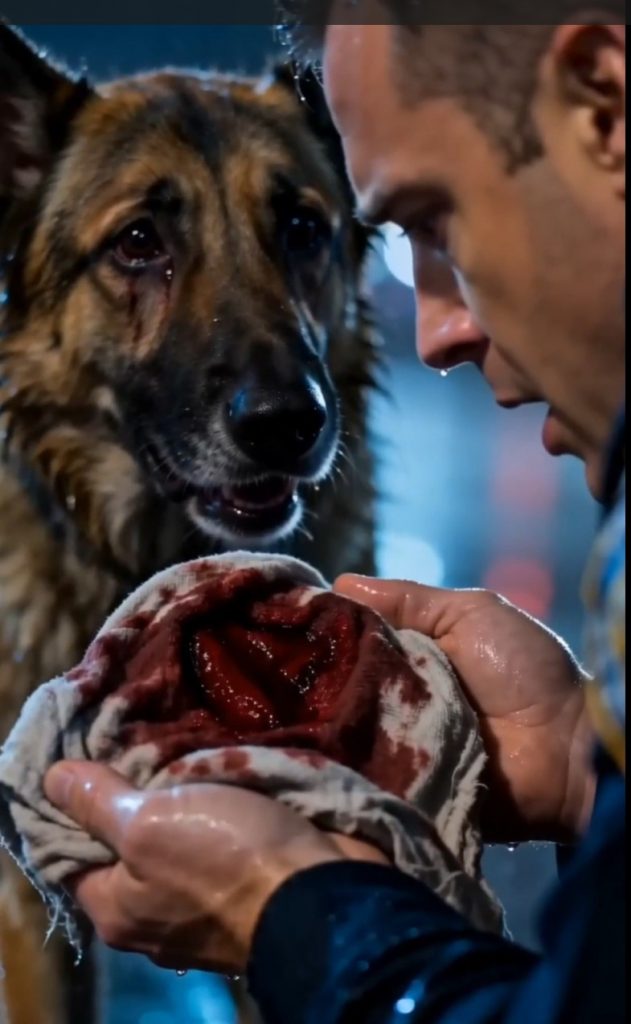
A stained rag fell into Miller’s palm.
The cloth was soaked through, stiff in places, discolored by rain and something darker. Miller unfolded it carefully, and the city noise seemed to pull away from him.
A deep crimson stain marked the inside of the fabric.
His breath shortened.
Before he could reach for his radio, the dog leaned forward and gently caught his sleeve between its teeth.
Not biting.
Pulling.
Miller looked into its face.
“You want me to follow you?”
The dog released him immediately, as if it understood.
Then it turned and limped toward the mouth of the alley.
Miller knew that alley. Everyone on patrol knew it. Narrow, brick-walled, almost always dark, cutting between the back of an abandoned laundromat and an old storage building that had been condemned for years. Even in daylight, people crossed the street to avoid it.
Tonight, it looked bottomless.
The dog disappeared into the shadows.
Miller stood, one hand on his radio, the stained rag gripped in the other.
“Dispatch, this is Miller,” he said, his voice low. “I’m investigating a possible injured person near Mercer and 9th. Send backup.”
Then he followed.
The alley swallowed the streetlight behind him. Rain echoed off metal fire escapes. Somewhere ahead, the German Shepherd gave one weak bark, then another, each sound thinner than the last.
Miller stepped deeper in, flashlight raised.
The beam caught a tipped trash can. A broken crate. A puddle rippling under the rain. Then the dog stopped beside a boarded service door half-hidden behind old pallets.
Miller moved closer.
That was when he heard it.
A child’s voice, barely more than a breath, coming from behind the wall.
“Ranger?”
Act II
Three days earlier, Officer Ethan Miller had stood in a different rain outside a different building, watching a mother beg two detectives not to close her daughter’s file.
Her name was Nora Bell.
Twenty-nine years old. Single mother. Night cleaner at several office buildings downtown. She had missed two shifts, failed to pick up her six-year-old daughter from school, and vanished from her apartment with no suitcase, no bank activity, and no goodbye.
Her daughter, Lily, was missing too.
So was their dog.
The first officer on the case wrote it down as a possible voluntary disappearance. Nora had struggled with rent. She had recently argued with her landlord. There were notes in the file about stress, late bills, and a custody dispute that had never actually existed.
Miller hated those words.
Possible voluntary disappearance.
They were the kind of words that made it easier for people to stop looking.
He had seen Nora’s mother in the precinct lobby clutching Lily’s school picture with both hands. He had seen the little girl’s missing poster taped crookedly beside the coffee machine. Lily had two front teeth missing, a purple sweater, and a smile too bright for paper.
Under the photo was a second picture.
A German Shepherd with one ear slightly bent.
RANGER.
Nora’s mother had told them the dog was old, loyal, and gentle with Lily. He slept across the child’s doorway every night. He had belonged to Nora’s father before he died and had somehow become the last piece of him the family still touched every day.
“If Ranger is gone too,” the grandmother said, voice breaking, “then he is with them. He would never leave Lily.”
Miller believed her.
But belief did not move paperwork faster.
Nora had cleaned offices in buildings owned by men with lawyers. Her landlord claimed she had been unstable. Her employer said she had recently been “agitated.” A neighbor reported hearing shouting near the back entrance the night she disappeared but could not identify the voice.
The detectives promised to follow up.
Then new calls came in. New emergencies. New files.
The city kept swallowing people.
Miller could not stop thinking about the missing poster.
Not because Nora’s disappearance was the first case to bother him. It was not. But because he had once been the kid in a poster.
Not missing. Not officially.
Just unseen.
He grew up two neighborhoods away, in a building where people heard yelling through walls and called it none of their business. His mother worked nights. His father drank through afternoons. Miller learned young that help rarely came unless someone made enough noise.
That was why he became a cop.
Not because he loved authority.
Because he remembered being small and waiting for an adult to notice.
Now, in the alley behind Mercer and 9th, with rain dripping from his cap and a starving German Shepherd shaking beside a boarded door, Miller understood that Ranger had done what the city failed to do.
He had refused to stop looking for help.
And whatever waited behind that door had been waiting too long.
Act III
Miller kicked the pallets aside and aimed his flashlight at the service door.
It had been boarded from the outside with rough planks and fresh screws. That detail hit him immediately. The building was condemned, but these boards were new. Someone had wanted this door sealed.
From inside came the faintest sound.
A child crying without strength.
Miller’s pulse pounded in his ears.
“Lily?” he called. “Lily Bell?”
The sound stopped.
Then a small voice answered.
“Ranger?”
The dog pushed forward, whining now, nose pressed to the gap beneath the door. His legs buckled, but he stayed upright.
Miller grabbed his radio.
“Dispatch, I need fire and medical now. Possible missing child located. Mercer and 9th alley, rear service entrance. Door is barricaded from outside.”
He did not wait.
He pulled at the first board. It held. He pulled again, harder, rain and sweat mixing on his face. The old screws shrieked against the wood. By the time backup reached the alley, Miller had torn one plank loose and bloodied his own knuckles without noticing.
Two officers joined him. Then firefighters arrived with tools.
The boards came off one by one.
Ranger stood trembling beside them, eyes fixed on the opening.
When the door finally gave way, Miller stepped inside first.
The smell of damp concrete and stale air rolled over him. His flashlight cut through the darkness, sweeping across old machines, broken shelves, and a narrow stairwell leading down into the basement beneath the laundromat.
At the bottom of the stairs, a little girl sat wrapped in an old coat.
Lily Bell looked smaller than her photograph.
Her purple sweater was dirty. Her curls stuck to her damp cheeks. One arm was wrapped around a woman lying beside her, weak but conscious, eyes half-open against the light.
Nora.
Miller froze.
Not because of what he saw in detail, but because of what it meant.
They had been here.
Under the city.
Behind a boarded door.
Close enough for people to walk past and never know.
“Oh, my God,” he breathed.
Ranger pushed past his leg and stumbled down the stairs.
“Careful,” Miller said, but the dog was already at Lily’s side.
The little girl reached for him with both hands.
Ranger lowered his head into her lap and went still.
Nora’s lips moved.
Miller crouched beside her.
“You’re safe,” he said. “Medical is coming. You’re safe now.”
Nora’s fingers closed around his sleeve with surprising force.
“No,” she whispered.
Miller leaned closer.
“He’ll come back.”
The words turned the cold basement colder.
“Who?” Miller asked.
Nora’s eyes flicked toward the ceiling, toward the boarded door, toward the alley above them.
Then she said a name Miller recognized.
“Caleb Voss.”
Act IV
Caleb Voss owned half the block.
Not directly, of course. Men like him rarely owned ugly things in their own names. His company owned the storage building. Another company owned the laundromat. A third was trying to buy the apartment complex where Nora and Lily lived, just across the service lane.
Miller had seen Voss before.
Press conferences. Charity breakfasts. Ribbon cuttings with politicians who praised him for “revitalizing neglected neighborhoods.” He wore expensive coats, smiled for cameras, and spoke about safety while his buildings rotted behind fences.
Nora had cleaned one of his downtown offices.
That was how she found the files.
Later, in the hospital, she would explain it with her mother holding one hand and Lily sleeping in the next room. She had been emptying trash late at night when she saw her own building address on a stack of papers marked for destruction. Eviction plans. Inspection manipulation. Internal emails about forcing out tenants before the winter deadline so Voss could sell the land clean.
Nora took photos.
Someone saw her.
The next night, Caleb Voss came to her building himself.
He was not alone.
Nora tried to run with Lily and Ranger through the back lane. The alley was dark. The rain was hard. Ranger fought hard enough to tear free, but Nora and Lily were forced through the old service door and locked below.
Voss thought nobody would hear them.
He thought the building was dead.
He did not know about a broken laundry vent near the alley floor, just wide enough for a starving dog to claw through after two days of trying.
Ranger had escaped.
But he had not left.
He found scraps. He searched the street. He carried the rag Nora had pushed through the vent, a piece of cloth she had stained while trying to signal for help. Every time he approached people, they shooed him away. Some crossed the street. One threw a cup at him. Another called animal control.
Still, Ranger kept walking.
Until he found Miller.
By the time Caleb Voss returned to the alley that night, the block was full of flashing lights.
He arrived in a black SUV with tinted windows, stepping out under an umbrella held by someone else. He looked annoyed at first. Then he saw the firefighters, the ambulance, the police tape, and Officer Miller standing near the service door with Nora’s phone sealed in an evidence bag.
Voss’s expression changed.
Only for a second.
But Miller saw it.
“Officer,” Voss said smoothly, “what happened here?”
Miller did not answer immediately.
He looked at the expensive coat. The polished shoes. The man pretending not to recognize the building he had come to check.
Then Miller held up the stained rag.
“A dog brought me this,” he said.
Voss glanced at it.
“A dog?”
“Yes,” Miller said. “Funny thing about dogs. They don’t care who owns the block.”
Voss’s jaw tightened.
The detectives arrived shortly after. Nora’s photos were recovered from a cloud backup. The service door boards were traced to a contractor connected to Voss’s company. Camera footage from a nearby traffic light showed his SUV entering the alley the night Nora disappeared.
The mask did not fall all at once.
Powerful men have lawyers for that.
But it cracked.
And once it cracked, everyone who had been afraid to speak began to understand that the crack was an opening.
A janitor from Voss’s building came forward.
Then a secretary.
Then a tenant organizer with months of ignored complaints.
By sunrise, Caleb Voss was no longer standing in front of cameras talking about renewal.
He was sitting in an interview room asking for counsel.
And Ranger, the old dog everyone had ignored, slept beside Lily’s hospital bed with his head resting against her shoe.
Act V
Ranger survived the night.
The veterinarian said it like a warning first, not a promise. He was old, severely malnourished, dehydrated, and exhausted beyond what any animal should have endured. But he had a heartbeat that refused to surrender and a little girl who refused to let go of his paw.
So the doctors treated Nora.
The nurses watched Lily.
And the vet staff worked on Ranger as if he were another officer injured in the line of duty.
Miller stayed until morning.
He told himself he was waiting for a statement. Then he told himself he was making sure evidence was handled correctly. By the time the sun came up gray over the hospital parking lot, he stopped lying to himself.
He was there because he needed to see someone make it.
Nora woke fully after dawn.
Her mother was beside her, crying silently into both hands. Lily was curled in a chair under three blankets, asleep at last. Ranger lay on a padded mat near the wall, shaved in small places for treatment, wrapped warm, breathing steadily.
Nora looked at Miller.
“You followed him,” she whispered.
Miller shook his head.
“He found me.”
Her eyes moved to Ranger.
“He always finds us.”
The story spread fast.
At first, the headlines got it wrong. They made it sound almost cute, like a brave dog story meant to make people smile over morning coffee. Then the rest came out.
The boarded door.
The ignored complaints.
The missing mother dismissed too quickly.
The developer whose money had made people slow to question him.
By the end of the week, the city was no longer smiling.
Voss’s projects were frozen. Inspectors returned to buildings they had signed off on too easily. Tenants who had been called dramatic brought out photographs, letters, and recordings. The laundromat basement became more than a crime scene. It became proof that neglect was not always accidental.
Sometimes cruelty wore a suit and called itself progress.
Miller testified at the first hearing three months later.
He wore his dark navy uniform and sat under fluorescent lights that reminded him too much of the hospital. Across the room, Caleb Voss looked smaller than he had on television. Men like him often did when they no longer stood in front of buildings they owned.
Nora testified too.
Her voice shook once, when she described Lily whispering to Ranger in the dark, telling him to go find help. But she did not break. Lily sat with her grandmother outside the courtroom, drawing pictures of a dog with one bent ear and a police officer in a blue uniform.
When Miller came out, Lily handed him one.
“This is for you,” she said.
In the drawing, Ranger was huge, much bigger than real life, standing between the alley and a small girl.
Miller crouched to accept it.
“You made him very strong,” he said.
Lily looked confused by the comment.
“He is.”
There was nothing to say after that.
Ranger returned home with Nora and Lily six weeks after the rescue.
Home was not the old apartment. That building entered legal review, then repair. For a while, they lived with Nora’s mother in a small house with yellow curtains and a fenced yard. Ranger spent his days in a patch of sunlight near the kitchen door, thinner than before but clean, brushed, and adored.
He no longer had to search the rain for someone willing to listen.
Miller visited once, then twice, then often enough that Lily began saving him cookies from dinner. He always said he was checking on the case. Nora always smiled like she knew better.
One afternoon, months after the alley, Miller stood in the yard while Ranger leaned heavily against his leg.
“He shouldn’t have been able to make it that far,” Nora said from the porch.
Miller looked down at the dog.
“No,” he said. “He shouldn’t have.”
Ranger looked up at him with those old, solemn eyes.
The same eyes that had stopped him in the rain.
The same eyes that had asked for help when the city kept walking.
Miller bent down and scratched behind the dog’s bent ear.
“You did good, partner,” he whispered.
Ranger’s tail moved once against the grass.
In time, the alley changed.
The boards came down. The condemned building was investigated, repaired, then turned into a community legal office for tenants who had spent too long being ignored. A light was installed over the entrance. A camera too. The city painted over the worst of the brick, but Miller could still see the old darkness beneath it whenever he passed.
He did not avoid the place.
He walked by often.
Not because he liked remembering.
Because forgetting was how places became dangerous again.
On the first anniversary of the rescue, Nora brought Lily and Ranger to Mercer and 9th. The rain had stopped that morning, leaving the pavement damp and reflective. Traffic moved behind them. People passed without knowing exactly where they stood.
Lily placed a small blue ribbon near the service door.
“For finding us,” she said.
Ranger sniffed it, then sat beside her.
Miller stood nearby, hands tucked into his jacket pockets. He thought about the rag. The stain. The tug on his sleeve. The terrible moment when he stepped into the alley and heard a child’s voice rise from behind a wall.
He had spent years believing police work was about arriving with authority.
That night taught him something humbler.
Sometimes rescue begins when a starving old dog refuses to let the world look away.
Nora took Lily’s hand.
Ranger stood slowly, ready to follow them home.
Before they left, the dog turned once toward Miller.
For a second, under the gray city sky, he looked almost like he had on that first night—tired, soaked, desperate, carrying an impossible message through a world too busy to stop.
Then Lily called his name.
“Ranger.”
His ears lifted.
His tail moved.
And this time, when he walked into the distance, he was not disappearing into darkness.
He was going home.