Act I
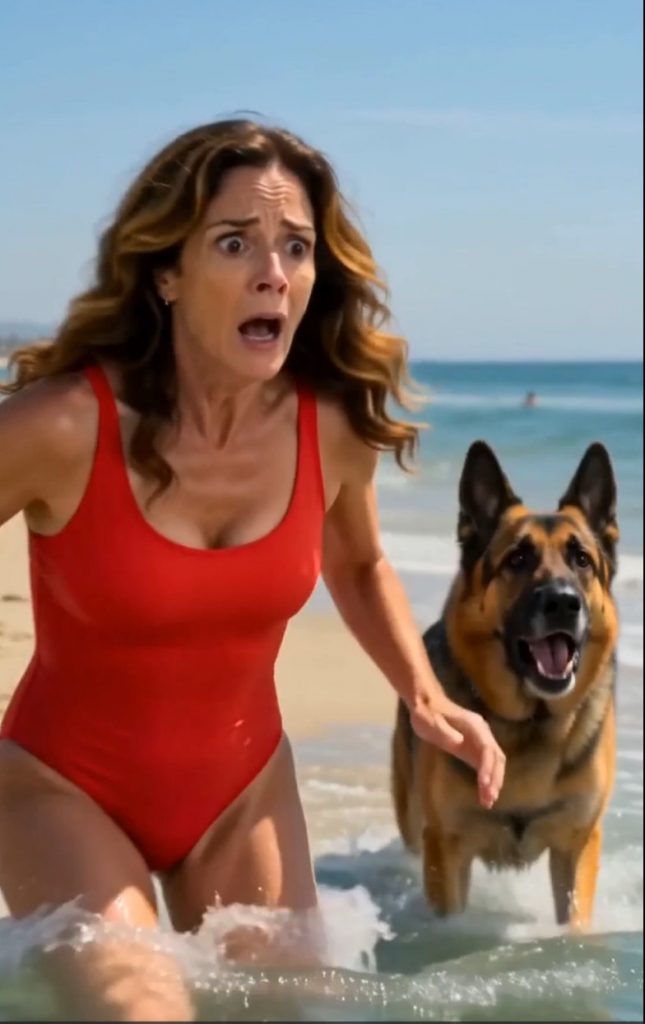
The German Shepherd came out of nowhere.
One moment, the beach was bright and lazy under a cloudless blue sky. The sea rolled in soft glittering lines. Children built sandcastles near umbrellas while people walked the long concrete pier in the distance, leaning over the railings to point at boats and waves.
Then the dog sprinted across the sand like something was chasing him.
He was huge, black and tan, with his ears pinned forward and his paws kicking up gold dust behind him. His barking cut through the peaceful afternoon, sharp and frantic enough to make every head turn.
The five women on the towel flinched at once.
Nina, in the black swimsuit, dropped her sunglasses into the sand. Carla, in blue, clutched her beach bag to her chest. Denise, in pink, leaned backward so quickly she nearly knocked into the fifth woman seated behind her, who stayed frozen behind dark glasses.
But Marissa Vale, the woman in the red one-piece swimsuit, did not move away.
She stared at the dog.
He was not attacking.
He was begging.
He circled them once, barking so hard his whole body shook. Then he lunged toward Marissa, stopped inches from her knees, and whipped his head back toward the water.
“What does he want?” Carla cried.
The dog barked again.
This time, he looked directly at Marissa.
His eyes were wild with purpose.
She had seen that look before, years ago, on the faces of people pointing toward the sea because words had failed them.
“No,” Marissa whispered.
The dog came closer.
Before anyone could stop him, he gently but firmly caught Marissa’s lower leg between his teeth and pulled.
She gasped.
The other women screamed.
But the dog did not bite down. He tugged once, released, barked toward the waves, and tugged again, urgent and careful at the same time.
Marissa’s fear changed shape.
Not fear of the dog.
Fear of what he knew.
She scrambled to her feet.
The German Shepherd instantly let go and bolted toward the shoreline. After a few yards, he spun back, barking, making sure she was following.
“Marissa!” Nina shouted.
But Marissa was already running.
The other women stumbled after her in a tight, panicked cluster. Sand flew beneath their feet. The dog led them straight toward the edge of the surf, not toward swimmers, not toward the pier crowd, but toward a stretch of shallow water where sunlight flashed too brightly against the waves.
Then Marissa saw it.
She stopped so abruptly Carla nearly crashed into her.
Both of Marissa’s hands flew to her mouth.
The dog stood beside her at the water’s edge, barking fiercely at one spot beneath the surface.
At first, the others saw only water.
Then something pale moved under the ripple.
A small hand.
Act II
Marissa had not gone into the ocean for seven years.
Not really.
She walked beside it. Sat near it. Let foam wash over her feet when friends teased her for being dramatic. She smiled in beach photos and pretended the sound of waves did not sometimes wake her from sleep.
But she never swam past her knees.
Her friends knew not to ask too many questions.
They knew there had been an accident once. A storm. A rescue that went wrong. A younger brother named Caleb whose picture still sat on Marissa’s kitchen shelf, tucked beside a candle she lit every July.
What they did not know was that Marissa had once been the strongest swimmer in every room.
She grew up on that coast. At sixteen, she worked summers as a junior lifeguard. At twenty-two, she could cross the pier channel in rough water and come back laughing. She taught kids how to float, how not to panic, how to let the water carry instead of fight.
Then Caleb disappeared beneath a winter current.
He had been nineteen. Reckless, sweet, certain nothing bad could happen to him because Marissa was always watching.
But she had not been watching that day.
She had been on the beach arguing with him about their father’s old truck, about college, about all the stupid ordinary things siblings fight over when they believe time is endless.
By the time someone shouted from the pier, Caleb was already too far out.
Marissa went in after him.
The water was gray and brutal. The current pulled sideways. She reached him once, felt his fingers brush hers, and then a wave turned everything to chaos.
Rescue boats found him later.
Alive, but only for a little while.
People called Marissa brave.
She hated them for it.
After the funeral, she quit lifeguard training, moved inland, and taught water safety in classrooms where pools were only pictures on slides. She could tell children what to do in a rip current. She could draw diagrams. She could lecture parents about supervision and fatigue and the danger of assuming shallow water meant safe water.
But when the ocean called for action, her body remembered failure.
That was why her friends had planned the beach day.
Gently. Carefully. With no pressure.
Nina called it “sun therapy.” Carla called it “mandatory relaxation.” Denise brought fruit, magazines, and too many towels. The fifth woman, Elise, came because she rarely said no to anything that let her hide behind sunglasses and pretend she was fine.
Elise had her own sadness.
Her son, Noah, was nine. Quiet, serious, and obsessed with marine animals. He had come to the beach with them that morning, but not to sit with the adults. He wanted to explore the tide pools near the pier with a summer camp group led by two teenage counselors.
“He’ll be safer with them than with me hovering,” Elise had said, trying to laugh.
Marissa noticed the way Elise checked her phone every few minutes.
She understood that kind of fear.
Still, the afternoon had softened.
The sun was warm. The water clear. The pier stretched into the blue like a postcard. For almost an hour, nothing happened except laughter and sunscreen and the ordinary gossip of women trying to forget how heavy life could get.
Then the German Shepherd came running.
And Marissa’s past stood up inside her.
Not as memory.
As command.
Because panic has many sounds.
But a dog barking at the sea like that meant only one thing.
Someone was running out of time.
Act III
The hand vanished beneath the surface.
Elise screamed.
“Noah!”
The name tore through the beach.
Marissa did not think.
Thinking would have killed the moment.
She ran into the water, the cold shock hitting her legs, then her waist. The old terror surged up, black and familiar, wrapping around her lungs.
Caleb.
The wave.
The hand slipping away.
She almost stopped.
Then the German Shepherd plunged in beside her.
He swam hard, eyes fixed on the same spot, barking between strokes until the water splashed over his muzzle. He reached the area first and began circling, not randomly, but with trained precision.
Marissa followed.
Behind her, Nina was shouting for lifeguards. Carla waved both arms toward the pier. Denise held Elise back when she tried to rush in blindly.
“Noah!” Elise sobbed. “Noah!”
Marissa dove.
The world became blue-green silence.
For one horrible second, she saw nothing but sand swirling beneath the surface. Then a flash of yellow. The strap of a child’s swim vest caught under a rusted metal brace near the base of the pier, hidden just below the moving water.
Noah was there.
His body twisted awkwardly, trapped by the strap and the pull of the current.
His eyes were open.
Terrified.
Marissa reached him and grabbed the vest, but the strap held tight. The water shoved her sideways. Her lungs burned.
She surfaced for air.
The dog barked directly beside her, then dipped his head toward the water again, refusing to leave the spot.
Marissa sucked in a breath and went under.
This time, she found the buckle.
Her fingers shook. The strap had looped around the jagged edge of the metal brace. She pulled once. Nothing. She pulled harder. The current slammed her shoulder into the pier support, sending pain down her arm.
Noah kicked weakly.
Marissa looked into his frightened face.
For a split second, it was Caleb’s hand she felt slipping from hers again.
No.
Not this time.
She hooked her thumb under the strap and twisted until it loosened. The buckle scraped free. Noah’s body jerked forward with the current.
Marissa wrapped one arm around him and pushed off the brace.
The German Shepherd was waiting above them.
When they surfaced, he swam close, blocking the waves with his body as if he knew exactly where to place himself.
“Help!” Marissa shouted.
Two lifeguards were already sprinting down the beach with rescue boards. A man from the pier had jumped the railing stairs and was racing across the wet sand. Nina and Carla screamed directions. Denise held Elise upright as she sobbed Noah’s name over and over.
Marissa kept Noah’s face above water.
“You’re okay,” she said, though she did not know if he could hear her. “I’ve got you. I’ve got you.”
The words were not only for him.
They were for the brother she lost.
For the girl she had been.
For every night she had dreamed of reaching a hand too late.
The lifeguard reached them and took Noah carefully onto the rescue board. Marissa held on until someone said, “Ma’am, let go. We have him.”
Her fingers would not open.
The German Shepherd nudged her shoulder with his wet nose.
Only then did Marissa release the child.
Act IV
The beach had changed completely.
The same blue sky hung overhead. The same pier stretched across the water. The same people stood in swimsuits and sun hats.
But peace was gone.
A circle formed near the shoreline as lifeguards worked over Noah with focused urgency. Elise knelt in the sand several feet away, shaking so violently that Denise had both arms around her. Nina kept whispering, “Breathe, breathe, breathe,” though no one knew whether she meant Elise, Noah, or herself.
Marissa stood waist-deep in the water, unable to move.
Her whole body was trembling.
The German Shepherd climbed out beside her, soaking wet, sand clinging to his legs. He barked once toward the lifeguards, then stood still, watching Noah with fierce attention.
A lifeguard spoke.
No one heard the words clearly.
Then Noah coughed.
The sound broke the beach open.
Elise screamed and crawled toward him, but the lifeguard held up one hand, gentle but firm, until Noah coughed again and began to cry.
Crying had never sounded so beautiful.
Marissa covered her face.
The dog pressed against her leg.
Only then did she lower herself to the wet sand.
She did not cry neatly. She folded forward with both hands against the ground as seven years of frozen grief cracked through her all at once.
Nina ran to her.
“Marissa, you did it,” she said, dropping beside her. “You saved him.”
Marissa shook her head.
The dog stood between them, panting hard, ears still alert.
“No,” Marissa whispered. “He did.”
That was when an older man pushed through the crowd near the pier.
He wore a faded lifeguard shirt, though he was clearly retired, with silver hair and a whistle hanging from a cord around his neck. His eyes locked on the German Shepherd.
“Atlas!” he shouted.
The dog turned.
For the first time since arriving, his urgency vanished.
He ran to the man, who dropped to one knee and wrapped both arms around his neck.
“You found them,” the man said, his voice breaking. “Good boy. Good boy.”
Marissa stared.
The old lifeguard looked at her, then at Noah, then back at the dog.
“He’s trained for water alerts,” he explained. “Used to work with my son.”
His face changed at the word son.
Marissa recognized the pain before he spoke another word.
“My boy drowned near this pier twelve years ago,” he said quietly. “After that, I trained dogs to find trouble before people understood what they were seeing.”
He stroked Atlas’s wet fur.
“Atlas was the last one he trained with before he died.”
The words settled heavily over Marissa.
The dog had not just been barking.
He had been carrying another family’s grief too.
The old man looked toward the water. “He must have seen the child go under before any of us did. Smartest dog I’ve ever known. Stubborn too.”
Atlas shook water from his coat, spraying Nina’s legs.
Under any other circumstances, someone might have laughed.
Instead, everyone simply stared at him with awe.
On the sand, Noah’s crying softened. The lifeguards had wrapped him in a towel, and Elise was finally allowed to crawl close. She touched his face with both hands, sobbing his name like a prayer.
Noah looked over her shoulder.
His eyes found Marissa.
Then the dog.
“Mom,” he whispered hoarsely, “the dog came back for me.”
Elise turned toward Marissa, her face shattered with gratitude.
Marissa could not speak.
Because beneath the bright sun, with the sea glittering behind them, she understood something that made her chest ache.
For years, she had believed the ocean only took.
Today, it had sent a messenger.
Act V
The ambulance arrived with flashing lights but no sirens.
By then, Noah was sitting upright, wrapped in towels, still frightened but breathing on his own. The paramedics checked him carefully while Elise hovered close enough to touch his shoulder every few seconds.
Noah refused to let Atlas leave.
The German Shepherd sat beside the stretcher with solemn patience, as if guarding the boy was now his official duty. Whenever a paramedic moved too quickly, Atlas lifted his head. Whenever Noah whimpered, Atlas leaned closer.
“He can come near the ambulance,” one paramedic said, smiling gently. “But he probably can’t ride.”
Noah’s face crumpled.
The retired lifeguard, whose name was Frank, cleared his throat.
“I’ll follow,” he said. “Atlas and I both will.”
Elise looked at him with tear-soaked eyes. “Thank you.”
Frank shook his head. “Thank the dog. I’m just his driver.”
This time, a few people did laugh.
Softly. Carefully.
The kind of laughter that comes after disaster passes close enough to leave its shadow behind.
Marissa stood apart from the crowd, her red swimsuit damp, her shoulder aching, her breath still uneven. She watched the paramedics lift Noah into the ambulance.
For a moment, the beach blurred.
Not from tears exactly.
From release.
Nina touched her arm. “You okay?”
Marissa looked toward the pier.
The concrete legs stood in the bright water, ordinary and terrible. People were still watching from the railing above. Some held phones. Others simply stood with their hands over their mouths, replaying the moment when a peaceful day had turned into a rescue they would talk about for years.
“I don’t know,” Marissa said honestly.
Nina nodded.
That was the only acceptable answer.
Later, at the hospital, Noah was declared shaken but stable. Exhausted, frightened, and lucky. The word lucky passed through every adult in the room, but everyone knew luck had four legs, wet fur, and a bark sharp enough to slice through denial.
Elise found Marissa in the hallway near the vending machines.
For a moment, neither woman spoke.
Then Elise hugged her so tightly Marissa winced from the bruising in her shoulder.
“I’m sorry,” Elise gasped, pulling back. “I’m sorry. Did I hurt you?”
Marissa shook her head.
Elise broke down again. “You brought him back.”
Marissa wanted to reject the words. Wanted to say it was Atlas, the lifeguards, timing, anything but her. But she looked into Elise’s face and realized refusal would only steal comfort from a mother who needed somewhere to place her gratitude.
So Marissa let herself accept part of it.
“We all followed the dog,” she said softly.
Elise laughed through tears. “You followed first.”
That night, after Noah fell asleep in the hospital bed, Marissa stepped outside into the cool air.
Frank was there with Atlas.
The dog lay at his feet, finally tired, his head resting on his paws. When he saw Marissa, his ears lifted.
“He knows you,” Frank said.
Marissa crouched slowly.
Atlas rose and pressed his forehead against her chest.
The gesture broke something open.
She wrapped both arms around him and cried into his damp fur, not because of fear this time, but because her body had carried a goodbye for seven years and had finally been allowed to answer it with a rescue.
Frank stood quietly beside them.
After a while, he said, “The ocean doesn’t make bargains. But sometimes it gives us one moment back.”
Marissa looked up.
“I lost my brother in the water,” she said.
Frank’s expression softened with instant understanding.
“I know that kind of ghost.”
She nodded.
Atlas licked the saltwater from her wrist.
The next morning, Marissa returned to the beach alone.
The sand was smooth in places where the tide had erased the footprints. The sky was softer, pale with early light. The pier stood silent over calm blue water.
She walked to the edge.
For several minutes, she only watched.
Then she stepped in.
The water wrapped around her ankles. Her calves. Her knees.
Her chest tightened, but she kept breathing.
Not far.
Not deep.
Enough.
Behind her, a bark rang out.
She turned.
Frank stood near the lifeguard tower, smiling faintly, with Atlas at his side. The dog wagged his tail once, as if approving.
Marissa laughed.
It surprised her, that laugh.
It sounded like someone she used to know.
Weeks later, the town placed a small sign near the pier warning about hidden current zones around the supports. The lifeguards added extra patrols. Parents watched the water more carefully. And every afternoon, Atlas walked the shoreline with Frank, treated by locals not like a pet, but like a hero in fur.
Noah visited him as soon as he was allowed.
He brought a handmade medal cut from cardboard and covered in gold marker.
BEST DOG EVER.
Atlas wore it for exactly nine seconds before trying to chew the ribbon.
Everyone laughed that time.
Fully.
Even Marissa.
By the end of summer, she began volunteering with Frank’s water safety program. She did not pretend she was healed. Healing was not a door one walked through once. It was a shoreline. Some days the tide came in. Some days it gave something back.
On her first day teaching, she stood before a group of nervous children and pointed toward the sea.
“If a dog ever barks at you like Atlas did,” she said, “listen.”
The children giggled.
Marissa smiled, then grew serious.
“And if the ocean ever scares you, respect that. Fear is not weakness. Sometimes fear is your body telling you to pay attention. Courage is what you do next.”
Atlas sat beside her, proud and watchful.
Out beyond the sand, the water sparkled under the sun.
For years, Marissa had remembered the sea as the place where she failed.
Now, when she looked at it, she remembered a German Shepherd racing across the beach, refusing to let humans misunderstand danger.
She remembered a small hand beneath the surface.
She remembered reaching.
And this time, holding on.