Act I
The horse should not have been lying down.
That was the first thing Hank Miller noticed when he stepped through the old ranch gate and saw the child sitting in the grass beside him.
The late afternoon sun had turned the whole pasture gold. It touched the wooden fence rails, the dry grass, the dust on Hank’s boots, and the soft brown flank of the horse stretched peacefully on the ground.
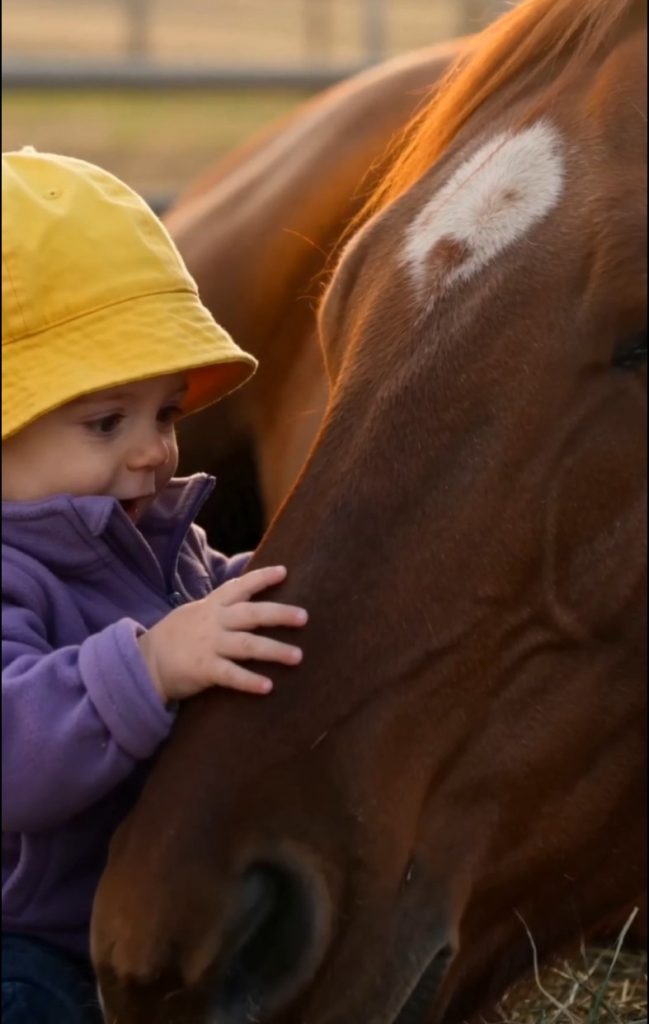
Beside the horse’s head sat a little girl in a bright yellow Winnie the Pooh hat and a purple fleece jacket.
She could not have been more than two.
Her tiny hands moved over the horse’s muzzle with clumsy tenderness, patting, stroking, then stopping as if she could not believe anything so large and warm would let her touch him. The horse’s eyes were half-closed. His breath moved slow and heavy through his nostrils.
The little girl laughed.
Not a polite laugh.
A full, bright, bubbling giggle that spilled out of her like sunlight.
She wrapped her arms around the horse’s face as far as they could reach and leaned her cheek against him. The horse did not pull away. He did not snort. He did not rise.
He stayed perfectly still.
At the fence, Maren watched with one hand wrapped around the middle rail, her other hand hanging by her side. For the first time in months, her face looked soft. Peaceful, almost. Like the world had given her one small moment that was not asking her to survive it.
Her daughter, Ellie, laughed again and tapped the horse’s cheek.
“Gentle,” Maren called softly, though she knew Ellie did not need reminding.
The horse’s name was Solomon, and everyone in Stone Creek knew not to crowd him. He was old, patient, and famously stubborn. He liked adults from a distance. He tolerated experienced riders. But toddlers?
Never.
Maren had been nervous when Ellie toddled toward the fence.
Then Solomon had lowered his massive head.
Then he had folded his front legs beneath him and eased himself down onto the earth like he had been waiting for her.
Maren’s eyes filled before she could stop them.
“She’s happy,” she whispered.
Hank came to stand beside her.
He was in his seventies, wearing a plaid flannel shirt and an old newsboy cap pulled low over his white hair. He had trained horses for longer than most people in town had been alive. His face usually carried the dry patience of a man who had seen every foolish thing a human could do around livestock.
But now he was not looking at Ellie with amusement.
He was looking at Solomon.
The horse lifted his head slightly and pressed his muzzle against Ellie’s chest.
The child giggled and hugged him tighter.
Hank’s expression changed.
The warmth vanished.
Maren noticed too late.
“What?” she asked, still smiling.
Hank did not answer immediately.
He watched the horse’s nostrils flare once. Watched him go still again. Watched Ellie’s small hand pat his face while she laughed, unaware that the old man at the fence had gone rigid.
Then Hank turned to Maren.
His voice was low, serious, and stripped of all comfort.
“You need to take your daughter to see a doctor.”
Maren’s smile disappeared.
“What?”
Hank did not blink.
“Today.”
Act II
Maren had come to Miller Ranch because grief had made her house too loud.
Every room in it still carried traces of her husband.
Noah’s jacket behind the door. Noah’s boots under the bench. Noah’s handwriting on a jar of nails in the garage. His coffee mug, chipped at the rim, still sitting in the cabinet because Maren could not bring herself to move it and could not bear to use it.
Noah had died eighteen months earlier on a rain-slick road outside Stone Creek.
That was what the report said.
A bad curve. A sudden skid. A truck found in a ditch before dawn.
Everyone called it an accident.
Maren had tried to believe them.
She had been pregnant then, heavy and exhausted and waiting for him to come home with the crib bolts he had sworn he could find cheaper at the hardware store. Instead, two officers came to her porch with their hats in their hands.
Ellie was born seven weeks later.
Small, loud, furious at the world.
Maren used to joke that her daughter came out fighting because she knew her mother had no strength left. Ellie became the reason Maren got out of bed, the reason she ate, the reason she answered the phone when neighbors called.
But there were things Maren did not say aloud.
Ellie tired quickly.
Sometimes, after running across the living room, she would stop and lean against the couch with a puzzled look, as if her own body had surprised her. Sometimes her lips looked faintly pale after a long laugh. Sometimes she slept so deeply Maren hovered over her crib, counting breaths until her own hands shook.
Doctors had told her babies were strange, toddlers stranger.
Growth spurts. Mild anemia. Normal variation. Nothing to panic over.
Maren wanted to believe that too.
Then came the day she took Ellie to the ranch.
Hank Miller had been Noah’s closest thing to a second father. Noah grew up at Miller Ranch after school, cleaning stalls, fixing fence posts, learning to ride before he learned to drive. Hank never had children of his own, and Noah never had a father worth missing, so they chose each other without making speeches about it.
After Noah died, Hank stopped visiting.
Maren thought it was because grief had made him distant.
The truth was worse.
He blamed himself.
Noah had been out at the ranch the afternoon before the crash. He had been working with Solomon, the old brown horse with the white mark on his forehead, when something strange happened.
Solomon had refused to move.
Noah laughed it off at first. Then the horse lowered his head to Noah’s chest and pushed him backward until Noah sat down on a hay bale.
Hank remembered it perfectly.
Noah had waved him away.
“I’m fine, old man.”
But he had not looked fine.
His face had gone gray around the mouth. His hand trembled when he reached for his water bottle. Solomon stood over him for ten full minutes, blocking him every time he tried to rise.
Hank told him to see a doctor.
Noah promised he would.
By the next morning, he was gone.
Hank had replayed that moment for eighteen months.
Solomon had known something.
The horse had sensed something human pride refused to name.
And now, in the warm glow of the pasture, Solomon had lowered himself beside Noah’s daughter the same way.
Not for affection.
Not for play.
For warning.
Act III
Maren did not want to listen.
That was the shameful truth she would admit only later.
For one terrible moment, she wanted to be angry at Hank for ruining the only peaceful thing she had felt in weeks. She wanted to snap that Ellie was fine. That toddlers giggled. That horses could be gentle. That not every beautiful moment had to become another emergency.
But Hank’s face stopped her.
He did not look dramatic.
He looked afraid.
“Hank,” she whispered, “what are you saying?”
He kept his eyes on Solomon. “I’m saying that horse did the same thing to Noah.”
Maren’s grip tightened on the fence rail.
The pasture seemed to tilt beneath her.
“What?”
“The day before the crash.”
“No.” Her voice went thin. “Noah crashed because of the rain.”
“That’s what they wrote down.”
“What does that mean?”
Hank finally looked at her.
“It means I never told you everything because you were pregnant, and I thought I was sparing you.”
Maren stared at him, and the old man looked suddenly older than she had ever seen him.
He told her about Noah in the barn.
The grayness in his face.
The way Solomon blocked him from standing.
The way Noah pressed a hand briefly to his chest and laughed when Hank noticed.
“He said he was tired,” Hank said. “Said you’d kill him if he came home late. Said he’d get checked after the baby was born.”
Maren’s eyes filled.
“He never told me.”
“Men hide fear when they think love depends on them being strong.”
The words landed hard because they sounded exactly like Noah.
Ellie giggled again in the grass.
Solomon moved his head closer to her, not nuzzling now, but listening. His big dark eye stayed open and fixed on the child.
Maren opened the gate with shaking hands.
“Ellie,” she called, trying to keep her voice steady. “Come here, baby.”
The little girl turned, smiling.
Then the smile faded.
For one second, Ellie looked confused. Her tiny hand went to Solomon’s mane. She blinked slowly, as if the sun had become too bright.
Maren was over the fence before she remembered climbing it.
She ran to her daughter and scooped her up.
Ellie’s body felt warm and soft against her chest, but her face had lost some color.
Hank was already moving toward the truck.
“Hospital,” he said.
Maren did not argue this time.
Solomon tried to stand as they carried Ellie away. His old legs struggled beneath him, but he pushed himself upright, ears forward, eyes following the child.
Ellie lifted one tired hand over Maren’s shoulder.
“Horsey,” she murmured.
Maren kissed her daughter’s hat and broke into a run.
At the hospital, the waiting felt like punishment.
Doctors asked questions Maren could barely answer. How often did Ellie tire? Had she ever fainted? Did anyone in the family have heart issues? Had Noah ever complained of dizziness, chest discomfort, sudden weakness?
Maren heard herself saying no.
Then maybe.
Then I don’t know.
Hank sat in the corner, cap in both hands, staring at the floor.
Hours later, a pediatric cardiologist entered the room with a face too careful to be casual.
Ellie was asleep against Maren’s side, one fist curled under her chin.
The doctor spoke gently.
They had found an abnormal rhythm.
Something that might have been missed during routine exams. Something that could be managed now that they knew. Something that may have explained Ellie’s fatigue.
Something that may also have explained Noah’s crash.
Maren stopped breathing.
The doctor kept talking, but the room had gone distant.
Noah had not simply lost control on a wet road.
Something inside him had warned him.
Solomon had warned him too.
But everyone had been too late.
This time, they were not.
Act IV
The next week split Maren’s life into before and after.
Before, she had believed grief was the worst thing that could happen to a family.
After, she understood that grief sometimes carried unopened doors inside it.
She began gathering Noah’s medical records, but there were almost none. He had been the kind of man who claimed headaches were nothing, exhaustion was work, and pain was something to be walked off.
Then Hank arrived at her house with a cardboard box.
“I should’ve brought this sooner,” he said.
Inside were Noah’s things from the ranch workshop.
A pair of gloves. An old pocketknife. A faded ball cap. A notebook filled with feed schedules, fence measurements, and half-finished sketches of the nursery Noah never lived to complete.
At the bottom was an envelope.
Maren recognized her husband’s handwriting immediately.
Mare.
Her fingers trembled around it.
She almost could not open it.
The letter inside had been written in pencil, probably while Noah sat in the barn pretending not to be scared.
Mare,
If Hank makes me go to the doctor tomorrow, don’t let him act like it was his idea. Solomon started it.
Something happened today. I felt strange. Not pain exactly. More like the lights in me flickered. I didn’t want to scare you before the baby comes, so I’m writing this down in case I chicken out and pretend it’s nothing.
I know. You’re making that face.
I’ll go. I promise.
But if this turns out to be something, and if our little girl ever has my stubborn heart, promise me you’ll believe the horse before you believe pride.
Maren pressed the letter to her mouth.
The sound that came from her did not feel human.
Hank turned away, his eyes wet.
“I found it after,” he said. “Couldn’t read past the first line for months. Then I put it back like a coward.”
Maren wanted to be angry.
Part of her was.
But she looked at the old man standing in her kitchen with grief folded into every crease of his face and understood that guilt had buried him too.
“You should have told me,” she said.
“I know.”
“You should have given me this.”
“I know.”
Her voice broke. “He was scared.”
Hank nodded, and tears slid into his beard.
“Yes.”
That was the first time Maren and Hank cried together.
Not politely.
Not quietly.
They stood in the kitchen while Ellie napped down the hall, and the grief they had carried in separate rooms finally recognized itself.
After that, things moved quickly.
Specialists confirmed Ellie’s condition. Plans were made. Precautions explained. Family history rewritten. Noah’s death certificate was reviewed, not because changing a document would bring him back, but because truth mattered.
Maren learned how to watch without panicking.
She learned what signs mattered and what fear invented.
She learned that her daughter could still run, laugh, grow, and live a wide, bright life.
But she also learned to trust the part of herself that noticed when something was wrong.
The part motherhood had sharpened.
The part grief had nearly drowned.
Through it all, Ellie kept asking for Solomon.
“Horsey nap?” she would say, patting the couch beside her.
Maren would smile through the ache.
“Yes, baby. Horsey was taking a nap.”
But she knew better now.
Solomon had not been resting.
He had been keeping a promise Noah never got to finish.
Act V
They returned to Miller Ranch in early spring.
The grass had softened from brown to green, and the wind carried the clean smell of turned earth. The fence rails were still weathered. The barn still leaned slightly to one side. Hank still pretended not to limp when the mornings were cold.
But everything felt different.
Ellie wore the same yellow Winnie the Pooh hat, though it sat a little higher now because her hair had grown. Her purple jacket had a new patch on one sleeve where Maren had mended it badly and refused to apologize.
Solomon stood in the pasture when he saw them.
For a moment, he did not move.
Then he walked slowly to the fence.
Ellie squealed.
“Horsey!”
Maren’s heart clenched, but this time fear did not take over. She checked her daughter’s color, her breathing, her bright eyes, and then opened the gate.
Hank stood beside her.
“You sure?”
Maren looked at him.
“No,” she said honestly. “But I’m learning the difference between danger and love.”
He nodded as if that made perfect sense.
Ellie ran in her small, uneven way toward Solomon. The horse lowered his head, and she threw both arms around his muzzle like they were old friends separated by years instead of weeks.
Solomon breathed over her hair.
He did not lie down.
Hank noticed.
So did Maren.
A laugh escaped her before she could stop it, broken and relieved. She covered her mouth, and suddenly she was crying too.
Ellie looked back in confusion.
“Mama sad?”
Maren wiped her face quickly.
“No, baby. Mama’s happy.”
Ellie considered this, then patted Solomon’s cheek.
“Hap-py,” she told the horse solemnly.
Hank turned away, pretending to examine a fence post.
Maren let him have the dignity of that lie.
Later, they spread a blanket beneath the cottonwood near the paddock. Ellie ate apple slices and kept trying to feed them to Solomon despite being told he already had his own. Hank brought out an old photo album from the barn office, its cover cracked and dusty.
Inside were pictures of Noah as a boy.
Noah on a fence. Noah in mud. Noah missing a front tooth. Noah at sixteen beside a much younger Solomon, one arm thrown proudly around the horse’s neck.
Maren touched the photo with one finger.
“He loved this place.”
“He loved you more,” Hank said.
She looked at him.
The old man cleared his throat.
“He told me once that marrying you made him feel like he’d been let into a warm house after standing outside his whole life.”
Maren looked down before the tears could fall.
Noah had said beautiful things badly. Awkwardly. Usually while pretending to fix something. It was like him to say his best sentence to someone else and never tell her.
Hank handed her another photograph.
This one showed Noah as an adult, standing near the barn with one hand on Solomon’s neck. On the back, in his handwriting, were four words.
Trust the quiet warnings.
Maren smiled through tears.
“I used to think he was fearless,” she said.
Hank shook his head.
“No. He was scared of plenty.”
“Then why did everyone think he was brave?”
“Because he showed up anyway.”
Maren looked across the pasture.
Ellie was crouched near a dandelion, showing it to Solomon as if explaining something important. The horse stood over her, patient and calm, his shadow falling gently across the grass.
For the first time since Noah died, Maren could imagine a future without feeling like she was betraying him.
Not an easy future.
Not a perfect one.
But a real one.
With doctor visits, yes. With careful watching. With fear that would return some nights and sit at the edge of her bed.
But also with ranch afternoons.
With Ellie’s laughter.
With Hank teaching her how to hold a brush.
With Solomon lowering his great head to be kissed by a child wearing a silly yellow hat.
Months later, Maren had Noah’s letter framed.
Not the whole thing.
Just the last line.
Believe the horse before you believe pride.
She hung it by the back door, where she would see it every time she left the house.
People asked about it sometimes.
Maren would smile and say it was a family story.
She did not tell everyone how close they had come to losing Ellie before they understood what Solomon was trying to say. She did not explain the hospital room, the letter, the guilt, the way one golden afternoon had split her life open and saved her daughter.
Some stories were too sacred for casual conversation.
But every Sunday, she took Ellie to the ranch.
And every Sunday, Solomon walked to the fence.
Sometimes Ellie brushed him. Sometimes she sang nonsense songs into his mane. Sometimes she simply sat in the grass while he grazed nearby, both of them content in the ordinary miracle of being alive at the same time.
One evening, as the sun lowered over the pasture, Ellie climbed into Maren’s lap and pointed at Solomon.
“Horsey saved me?” she asked.
Maren froze.
Hank, sitting nearby on an overturned bucket, looked up.
Ellie was too young to understand the whole truth. Too young for inherited conditions, lost fathers, old letters, and the terrible mercy of warnings heard in time.
So Maren kissed the top of her daughter’s hat.
“Yes,” she said softly. “He helped us listen.”
Ellie nodded, satisfied.
Then she waved at Solomon.
“Thank you, horsey.”
The old horse lifted his head as if he understood.
Maybe he did.
Maren no longer laughed at things like that.
She just held her daughter closer and watched the golden light settle over the ranch, over the fence, over Hank’s bowed head, over the horse who had once lowered himself to the ground because a child’s body was whispering something only he could hear.
That day had begun as a beautiful moment.
A toddler laughing.
A horse breathing softly.
A mother smiling at the fence.
Then an old man had spoken one sentence that shattered the peace.
But sometimes love does not arrive gently.
Sometimes it comes as a warning.
Sometimes it wears a plaid shirt and a serious face.
Sometimes it has four hooves, patient eyes, and the wisdom to lie down when everyone else is still standing.