Act I
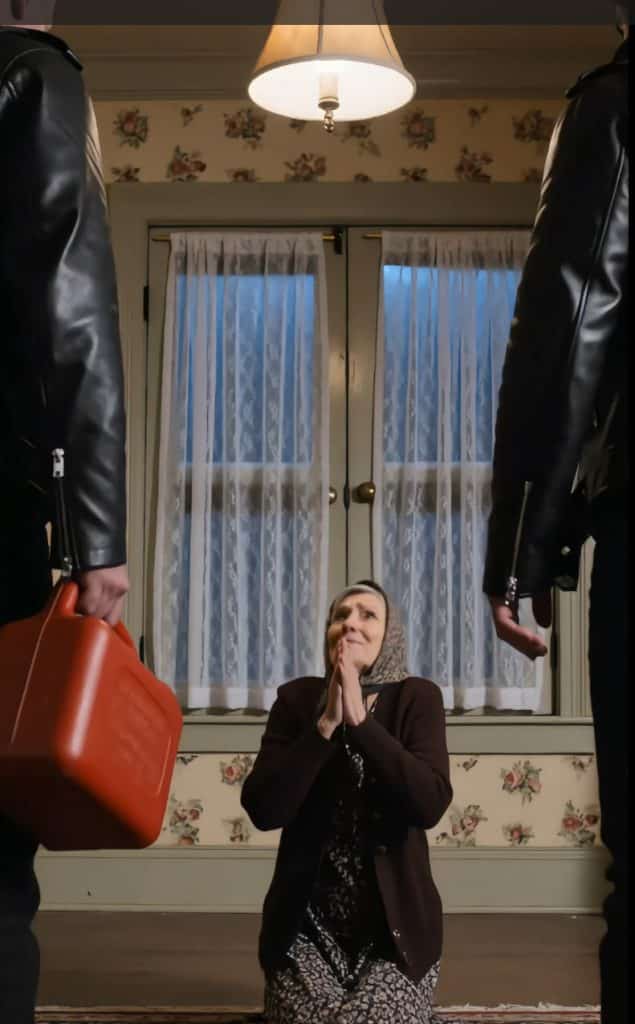
The old woman was on her knees when the men began to laugh.
Her hands were clasped beneath the yellow light of the hanging bulb, fingers bent with age, trembling as if prayer itself had grown too heavy to hold. The room around her looked like something from another lifetime: faded floral wallpaper, lace curtains, dark wooden floorboards, a red-and-brown rug worn thin at the corners from decades of footsteps.
“Please,” she cried. “Don’t take my house.”
The tall man in the black leather jacket looked down at her without blinking.
He had a shaved head, a short beard, and the calm expression of someone who had learned to enjoy begging. His boots were planted on the edge of her rug. Behind him, two other men stood like shadows with shoulders.
One of them held a red can.
The old woman’s name was Anya Petrov.
Everyone in the village called her Baba Anya because she had lived in that little house longer than most of them had been alive. She had delivered soup when children were sick. She had stitched torn coats for men who could not afford new ones. She had lit candles for the dead, even when the dead had no family left to remember them.
But now no one was there to help her.
Only three men.
Only the creaking floorboards.
Only the old lamp swinging faintly above her head.
The tall man smiled.
“No.”
One word.
Soft. Final. Empty.
The second man burst into laughter. He was bald and stocky, with a grin that made his face look almost childish in its cruelty. He lifted the red can and shook it slightly, letting Anya hear the liquid move inside.
The third man pointed at her and laughed harder.
Anya’s mouth opened in a sound that was not quite a sob and not quite a scream.
“This house is mine,” she said. “My husband built it. My children were born here. I have papers.”
The tall man crouched until his face was level with hers.
“Old papers,” he said. “Old women. Old stories.”
Then he stood and nodded to the man with the can.
Anya reached out as the first splash hit the floor.
The sharp smell filled the room instantly.
The liquid spread across the dark boards, sliding toward the edge of the patterned rug. The man poured in a slow arc, smiling as if he were watering flowers.
“No!” Anya screamed. “No, please!”
She stretched both hands toward him, but the tall man caught her shoulder and held her back with one hand.
“Careful, Baba,” he said. “You might fall.”
They laughed again.
Outside, wind pushed against the old window. The lace curtain lifted slightly, then fell.
Anya looked at the rug.
Not at the fuel. Not at the men.
The rug.
For seventy years, no one had moved it.
Not fully.
Not even her.
Her husband, Luka, had placed it there on the night they moved into the house, smoothing it over the floorboards with a seriousness she had never understood.
“Promise me,” he had said, young and stubborn and beautiful in the lamplight. “Whatever happens, this rug stays.”
Anya had promised.
Now the liquid crawled toward its edge.
And for the first time in decades, she wondered what Luka had been hiding beneath it.
Act II
They had come at dusk.
Not loudly at first.
A black car stopped outside the little gate. Three men stepped out, their boots sinking into the mud near Anya’s cabbage patch. She watched them from the window while stirring barley soup, thinking they were lost, thinking perhaps one of them needed directions.
Then she saw the folder.
The tall man carried it under one arm.
That was when her stomach tightened.
The village had changed in the past two years. Men in clean coats had begun visiting farms with maps and promises. They spoke of a road project, a resort, a distribution center, new jobs, progress. They told people the land was worth more empty than lived in.
Some sold.
Some refused.
The ones who refused began receiving letters.
Then inspections.
Then fines.
Then visits.
Anya had received all three.
Her house sat on the last strip of land between the old forest road and the river bend. Without it, the development company could not connect its private road to the highway. With it, they could move machines, trucks, money.
They offered to buy the house.
She said no.
They doubled the offer.
She said no again.
Finally, a lawyer came and told her the deed had irregularities. He used that word with a smile, as if a poor old woman should be grateful for the music of legal language before it ruined her.
Irregularities.
Anya knew what it meant.
It meant someone powerful had found a way to make paper lie.
Her husband Luka had built the house after the war, stone by stone, board by board, using timber from his father’s land and nails pulled from a burned barn. He had carved their initials beneath the kitchen table. He had planted the pear tree near the well. He had carried each newborn child through the doorway and whispered, “This roof knows your name.”
Now three strangers stood in that same room telling her the roof belonged to someone else.
The tall man introduced himself as Milan Krost.
He said he represented the rightful owner.
Anya laughed then, not because it was funny, but because grief sometimes comes out wearing the wrong face.
“The rightful owner is dead,” she said. “And I was married to him for fifty-one years.”
Milan opened the folder.
He showed her stamped papers. Court orders. Transfer notices. A signature that was supposed to be hers, though Anya had never written her name with such smooth, careless loops.
“You signed away your claim,” he said.
“I did not.”
“Then you forgot.”
“I forget names,” Anya said. “Not my home.”
The stocky bald man stepped closer, carrying the red can.
That was when she understood this was not negotiation.
It was theater.
They wanted her afraid enough to leave before anyone could ask questions. They wanted her to run into the cold with nothing but a coat and a memory. They wanted the house ruined, the evidence gone, the old woman broken.
Milan looked around the room with mild disgust.
“Why cling to this?” he asked. “It is damp. It is small. It smells like smoke and old cabbage.”
Anya looked at the floral wallpaper, the lace curtains, the cabinet Luka had made with uneven doors because he was better with roofs than hinges.
“It smells like my life,” she said.
That answer annoyed him.
He nodded to the man with the can.
Now, as the fuel spread across the floor, Anya tried to pull herself toward the rug. The tall man tightened his grip.
“Leave it,” he said.
But her eyes were fixed on the pattern, on the red and cream shapes she had swept, beaten, patched, and protected for seven decades.
The edge of the rug darkened.
A memory returned.
Luka, coughing in his final winter, grabbing her wrist with surprising strength.
“When they come for the house,” he whispered, “make them lift the rug.”
At the time, Anya thought fever was speaking.
Now she knew it had been warning.
Act III
The bald man stopped pouring.
Not because he felt mercy.
Because Anya had started smiling.
It was small, fragile, almost invisible beneath the tears on her face. But Milan saw it. Men like him were good at noticing when fear changed shape.
“What?” he asked.
Anya looked up.
“You should move the rug.”
The room went quiet.
The third man stopped laughing.
Milan’s eyes narrowed. “Why?”
“My husband said so.”
The bald man snorted. “Her dead husband gives orders now?”
But Milan did not laugh.
He stared at the old woman, then at the rug.
The house was quiet except for the lamp’s faint hum and Anya’s uneven breathing. Outside, a branch scraped against the window like fingernails.
Milan released her shoulder and stepped onto the rug. He pressed one boot into the center, testing the floor beneath.
Nothing happened.
He looked irritated by his own caution.
“Move it,” he said.
The bald man grumbled, but he handed the red can to the third man and grabbed one corner of the rug. It stuck slightly to the damp floorboards. He pulled harder.
The rug shifted for the first time in seventy years.
Dust rose.
Anya closed her eyes.
Underneath, the floor was not like the rest of the room.
The boards beneath the rug were older, darker, and arranged in a square. At the center sat a small iron ring, nearly black with age.
Milan stared.
The bald man looked at him. “Cellar?”
Anya whispered, “No.”
Milan bent and pulled the ring.
The square of wood lifted with a groan.
A shallow compartment lay beneath it.
Not a cellar.
A hidden space between the floor joists.
Inside was an oilcloth bundle wrapped with rope, a metal box, and a stack of yellowed papers sealed in a leather folder.
For the first time that night, Milan lost his calm.
He reached for the papers.
Anya lunged forward, but the third man grabbed her arms.
“Careful,” he mocked. “Old bones break.”
Milan opened the leather folder.
His expression changed as he read.
The room seemed to bend around that moment.
Inside were not just deeds.
There were maps. Signatures. War-era land grants. Witness statements. A survey stamped by the regional court in 1948. A sealed document naming Luka Petrov and Anya Petrov as permanent legal owners of the house and surrounding land, protected under a postwar restitution act that had never been repealed.
But beneath those papers was something worse for Milan.
A letter.
Signed by his grandfather.
Anya saw the name before he folded it back too quickly.
KROST.
Her breath caught.
She knew then why Luka had hidden everything.
After the war, several families had tried to claim abandoned land that did not belong to them. Luka had testified against one of them. A man named Stefan Krost. The court ruled against Krost and granted protection to the families who had rebuilt the village.
Luka must have known the fight would return one day.
Not through soldiers.
Through lawyers.
Through forged signatures.
Through men with folders and fuel cans.
Milan shoved the documents back into the folder.
“Burn it,” he said.
The words were quiet.
The bald man blinked. “What?”
“Burn all of it.”
Anya surged against the man holding her. “No!”
Milan turned toward her, his face no longer cold but furious.
“You should have taken the money.”
He reached for the metal box.
But before he could open it, something clicked from inside.
A small red light began blinking.
Milan froze.
The old woman looked at the box.
Then she remembered one more thing Luka had said near the end, smiling through pain as if he had finally made peace with a joke only he understood.
“I trusted paper once,” he told her. “Next time, I trust witnesses.”
Act IV
The metal box was not old.
That was the first thing Milan understood.
It had been placed there recently.
Not by Luka.
By someone else.
The third man shoved Anya aside and stepped back from the blinking light. “Is that a camera?”
Milan grabbed the box and opened it.
Inside was a small recording device, a battery pack, and a phone already connected to a live call.
On the screen were three words.
Connected to Prosecutor.
The room emptied of sound.
Then a voice came through the speaker.
“Mrs. Petrov, can you hear me?”
Anya began to cry again.
But this time, the tears were different.
“Yes,” she whispered. “I hear you.”
Milan moved fast, smashing the phone against the floor with his heel.
Too late.
Far too late.
The call had been live for thirteen minutes.
Long enough to hear the threats.
Long enough to record the forged papers.
Long enough to hear Milan Krost order the destruction of protected land records.
Long enough.
Outside, headlights swept across the lace curtains.
The bald man cursed and ran to the window.
Two police vehicles rolled through the gate, followed by an old blue truck and half the village on foot.
At the front of them stood Anya’s granddaughter, Mila.
Twenty-six years old. City lawyer. The only person in the family stubborn enough to argue with judges and kind enough to call her grandmother every evening at seven.
Mila had not believed the first eviction letter.
Not because she distrusted Anya.
Because she recognized the law firm printed on the bottom.
Krost Development.
Mila had spent weeks digging through archives, calling regional offices, and chasing records no one wanted found. Then she uncovered a note in Luka’s old military file referring to “floor documents” and “witness safeguard.”
She called Anya that morning.
“Baba,” she said, “if anyone comes tonight, don’t fight them. Keep them talking.”
“Talking?” Anya asked.
“And if they threaten the house, tell them to lift the rug.”
Anya had not understood.
Now she did.
Mila burst through the door behind two officers.
Her face went white at the sight of the floor, the torn-up rug, the dark liquid spreading near the boards, her grandmother on the ground.
Then her eyes found Milan.
“You,” she said.
Milan lifted both hands slowly, already trying to become respectable again.
“This is a misunderstanding.”
Mila laughed once.
It was not a kind sound.
Behind her, the prosecutor stepped into the room, phone in hand, expression hard enough to cut glass.
“We heard everything,” he said.
The bald man tried to slip toward the back door.
The village blacksmith blocked it with one arm across the frame.
The third thug looked at the window.
Two farmers stood outside it holding shovels, not raised, not threatening, simply present.
The room that had felt so small around Anya now felt too small for Milan’s lies.
Police secured the red can. The officers moved carefully around the floor. The prosecutor collected the leather folder from the hidden compartment and placed it into an evidence bag.
Milan watched the papers disappear from his reach.
His face had gone gray.
Anya pushed herself upright with shaking hands.
Mila rushed to her.
“Baba.”
Anya touched her granddaughter’s face as if confirming she was real.
“You moved my rug,” Anya said weakly.
Mila let out a broken laugh and held her tighter.
“I’m sorry.”
“No,” Anya whispered, looking past her at the exposed floor, at the papers, at the men now surrounded by witnesses. “Your grandfather would have liked it.”
Milan’s eyes snapped toward her.
For the first time all night, Anya stood.
Slowly.
Painfully.
But on her own feet.
“You came to burn an old woman’s house,” she said. “And found an old man waiting under the floor.”
Act V
By morning, everyone in the region knew what had happened inside Anya Petrov’s house.
At first, the story spread in fragments.
Three men arrested.
Development fraud.
Hidden land deeds.
Old widow saved by secret recording.
Then the details arrived, and the village understood the weight of what Luka Petrov had protected beneath that rug.
The papers did more than save Anya’s house.
They exposed a chain of forged claims reaching back through three generations of the Krost family. Land taken from widows. Orchards seized after owners died. River access sold twice under altered maps. Families pressured into signing documents they could not read, then blamed for their own dispossession.
Milan had not come for one house.
He had come to finish an inheritance of theft.
But Luka’s hidden folder named names.
So did the newer files Mila had gathered. Bank transfers. Court filings. False witnesses. Bribes disguised as survey fees. It was all there, old sins shaking hands with new money.
The arrests widened.
The development project stopped.
The road machines never arrived.
For two days, Anya stayed with Mila in town while the house was cleaned. The floorboards were scrubbed, the windows left open, the old rug carried outside and beaten gently in the cold light. Neighbors came without being asked. One repaired the broken latch. Another fixed the cabinet door Luka had never managed to hang straight. The women washed the curtains. The blacksmith replaced the damaged boards around the hidden compartment but left the iron ring visible.
“History needs a handle,” he said.
Anya pretended not to hear him crying when he said it.
When she returned on the third evening, she stopped at the doorway.
The room still smelled faintly of smoke, soap, and old wood. The rug lay back in its place, but not exactly as before. Mila had turned it slightly so the pattern lined up with the lamp’s circle of light.
Anya stared at it.
For seventy years, she had walked across that rug thinking it was only a rug.
A wedding gift.
A memory.
A piece of home.
Now it was something else too.
A door.
Mila stood beside her. “Do you want it removed?”
Anya shook her head.
“No. Your grandfather chose well.”
That night, Anya slept in her own bed.
For the first time in months, no car stopped outside. No man knocked. No letter waited under the door. Wind moved through the trees, and the old house creaked around her like a living thing settling back into itself.
But sleep did not come easily.
She kept seeing Milan’s boot on her rug. The bald man’s grin. The liquid spreading across the floor. Her own hands reaching out, useless and desperate.
Then she remembered standing.
She remembered the look on Milan’s face when he heard the prosecutor’s voice.
She remembered Luka’s papers, still dry beneath the floor after all those years.
And slowly, fear loosened its grip.
The trial began six months later.
Anya did not want to attend, but Mila told her that cowards love empty witness benches.
So she went.
She wore her dark brown cardigan, her floral dress, and the same patterned headscarf she had worn that night. She walked into the courthouse with a cane in one hand and Mila’s arm in the other.
Milan Krost did not look at her.
That pleased her.
The prosecutor played the recording in court.
The men’s laughter filled the room.
Their threats.
The pouring.
Anya’s voice begging, breaking, pleading.
Some people looked away.
Anya did not.
She listened to all of it, hands folded in her lap, because shame belonged to the men who created that sound, not the woman forced to survive it.
When she testified, the defense attorney tried to make her seem confused.
Old.
Emotional.
Unreliable.
Anya waited for him to finish.
Then she leaned toward the microphone.
“You think age makes memory weak,” she said. “Sometimes age is the only reason memory survives.”
The courtroom went still.
She told them about Luka. About the house. About the letters. About the men standing over her while she begged for mercy they never intended to give.
Then she looked at Milan.
“They wanted me on my knees,” she said. “So that is where I saw the floor best.”
No one forgot that sentence.
By the end of the year, the protected land titles were restored. Families who had been cheated reopened claims. Krost Development collapsed under investigations, debts, and the sudden disappearance of friends who no longer answered Milan’s calls.
The village changed too.
Not in the way developers had promised.
No glass resort. No private road. No fences cutting the river from the people who had fished there for generations.
Instead, the old schoolhouse became a land records office run by volunteers and lawyers from the city. Mila helped families scan documents, file claims, and understand what their grandparents had signed or refused to sign.
Above the door, someone painted a simple line:
KEEP YOUR PAPERS. KEEP YOUR WITNESSES.
Anya became a legend against her will.
Children asked to see the rug.
She told them no.
Then gave them biscuits.
Reporters came twice. She sent them to Mila because Mila used better words. But when one asked Anya what she wanted people to learn from her story, she answered before Mila could.
“Do not mistake quiet people for empty houses.”
The quote traveled farther than she expected.
Still, Anya cared more about ordinary things.
The soup simmering on the stove.
The pear tree blooming late but stubborn.
The repaired floorboards beneath her feet.
The lamp above the rug casting warm light every evening, just as it had when Luka was alive.
One winter night, nearly a year after the men came, Anya sat alone at the small table with a cup of tea. Snow brushed softly against the window. The house creaked. The rug lay still in the center of the room, its red and cream patterns glowing under the lamp.
Mila had offered to install security cameras, stronger locks, motion lights.
Anya accepted the locks.
Refused the rest.
“This house has seen enough watching,” she said.
Before bed, she walked to the rug and stood over the hidden compartment.
For a long moment, she listened.
There was no voice from beneath the floor. No miracle. No ghostly hand reaching through time.
Only memory.
Only love.
Only the stubborn work of a husband who had known that evil often returns dressed as paperwork, and the courage of a granddaughter who knew how to make that paperwork bleed truth.
Anya lowered herself slowly to her knees.
Not as she had that night.
Not begging.
This time, she touched the rug with both hands and bowed her head in gratitude.
“You were right, Luka,” she whispered.
The wind moved outside.
The house held.
And beneath the warm light, in the room where cruel men had laughed, an old woman rose from her knees with her home still standing.