Act I
The police lights painted the quiet street red, then blue, then red again.
They flashed across trimmed lawns and white porch columns, across the polished hood of a silver sedan parked neatly in a driveway, across the faces of neighbors watching through half-closed blinds. It was dusk in one of those suburbs where every mailbox matched, every hedge looked measured, and the loudest sound after dinner was usually a garage door closing.
Until Officer Barrett shouted.
“Ma’am, step away from the vehicle.”
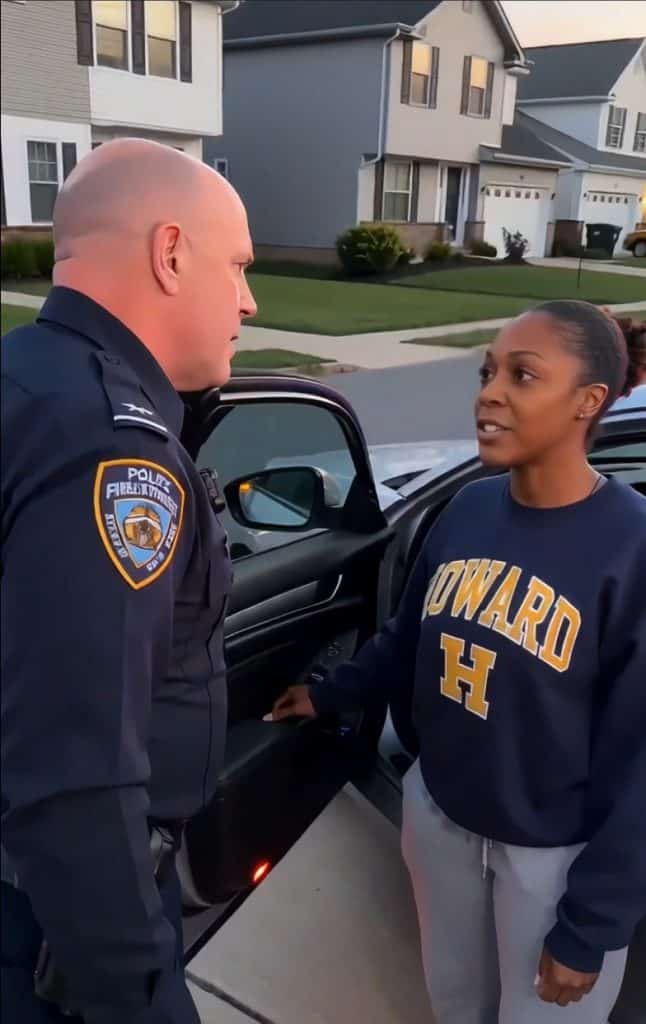
The woman standing beside the open passenger door turned toward him, barefoot on the concrete, a navy Howard sweatshirt hanging loose over gray sweatpants. Her hair was pulled back, and her face carried the exhausted irritation of someone who had already explained the obvious once and could not believe she had to do it again.
“This is my car,” she said. “I live here.”
Her voice was firm.
Not loud. Not wild. Not guilty.
Firm.
Officer Barrett did not soften.
He was broad, shaved-headed, middle-aged, and dressed in a dark navy uniform that seemed to make him feel larger than the space around him. He stood near the front of her sedan with his hands slightly away from his sides, watching her as if the driveway were a crime scene and she had wandered into it holding a secret.
Behind him, the patrol car sat at the curb with its lights flashing. The radio crackled through the open window. A younger officer stood a few steps back, one hand near his belt, his body camera glowing faintly against his chest.
The woman looked from one officer to the other.
“My daughter called you?” she asked. “Because I was locked out for ten minutes? That’s what this is?”
Barrett ignored the question.
“Do you have ID?”
She exhaled sharply, then nodded toward the open car door.
“My wallet is clipped to the visor.”
The younger officer shifted, as if preparing to say something routine. Maybe, Go ahead slowly. Maybe, I can get it for you. Maybe anything that would have kept the evening from breaking open.
But Barrett was already moving closer.
The woman raised one hand slightly.
“It’s right there,” she said. “I’m reaching for it.”
She turned toward the passenger door.
Her fingers lifted toward the sun visor.
Then Barrett lunged.
It happened so fast that the street seemed to lose sound.
His hand clamped around her arm. His shoulder drove forward. Her body twisted away from the car, not by choice but by force. The open door jolted. Something small and black slipped from above the visor and hit the driveway with a sharp clack.
Her wallet.
“Wait—” she gasped.
Barrett did not wait.
He spun her hard and forced her down onto the concrete.
A dull impact cut through the hum of the patrol car.
The younger officer froze.
The woman was face-down now, one cheek against the driveway, her Howard sweatshirt bunched at her shoulder, her bare feet still only steps from the welcome mat of the house she had said was hers. Barrett dropped a knee onto her back and pulled her arms behind her.
“Stop resisting,” he barked.
“I’m not resisting,” she said, voice strained beneath him. “I told you where my ID was.”
Metal clicked.
The sound of cuffs.
The younger officer looked down and saw the black leather wallet near her feet.
For a moment, he seemed relieved to have something useful to do. He bent, picked it up, and flipped it open with the practiced motion of a man expecting a license, an address, maybe a name that would make the paperwork easier.
Then he stopped.
His face changed.
First confusion.
Then recognition.
Then horror.
His breath caught so sharply that Barrett looked up.
The younger officer stared at the identification inside the wallet as if the letters had rearranged themselves into a sentence that could ruin both of them.
“Oh, no,” he whispered.
Barrett frowned. “What?”
The younger officer lifted the wallet, his hand shaking.
His eyes were wide now. Not surprised.
Terrified.
“Oh shit,” he shouted. “Barrett, get off her!”
Barrett stared back, still kneeling on the woman’s back, still gripping her cuffed wrists.
The woman closed her eyes against the concrete.
And in that moment, every flashing light on that perfect suburban street suddenly looked less like protection.
And more like evidence.
Act II
Her name was Dr. Naomi Ellis.
That was the first thing Officer Logan Price saw on the ID.
Not just Naomi Ellis.
Not just an address matching the house in front of them, the car in the driveway, the life Barrett had treated like a lie.
Dr. Naomi Ellis.
Below the name was a gold seal, a federal credential, and a title that made Logan’s stomach drop so hard he nearly forgot how to breathe.
Civil Rights Division.
Department of Justice.
Special Counsel.
He read it twice because the first time felt impossible.
Then he looked at the woman pinned to the driveway beneath Barrett’s knee, barefoot in her own yard, and understood with sick clarity that impossible was already happening.
Naomi Ellis had spent fifteen years teaching people that law was not the same thing as power.
Power was easy. Power could shout. Power could shove. Power could make a person lie on cold concrete while neighbors watched from behind curtains.
Law was harder.
Law required restraint. Memory. Evidence. The discipline to ask one more question before doing something that could never be undone.
Her father had taught her that.
Judge Malcolm Ellis was the first Black judge in their county and the quietest man in every room he entered. He spoke softly because he had learned early that people afraid of your mind would pretend to fear your tone. He wore plain suits, carried a leather briefcase older than Naomi, and kept a framed line from the Constitution above his desk.
No person shall be deprived of liberty without due process of law.
When Naomi was a girl, she thought it sounded boring.
By the time she was grown, she understood it was one of the most radical promises ever written.
Her mother, Celia, used to say Naomi inherited her father’s spine and her own impatience. That was mostly true. Naomi did not like being spoken over. She did not like bullies in nice uniforms or polished offices. She did not like watching people apologize for existing in places they had every right to be.
That was why she went to Howard.
That was why she went to law school.
That was why she turned down private firms with glass conference rooms and chose work that made her phone ring at midnight.
Police misconduct. Housing discrimination. Wrongful stops. Retaliation complaints. Patterns hidden beneath individual incidents that departments dismissed as misunderstandings.
Naomi built cases from body-camera footage, dispatch logs, neighbor videos, old complaints, and the small details people in power forgot to hide.
She knew how stories were edited.
She knew how language was used to soften force.
Subject became combative.
Resident became suspicious person.
Homeowner became unknown female.
And now, on a Sunday evening, she had become one of those phrases.
It had started with a locked door.
Naomi had been unpacking groceries from her car while arguing gently with her sixteen-year-old daughter, Amara, through the front door. Amara was upstairs with headphones on and had not heard the bell at first. Naomi’s keys were inside. Her phone battery was nearly dead. She had laughed through the kitchen window and told Amara to hurry up before the ice cream melted.
A neighbor had seen a barefoot Black woman pulling at the front door of a nice house and called the police.
Not the first neighbor to meet Naomi.
Not the neighbor who waved when she ran in the mornings.
Someone farther down the street. Someone who had seen a silhouette and built a threat around it.
By the time Amara came downstairs, the patrol car had arrived.
Naomi had been at the passenger side of her sedan, reaching for her wallet, when Barrett stepped onto the driveway like he had already decided what kind of evening this was.
“This your vehicle?” he asked.
“Yes.”
“You live here?”
“Yes.”
“Name?”
“Naomi Ellis.”
He looked at the house, then at her sweatshirt, then at her bare feet.
“Step away from the vehicle.”
She felt the old warning in her chest.
The one she had heard from clients. From mothers. From men who carried receipts in their pockets so they could prove they had purchased what they owned.
Stay calm.
Be clear.
Do not give them an excuse.
“I live here,” she said.
“Do you have ID?”
“My wallet is clipped to the visor.”
It should have been simple.
It should have been nothing.
But Barrett had not been listening for the truth. He had been listening for control.
And when Naomi reached for her own ID in her own car in her own driveway, he turned her body into an accusation.
Now the younger officer was shouting.
“Barrett, get off her!”
Barrett’s face twisted with confusion first, then irritation.
“What the hell is wrong with you?”
Logan Price held the wallet out like it was burning his fingers.
“That’s Dr. Ellis.”
Barrett blinked.
“So?”
Logan’s voice cracked.
“DOJ.”
The word moved through the air differently from the siren lights.
Barrett’s grip loosened.
Naomi felt it.
So did every neighbor watching from the windows.
Barrett stared at the wallet.
Then he looked down at the woman under his knee.
For the first time since he arrived, he seemed to see her.
Not as a problem.
Not as a lesson.
As a person with a name, a house, a daughter, a career, and power he had not expected her to possess.
Naomi turned her face slightly against the concrete.
Her voice was low.
“Get off my back.”
It was not a request.
It was the calmest command on the street.
And this time, even Barrett heard it.
Act III
The first person to run outside was Amara.
She came through the front door barefoot like her mother, one hand still gripping her phone, her braids swinging against the shoulders of her oversized school hoodie.
“Mom!”
The sound cracked something in Naomi that Barrett’s weight had not.
She lifted her head as much as she could.
“Amara, stay on the porch.”
Her daughter did not.
She came down two steps before Logan raised both palms.
“Please stay back,” he said, but his voice had lost the authority it was supposed to carry. He sounded young. Frightened. Human.
Amara stared at the cuffs on her mother’s wrists.
Her face went from confusion to terror to rage in a matter of seconds.
“She told you she lives here!”
Barrett stood, but not quickly enough to look innocent. He stepped back from Naomi while Logan crouched to unlock the handcuffs.
“Ma’am,” Logan said, voice shaking, “I’m going to remove these.”
Naomi did not answer.
Her wrists were freed.
She pushed herself slowly onto one elbow, then sat up on the concrete. Her cheek was marked from the driveway. Her palms were scraped, but not badly. Her dignity had taken the harder blow, and everyone could feel it.
Amara rushed to her.
Naomi held her daughter with one arm.
“I’m alright.”
“No, you’re not.”
“I’m here.”
That was all Naomi could promise.
Across the street, porch lights flickered on one by one. A woman in a cardigan stood at her mailbox, phone held chest-high, recording openly now. A man from next door stepped onto his lawn with a stunned expression and no idea what to do with his hands.
Barrett adjusted his belt.
It was a small, ugly motion.
A man trying to return to uniform before anyone saw the damage underneath.
“We received a call,” he said.
Naomi looked at him.
Her breathing was steady now.
“About what?”
“Suspicious activity.”
“At my house?”
“At this address.”
“And what was suspicious?”
Barrett’s jaw tightened.
“You were attempting to enter the residence.”
“My residence.”
“That had not been established.”
“My car was in the driveway. My daughter was inside. My wallet was where I told you it was.”
“You reached into the vehicle after being told—”
“I told you what I was reaching for.”
Logan looked down.
His body camera had captured that.
So had Barrett’s, unless he had found some clever way to fail at the exact moment failure benefited him.
Naomi’s eyes moved to the camera on Barrett’s chest.
“Is your body camera recording, Officer Barrett?”
He did not answer quickly enough.
Naomi’s voice sharpened.
“Is it recording?”
Logan swallowed.
“Mine is.”
Naomi turned to him.
“Good.”
Barrett’s face darkened.
“You need to calm down.”
The entire street seemed to hold its breath.
Naomi rose to her feet.
Slowly.
Carefully.
Amara tried to help, but Naomi touched her hand and stood on her own. She was not tall, but in that moment she seemed to take up the entire driveway.
“Do not tell me to calm down,” she said.
The words were even.
No screaming. No shaking. No spectacle.
Just steel.
“You tackled me in front of my daughter. You pinned me to my own driveway. You cuffed me after I told you exactly where my identification was. You did not ask one follow-up question before putting your hands on me.”
Barrett glanced toward the neighbors.
The audience had become too visible now.
Naomi noticed.
“You’re worried they’re watching,” she said. “You should be worried that you weren’t.”
Logan flinched, though the words were not aimed at him alone.
The police radio crackled.
Dispatch asked for status.
Nobody answered.
Then Amara spoke.
“She’s the reason your department is under investigation.”
Barrett turned toward the girl.
“What did you say?”
Naomi closed her eyes for half a second.
“Amara.”
But it was too late.
Amara’s voice trembled with fury.
“My mom is reviewing your department.”
Logan’s head snapped toward Naomi.
Barrett went still.
That was the secret inside the secret.
Naomi was not simply a federal attorney.
She was in town for a reason.
For eight months, she had been quietly leading a federal review of the Westbridge Police Department after a series of complaints that looked separate until placed side by side. Traffic stops that escalated without cause. Homeowner calls handled differently depending on the neighborhood. Body cameras muted at convenient moments. Reports that used the same phrases too many times to be coincidence.
And one name appeared again and again.
Barrett.
Officer Daniel Barrett had been named in six complaints over four years. None sustained. Not one. Every file ended with the same careful language.
Insufficient evidence.
Subject noncompliant.
Officer followed protocol.
Naomi had read those files two nights earlier at her kitchen table while Amara studied chemistry across from her. She remembered Barrett’s name because she had underlined it twice.
She had not expected to meet him this way.
But Barrett understood now.
His face drained.
Logan looked physically sick.
“You’re Dr. Ellis,” he said again, quieter this time. “The review counsel.”
Naomi bent, picked up her wallet from where Logan had placed it on the hood of the car, and slid the credential back into its sleeve.
“Yes,” she said.
Barrett’s voice came out rough.
“This has nothing to do with any review.”
Naomi looked at the cuffs still in Logan’s hand.
“No,” she said. “That is exactly the problem.”
Act IV
The supervisor arrived seven minutes later.
Seven minutes was long enough for the whole block to come alive.
Neighbors gathered at safe distances with phones out. A teenage boy filmed from an upstairs window. The woman in the cardigan had moved closer, tears in her eyes, repeating to anyone nearby, “She said it was her house. I heard her. She said it.”
Naomi stood beside Amara near the open passenger door, refusing to go inside until the scene was documented properly. Her bare feet were still on the concrete. Her wrists had red marks from the cuffs. She had pulled her sweatshirt sleeves down over them, not to hide the marks, but because Amara kept looking at them.
Sergeant Linda Carver stepped out of her cruiser with the face of someone who had spent her career managing men like Barrett and was deeply tired of the damage.
She took in the driveway.
Naomi.
Amara.
Logan.
Barrett.
The wallet.
The open car door.
The neighbors.
The phones.
Then she looked at Barrett.
“What happened?”
Barrett started first.
“Responded to a suspicious person call. Subject refused commands and reached into the vehicle—”
“No,” Logan said.
Everyone turned.
Barrett’s eyes cut toward him.
Logan Price looked like he might be sick, but he did not look away.
“No?” Carver asked.
Logan swallowed.
“She identified the vehicle as hers. She stated she lived here. Officer Barrett asked for ID. She said her wallet was clipped to the visor. She reached for it, and he took her down before she could retrieve it.”
Barrett’s voice lowered.
“Careful, Price.”
Logan’s face tightened.
“I am being careful.”
Naomi watched him.
So did his body camera.
Carver looked at Barrett’s chest.
“Your camera on?”
Barrett’s silence answered before his mouth did.
“It malfunctioned,” he said.
Logan closed his eyes.
Carver stared at him.
“Of course it did.”
Barrett bristled.
“With respect, Sergeant—”
“Do not.”
One word.
It stopped him.
Carver turned to Naomi.
“Dr. Ellis, I am Sergeant Carver. I apologize for what happened here. Medical assistance is on the way if you’ll accept it.”
Naomi’s expression did not change.
“I’ll accept documentation.”
Carver nodded.
“You’ll have it.”
“I want the call record preserved. Dispatch audio. Unit GPS. Both body cameras. Any dash footage. All radio traffic. I want Officer Barrett’s use-of-force report filed before his shift ends, and I want his camera logged as inactive with the exact explanation he gives you tonight.”
Barrett muttered, “Unbelievable.”
Naomi looked at him.
“No, Officer Barrett. What’s unbelievable is how predictable this is.”
Carver’s jaw tightened, but not at Naomi.
At the truth.
Amara took her mother’s hand.
“Mom, please go inside.”
Naomi softened.
“In a minute.”
“No. Now.”
The command sounded so much like Naomi that, despite everything, she almost smiled.
Then another car pulled up at the curb.
A black SUV.
Two people stepped out.
One was a tall woman in a dark suit carrying a leather folder. The other was an older man with silver hair, moving with a cane and a slow dignity that made several neighbors straighten without knowing why.
Naomi’s face changed.
“Dad?”
Judge Malcolm Ellis looked at his daughter standing barefoot under police lights, and something ancient passed through his expression.
Not surprise.
Not confusion.
A grief he had hoped his child would be spared.
He walked up the driveway slowly.
Amara ran to him first, and he wrapped one arm around her while his eyes stayed on Naomi.
“Are you hurt?” he asked.
“I’m alright.”
He looked at the marks on her wrists.
“That was not my question.”
Naomi’s composure cracked just enough for him to see through it.
“I’ll be okay.”
The woman in the suit approached Carver and identified herself as Attorney Rachel Kim from the Department of Justice field office. Her voice was professional, controlled, and cold enough to change the temperature of the driveway.
“We’re taking possession of the federal credential and incident documentation chain,” she said. “Nothing gets altered. Nothing gets misplaced.”
Barrett’s face hardened.
“This is a local response.”
Rachel looked at him.
“It stopped being local when you put hands on a federal civil rights attorney already assigned to investigate this department.”
The sentence hit the street like a gavel.
Neighbors murmured.
Carver did not argue.
She knew there were moments when the safest thing for everyone was to stop pretending.
Logan removed his body camera and handed it to Carver only after she logged the time, the device number, and his badge number aloud for Rachel to record.
Then Carver turned to Barrett.
“Remove your belt.”
His head snapped back.
“What?”
“You’re relieved from field duty pending review. Remove your duty belt.”
The color rose in Barrett’s face.
“Sergeant, you’re overreacting because of who she is.”
Naomi stepped forward.
“No,” she said. “You reacted because of who you thought I was.”
That silenced even the neighbors.
Barrett stared at her.
For the first time, no command came to his mouth.
Carver repeated, “Belt.”
Slowly, with every phone watching, Barrett unfastened his duty belt.
The sound of it coming loose was quiet.
But for Naomi, it echoed.
Not because it fixed anything. It did not. A belt on a driveway could not undo the weight on her back or the look on her daughter’s face. It could not repair every complaint that had vanished into internal review folders. It could not rebuild trust between a neighborhood and the people sent there under the word service.
But it was a beginning.
A visible one.
And sometimes systems only admitted a wound existed when someone powerful enough was forced to bleed in public.
Naomi hated that part most of all.
Act V
By midnight, the video was already online.
Not one video.
Five.
The neighbor across the street had captured the moment Barrett grabbed Naomi. The teenager upstairs had recorded Logan shouting for him to get off her. The woman in the cardigan had filmed Naomi calmly asking whether his body camera was recording. Logan’s own body camera, preserved before anyone could touch it, captured the words that mattered most.
My wallet is clipped to the visor.
The next morning, Westbridge woke up to its own reflection.
The official statement came before lunch. It called the incident “concerning.” It promised transparency. It said Officer Barrett had been placed on administrative leave pending investigation.
Naomi read it at her kitchen table with an ice pack near her shoulder and a cup of coffee she had forgotten to drink.
Amara sat across from her, silent.
That frightened Naomi more than the anger would have.
“You can say it,” Naomi told her.
Amara looked up.
“Say what?”
“Whatever you’ve been holding in since last night.”
Her daughter’s eyes filled instantly.
“I thought he was going to hurt you worse.”
Naomi reached across the table.
Amara did not take her hand at first.
“I did everything right,” Amara said. “When I opened the door, I stayed back. I didn’t run at them. I filmed. I remembered what you taught me.” Her voice cracked. “I hate that you had to teach me.”
Naomi closed her eyes.
There it was.
The cost that never made it into reports.
Not only bruises. Not only legal claims. Not only headlines.
The lesson passed from parent to child that safety required rehearsal.
Naomi moved around the table and pulled Amara into her arms.
“I hate it too,” she whispered.
For the first time since the driveway, Amara cried.
Naomi held her and let the coffee go cold.
Three days later, Naomi returned to work.
Her colleagues told her she could step back from the Westbridge review. No one would question it. In fact, some advised it. Conflict of interest. Personal involvement. Emotional burden. The phrases were clean and reasonable and wrong in the way clean, reasonable phrases sometimes are.
Naomi refused to disappear from the case.
Instead, she recused herself from direct findings about her own incident and remained on the broader pattern investigation, with independent counsel assigned to Barrett’s use-of-force review.
She knew what people would say.
Too close.
Too angry.
Too biased.
But neutrality had never meant pretending not to know what happened.
It meant proving it carefully.
So she did what she had always done.
She built the record.
The investigation widened. Logan Price gave a sworn statement that matched his body-camera footage. Sergeant Carver turned over prior internal memos warning command staff about Barrett’s escalation patterns. Dispatch logs revealed the original caller had described Naomi as “a woman messing with a car” despite admitting she had not seen any forced entry.
Then came the old complaints.
A grandfather stopped outside his own garage.
A college student pulled from his car after a broken taillight stop.
A nurse questioned in front of her apartment building while holding hospital scrubs and keys.
Different names. Different dates. Same language in the reports.
Subject became agitated.
Subject failed to comply.
Officer perceived threat.
Naomi read each file twice.
Not as a victim.
As a lawyer.
But sometimes, late at night, she had to stand up from the desk and breathe through the memory of concrete beneath her cheek.
The hearing took place six weeks later in a packed municipal chamber.
People lined the walls. Reporters stood near the back. Neighbors from Naomi’s street sat together in the third row, including the woman in the cardigan, who clutched a printed statement with both hands.
Barrett arrived in a suit that did not fit him as well as his uniform had.
Without the badge, he looked less certain of where to put his hands.
His attorney argued that he had made a split-second decision. That the neighborhood had reported a possible burglary. That Naomi had moved toward the vehicle despite commands. That hindsight was easy from the safety of a chair.
Then Logan testified.
He was pale, nervous, and honest.
“She told us where the wallet was,” he said. “She was doing what Officer Barrett asked. There was time to slow down.”
Barrett did not look at him.
Then Amara testified.
Naomi had tried to spare her from it. Amara insisted.
She walked to the microphone in a blazer borrowed from her mother, hair neatly pulled back, hands shaking only until she began speaking.
“My mom teaches people that rights are real even when nobody wants to honor them,” she said. “That night, I watched an officer treat her like her words didn’t matter until he found out her job did.”
The room fell silent.
Amara looked at the panel.
“That scares me. Because most people don’t have her job.”
Naomi lowered her eyes.
Pride and heartbreak can live in the same breath.
The final decision did not fix everything.
It never does.
Barrett was terminated. The department entered a federal consent agreement requiring new training, revised use-of-force policies, body-camera compliance audits, and independent review of misconduct complaints. Several old cases were reopened. The dispatch protocol for suspicious person calls changed, requiring clearer questioning before officers arrived primed by assumptions.
There were protests.
There were angry radio segments.
There were people who insisted Naomi had used her position to ruin a good officer’s career.
Naomi did not answer every lie.
She had learned long ago that some people did not want evidence. They wanted permission to keep believing what comforted them.
Months later, on a warm evening, Naomi stood in the same driveway where it had happened.
The silver sedan was clean. The passenger door was closed. The grass had been cut. A chalk drawing Amara’s younger cousins had made during a weekend visit still marked the sidewalk in pink and blue stars.
Judge Ellis sat on the porch with a glass of iced tea, watching the street.
“You’re staring,” Naomi called.
“I’m observing,” he said.
“That’s what you called staring when I was little.”
He smiled.
Amara came outside wearing Naomi’s Howard sweatshirt, the same one from that night. Naomi had not worn it since. Seeing it on her daughter hurt for a second, then healed something beside the hurt.
“You sure you want that one?” Naomi asked.
Amara looked down at the yellow letters.
“Yeah.”
“Why?”
Amara shrugged, but her face was serious.
“Because he doesn’t get to make it something bad.”
Naomi had no answer for that.
So she simply nodded.
Across the street, a patrol car rolled slowly by.
Not flashing. Not stopping.
Just passing.
The officer inside lifted two fingers from the steering wheel in a cautious wave. Naomi recognized Logan Price. He had stayed with the department after the investigation, though not everyone made that easy for him.
Naomi returned the wave.
Amara did too.
Judge Ellis watched the car disappear around the corner.
“Trust is a slow thing,” he said.
Naomi leaned against the porch railing.
“So is accountability.”
“Yes,” he said. “But slow is not the same as impossible.”
The sky deepened from orange to violet. Porch lights flickered on along the street, one by one. Somewhere, a dog barked. A lawn sprinkler clicked softly against the quiet.
It looked like an ordinary suburb again.
But Naomi knew ordinary could be fragile.
A street could look peaceful and still carry the memory of flashing lights. A driveway could look clean and still remember the weight of a body forced down onto it. A uniform could mean safety to one person and fear to another, depending on what had happened the last time a command was shouted in their direction.
She also knew this.
The truth had not stayed on the concrete.
It had risen.
Through a wallet opened by shaking hands. Through a young officer who found his voice. Through a daughter who refused to forget what she saw. Through neighbors who finally understood that watching was not the same as witnessing unless they were willing to speak.
Naomi looked at Amara beside her.
“You hungry?”
“Always.”
Judge Ellis lifted his glass.
“That girl is your mother’s grandchild.”
Amara smiled for the first time all evening.
Naomi opened the front door, then paused and looked back at the driveway.
For a moment, she saw it all again.
The patrol lights.
The open car door.
The wallet on the ground.
Barrett’s confusion when power did not protect him from consequence.
Then the memory shifted.
She saw Amara standing tall at the hearing.
Logan telling the truth.
Her father walking up the driveway with his cane and his quiet fury.
Neighbors handing over videos.
A department forced to say, on paper and in public, that what happened was not acceptable.
Naomi stepped inside her home.
Not because she had forgotten.
Because it was hers.
Her car.
Her driveway.
Her daughter.
Her name.
And no officer, no report, no shouted command in the dusk could take that truth away again.