Act I
The chicken was black around the edges before Mara even smelled the smoke.
She had been standing at the sink, sleeves pushed to her elbows, scrubbing the same pan over and over because her hands would not stop shaking. The kitchen was warm, cramped, and yellow with old light. The refrigerator hummed behind her, crowded with grocery lists, overdue notices, and little reminders she had written to herself in a handwriting that had grown smaller every month.
Take vitamins.
Call dentist.
Buy soap.
Hide cash.
Then the front door slammed.
Mara’s whole body tightened before Cal said a word.
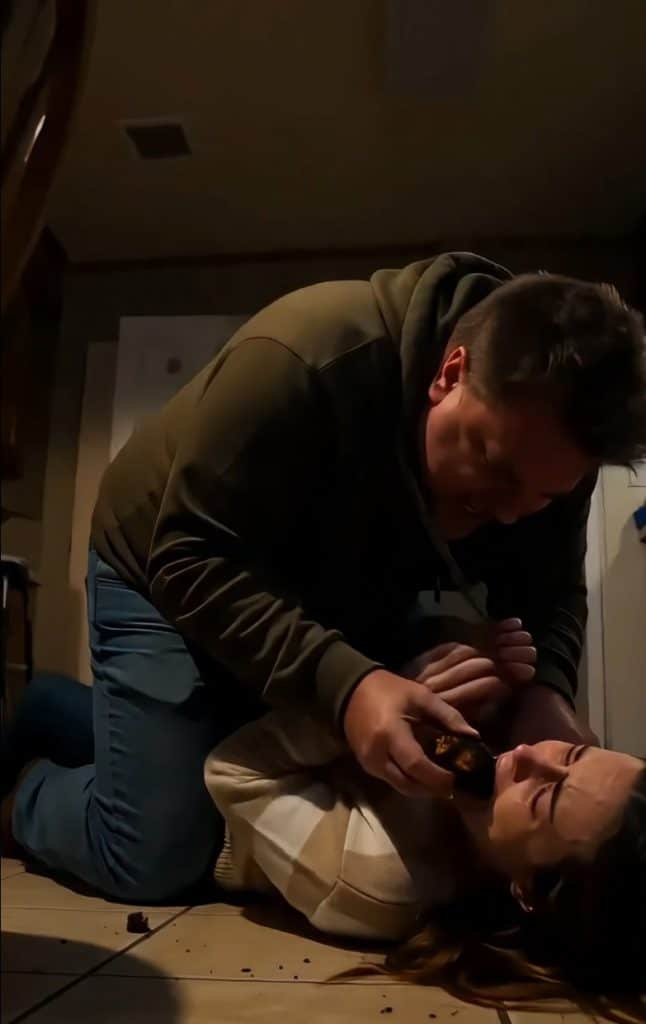
He came into the kitchen in his olive-green jacket, heavy steps hitting the floor like warnings. His eyes landed on the table first. Then on the plate.
The burnt chicken sat there in the middle of the wooden table like evidence of a crime.
Cal stopped.
“What the hell is this supposed to be?” he shouted. “Is this garbage what you call dinner?”
Mara turned off the sink too fast. Water dripped from her fingers onto the floor.
“I’m sorry,” she said, her voice already breaking. “I was cleaning and I lost track of the time.”
Cal stared at her.
Not at the chicken.
At her.
That was how Mara knew this was not about dinner.
It never was.
She gripped the edge of the counter, trying to stay upright, trying to make herself small enough to survive the next few minutes. Her striped sweater clung damply to her wrists. Her long brown hair had fallen partly across her face, and she did not dare push it back.
Cal pointed at the plate.
“I work all day,” he said, each word getting lower, uglier. “And you can’t even do this?”
“I can make something else.”
He moved before she finished the sentence.
Mara saw the shadow first. Then his hand. Then the kitchen spun, and the floor came up beneath her with a shock that stole the air from her chest.
The chair legs towered above her. The plate rattled on the table. Her hair spread across the tile, and Cal loomed over her, breathing hard, his face twisted with the kind of anger that had once made her apologize for things she had not done.
He reached for the chicken.
Mara shut her eyes.
“Eat it,” he snarled. “Eat every bite of what you made.”
But as she turned her face away, her cheek pressed against the cold tile, Mara saw something beneath the refrigerator.
A folded corner of paper.
White.
Clean.
Not one of her notes.
Not one of his bills.
A piece of paper hidden where only someone on the floor would ever see it.
And written across the edge, in a woman’s handwriting, were the words:
Mara, when he does this again, look behind the magnets.
Act II
Three years earlier, Cal Rourke had not looked like a monster.
That was the part Mara hated admitting.
He had looked like rescue.
He was broad-shouldered, polite to waitresses, and charming in that careful way that made people trust him quickly. He knew how to make a woman who had been lonely feel chosen. He brought flowers to her office. He remembered that she hated onions. He said her laugh made the room feel warmer.
Back then, Mara worked as a receptionist at a small dental clinic and lived in a second-floor apartment above a laundromat. Her father had been gone for years. Her mother had died after a long illness, leaving behind a little house, a few family keepsakes, and a stack of medical bills that made Mara feel like she was drowning before she had even learned how to swim.
Cal entered her life during that soft, broken season.
He fixed her car when it would not start. He dealt with a rude landlord. He told her she was too sweet for the world and that he would protect her from people who took advantage.
Mara did not realize protection could become a cage.
At first, he only corrected her.
Don’t wear that.
Don’t talk to him like that.
Don’t spend money without asking me.
Don’t make me look stupid.
Then he started deciding who she could see. Her friends were “bad influences.” Her boss was “using her.” Her cousin Jenna was “jealous” because Mara had a husband and a home.
By the time Mara understood what was happening, the doors had already closed around her.
Cal sold her car, saying they needed to be practical. He convinced her to quit her job, saying a proper wife should not be exhausted all the time. He took over the bills because, according to him, numbers stressed her out.
Then he took over everything else.
The house became smaller every day.
The kitchen became Mara’s station. She cooked there, cleaned there, cried there quietly after midnight when Cal was asleep. The refrigerator became the only place in the house that still felt partly hers.
She covered it with notes.
Some were normal enough to pass inspection.
Milk.
Eggs.
Trash pickup Thursday.
But others had secret meanings.
Buy soap meant hide two dollars in the flour tin.
Call dentist meant check the loose floorboard under the hall rug.
Take vitamins meant remember you are real.
Mara had learned to survive in pieces.
A hidden twenty-dollar bill.
A spare house key taped behind the laundry shelf.
A phone number memorized because Cal checked her contacts.
Her neighbor, Ruth Delgado, had given her that number one rainy morning at the mailbox.
Ruth was in her sixties, with silver hair, sharp eyes, and the kind of quiet kindness that did not announce itself. She had seen the long sleeves Mara wore in summer. She had heard the shouting through thin suburban walls. She had once found Mara sitting on the back steps at dawn, staring at nothing.
“You don’t have to tell me anything,” Ruth had said softly. “But you need to know there are people who can help.”
Mara had denied everything.
Of course she had.
Denial was safer than truth when truth had nowhere to go.
But Ruth had written the number anyway on the back of a grocery receipt and slipped it into Mara’s hand.
Mara hid it behind a sunflower magnet on the refrigerator.
For six months, it stayed there.
Then it disappeared.
Cal found it during one of his “cleanups,” when he stormed through the house throwing away anything he decided was clutter. He held the receipt between two fingers and smiled without warmth.
“What’s this?”
Mara lied.
Badly.
By the next morning, every magnet had been moved. Every drawer had been searched. Every note on the fridge had been rearranged.
Cal did not hit her that day.
He did something worse.
He laughed.
“You really think anyone is coming to save you?” he asked. “Mara, people barely remember you exist.”
That sentence stayed longer than any bruise.
After that, Mara stopped reaching out.
Or at least Cal thought she did.
What he never understood was that fear could silence a woman’s mouth while sharpening everything else inside her.
Mara began to watch.
She watched him take late-night calls in the garage. She watched him hide bank envelopes under the seat of his truck. She watched him unlock the old file cabinet in the spare room with a key he kept taped beneath his dresser.
And one afternoon, while Cal was at work and the chicken sat raw on the counter, Mara opened that cabinet.
What she found burned dinner before the oven ever did.
Act III
The first folder had her mother’s name on it.
Evelyn Bennett.
Mara stood in the spare room with flour on her sweater and cold fear climbing up her neck. The folder was thick, heavier than it should have been. Inside were copies of legal forms, bank notices, and papers Mara recognized only in fragments.
Her mother’s house.
Her mother’s account.
Her mother’s signature.
Except the signature was wrong.
Mara knew her mother’s handwriting. Evelyn Bennett had written birthday cards in tall, looping letters, always leaning slightly to the right. The signature on the documents was flat and rushed, as if someone had practiced it but never understood it.
Cal had.
Mara felt it before she could prove it.
There were loan papers she had never seen. Transfer forms she had never signed. A document stating that Mara had agreed to sell her mother’s house to one of Cal’s business contacts for far less than it was worth.
Her inheritance had not vanished because of medical bills.
It had been taken.
Piece by piece.
Under the folder was a second one.
This one had another woman’s name.
Dana Whitcomb.
Mara had heard that name once, during the first month of her marriage, when a cashier at the hardware store looked at Cal and suddenly went pale.
“You know Dana?” Mara had asked later.
Cal’s jaw tightened.
“Old mistake,” he said. “Don’t bring her up again.”
Now Dana’s name sat in Mara’s hands like a warning from the past.
Inside the folder were photographs of a younger woman with red hair. Copies of court documents. A letter from an attorney. A report from a shelter. There were notes written in Dana’s hand, describing patterns Mara knew too well.
The apologies.
The isolation.
The money.
The sudden rages over tiny things.
Dinner.
Laundry.
A wrong look.
A quiet answer.
At the bottom of the folder, Mara found a small envelope addressed to no one.
Inside was a single fridge magnet shaped like a bluebird and a note folded three times.
If he still has this, it means he kept trophies. Hide what you can. Trust Ruth Delgado. She helped me once. I was too scared to finish it. Maybe you won’t be.
Mara’s knees weakened.
Ruth had known.
Not everything.
But enough.
And Dana had been here before her.
Another woman in the same kitchen. Another woman learning to read Cal’s footsteps. Another woman leaving breadcrumbs in a house designed to swallow evidence.
Mara took photos of every document with an old prepaid phone she had hidden beneath the bathroom sink. Her hands shook so badly half the pictures blurred. She took them again. Then she put everything back exactly where she had found it.
By the time she returned to the kitchen, the chicken was smoking.
The pan hissed. The edges had gone black. The room filled with that bitter smell of burned meat and something ending.
Mara should have thrown it away.
She should have started over.
But she stood there frozen, holding the old phone inside her sleeve, listening to Cal’s truck pull into the driveway.
The door slammed.
The kitchen became a stage.
The chicken became his excuse.
And the floor, somehow, became the place where Dana’s final clue found her.
Now, while Cal shouted above her, while the plate scraped and his anger filled every inch of the room, Mara focused on the folded paper beneath the refrigerator.
Behind the magnets.
That was what it said.
Behind the magnets.
When Cal finally stepped away, disgusted with her tears, Mara remained still until he left the kitchen.
He muttered something about sleeping in the den. The television turned on loud enough to shake the walls. A game show laugh track burst through the house, bright and cruel.
Mara slowly sat up.
Her body ached. Her throat burned from panic. But her mind was clear in a way it had not been in years.
She crawled to the refrigerator.
One by one, she removed the magnets.
Grocery list.
Dentist reminder.
A faded photo of her and Cal from the first year, his arm clamped around her shoulders like ownership.
Then the bluebird magnet.
Behind it, stuck flat against the refrigerator door with clear tape, was a tiny memory card.
Mara stared at it.
Her breath caught.
Dana had not left only a warning.
She had left proof.
Act IV
Mara did not sleep that night.
Cal snored in the den with the television still flickering blue against the wall. Every few minutes, canned laughter filled the house, and Mara had to stop herself from flinching.
She sat on the bathroom floor with the door locked and the shower running, the old phone plugged into the wall.
The memory card fit.
For one terrifying second, nothing happened.
Then a folder opened.
There were videos.
Audio files.
Scanned documents.
Dana had recorded everything she could before she disappeared from Cal’s life. Not disappeared, Mara realized. Escaped. There was a difference, and for the first time, Mara allowed herself to believe one might be possible for her too.
One recording captured Cal bragging to another man about “fixing” a wife’s signature.
Another showed him threatening Dana over money.
A scanned letter connected Cal to the same man who had bought Mara’s mother’s house.
And then came the final file.
It was a video of Dana sitting in a car at night, face pale but steady, speaking directly into the camera.
“My name is Dana Whitcomb,” she said. “If another woman finds this, believe me when I say he plans everything. The anger is real, but it is also useful to him. He scares you so you stop asking questions. Don’t stop.”
Mara pressed one hand over her mouth.
Dana continued.
“Ruth Delgado has copies of some of this. I was supposed to go to the police with her. I panicked. I left town instead. I have regretted that every day.”
The video ended with Dana looking away from the camera, eyes full of shame she did not deserve.
Mara replayed the last sentence twice.
Then she stood.
Her legs trembled, but they held.
At 6:12 the next morning, while Cal was still asleep, Mara walked out the back door in slippers and crossed the strip of damp grass between their houses.
Ruth opened the door before Mara knocked twice.
The older woman took one look at her face and said, “Come in.”
That was the first mercy.
The second was that she did not ask Mara to explain everything at once.
She sat her at the kitchen table, wrapped a blanket around her shoulders, and placed a cup of tea near her hands. Then Ruth opened a metal box from the pantry.
Inside were copies.
Dana’s copies.
Mara’s hidden receipt.
Photos Ruth had taken of Cal’s truck coming and going at strange hours.
A written log of dates and sounds from next door.
“I kept it,” Ruth said. “I didn’t know when you’d be ready. But I kept it.”
Mara broke then, but not loudly.
She cried with her head bowed over the tea, not because she was weak, but because someone had finally believed her before she had to beg.
Ruth called her niece, who worked with a legal aid office. The niece called an advocate. The advocate called a detective who had already seen Cal’s name attached to an old complaint that had never gone anywhere.
By nine o’clock, Mara had given a statement.
By noon, the memory card had been copied.
By three, Cal called her phone twenty-seven times.
She did not answer.
At 4:40, he came home to find two police cars outside his house and Ruth standing on the sidewalk with her arms crossed.
Cal got out of his truck slowly.
His face went from confusion to rage to calculation in less than five seconds.
When he saw Mara standing behind the officer, something in him shifted. The old look appeared, the one meant to shrink her back into obedience.
Mara felt it hit her.
Then she felt it fail.
Cal pointed at her. “She’s lying.”
No one moved.
“She burns dinner, she throws a tantrum, and now she’s making up stories because she wants attention.”
Still, no one moved.
The detective held up a sealed evidence bag containing the memory card.
“Mr. Rourke,” he said, “we need to talk about Dana Whitcomb, Evelyn Bennett’s property transfer, and the documents in your file cabinet.”
For the first time, Cal had no command ready.
No insult.
No plate to point at.
No kitchen small enough to make him king.
Behind Mara, Ruth whispered, “Keep breathing.”
So Mara did.
She breathed as Cal’s face went pale.
She breathed as he looked toward the house, toward the refrigerator covered in little notes, toward the room where he had believed every secret belonged to him.
And then she watched him understand.
The woman he thought he had broken had been reading the walls all along.
Act V
The story did not end that afternoon.
Stories like Mara’s rarely end in one clean moment, no matter how badly people want them to.
There were statements. Hearings. Bank records. Property records. Old complaints reopened. Lawyers who asked careful questions. Officers who photographed the kitchen. Advocates who explained options while Mara sat under a borrowed blanket, nodding even when her mind went blank.
Cal was not only charged for what he had done in the house.
The documents opened a wider door.
Investigators found that he had used fear the way other men used keys. To access accounts. To pressure signatures. To isolate women from anyone who might notice the theft beneath the cruelty.
Dana came back for the hearing.
Mara recognized her immediately from the video, though her red hair was shorter now and threaded with gray. She stood outside the courthouse in a navy coat, hands clasped tightly in front of her, eyes searching Mara’s face.
“I’m sorry,” Dana said.
Mara shook her head.
For a moment, neither woman knew what to do with all the pain between them.
Then Dana stepped forward and hugged her carefully, like someone approaching a wound with respect.
“I left the magnet,” Dana whispered. “I thought maybe one day…”
“You did,” Mara said. “You left enough.”
That was the truth.
Not perfect.
Not heroic in the clean, shining way people imagine courage.
Enough.
Ruth testified too. So did the legal aid attorney. So did a bank employee who confirmed the forged paperwork. Piece by piece, Cal’s version of the world began to collapse under the weight of records, recordings, and women who were no longer alone.
In court, Cal looked smaller than he ever had in the kitchen.
Without the yellow light, without the table, without the walls that had held his shouting for years, he was just a man in a pressed shirt trying to look misunderstood.
He turned once and found Mara sitting behind the prosecutor.
For a second, she saw him searching for the old fear in her face.
He did not find it.
Months later, Mara returned to the house.
Not to live there.
Never again.
She came with Ruth and Dana to collect the last of her belongings before the property was sold. The rooms smelled stale. The table was gone. The refrigerator still stood in the kitchen, bare now except for a few strips of old tape stuck to the door.
Mara stood in front of it for a long time.
This was where she had written her tiny reminders.
This was where she had hidden money, phone numbers, pieces of herself.
This was where Cal thought clutter meant weakness.
He had never understood that every note was a survival map.
Dana reached into her purse and took out the bluebird magnet.
“I kept it after the hearing,” she said. “But I think it belongs here one last time.”
She placed it on the refrigerator.
The tiny bird clung to the white door, bright against the emptiness.
Mara looked at it and smiled through tears.
Then she took out one final note from her pocket.
She had written it that morning in large, steady letters.
Not the small handwriting of the woman who used to hide inside her own home.
This time, the words were clear enough for anyone to read.
I got out.
She placed it beneath the bluebird magnet.
For a few seconds, the three women stood in silence.
No shouting.
No slammed doors.
No plate on the table waiting to become an excuse.
Just a kitchen that had finally run out of secrets.
When Mara walked outside, the evening air felt cool against her face. Ruth locked the door behind them. Dana slipped her hand into Mara’s and squeezed once before letting go.
Across the street, porch lights flickered on one by one.
Normal life continuing.
Ordinary and miraculous.
Mara looked back at the house.
For years, she had thought the worst night of her life was the one where Cal made her feel smaller than the burnt dinner on the table.
But she understood now.
That night had not been her ending.
It had been the night the floor gave her back the truth.
And once Mara had the truth, Cal never owned the kitchen, the house, or her silence again.