Act I
The young man smiled like he had already won.
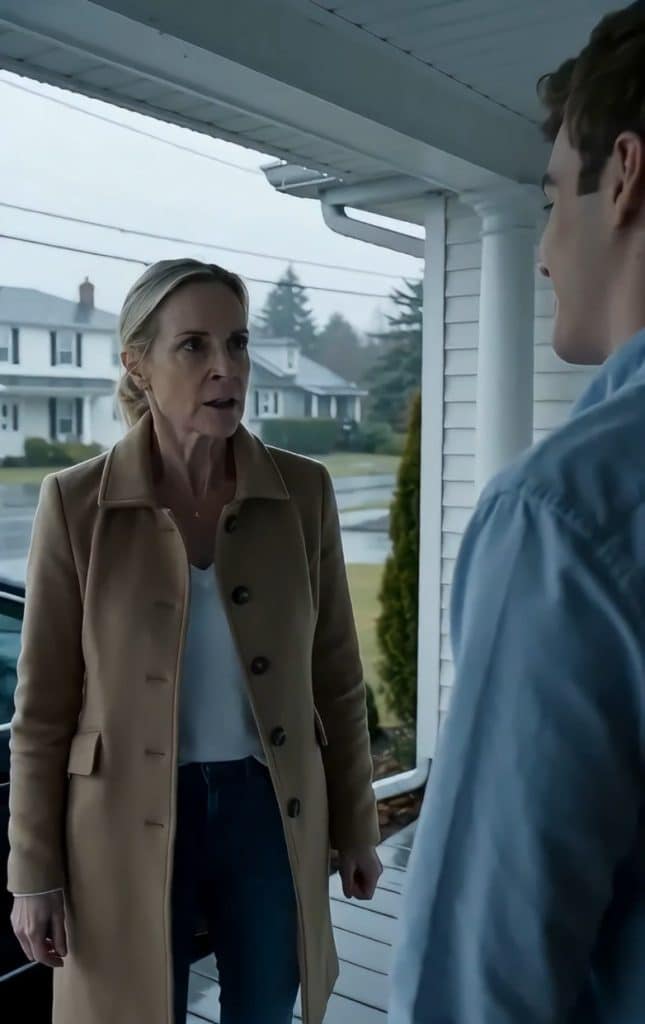
Rainwater dripped from the porch roof behind him, falling in thin silver lines onto the steps. The white siding of the suburban house looked clean, almost too clean, under the gray afternoon sky. A black car sat in the driveway, slick with rain, its windows fogged at the edges.
Margaret Ellis stood on the porch in her tan trench coat, fists clenched at her sides.
“Where is my daughter?”
Her voice was sharp enough to cut through the rain.
The young man leaned against the doorframe, one shoulder relaxed, his light blue shirt neatly buttoned as if this were a casual visit and not a mother standing on his porch with fear in her eyes.
“She’s on a trip,” he said.
Behind him, in the dim hallway, a blonde young woman appeared barefoot in a loose blue robe. She stood half-hidden behind his shoulder, watching Margaret with a faint smile.
Not nervous.
Not surprised.
Amused.
Margaret’s stomach turned.
“My daughter hasn’t answered her phone in two days.”
The young man shrugged.
“That sounds like her problem.”
Margaret stepped closer. “Call her.”
His smile widened.
“No.”
For one second, Margaret saw the boy her daughter had brought to Thanksgiving dinner six months earlier. Polite. Handsome. Soft-spoken. He had helped carry plates to the kitchen and called her ma’am until everyone laughed.
His name was Caleb Rourke.
Her daughter, Emily, had said he made her feel safe.
Now he stood in Emily’s house like he owned the air inside it.
Margaret looked past him again.
The barefoot woman’s smile grew.
“Get off my porch,” Caleb said, his voice dropping.
Margaret wanted to push past him. She wanted to tear through the house room by room until she found her daughter’s purse, her coat, her phone, any proof that Emily had not simply vanished into the lie this man was offering.
But Caleb was taller.
Stronger.
And too calm.
So Margaret turned away.
She walked back through the rain to her black car, gripping her keys so hard the metal bit into her palm. Her hand closed around the door handle.
Then she heard it.
A muffled cry.
High.
Distorted.
Barely human through the walls.
Margaret froze.
The sound came from inside the house.
Or beneath it.
Or behind the closed white garage door.
She turned slowly.
Caleb was still on the porch.
He lifted his eyebrows, almost laughing.
“Old pipes,” he called.
The barefoot woman behind him smiled again.
Margaret opened her car door and slid inside, but she did not leave.
Instead, she kept her phone low, angled away from the house, and opened the recording app.
Her thumb hovered over the red button.
Then another muffled sound rose from somewhere behind the garage.
Margaret pressed start.
And this time, she was not leaving without proof.
Act II
Emily Ellis had always called her mother too much.
That was what she joked about, anyway.
When she got a promotion at the design firm, Margaret was the first person she called. When she adopted a half-dead basil plant from a grocery store clearance shelf, Margaret received four photos and a dramatic update every morning. When she bought the white house on Maple Lane, she called Margaret from the empty living room and cried because she had done it by herself.
“I have stairs, Mom,” Emily said. “Actual stairs. Like a real adult.”
Margaret cried too, though she pretended it was allergies.
Emily was twenty-six, bright, stubborn, generous, and far too willing to believe wounded people could be loved into becoming better.
That was how Caleb entered her life.
He was charming in a quiet way. Not loud. Not flashy. He listened carefully and remembered details. He said he had grown up hard, that trust did not come easy to him, that Emily was the first person who made him want to stay.
Margaret wanted to like him.
At first, she did.
Then little things began to change.
Emily stopped calling from the car after work because Caleb said it was “dangerous.” She stopped inviting Margaret over without checking first. She laughed less freely when Caleb was in the room. Her clothes became plainer. Her opinions became softer.
Margaret noticed.
Emily denied it.
“He’s just private,” she said. “You’re reading into things.”
Maybe she was.
Mothers can become detectives against their own will.
Then came the last call.
Two nights earlier, Emily rang at 11:47 p.m. Margaret had been asleep, and by the time she fumbled for the phone, the call had gone to voicemail.
There was no message.
Only three seconds of breathing.
Then a muffled scrape.
Then nothing.
Margaret called back.
No answer.
She drove to Emily’s house the next morning. Caleb answered the door and said Emily had left early for a “wellness retreat” with friends.
Margaret asked which friends.
He said he did not know.
She asked where.
He smiled and said, “You’d have to ask her.”
That was when fear became certainty.
Margaret filed a missing person report, but the first officer told her adults were allowed to travel without notifying parents. Emily had no documented history of danger. No visible signs of forced entry. Caleb repeated the same calm story.
A trip.
Voluntary.
No concern.
But Margaret knew her daughter.
Emily did not leave basil plants unwatered. She did not miss client deadlines. She did not disappear without taking the necklace her late father gave her.
And she did not stop calling her mother.
Now, sitting in the rain outside Emily’s own house with the recorder running, Margaret understood that Caleb had counted on exactly the thing that protected him.
A mother’s fear looked irrational to strangers.
A boyfriend’s calm looked reasonable.
So she sat there and let the phone listen.
Rain tapped the windshield.
Her breath shook.
Through the window, she saw Caleb step back inside and close the front door.
The house went still.
Then, from behind the garage, came another sound.
A weak, muffled cry.
This time, Margaret heard one word inside it.
“Mom.”
Act III
Margaret did not scream.
That surprised her later.
She did not run at the house. She did not pound on the door. She did not let grief take the wheel and drive her straight into Caleb’s hands.
She pressed the lock button on her car door and called 911.
Her voice came out low, controlled, almost unrecognizable.
“My daughter is missing. I’m at her house. I just heard her voice from inside.”
The dispatcher asked questions.
Margaret answered while staring at the garage door.
Address.
Names.
Description.
Possible danger.
“Yes,” she whispered. “He knows I suspect him.”
The dispatcher told her to stay in the car.
That was impossible.
Caleb could move Emily.
He could hurt her.
He could make the sound stop before anyone arrived.
Margaret looked toward the side of the house. There was a narrow path leading to the backyard gate. Emily kept trash bins there. Margaret had helped paint that gate last spring, laughing as Emily got white paint on her jeans.
She knew the latch stuck.
She also knew there was a small basement window near the garage.
Margaret slid out of the car, keeping low.
The phone remained recording in one hand, the 911 call still open in the other. Rain soaked her hairline and ran down the collar of her coat. She moved along the side of the house, each step careful against the wet grass.
At the gate, she heard voices.
Caleb.
Then the young woman.
“You said she’d leave,” the woman hissed.
“She will.”
“She heard something.”
“Then stop making noise down there.”
Margaret covered her mouth.
Down there.
Not on a trip.
Not gone.
Down there.
A cold fury rose in her so strongly she almost forgot fear.
She edged closer to the basement window. It was dirty, half-covered by an old planter box. Through the streaked glass, she saw only darkness at first.
Then movement.
A pale hand.
Margaret’s knees nearly gave way.
“Emily,” she whispered.
Inside, something shifted.
A face appeared near the low window, barely visible in the dimness.
Emily.
Her hair was tangled. Her face was frightened and exhausted. A strip of tape hung loose near her wrist, as if she had fought free from something.
Margaret pressed her fingers to the glass.
Emily’s eyes widened.
“Mom,” she mouthed.
Margaret lifted the phone so her daughter could see it.
Help is coming.
Emily began to cry silently.
Then a floorboard creaked inside the house above them.
Emily vanished from the window.
Margaret ducked behind the bins just as the side door opened.
Caleb stepped into the rain.
For the first time, his calm was gone.
His face was red, his jaw tight, and in one hand he held Emily’s phone.
He looked toward the driveway.
Then toward the side yard.
Margaret held her breath.
Inside her hidden phone, the recording continued.
Inside her other hand, the dispatcher whispered, “Ma’am, officers are three minutes out.”
Margaret looked toward the basement window.
Emily was still down there.
Three minutes suddenly felt like a lifetime.
Act IV
Caleb saw the footprints in the wet grass.
Margaret knew because his whole body changed.
He stopped near the trash bins, head lowering slowly, eyes scanning the mud. His gaze followed the faint marks from the driveway to the gate, then toward the basement window.
Margaret was crouched behind the bins, rain dripping from her coat sleeve, one hand pressed over her phone to muffle the dispatcher’s voice.
Caleb took a step closer.
“Mrs. Ellis?” he called.
The sweetness had returned.
That was worse.
“I know you’re upset,” he said. “You’re making this harder than it has to be.”
From inside the basement came a dull thump.
Caleb’s eyes flicked toward the window.
Margaret stood before she could talk herself out of it.
“You kept her in the basement.”
Caleb stared at her.
For one second, there was no mask.
Only hatred.
Then he laughed.
“You’re confused.”
Margaret held up the phone.
“I recorded everything.”
The laugh died.
The young woman appeared behind him in the side doorway, clutching her robe around herself.
“Caleb,” she whispered.
He turned on her. “Go inside.”
She did not move.
In that moment, Margaret understood something important.
The woman had smiled on the porch because she thought she was untouchable.
Now she looked like someone realizing the story might not end in her favor.
Sirens sounded in the distance.
Caleb heard them.
His face changed again.
Calculation.
Margaret backed toward the driveway.
“You can still open the door,” she said. “You can let her out before they come in.”
His eyes sharpened.
“She was going to ruin my life.”
Margaret’s stomach twisted.
“What did she find?”
The answer came from the young woman.
“The accounts,” she whispered.
Caleb spun toward her, furious.
Margaret looked between them.
Emily had once told her Caleb was “helping” with freelance billing for her design firm because he was good with numbers. Margaret had thought nothing of it.
Now the shape of the truth emerged.
Money.
Control.
A daughter who discovered too late that the man she loved had been draining her business, isolating her, and planning to leave her blamed for the damage.
“She was going to report you,” Margaret said.
Caleb stepped toward her.
“She was going to destroy me.”
“No,” Margaret said. “She was going to escape you.”
The first police cruiser turned onto the street.
Red and blue light flashed against the wet siding.
Caleb bolted for the side door.
Margaret screamed, “Basement! She’s in the basement!”
Officers poured from the cruiser before it fully stopped.
Caleb slammed the side door shut.
The young woman tried to run inside after him, but an officer caught her at the threshold.
Another officer forced the side door.
Margaret stood in the rain, shaking so hard she could barely breathe.
From inside the house came shouting.
Then a crash.
Then Emily’s voice.
Real.
Clear.
Terrified.
“Mom!”
Margaret ran.
An officer caught her gently at the porch steps.
“Ma’am, wait.”
“No, that’s my daughter!”
The front door burst open.
Two officers came out first.
Then Emily.
She was wrapped in a gray emergency blanket, barefoot, crying so hard she could barely stand.
Margaret broke free.
Emily stumbled into her arms.
For a moment, there was no house, no rain, no police, no Caleb screaming from somewhere inside.
Only Margaret holding the child she had once rocked to sleep, the woman she had nearly lost, the daughter who had not gone on any trip at all.
Act V
Caleb’s story unraveled before dawn.
At the station, he tried to claim Emily had locked herself in the basement during an argument. He said Margaret misunderstood. He said Emily was unstable. He said the young woman, Tessa, was only a friend.
Then detectives played Margaret’s recording.
Caleb’s voice on the porch.
Old pipes.
His voice by the side door.
Stop making noise down there.
His voice in the rain.
She was going to ruin my life.
The room went quiet.
After that, Caleb stopped smiling.
Emily spent the night at the hospital for evaluation and observation. Margaret stayed beside her bed, one hand wrapped around Emily’s even after her daughter fell asleep.
There were no dramatic speeches at first.
Only little things.
A nurse bringing warm socks.
Emily flinching at footsteps.
Margaret learning not to reach too quickly.
The doctor asking if Emily felt safe with her mother in the room, and Emily answering yes before the question was finished.
In the morning, Emily woke and stared at the ceiling.
“I thought you left,” she whispered.
Margaret leaned closer.
“I didn’t.”
“He told me you would. He said everyone would believe him.”
Margaret’s eyes burned.
“He was wrong.”
Emily swallowed.
“I was so embarrassed.”
“Why?”
“I let him in.”
Margaret shook her head.
“No. He lied his way in.”
The difference mattered.
It would take Emily months to believe it.
Investigators later found the missing documents hidden in Caleb’s laptop bag. Unauthorized transfers. Loans in Emily’s name. Draft emails meant to make it look like she had disappeared under pressure from debt.
Tessa, the barefoot woman in the blue robe, eventually admitted she knew Caleb planned to scare Emily into signing over access to her accounts. She claimed she did not know he would lock her downstairs.
No one believed her completely.
Emily’s white house became evidence before it became a home again.
For weeks, Margaret tried to convince her daughter to sell it.
Emily refused.
“That’s what he wanted,” she said. “To make every place feel like his.”
So they returned together.
Not right away.
Not alone.
A locksmith changed every lock. A contractor repaired the basement door. A security company installed cameras. The neighbor across the street, an older woman named Diane, brought soup and then stayed for three hours because she knew silence after trauma could become too large.
Emily walked through each room slowly.
The living room.
The kitchen.
The hallway.
The basement stairs.
At the top, she stopped.
Margaret stood beside her.
“You don’t have to go down.”
Emily gripped the railing.
“Yes, I do.”
They went together.
The basement was empty now, bright with temporary work lights. The old storage boxes were gone. The small window had been cleaned. Rain tapped softly against the glass.
Emily stood in the center of the room.
Then she reached for her mother’s hand.
“I screamed,” she said.
“I heard you.”
“I didn’t think you would.”
Margaret’s voice broke.
“I will always hear you.”
Months passed.
The case moved toward trial. Emily rebuilt her business with help from clients who had wondered why she had gone silent and now returned with fierce loyalty. Margaret came over often, sometimes invited, sometimes not, always carrying groceries she pretended were extra.
Emily began calling again.
At first, every day.
Then every other day.
Then sometimes just to say, “The basil plant survived.”
Margaret cried after that call, though she told no one.
The porch changed too.
Emily repainted the front door a deep blue. She replaced the old porch light with a brighter one. She planted rosemary and lavender in pots where rainwater used to pool.
One afternoon, when the sky cleared after a storm, Emily stood on the porch with Margaret and looked toward the driveway.
“This is where you recorded him?”
Margaret nodded.
“I was terrified.”
“I know.”
“No,” Margaret said softly. “I mean I was terrified I’d be wrong.”
Emily turned to her.
Margaret looked at the front steps.
“That I’d make a scene. That people would say I was overreacting. That I would push too hard and embarrass you.”
Emily took her hand.
“You saved me because you didn’t care how it looked.”
Margaret breathed out slowly.
That was the truth she wished every mother knew.
Sometimes protection looks unreasonable before the evidence arrives.
Sometimes suspicion is love refusing to be polite.
And sometimes a woman has to stand in the rain with a phone hidden low in her hand, recording the lie everyone else is ready to believe.
A year later, Emily hosted dinner in the same house.
Not a large party.
Just Margaret, Diane from across the street, the detective who had worked the case, and two friends Emily had slowly let back into her life.
The basil plant sat in the kitchen window, enormous and ridiculous.
After dinner, Emily stood on the porch while the others laughed inside.
Margaret joined her.
The night was cool and dry. The black car in the driveway had been traded for a blue one. The garage door had been repainted. The house no longer looked like a crime scene.
It looked like Emily’s again.
“Mom?”
“Yes?”
Emily leaned her head on Margaret’s shoulder.
“Thank you for coming back.”
Margaret kissed her hair.
“I never left.”
Across the street, porch lights glowed one by one. The neighborhood settled into evening, ordinary and imperfect and alive.
For a long time, they stood there together.
No secrets behind the door.
No false smiles in the hallway.
No muffled cries hidden under the sound of rain.
Only a mother, a daughter, and a house that had finally stopped holding its breath.