Act I
The dog came out of the snow like a warning no one could read.
One second, Caleb Ward was guiding his white semi down the slushy two-lane highway, both hands steady on the wheel, breath fogging faintly in the cold cab. The next, a Golden Retriever charged from the shoulder straight into his lane, barking at the windshield as if it had chosen the truck on purpose.
Caleb slammed the brakes.
The trailer fishtailed.
The tires screamed against wet asphalt, spraying dirty slush across the snowbank. Behind him, horns erupted. Cars braked hard in a crooked line, bumpers sliding, headlights flashing through the gray winter air.
The semi stopped at an angle across the lane and shoulder.
Caleb sat frozen for half a heartbeat.
Then anger hit.
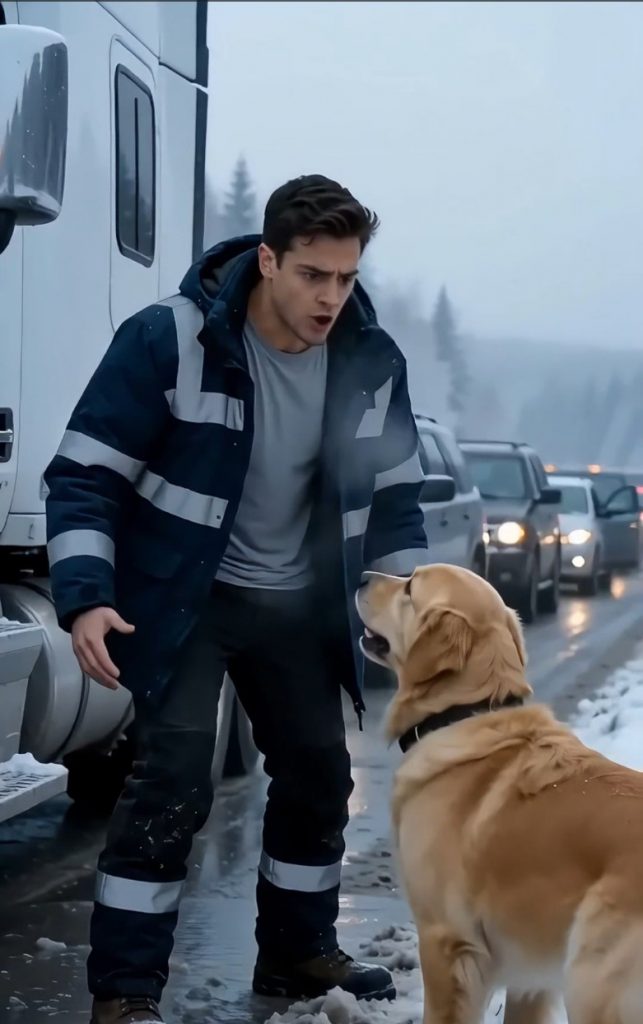
He threw open the cab door and climbed down into the cold.
“Move!” he shouted at the dog. “Get out of the road!”
The Golden Retriever did not move.
It stood near the double yellow lines, thick golden fur damp with snow, black collar dark against its neck, gold tag swinging as it barked in short, desperate bursts.
Caleb stormed toward it, boots splashing through slush.
“You almost caused a pileup!”
The dog backed away.
Not randomly.
Toward the shoulder.
Then it barked again and looked over its shoulder at the snowbank.
A woman in a long tan coat got out of a stopped car behind the truck. Other drivers followed, angry at first, then confused.
“What happened?” someone called.
“That dog ran in front of me,” Caleb snapped.
The Golden Retriever barked again, sharper this time, then moved toward a cluster of broken branches half-buried in snow.
Caleb followed only because the dog would not stop.
At the edge of the shoulder, the ground was wrong.
The snow dipped inward.
Branches sagged over a dark opening.
Caleb took one step closer and felt the breath leave his body.
A sinkhole had opened beside the road, deep and jagged, its rim hidden under snow and broken brush. Wind moved across the hole with a hollow sound.
And down inside, tangled among icy branches, was a flash of bright blue clothing.
The woman in the tan coat gasped behind him.
Caleb stared into the pit, all his anger gone.
The dog whined at his side, looking down, then back at him.
Caleb’s voice came out rough.
“What is it?”
No answer came from below.
Only the wind.
Only the dog’s frantic barking.
Only the terrible knowledge that someone was down there, and the Golden Retriever had stopped an entire highway to make sure the humans finally looked.
Caleb turned toward the gathered drivers.
“Someone call—”
Then a small sound rose from the hole.
A weak cry.
And every person on that frozen road went silent.
Act II
Caleb had been driving winter roads since he was nineteen.
He knew the rules.
Do not panic when the trailer shifts. Do not trust clean-looking pavement. Do not brake too late. Do not swerve for deer unless you want forty tons of steel to become a weapon.
And never stop in the middle of a highway unless you have no other choice.
That was why the dog made him furious.
It had broken every rule he lived by.
Caleb had already had one close call that winter, outside Duluth, when a sedan spun across black ice and clipped his trailer. No one died, but he still dreamed of the sound. Metal folding. Glass bursting. A stranger screaming before he even knew if he was hurt.
Since then, Caleb drove with a knot under his ribs.
He hid it well.
Truckers were supposed to be calm. Hard. Practical. Caleb had learned that from his father, who taught him to drive before teaching him to apologize. Ward men did not shake. Ward men did not talk about fear. Ward men fixed problems with tools, straps, and silence.
But the highway had a way of humbling everyone.
That morning, Caleb had left the distribution yard before sunrise, hauling medical supplies north through a rural stretch of state road that wound between frozen woods and abandoned farm fields. The sky was low and gray. Snowbanks pressed close to the shoulder. Branches sagged under frost.
He saw the Golden Retriever only when it appeared in his headlights.
Not crossing the road.
Charging against traffic.
Straight toward him.
He braked before he thought.
The trailer slid.
For one sickening second, Caleb thought he had killed everyone behind him.
Then the truck stopped.
Cars stopped.
The dog kept barking.
By the time Caleb climbed down, shame was already hiding beneath his anger. He knew how close it had been. He knew the drivers behind him were staring. He knew one wrong movement could have turned that snowy highway into a disaster scene.
So he yelled at the only creature who could not explain itself.
The dog took it.
It did not cower. Did not run. Did not bare its teeth.
It barked.
Then turned toward the shoulder.
That was what Caleb remembered later.
The dog’s persistence.
Its refusal to be misunderstood.
The woman in the tan coat, whose name he would later learn was Marissa Vale, noticed it too.
“He’s trying to show us something,” she said.
Caleb almost told her to stay back.
Then the dog stepped near the snowbank and whined.
Something about the sound cut through him.
It was not fear for itself.
It was pleading.
So Caleb followed.
Three steps.
Four.
Then the snow-covered shoulder gave way visually, and the hole revealed itself.
The sinkhole had opened like a mouth beside the highway, hidden from passing cars by a bent guard marker and a curtain of broken branches. Anyone who pulled too far onto the shoulder could have dropped straight in.
But someone already had.
Caleb saw the blue fabric first.
Then a gloved hand.
Small.
Too small.
The cold moved through him in a way no winter wind ever had.
“Call 911!” Marissa shouted behind him.
A man in a red knit hat pulled out his phone. Another driver backed everyone away from the rim. Someone began directing traffic around the stopped semi, waving with both arms.
Caleb dropped to his stomach near the edge before anyone could stop him.
The Golden Retriever crouched beside him, whining into the dark.
“Hey!” Caleb called down. “Can you hear me?”
For two seconds, nothing.
Then from inside the hole came the faintest voice.
“Help.”
Caleb closed his eyes.
The dog pressed its shoulder against his arm.
And that was when he understood.
This was no stray causing trouble.
This was a rescue already in progress.
The humans were just late.
Act III
The child’s name was Owen.
They learned that only after Caleb kept talking into the hole, refusing to let the boy slip back into silence.
“My name’s Caleb,” he called. “I’m right here. We called for help. What’s your name?”
A pause.
Then, weakly, “Owen.”
“How old are you, Owen?”
“Seven.”
Marissa turned away, one hand over her mouth.
The Golden Retriever barked once, and the boy’s voice changed.
“Sunny?”
The dog’s whole body jolted.
It whined so sharply Caleb felt it in his chest.
“You know this dog?” Caleb called.
“That’s my dog,” Owen cried, the words breaking apart. “She went to get help.”
Sunny.
Of course she had a name.
Of course she belonged to the child in the hole.
Caleb looked at the dog, then down at the blue jacket tangled in the broken branches.
“What happened, buddy?”
“I fell,” Owen said. “I was looking for my sled.”
His voice faded.
Caleb forced his own voice steady.
“Stay with me, Owen. Keep talking.”
The story came in fragments.
Owen lived in a farmhouse half a mile through the woods. School had been canceled because of ice. His mother worked nights and was sleeping. His older brother was supposed to watch him, but Owen slipped outside with Sunny to look for a red sled that had blown toward the road the day before.
Near the shoulder, snow gave way beneath him.
Sunny barked from above.
Owen screamed until his throat hurt.
No one heard.
The hole was too deep, the highway too loud, the trees too thick.
Sunny stayed with him for a while, circling the rim, barking down. Then the dog disappeared.
Owen thought she had left him.
But Sunny had run toward the only thing loud enough and large enough to stop everyone.
A semi-truck.
Caleb’s throat tightened.
He looked at the dog.
Sunny stared down into the sinkhole, trembling with focus.
“You brilliant girl,” he whispered.
Sirens sounded in the distance.
Marissa knelt beside Caleb, careful to stay back from the edge.
“Is he okay?”
Caleb did not answer quickly.
The blue jacket was too still between cries. The boy sounded exhausted. The branches that had caught him might have saved him from falling deeper, but they were shifting under his weight. Snow slid occasionally from the rim and disappeared into darkness.
“We need rope,” Caleb said.
A driver ran to his pickup and came back with tow straps. Another brought emergency blankets. Someone had a flashlight. Someone else had a first-aid kit.
But Caleb knew enough not to rush. The ground near the rim was unstable. If adults crowded too close, the edge could collapse and bury the boy deeper.
So he became calm because panic had no use.
“Everyone back,” he shouted. “Two people only near the edge until rescue gets here.”
No one argued.
Maybe it was the reflective stripes on his parka.
Maybe it was the truck blocking the road.
Maybe it was the dog.
But the crowd obeyed.
Sunny stayed low, front paws planted in the snow, nose pointed toward Owen.
“Owen,” Caleb called, “Sunny’s right here.”
The boy sobbed.
“She came back?”
“She came back,” Caleb said. “She stopped my whole truck.”
A tiny sound rose from the hole.
It might have been a laugh.
Or a cry.
Maybe both.
Then the branches below cracked.
Sunny barked violently.
Caleb threw one arm out to keep Marissa back.
“Owen?”
No answer.
“Owen!”
A faint whimper.
The sirens grew louder.
Caleb looked toward the road and saw red lights flashing through the snow.
“Hold on, buddy,” he shouted. “You hear me? Hold on.”
Sunny pressed against the edge, barking down into the cold darkness as if her voice alone could keep the boy awake until help arrived.
Act IV
The rescue team arrived like winter thunder.
Fire trucks. An ambulance. State police. Men and women in helmets and cold-weather gear moved fast but carefully, setting cones, securing the road, pushing onlookers back, and testing the ground around the sinkhole with poles before stepping near it.
A firefighter named Captain Ruiz took command.
“What do we have?”
Caleb pointed into the hole. “Seven-year-old boy. Name’s Owen. Conscious, but fading. Branches caught him. Ground’s unstable.”
Captain Ruiz looked at Sunny.
“And the dog?”
“His,” Caleb said. “She found us.”
The captain’s face shifted for half a second.
Then he nodded.
“Good dog.”
Sunny did not look at him.
She kept staring into the pit.
Rescue crews anchored lines to the fire truck and stretched equipment across the shoulder. One firefighter clipped into a harness. Another lowered a camera and light into the hole.
The screen showed what Caleb had only glimpsed.
Owen was wedged on a shelf of broken roots and branches about fifteen feet down. His blue winter coat was torn. His face was pale and wet with melted snow. One leg was trapped beneath a branch. He was conscious, but barely.
Marissa began to cry silently.
Caleb turned away for one second, breathing hard.
He had been angry at the dog.
He had shouted at her.
Move. Get out of the road.
And all the while, a child had been freezing beneath the snow.
Sunny suddenly pulled against a firefighter’s hand when they tried to move her away.
“Easy,” the firefighter said.
“She knows him,” Caleb said. “Let her stay where he can hear her.”
Captain Ruiz considered it.
Then nodded.
“Keep her back from the rim. But let the boy hear the dog.”
Caleb crouched beside Sunny and held her collar gently.
“All right, girl. Not too close.”
Sunny whined but stayed.
The firefighter descended slowly into the hole.
“Owen,” Captain Ruiz called, “we’re coming down to you.”
No response.
Sunny barked once.
The boy stirred.
“Sunny?”
Caleb leaned close to the edge. “She’s here, Owen.”
That voice did what the sirens could not.
Owen opened his eyes.
The firefighter reached him, secured a small harness around his chest, and checked the trapped leg. The branch had pinned his boot, not crushed him. It still took careful work to free him without shifting the debris.
Every minute felt like a held breath.
Snow began to fall again, thin and icy.
Traffic remained stopped in both directions now, not from chaos but collective witness. Drivers stood behind police lines, quiet in winter coats and hats. Nobody complained about the delay anymore.
They watched the hole.
They watched the dog.
They watched Caleb holding Sunny’s collar with one hand and wiping his face with the other when he thought no one noticed.
Finally, Captain Ruiz raised his hand.
“Lift!”
The rope tightened.
Slowly, Owen rose out of the darkness.
First the blue coat.
Then the pale face.
Then the small gloved hands clinging weakly to the harness.
Sunny erupted.
She barked, cried, and pulled so hard Caleb nearly lost his grip.
The moment Owen reached the surface, paramedics wrapped him in blankets and moved him carefully onto a stretcher.
Sunny broke free only when Captain Ruiz himself said, “Let her through.”
The dog rushed to the boy’s side and pressed her nose against his cheek.
Owen opened his eyes.
His lips moved.
No one heard the words except Caleb, who was close enough.
“Good girl.”
Sunny laid her head on the stretcher and shook with relief.
Then a woman’s scream came from beyond the police line.
“Owen!”
A woman in a gray winter coat was running down the road, barefoot inside unlaced boots, hair wild, face destroyed by fear.
Owen’s mother had arrived.
And the highway, which had almost become the place she lost her son, became the place she found him alive.
Act V
They loaded Owen into the ambulance with Sunny beside him.
No one argued.
A paramedic tried to say there were rules. Captain Ruiz looked at the dog, then at the boy, then at the mother shaking so hard she could barely stand.
“Not today,” he said.
Sunny climbed in and settled against Owen’s blanket.
Caleb stood in the snow as the ambulance doors closed.
The boy’s mother, Hannah, turned to him before climbing in.
Her face was blotched with tears. Her hands trembled.
“They said you stopped,” she said.
Caleb looked toward Sunny through the ambulance window.
“She stopped me.”
Hannah followed his gaze.
“My son would be dead if she hadn’t.”
Caleb swallowed.
“Yes, ma’am.”
She grabbed his hand suddenly.
“Thank you for listening to her.”
He almost said he hadn’t.
Not at first.
He had yelled. He had blamed. He had seen danger in the creature creating a scene instead of asking why the scene needed to be created.
But Hannah was looking at him with the desperate gratitude of a mother who had nearly lost everything.
So he simply said, “I’m glad she found the right truck.”
The ambulance pulled away, lights flashing red against the snowbanks.
The highway remained closed for another hour while crews marked the sinkhole and inspected the shoulder. State police took statements. Drivers returned slowly to their cars. Some patted Caleb’s shoulder. One elderly man said, “Never seen anything like that dog.”
Caleb had not either.
By evening, the local news had the story.
Golden Retriever stops semi-truck to save boy trapped in sinkhole.
The headline made it sound simple.
It was not simple to Caleb.
For days afterward, he kept replaying the moment Sunny appeared in the road. How close the truck came. How close the cars behind him came. How quickly anger rose when fear needed somewhere to go.
He visited the hospital two days later.
He told himself he was only checking on the boy.
But he also needed to see the dog.
Owen was sitting up in bed with a cast on one ankle, a bruise on his cheek, and a grin that appeared the second Sunny lifted her head from beside the bed.
“You’re the truck guy,” Owen said.
Caleb smiled. “That’s me.”
“You almost hit Sunny.”
Hannah winced. “Owen.”
Caleb held up one hand.
“He’s right.”
Owen looked at him seriously.
“She knew you’d stop.”
Caleb glanced at the dog.
Sunny’s tail thumped once against the hospital floor.
“I’m glad one of us knew.”
Hannah told him the rest then.
Sunny had been Owen’s dog since he was four. A gentle, patient Golden Retriever who slept outside his room and carried his mittens in winter. That morning, when Hannah woke and found both Owen and Sunny gone, she thought they were in the barn. Then she saw the open gate.
By the time police called, she had already been running through snow for nearly an hour.
“I kept thinking she’d stay with him,” Hannah whispered. “I didn’t understand why I couldn’t hear her barking.”
Caleb looked at Sunny.
“She didn’t stay because she knew staying wasn’t enough.”
That sentence hung in the room.
Owen reached down and touched Sunny’s head.
“She always comes back.”
A month later, the highway reopened with a new guardrail, warning signs, and a repaired shoulder. Caleb drove that route again on a clear morning after fresh snow had softened the trees.
He slowed near the place.
Not dangerously.
Just enough to look.
The sinkhole was fenced now. Orange markers stood bright against the white. On the fence, someone had tied a blue ribbon and a gold dog tag-shaped ornament that read:
SUNNY STOPPED HERE.
Caleb pulled into a safe turnout beyond the repair site.
He sat for a while with the engine idling.
Then he took a photo and sent it to Hannah, who had given him her number after the hospital visit.
Her reply came a minute later.
Owen says Sunny wants you to drive slower.
Caleb laughed.
A real laugh.
The kind that pushed something heavy out of his chest.
Months passed. Winter loosened. The snowbanks shrank. Caleb kept driving. But something in him had changed.
He watched the shoulders more carefully now. Not just for hazards, but for signs. A stalled car half-hidden behind trees. A dropped scarf near a ditch. A dog barking where no dog should be.
He stopped assuming disruption meant stupidity.
Sometimes it meant warning.
Sometimes what looked like chaos was the only language desperation had left.
In spring, Hannah invited him to Owen’s eighth birthday.
Caleb almost refused. He was a trucker, not family. But Owen sent a video message with Sunny beside him, saying, “You have to come because Sunny says you’re part of the story.”
So Caleb went.
The party was in a farmhouse yard with muddy grass, paper plates, and a lopsided chocolate cake. Owen ran with a limp that would fade with time. Sunny followed him everywhere, never more than three steps away.
When she saw Caleb, she trotted over and leaned her golden body against his legs.
He bent down and scratched behind her ears.
“Hey, roadblock.”
Sunny licked his wrist.
Owen ran up breathless.
“She likes you.”
“She nearly gave me a heart attack.”
“She saved me.”
Caleb looked at the boy.
“I know.”
Owen’s smile softened.
“Mom says you helped.”
Caleb watched Sunny return to Owen’s side, alert even in a backyard full of balloons and laughter.
“No,” he said. “I just stopped when she told me to.”
That was the truth he carried with him afterward.
A dog had run into traffic on a frozen highway and risked being struck by a semi because a child was trapped where no one could see him. She could not call 911. Could not explain. Could not wave down help with words.
So she used her body.
Her bark.
Her courage.
And a trucker angry enough to climb down, but human enough to follow.
Years later, Caleb would still remember the flash of gold against gray snow, the hiss of air brakes, the frightened crowd, the blue coat in the sinkhole, and Sunny’s face when Owen finally reached the surface.
The world often asks for warnings to arrive politely.
They rarely do.
Sometimes they come barking in front of a semi-truck, forcing everyone to stop before the road swallows something precious forever.