Act I
The tray hit the marble like a gunshot.
Four plates flipped into the air. Grilled vegetables scattered across the polished floor. French fries slid beneath the hem of a designer gown. A silver serving tray spun once, loudly, then clattered to a stop under the crystal chandelier.
Everyone turned.
In the center of the ballroom, the young waiter was on his knees.
His name was Caleb, though no one in that room had bothered to read his name tag. He wore a crisp white shirt, a black bowtie, and a black vest pressed so neatly it almost looked borrowed from someone with a more important life.
For one second, he stayed still, stunned and humiliated, palms flat on the cold marble.
Then he looked up.
The man standing over him was laughing.
Dorian Vale, heir to one of the city’s loudest fortunes, lowered his polished shoe back to the floor as if he had not deliberately placed it in Caleb’s path. His black tuxedo fit perfectly. His smile was cruel enough to make the people around him laugh before they understood what they were laughing at.
“Careful,” Dorian said loudly. “They’ll hire anyone these days.”
A few women behind him giggled into their champagne glasses.
Caleb’s face flushed. Coffee-colored sauce from one of the plates had splashed onto his sleeve. He began gathering broken pieces of ceramic with shaking hands.
Then Dorian took a white cup from the nearest table.
The room seemed to pause.
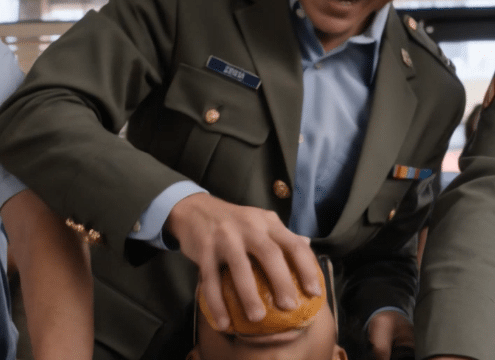
He leaned over Caleb and poured dark coffee directly onto his hair.
Liquid ran down Caleb’s forehead, along his cheek, and into the collar of his shirt.
The laughter grew.
Caleb closed his eyes.
Not because he was weak.
Because if he opened them too quickly, everyone would see the anger there.
Dorian tossed the empty cup aside.
“Look at you,” he said, performing for the crowd. “A poor waiter like you doesn’t belong here.”
Caleb slowly raised his face.
His eyes were wet now, but not empty. Beneath the humiliation, something steady burned.
Then the laughter died.
Heavy footsteps crossed the ballroom.
An older man in a black tuxedo moved through the crowd, his gray hair neat, his expression carved from controlled fury. Guests stepped back before they even realized they were making room.
Everyone knew him.
Arthur Blackwell.
Chairman of the Blackwell Foundation. Owner of the hotel. Host of the gala. A man whose handshake could make a career and whose silence could end one.
He stopped in front of Dorian.
Dorian’s smile collapsed.
“Who are you?” he asked, voice suddenly thin.
Arthur’s hand rose.
The slap cracked through the ballroom.
Dorian staggered back, one hand flying to his cheek.
Arthur pointed at Caleb, still kneeling on the floor.
“He is my son.”
The ballroom froze.
And Caleb looked up as if those four words had broken something open inside him.
Act II
Caleb had spent his whole life believing his father was dead.
That was what his mother told him first, when he was little and asked why the other children at school had men waiting beside their mothers after class.
“Your father is gone,” she said.
Later, when Caleb was old enough to understand that gone could mean many things, she told him a different version.
“He chose another life.”
Her name was Mara Reed, and she had once been a housekeeper at the Blackwell estate. She was young then, poor but proud, working double shifts in a mansion where every room had fresh flowers and no one ever wondered who replaced them.
Arthur Blackwell was not yet the legendary chairman people feared and admired. He was the heir to an empire, newly married in public, lonely in private, and reckless enough to believe secrets obeyed money.
Mara never called what happened between them a romance.
Romance required equality.
Whatever it had been, it ended the moment Arthur’s family found out.
There was money offered. Papers prepared. Threats wrapped in courtesy. Mara was told she could destroy Arthur’s future, or she could disappear with dignity.
She chose her child.
But she did not choose silence out of shame.
She chose it because the Blackwell name was too heavy for a baby to carry.
So Caleb grew up in apartments with thin walls and secondhand furniture, never knowing that the man on magazine covers had his eyes.
Mara worked until her hands cracked. She cleaned office buildings at night and hotel rooms in the morning. She taught Caleb how to iron a shirt, how to look adults in the eye, how to save money inside old envelopes labeled rent, food, emergency.
She also taught him dignity.
“Never let someone else’s cruelty decide your worth,” she would say.
Caleb tried to live by that.
But it was harder in rooms like the ballroom.
The Blackwell Gala was the biggest event of the year. Politicians came. Investors came. Families with names carved into hospitals and art wings came. Caleb took the catering shift because it paid more than a week of regular hours.
He did not know Arthur would be there.
He had seen the chairman from a distance before, of course. Everyone had. Arthur Blackwell appeared on charity banners, business panels, and news clips about historic donations. He seemed unreal to Caleb, like a statue that occasionally gave speeches.
But that night, when Caleb entered the ballroom carrying the silver tray, he felt Arthur’s eyes on him.
Once.
Then twice.
Caleb told himself he was imagining it.
He was used to rich people looking through him, not at him.
What he did not know was that Arthur had recognized him the moment he crossed beneath the chandelier.
Not fully.
Not logically.
But in the stunned, impossible way the body recognizes blood before the mind dares to.
The shape of the jaw.
The eyes.
The way Caleb held his shoulders when trying not to appear tired.
Arthur had seen Mara Reed in that face.
And then, with a force that nearly took his breath, he had seen himself.
For twenty-six years, Arthur believed Mara had left because she wanted nothing from him. He had searched once, badly, too late, through people paid to make uncomfortable problems quiet. They told him she had moved away. Married. Started over.
He let himself believe it.
That was easier than admitting he had been a coward.
But then Caleb fell.
And Dorian laughed.
And when the coffee ran down that young man’s face, Arthur felt every year of his silence turn into a blade.
By the time he crossed the ballroom, he was no longer wondering whether Caleb was his son.
He was wondering how much of a father he could still become after failing him for a lifetime.
Act III
No one moved after Arthur spoke.
Not Dorian.
Not the guests.
Not Caleb.
The words seemed to hang beneath the chandelier, glittering and impossible.
He is my son.
Caleb’s lips parted, but no sound came out.
Arthur turned from Dorian and knelt beside him, ignoring the coffee on the floor, the broken plates, the horrified whispers.
“Caleb,” he said quietly.
That made Caleb flinch.
“You know my name?”
Arthur’s face tightened with pain.
“I know your mother’s name too.”
Caleb stopped breathing.
Across the room, several older guests exchanged looks. The Blackwell family had survived decades of scandals by turning them into rumors no one could prove. But this was no rumor now.
This was a young waiter on his knees and the most powerful man in the ballroom kneeling beside him.
Dorian tried to recover.
“Chairman Blackwell, I didn’t know—”
Arthur stood so fast Dorian stepped backward.
“You didn’t know what?” Arthur asked.
Dorian swallowed.
“That he was your son.”
Arthur’s eyes sharpened.
“So you would have been comfortable humiliating him if he were only a waiter?”
The silence that followed was worse than any shout.
Dorian looked around for help.
No one offered it.
The women who had laughed behind him now stared at the floor. A man who had clapped Dorian on the shoulder earlier suddenly found his champagne glass fascinating.
Arthur looked toward hotel security.
“Escort Mr. Vale out.”
Dorian’s face went pale.
“You can’t be serious.”
Arthur did not raise his voice.
“Remove him from my property.”
Two guards stepped forward.
Dorian’s arrogance broke into panic.
“My father is on the foundation board.”
“Not after tonight,” Arthur said.
That sentence landed like a second slap.
Dorian stared at him, stunned.
Arthur turned to the crowd.
“And anyone who laughed should ask themselves why they found cruelty entertaining until it became expensive.”
No one breathed.
Security guided Dorian toward the exit. His hand stayed near his cheek, but the real wound was not there. It was in the way every person who had once admired him now watched him leave like a stain being carried out.
Caleb tried to stand.
His knees shook.
Arthur reached for him, then stopped, as if afraid he had lost the right to touch him.
Caleb saw the hesitation.
It hurt more than the coffee.
“Why did you say that?” he whispered.
Arthur’s face changed.
“Because it’s true.”
Caleb shook his head.
“My father’s dead.”
Arthur swallowed.
“No. He was a coward.”
And for the first time in his adult life, Arthur Blackwell said the truth without hiding behind power.
“I was a coward.”
Act IV
They took Caleb to a private room behind the ballroom.
Not because Arthur was ashamed.
Because Caleb was shaking so badly he could barely hold a towel.
A staff manager offered to help him clean up, but Caleb asked everyone to leave except Arthur. That surprised them both.
The room was quiet after the door closed.
Muted music still drifted from the ballroom, though the gala had lost its shine. Outside, people whispered through forced smiles, already deciding how to retell the scandal without making themselves look cruel.
Inside, Caleb stood by a mirror, wiping coffee from his hair.
Arthur stood several feet away.
For once, the chairman looked like an old man.
“Your mother,” Arthur said carefully. “Mara. Is she alive?”
Caleb’s hand stopped.
“She died three years ago.”
Arthur closed his eyes.
The grief that crossed his face was real, but Caleb did not know what to do with it. He had spent his whole life being loyal to a woman who had done everything alone. He was not ready to comfort the man who should have been there.
“She never told me your name,” Caleb said.
“She had every right not to.”
“She said you chose another life.”
Arthur looked at him.
“I did.”
There was no excuse in it.
That mattered.
Caleb dropped the towel into the sink.
“Why now?”
Arthur’s voice was rough.
“Because I saw you.”
Caleb laughed once, bitterly.
“Because someone embarrassed me in front of your rich friends?”
“No,” Arthur said. “Because someone treated you like you were invisible, and I realized I had done the same thing for twenty-six years.”
Caleb looked away.
His eyes burned again, and he hated it.
Arthur reached into his jacket and removed a small leather wallet. From inside, he took an old photograph, worn at the edges.
Mara.
Younger. Smiling despite herself. Standing beside a rose garden in a house Caleb had never seen.
Caleb stared.
“My mother hated having her picture taken.”
“She did,” Arthur said softly. “She told me photographs made people think they owned a moment.”
Caleb almost smiled.
Then the ache returned.
“You kept that?”
“All these years.”
“Not me, though.”
Arthur absorbed the words like punishment he deserved.
“No,” he said. “Not you. And there is no apology large enough for that.”
Caleb’s jaw trembled.
“My whole life, she worked herself tired. Rent, bills, medicine. She never asked anyone for anything.”
“I know.”
“No, you don’t,” Caleb snapped. “You don’t know. You were here. With chandeliers and marble floors and people who clap when you enter rooms. She was counting coins in a laundromat at midnight.”
Arthur’s eyes filled, but he did not look away.
“You’re right.”
The anger in Caleb faltered because Arthur refused to defend himself.
That was not how Caleb imagined powerful men behaved.
Arthur took a breath.
“I can’t repair your childhood. I can’t give your mother back what was taken from her. But I can tell the truth publicly, and I can spend whatever time you allow me trying to be worthy of knowing you.”
Caleb stared at him.
From outside came the faint sound of applause, awkward and delayed. Someone had resumed the gala program, because rich rooms hated unresolved emotion.
Caleb looked toward the door.
“Those people laughed.”
“Yes.”
“They only stopped because I became related to you.”
Arthur’s expression hardened.
“I know.”
“That doesn’t make me feel better.”
“It shouldn’t.”
Caleb picked up his soaked bowtie from the counter.
“I don’t want your money.”
Arthur nodded.
“I assumed that.”
“I don’t want your name either.”
Pain flickered across Arthur’s face.
But he nodded again.
“Then what do you want?”
Caleb looked at the door.
Then back at Arthur.
“I want you to go back out there and say my mother’s name.”
Arthur stilled.
Caleb’s voice shook.
“Not mine. Hers. In front of all of them.”
Arthur closed his hand around the old photograph.
Then he opened the door.
And this time, Caleb followed him.
Act V
Arthur returned to the ballroom without music.
He walked to the stage where the orchestra had gone silent and the microphone still waited beside an arrangement of white roses. The crowd turned uneasily toward him. Some guests looked relieved, expecting a polished apology, a graceful transition, something to smooth the scandal back into elegance.
Arthur gave them nothing smooth.
“My remarks tonight have changed,” he said.
The room tightened.
Caleb stood near the side of the stage in a clean jacket someone had brought him. His hair was still damp. His eyes were still red. But he was standing.
Arthur looked at him once.
Then he faced the room.
“Many years ago, a woman named Mara Reed worked in my family’s home. She was intelligent, proud, and braver than I was. I loved her, then allowed my family and my fear to decide what her life should be worth.”
Whispers rose.
Arthur continued.
“She raised our son alone.”
A woman near the front covered her mouth.
Caleb lowered his eyes.
“Tonight,” Arthur said, “that son was serving in this ballroom. He was tripped, degraded, and mocked by a guest who believed a uniform made him less human.”
No one moved.
Arthur’s voice grew colder.
“What should shame us most is not only the cruelty of one man. It is the laughter that followed.”
The guests who had laughed looked like they wanted the marble to open beneath them.
Arthur removed the folded photograph from his wallet and held it in his hand.
“Mara Reed deserved better from me. Her son deserved better from this room. And from this moment forward, the Blackwell Foundation will establish the Mara Reed Hospitality Scholarship for working students in service industries who are treated as invisible while keeping rooms like this alive.”
Caleb looked up sharply.
Arthur did not look back yet.
He knew if he did, he might not finish.
“Every employee working this event tonight will receive a full month’s pay as a bonus. Not as charity. As overdue respect.”
This time, the silence changed.
It was no longer only fear.
It was reckoning.
Arthur stepped away from the microphone.
Then he turned toward Caleb.
No command. No performance. No expectation.
Just an old man standing under a chandelier, offering the only thing he had left that money could not manufacture.
The truth.
Caleb walked toward him slowly.
For a moment, the whole ballroom seemed to disappear. No marble. No guests. No broken plates. No spilled coffee. Only the space between a son who had survived without a father and a father who had finally run out of excuses.
Arthur held out the photograph.
Caleb took it.
His mother smiled up from the past, young and stubborn and alive in a way that made his chest hurt.
“She would have hated this room,” Caleb whispered.
Arthur gave a broken laugh.
“Yes. She would have.”
Caleb looked at him.
“She would have hated you more.”
Arthur nodded.
“Yes.”
That honesty did something neither of them expected.
It did not heal everything.
It simply opened a door.
The weeks after the gala were chaos.
News outlets wanted interviews. Dorian Vale’s family tried to bury the story, then distance themselves from him when the video spread. The foundation board accepted Arthur’s decision after realizing the public had already made morality profitable.
Caleb refused every camera.
He went back to work, though not at the hotel. Arthur offered him a position, then apologized before Caleb could even reject it.
“I’m still learning,” Arthur admitted.
Caleb did not forgive him quickly.
Some days, he did not forgive him at all.
But they began with coffee.
Not the kind poured in cruelty on a ballroom floor.
The ordinary kind, bitter and hot, shared at a small diner near Caleb’s apartment where no one cared who Arthur Blackwell was.
Arthur asked about Mara.
Caleb answered when he could.
He told him she sang off-key while cooking. That she liked old detective shows. That she kept emergency cash in a flour tin. That she cried only once in front of him, after the landlord raised rent and she thought he was asleep.
Arthur listened to every word like a man collecting pieces of a life he had no right to claim but could not bear to lose again.
Months later, the first Mara Reed Scholarship dinner was held.
Not in the grand ballroom.
Caleb insisted on a community hall.
There were no chandeliers. No marble. No tuxedos required. The tables had paper programs and simple flowers. The recipients were dishwashers, line cooks, hotel cleaners, servers, and students working double shifts while attending classes.
Caleb spoke briefly.
His hands shook, but his voice did not.
“My mother used to say dignity is not something rich people give you. It is something they reveal about themselves by whether they recognize it in you.”
Arthur sat in the front row.
His eyes were wet.
Caleb looked at him only once.
Not with forgiveness exactly.
But without hatred.
That was enough for the moment.
At the end of the night, a young dishwasher approached Caleb and said, “I saw the video. The way you looked up at him after he poured coffee on you… I don’t know. It made me feel like maybe I don’t have to swallow everything.”
Caleb did not know what to say at first.
Then he heard his mother’s voice.
Never let someone else’s cruelty decide your worth.
So he told the young man, “You don’t.”
Years later, people still talked about the slap.
They loved that part.
The powerful chairman striking the arrogant guest. The public gasp. The instant reversal. The rich bully humiliated under the chandelier.
But Caleb rarely thought about the slap.
He thought about the moment before it.
When he was on his knees, soaked in coffee, surrounded by laughter, and still managed to lift his head.
That was the real turning point.
Arthur’s words changed the room.
But Caleb’s dignity had already survived it.
Dorian thought a waiter did not belong in that ballroom.
He was wrong.
Caleb belonged anywhere he could stand without bowing.
And by the time the chandelier lights dimmed that night, everyone in the room understood that the poorest man on the marble floor had been carrying more honor than all of them combined.