Act I
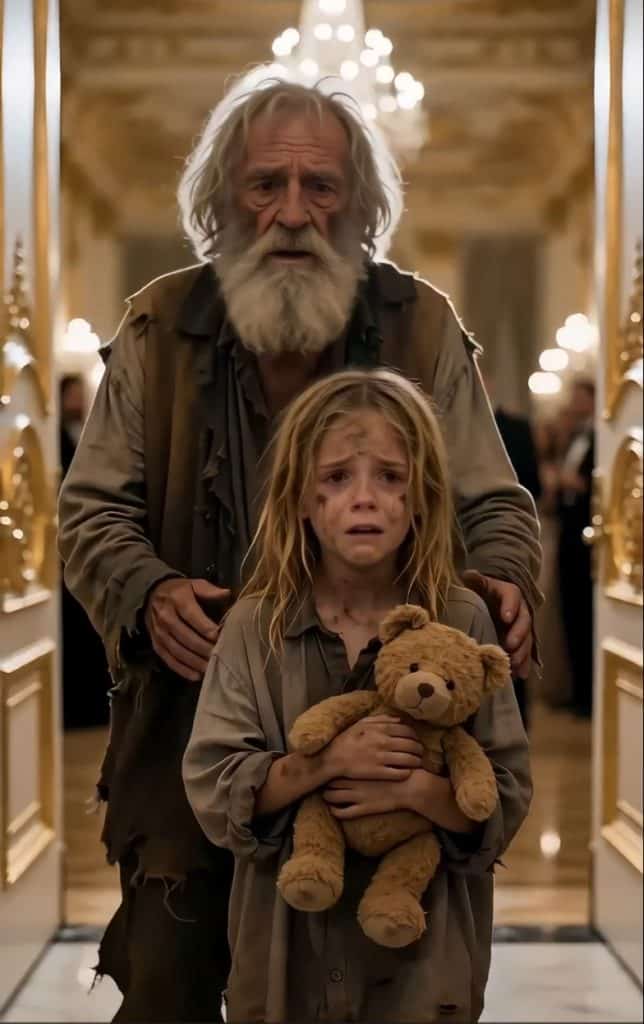
Emily stepped into the ballroom like a shadow that had wandered into a palace.
The chandeliers above her glittered with thousands of crystals. Champagne glasses caught the light. Marble floors reflected gowns, tuxedos, diamonds, polished shoes, and the golden ceiling carved like something from another century.
Then everyone saw the little girl at the doors.
Her blonde hair was tangled and darkened with soot. Her oversized gray-brown shirt hung from her thin shoulders. Dirt streaked her cheeks, except where tears had already cut pale tracks through the grime.
In both arms, she held a worn brown teddy bear against her chest.
For a moment, the entire ballroom forgot how to breathe.
Then someone laughed.
“Look at her clothes,” a woman whispered loudly, her silver necklace flashing as she turned to her friends.
A man near the champagne table frowned. “How did she even get in?”
Emily froze just inside the entrance.
Behind her came an old man with a long white beard and layered rags hanging from his narrow frame. He moved slowly, protectively, one hand hovering near the girl’s back as if the brightness of the room itself might hurt her.
“Emily,” he murmured in a gravelly voice. “Stay close.”
She did.
But her eyes had found the long buffet table across the room.
Roasted meats. Glazed pastries. fruit towers. silver trays of bread.
Food.
So much food it looked unreal.
Her small body trembled.
One of the wealthy women covered her nose with two jeweled fingers.
“She smells terrible.”
Laughter rippled through the guests.
Emily’s lower lip shook. She hugged the teddy bear tighter, pressing its worn face under her chin.
“I just wanted food,” she whispered.
The old man’s face cracked with pain.
“Emily, let’s go,” he said softly.
But before he could guide her away, two uniformed officers entered the ballroom from the side aisle. Their boots clicked over the marble. The laughter faded as people moved aside.
At the far end of the room, an older man in a black tuxedo stood near a cluster of donors, silver hair neat, white bow tie perfect, his face unreadable.
His name was Theodore Ashford.
He had built half the city.
He had buried his daughter ten years ago.
And when Emily turned to leave, the teddy bear in her arms swung just enough for him to see the faded blue ribbon sewn around its neck.
Theodore stopped moving.
His champagne glass slipped slightly in his hand.
His face went white.
“That bear…” he breathed.
No one heard him at first.
Then he said it again, louder, broken with shock.
“That bear.”
Emily turned.
The old man tightened his hand on her shoulder.
And Theodore Ashford stared at the soot-covered child as if the dead had just walked through his ballroom doors.
Act II
Ten years earlier, Theodore Ashford had given that teddy bear to a baby named Lily.
Not Emily.
Lily.
His granddaughter.
She had been born on a cold February morning after twenty hours of labor and one terrifying emergency surgery. Theodore had arrived at the hospital in a tuxedo because he had left a charity dinner without changing, and his daughter Grace had laughed so hard she cried.
“You look like you came to negotiate with the baby,” she teased.
Theodore had placed the teddy bear in her arms.
The bear was small then, soft brown, with a blue ribbon and one tiny silver button sewn into its left paw. Theodore had ordered it from a shop in London because money had always been the easiest language he knew how to speak.
Grace had rolled her eyes at the expense.
Then she saw the embroidery under the bear’s paw.
For Lily, always loved.
She stopped laughing.
For a while, Theodore believed that was the beginning of a better life.
Grace had been his only child. Brilliant, stubborn, and far kinder than he had ever deserved. She married a man Theodore did not trust, a charming investment advisor named Calvin Reed, who smiled too often and answered questions too smoothly.
Grace insisted she was happy.
Theodore wanted to believe her.
Then came the fire.
The official report said a gas leak destroyed the small lakeside house where Grace, Calvin, and baby Lily were staying for a weekend. Grace’s remains were found. Calvin survived with minor injuries, claiming he had been thrown clear by the blast and could not get back inside.
Lily was never found.
Not alive.
Not otherwise.
Search teams said the fire and collapse had consumed too much.
Theodore never accepted it.
For years, he paid investigators. He funded private searches. He chased rumors across three states. A nurse who remembered a baby. A woman at a bus station. A photograph too blurry to prove anything.
Calvin called it grief.
Doctors called it denial.
The newspapers called it tragedy.
Eventually, even Theodore stopped speaking Lily’s name in public.
But every year, on her birthday, he opened the drawer in his study where he kept the receipt from the teddy bear shop and the only photograph he had of Lily holding it.
A baby’s fist wrapped around one brown ear.
A blue ribbon bright against a hospital blanket.
A silver button under the paw.
That night’s black-tie event was supposed to launch the Ashford Children’s Foundation, created in Grace’s memory. Wealthy guests had gathered beneath chandeliers to pledge money for children they would never meet, while a hungry little girl was laughed at for reaching the wrong doorway.
The cruelty of it was almost too perfect.
Theodore could not look away from the bear.
The blue ribbon had faded nearly gray. One ear was torn. The fur was flattened from years of being held too tightly.
But the silver button was still there.
So was the shape of the stitching under the paw.
He took one step forward.
The officers noticed.
So did the old man.
The old man’s eyes hardened with fear.
“We don’t want trouble,” he said.
Theodore barely heard him.
“What is her name?”
The old man pulled Emily closer.
“Emily.”
Theodore’s breath shook.
“Who gave her that bear?”
The girl looked down at the toy, confused and frightened by the sudden attention.
The old man’s jaw tightened.
“It’s hers.”
“I asked who gave it to her.”
The mocking guests were no longer laughing.
Emily’s fingers curled into the bear’s dirty fur.
Theodore looked at her face then. Really looked.
Under the soot. Under the hunger. Under the fear.
Grace’s eyes.
His daughter’s eyes, staring back at him from a child who should have been gone.
Act III
The first officer stepped forward.
“Mr. Ashford?”
Theodore lifted one hand without looking away from Emily.
“Not now.”
The officer hesitated. “Sir, we were sent because security reported two intruders.”
The word hit Emily like a slap.
Intruders.
Her face crumpled.
The old man’s expression changed from fear to fury.
“She’s a child,” he said. “Not an intruder.”
A blonde woman in a beige sequined gown gave a nervous laugh. “Well, she can’t just wander into a private gala looking like that.”
Theodore turned on her so sharply she went silent.
“Leave.”
Her mouth opened.
He did not raise his voice.
“Now.”
The woman lowered her glass and stepped back, face flushed.
Theodore faced the old man again.
“Please,” he said, and the word sounded unfamiliar in his mouth. “Tell me where she got the bear.”
The old man studied him with distrust earned from years of being shoved aside by men in fine suits.
Then Emily spoke.
“My grandpa found me with it.”
The ballroom went still.
Theodore’s eyes moved to the old man.
“You found her?”
The old man swallowed. His weathered hands trembled slightly on Emily’s shoulders.
“In an alley behind St. Agnes shelter. Six years ago.”
A murmur spread through the room.
“She was little,” he continued. “Three, maybe four. Feverish. Barefoot. Wouldn’t tell anyone her name. Just kept saying ‘Bear’ and crying. Social services came once, but she ran before they took her. After that, she stayed with me.”
One officer frowned. “You never reported her?”
“I tried,” the old man snapped. “You think anyone listened? A dirty old man bringing in a dirty child? They said I was confused. Said she’d be taken somewhere safe. But she was terrified of men in uniforms. She screamed until she couldn’t breathe.”
He looked down at Emily, his voice softening.
“So I kept her alive the only way I knew how.”
Theodore felt something inside him tear.
“What is your name?” he asked.
“Jonah Briggs.”
Theodore remembered the name.
A groundskeeper.
Grace’s old house.
A man Calvin had accused of stealing after the fire investigation. A man who vanished before Theodore could question him.
“You worked for my daughter.”
Jonah froze.
The officers glanced at each other.
Theodore stepped closer.
“You worked at the lakeside property.”
Jonah’s face drained of color.
“I didn’t steal anything,” he whispered.
“I know.”
“No, you don’t.” Jonah’s voice broke. “You don’t know anything.”
Emily looked up at him.
“Grandpa?”
Jonah closed his eyes.
Then he reached into the inner layer of his torn coat and pulled out a small plastic pouch wrapped in tape.
Inside were old papers.
A burned photograph.
And a hospital bracelet.
Theodore’s knees almost failed.
The bracelet was tiny.
Faded.
But the printed name was still visible.
Lily Grace Ashford-Reed.
The ballroom vanished around him.
Only the bracelet remained.
Only the teddy bear.
Only the little girl clutching both hands around a life that had been stolen from them.
Act IV
Jonah told the truth in pieces.
Not because he wanted drama.
Because each memory seemed to cost him something.
He had been working nights at the lakeside house when the fire started. He smelled smoke before the explosion. He ran toward the nursery and found the back door already open.
Calvin was outside.
Not unconscious.
Not thrown clear.
Standing.
Holding a duffel bag.
“He told me the baby was gone,” Jonah said. “But I heard her crying.”
Theodore’s face hardened.
Jonah’s voice shook.
“I went in through the kitchen. Smoke everywhere. Found Lily under the nursery window, wrapped in a blanket with that bear. I carried her out the side. When I came around, Calvin saw me.”
Emily was silent, pressed against Jonah’s leg.
“He said I’d killed Grace. Said no one would believe me. Said if I took the baby to the police, he’d make sure I disappeared before sunrise.”
Theodore’s hands clenched.
“I should’ve gone anyway,” Jonah whispered. “I know that. I know. But I was scared. I had priors from when I was young. No family. No money. Calvin had lawyers, police friends, everybody shaking his hand.”
He looked at Emily.
“She was burning with fever two days later. I took her to a clinic under a fake name. They asked too many questions. I panicked. After that, we just kept moving.”
Theodore could barely speak.
“And you called her Emily?”
“She stopped answering to Lily. Too much crying. One day she pointed at a picture book and liked the name Emily. So that’s what I called her.”
Emily looked from Jonah to Theodore.
“What’s happening?”
The question broke the room more than any accusation could have.
Theodore lowered himself slowly until he was kneeling on the marble in his tuxedo, heedless of the shocked guests.
“May I see your bear?” he asked gently.
Emily hesitated.
Jonah nodded once.
She held it out, but did not let go.
Theodore turned the bear’s left paw upward.
The silver button was scratched.
The stitching beneath it was faded, but still readable.
For Lily, always loved.
Theodore covered his mouth.
A sound escaped him, raw and old.
Emily stared.
“That’s what it says?” she whispered.
He nodded, tears filling his eyes.
“My daughter named you Lily,” he said. “She was your mother.”
Emily’s brow furrowed.
“My mother?”
“Yes.”
Jonah’s shoulders shook.
Theodore looked up at him.
“You saved her.”
Jonah shook his head. “I failed her.”
“No,” Theodore said. “You saved her.”
One of the officers stepped closer, voice careful now.
“Mr. Ashford, we need to secure those documents.”
Theodore rose, still holding the bear’s paw lightly.
“You’ll have everything. And you’ll reopen the fire investigation.”
The officer nodded.
Theodore turned to the room.
The guests who had mocked Emily stood frozen beneath the chandeliers, faces pale, champagne forgotten.
His voice cut through the ballroom.
“This child came into a room full of people raising money for children, and most of you laughed at her hunger.”
No one answered.
“She did not need your judgment. She needed bread.”
Emily leaned into Jonah, overwhelmed.
Theodore looked toward the buffet.
“Bring her food.”
A dozen servers moved at once.
But Theodore stopped them.
“No. Not from the display.”
He looked at Emily.
“What do you like?”
Her voice was tiny.
“Soup.”
Theodore nodded as if she had requested the moon and he intended to deliver it.
“Then soup.”
Act V
The DNA test took four days.
Theodore did not need it.
Not really.
But Emily did.
So did the law.
So did a world that had already failed her once by trusting the wrong man’s version of events.
The results confirmed what the bear, the bracelet, and Theodore’s heart already knew.
Emily was Lily Grace Ashford-Reed.
The missing granddaughter.
The child everyone had mourned without a grave.
Calvin Reed was arrested two days later at his condo in Miami, where he had been living comfortably under the sympathy of a widower and the fortune he quietly diverted after Grace’s death. He denied everything until detectives showed him Jonah’s documents, the hospital bracelet, and the recovered insurance files Grace had hidden before the fire.
Grace had discovered Calvin was stealing.
She had planned to leave.
The fire was never an accident.
The full legal battle took months, and Emily was protected from most of it. Theodore made sure of that. So did Jonah.
At first, Emily refused to sleep in the Ashford mansion.
The ceilings were too high. The rooms too quiet. The bed too soft. She woke up crying for Jonah if he was not nearby.
So Theodore did not force anything.
He moved Jonah into the guest cottage on the estate.
He hired doctors, tutors, therapists, and nutritionists, but he learned quickly that care was not the same as control. Emily had lived too long being pulled from place to place by adults with urgent voices.
So he asked.
Would she like soup now?
Would she like the blue room or the yellow room?
Would she like Jonah at dinner?
The answer to the last question was always yes.
The first time Theodore saw Emily laugh, it was because Jonah tried to wear a dinner jacket and looked so miserable that she nearly spilled milk across the table.
“You look like a penguin who lost a fight,” she giggled.
Jonah grumbled, but his eyes shone.
Theodore laughed too, though it hurt.
Everything beautiful hurt now.
Emily’s smile hurt because Grace should have seen it.
Her fear hurt because no child should have learned to flinch at kindness.
The teddy bear hurt most of all.
Emily still slept with it every night.
Theodore had it carefully cleaned, but not restored. He refused to erase the years it had survived with her. The worn fur, the torn ear, the faded ribbon—those were not damage anymore.
They were testimony.
Months later, Theodore held another event in the same ballroom.
Not a gala.
No champagne towers.
No mocking guests.
No gold-lettered invitations to people who wanted charity to look elegant.
This time, the ballroom was filled with foster families, shelter workers, nurses, teachers, caseworkers, and children who ate first.
At the front of the room stood a new foundation banner.
The Lily & Grace Trust.
Beside Theodore stood Emily in a simple blue dress, hair brushed but still wild at the ends, one hand holding Jonah’s, the other wrapped around her teddy bear.
She did not speak to the crowd.
She did not have to.
Theodore did.
“My granddaughter came into this room hungry,” he said. “And some people saw only dirt.”
His voice trembled, but he continued.
“That will never happen here again.”
Jonah looked down, uncomfortable with attention.
Emily squeezed his hand.
Theodore glanced at them both.
“Family is not only blood. Sometimes family is the person who keeps you alive when the world looks away.”
The room went quiet.
Jonah wiped his eyes with the back of his dirty sleeve, though he was much cleaner now and wore clothes that fit.
Emily leaned against him.
After the speech, Theodore knelt beside her.
“Too much?” he asked.
She nodded honestly.
He smiled.
“Would you like to leave?”
She looked around the ballroom, then at the buffet table where children were being served warm soup in white bowls.
“No,” she said. “Can Jonah eat with me?”
“Always.”
That became the rule.
Always.
Years later, Emily would remember little of the ballroom from that first night. The chandeliers blurred in her memory. The gowns and tuxedos became shapes. The cruel laughter faded into something distant and weak.
But she remembered the soup.
She remembered Jonah’s hand on her shoulder.
She remembered an old man in a tuxedo kneeling on the marble, crying over a teddy bear.
And she remembered the first time someone called her Lily without taking Emily away.
Theodore never made her choose between the names.
“You survived as Emily,” he told her. “You were loved first as Lily. Both are yours.”
So she became Emily Lily Ashford.
The girl with two names.
The girl with one bear.
The girl who walked into a room full of wealth with soot on her cheeks and hunger in her stomach, and unknowingly carried the one thing powerful enough to expose a decade of lies.
Not diamonds.
Not documents.
Not a speech.
A worn brown teddy bear with a faded ribbon and a promise stitched under its paw.
For Lily, always loved.