Act I
The classroom went silent right before the chair screamed against the tile.
Everyone saw Mr. Keller move too fast.
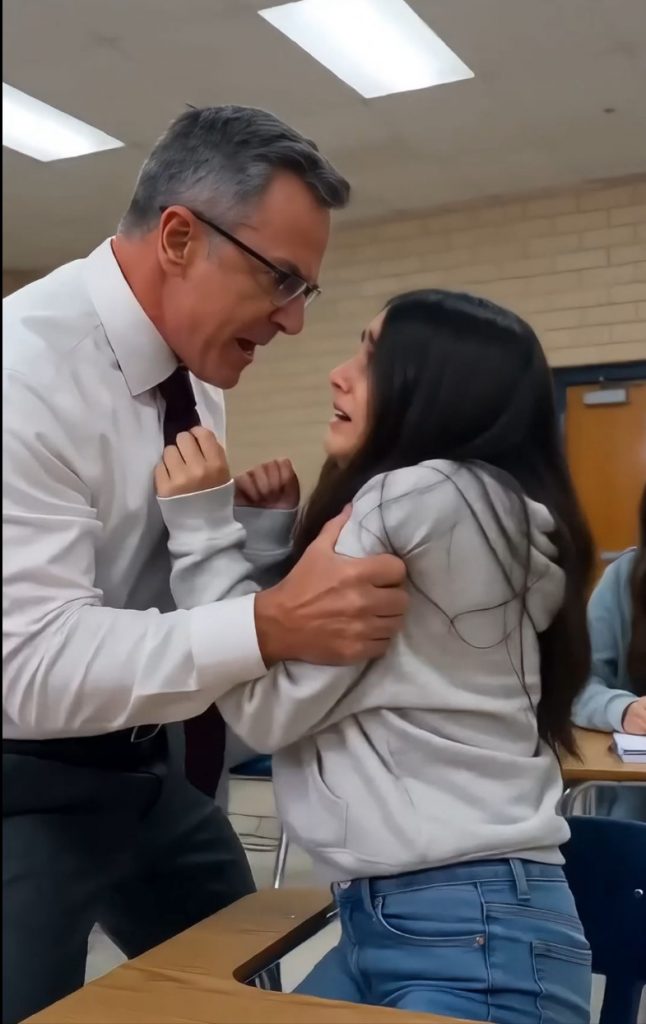
One second, Emily Hart was sitting in the right-side row with her notebook open, her gray hoodie sleeves pulled over her hands. The next, her teacher was storming down the aisle, his burgundy tie swinging, his glasses low on his nose, his face twisted with fury.
“You dared report me to the principal?” he shouted.
Emily barely had time to stand.
His hand clamped around her arm.
The room froze.
Desks scraped as students turned. A pencil rolled off someone’s desk and tapped against the floor. In the back row, a boy whispered, “Yo, what is he doing?”
Mr. Keller yanked Emily halfway out of her blue metal chair.
She gasped, her body twisting awkwardly as she tried to keep her balance.
“I didn’t—please—”
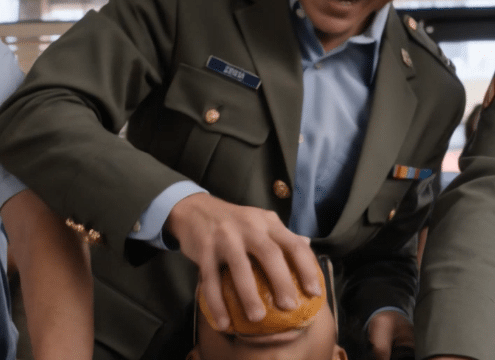
He shoved her before she could finish.
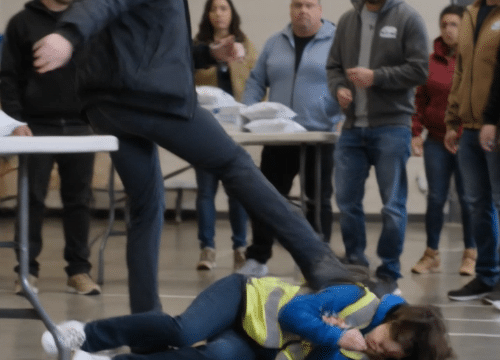
Emily stumbled backward into the desk behind her. The wooden edge hit her side, the chair legs shrieked across the tile, and she fell hard beside the row of desks.
A girl near the window screamed.
For one horrible second, nobody moved.
Emily lay curled on the floor, one hand near her shoulder, the other bracing against the tile. Her long dark hair had fallen across her face, and her breath came in broken little sounds that made the room feel smaller.
Mr. Keller stood over her.
His chest rose and fell.
“Quiet,” he snapped at the class.
But the classroom was no longer quiet.
It was waking up.
Students pushed back their chairs. Someone whispered, “Record it.” Another phone lifted. Then another.
In the left-side row, Marcus Reed stood so fast his chair hit the desk behind him.
He was seventeen, broad-shouldered in a navy-and-white varsity jacket, with his phone already raised in one hand.
“Stop!” Marcus shouted.
Mr. Keller turned toward him.
The teacher’s anger shifted like a weapon.
“What did you say?”
Marcus stepped into the aisle, shaking but refusing to lower the phone.
“You can’t do that!”
Emily sobbed from the floor.
More phones rose.
Mr. Keller’s eyes narrowed as he realized the room was watching him now in a way he could not control.
“Quiet!” he roared.
Then he stepped toward Marcus.
And at the exact moment every student thought he might strike again, the wooden double doors at the back of the classroom burst open.
A police officer filled the doorway.
Dark uniform. Gold badge. Hand on his belt. Eyes locked on the teacher.
“What are you doing?”
Mr. Keller froze.
And for the first time that morning, fear replaced the rage on his face.
Act II
Emily had not wanted to report him.
That was the part nobody in the classroom knew.
For months, Mr. Keller had been the kind of teacher adults called “strict” and students called something else when no one official was listening. He didn’t just mark answers wrong. He mocked them. He didn’t just give detention. He made examples.
If a student forgot homework, he read their grade aloud.
If someone asked a question he thought was stupid, he repeated it in a childish voice.
And if anyone complained, their next quiz somehow came back lower than expected.
Everyone knew.
No one could prove it.
Emily was quiet, which made her an easy target. She sat near the middle of the right-side row, turned assignments in early, and apologized when people bumped into her. Her mother worked nights at the hospital, and Emily spent most evenings helping her younger brother with homework before finishing her own.
She could not afford trouble.
So when Mr. Keller started singling her out, she tried to disappear.
At first, it was small.
“Miss Hart, perhaps you’d like to join us today.”
“Miss Hart, try not to look so lost.”
“Miss Hart, not everyone is built for honors coursework.”
Then came the grade.
Emily had earned a ninety-two on a history essay. She knew because Mr. Keller left the graded copy on his desk while she was collecting worksheets after class.
By the next morning, the online system showed a sixty-one.
When she asked him about it, he smiled.
“That is the grade you earned.”
“But my paper—”
“Are you accusing me of something?”
His voice had been soft then.
That was worse than shouting.
Emily backed down.
But Marcus noticed.
He had been in detention that afternoon, sitting near the door with his own resentment burning quietly. He saw Emily leave Mr. Keller’s room pale and trembling. Later, he found her crying in the library stairwell with the essay in her hands.
At the top, in red ink, was the original score.
In the system, it was still 61.
Marcus wanted to take a picture and post it everywhere.
Emily begged him not to.
“He’ll make it worse,” she said.
“He already made it worse.”
The next day, Emily went to the principal anyway.
She did it because her mother saw the grade report and asked what happened. Emily tried to say she had just messed up, but her voice cracked.
Her mother listened.
Then said, “People who abuse power count on good kids being too scared to speak.”
So Emily brought the paper.
The principal promised to “look into it.”
That phrase spread through the school faster than gossip should have.
By Monday morning, Mr. Keller knew.
Nobody knew who told him. Maybe someone in the office mentioned it. Maybe he saw the grade audit request. Maybe he was the kind of man who watched every small threat to his control.
But when Emily walked into class, he was already waiting.
He did not begin the lesson.
He did not open his book.
He watched her sit down.
Then he walked toward her row.
And every student in that room felt something bad coming before it happened.
Act III
The police officer’s name was Daniel Ortiz.
He was not supposed to be there yet.
That became important later.
The school had a resource officer, but Officer Ortiz worked city patrol. He had been two blocks away responding to a minor traffic incident when the first emergency call came in from the school’s front office.
A teacher was out of control.
A student might be hurt.
Then a second call came.
This one was from inside the classroom.
Marcus had not only recorded.
He had livestreamed the first ten seconds to a private group chat while another student called 911 from beneath her desk.
By the time Officer Ortiz reached the hallway, half the administration was still arguing about procedure.
He did not wait for permission.
Inside the classroom, the mood shifted the instant he entered.
Mr. Keller’s pointing hand lowered.
The students looked suddenly younger, phones still raised, faces pale with adrenaline. Emily remained on the floor beside the desks, crying softly.
Officer Ortiz took in the room in one sweep.
The disturbed desks.
The girl on the tile.
The teacher standing too close to the students.
The phones recording from every angle.
“Step away from her,” he said.
Mr. Keller swallowed.
“Officer, this is a classroom matter.”
“No,” Marcus snapped. “He shoved her.”
Mr. Keller turned on him. “You shut your mouth.”
Officer Ortiz moved forward.
“Do not speak to him like that.”
That stopped the teacher again.
The officer crossed to Emily and crouched a careful distance away.
“Can you hear me?”
Emily nodded, tears running down her cheeks.
“Are you hurt?”
“My shoulder,” she whispered. “And my side.”
A girl behind her started crying.
Officer Ortiz looked toward the doorway.
“Get the nurse. Now.”
A teacher from across the hall ran.
Mr. Keller tried again.
“She was being disruptive. The class became emotional.”
Marcus laughed once, sharp and furious.
“You grabbed her.”
Several students spoke at once.
“He pulled her out of the chair.”
“She hit the desk.”
“He yelled because she reported him.”
“I got it on video.”
Mr. Keller’s face changed at that last sentence.
Not guilt.
Calculation.
“Phones are not allowed during instructional time,” he said.
Marcus lifted his phone higher.
“Good thing you weren’t instructing.”
The room inhaled.
Officer Ortiz stood.
“Everyone keep your phones exactly where they are. Do not delete anything.”
Mr. Keller’s mouth opened.
The officer looked at him.
“And you are going to step into the hallway with me.”
“I am not leaving my classroom.”
“You are.”
The words were calm.
Final.
Mr. Keller looked toward the students, searching for the fear that usually gave him power.
But it was gone.
In its place were cameras.
Witnesses.
Evidence.
And Emily, still on the floor, no longer invisible.
Act IV
By the end of the day, the story had already left the school.
Not because students wanted drama.
Because the truth had finally found a way out.
Three videos spread first. Marcus’s angle from the aisle. A horizontal recording from the second row. A shaky clip from the back showing Mr. Keller storming toward Emily before the shove.
The school district tried to contain it with careful language.
An incident occurred.
A staff member has been placed on leave.
The safety of our students is our top priority.
But the videos did what official statements could not.
They showed the sound of Emily’s chair scraping.
They showed Mr. Keller’s hand on her arm.
They showed the fall.
They showed the moment he turned from one frightened girl to an entire classroom and tried to silence them.
By evening, parents were outside the school.
Not shouting at children. Not attacking teachers. Just standing with signs under the cold glow of the parking lot lights.
Protect our kids.
Believe students.
Cameras don’t lie.
Emily watched the news clip from her couch with an ice pack on her shoulder and her mother sitting beside her.
Her younger brother sat on the carpet, quiet for once.
When Marcus appeared on screen, phone raised, Emily started crying again.
Her mother wrapped an arm around her.
“He stood up for you.”
Emily nodded.
“I thought everyone would just watch.”
Her mother’s jaw tightened.
“Some did. But not all.”
The next morning, Officer Ortiz visited the Hart apartment with a detective. He spoke gently, not like Emily was a problem to document, but like she was a person who had been hurt in a place where she should have been safe.
He asked questions.
Emily answered slowly.
Then her mother placed the graded essay on the table.
The red 92.
The online 61.
The detective looked at it for a long moment.
“This wasn’t just about one report,” he said.
Emily shook her head.
“No.”
The investigation widened.
Other students came forward.
A boy whose grade dropped after he complained about being mocked.
A girl who said Mr. Keller threatened to fail her if she spoke to the counselor.
A former student who had left the honors program after months of humiliation.
Then an assistant in the main office admitted Mr. Keller had been informed of Emily’s complaint before the principal had interviewed her properly.
That changed everything.
Retaliation.
Intimidation.
Assault.
The words were serious now.
Too serious for the district to hide behind “incident.”
When Emily returned to school a week later, the classroom felt different even though Mr. Keller was gone. His desk had been cleared. A substitute stood near the board with a nervous smile. Students spoke softly when Emily walked in.
Marcus stood from his seat.
For one terrible second, Emily thought everyone was going to stare.
Then Marcus simply nodded toward her desk.
“I saved your seat.”
It was such a normal sentence that she almost broke down.
She sat.
No one laughed.
No one whispered.
The substitute began class with one quiet statement.
“You are safe here.”
Emily did not fully believe it yet.
But for the first time in months, she wanted to.
Act V
The hearing took place three months later.
By then, winter had softened into rain. Emily’s shoulder had healed. Her fear had not disappeared, but it had changed shape. It no longer controlled every doorway, every raised voice, every adult who said, “Can I speak with you for a moment?”
She attended the hearing because she wanted Mr. Keller to see her standing.
Not on the floor.
Not curled beside a desk.
Standing.
The room was smaller than people expected. No dramatic courtroom. No packed gallery. Just a district panel, legal representatives, union observers, parents, and witnesses waiting under fluorescent lights.
Mr. Keller arrived in a gray suit.
Without the burgundy tie and classroom podium, he looked less powerful.
Older.
Smaller.
But when his eyes found Emily, she felt the old fear move through her body.
Marcus, seated beside her, leaned slightly forward.
“You good?”
Emily breathed in.
“Yeah.”
When it was her turn, she walked to the microphone.
Her hands shook, so she placed them flat on the table.
“My name is Emily Hart,” she began. “I reported Mr. Keller because he changed my grade after I questioned him. I was scared to report him. I was right to be scared.”
Mr. Keller looked down.
She kept going.
“He grabbed me in front of the class. He shoved me. But the worst part was that I knew he thought he could do it because everyone would be too afraid to say anything.”
Her voice trembled.
Then steadied.
“He was wrong.”
Marcus testified next.
He did not try to sound heroic.
“I was scared,” he said. “Everyone was. But she was on the floor and he was still yelling, so I recorded because I knew if we didn’t have proof, people would call it a misunderstanding.”
The videos were played.
No one in the room spoke during them.
Even though Emily had seen the clips before, watching them in that quiet room made her stomach twist. She saw herself pulled from the chair. Saw the shove. Heard the impact.
Then she saw something else.
She saw students stand.
One by one.
Afraid, but standing.
Phones raised not for entertainment, but protection.
Officer Ortiz testified last.
He described the scene plainly. His calm made the truth harder to dodge.
When the panel announced its decision weeks later, Mr. Keller was terminated and referred for criminal prosecution. The district also removed the administrator who had leaked Emily’s complaint before it was investigated.
That mattered almost as much.
Because the system had not failed in one dramatic moment.
It had failed in whispers, warnings ignored, complaints mishandled, and adults protecting comfort over children.
Emily’s mother framed the corrected essay grade.
Emily hated that at first.
“Mom, it’s just an essay.”
“No,” her mother said. “It’s evidence that you knew the truth before anyone believed you.”
So it went on the wall near the kitchen.
Not because of the 92.
Because of what it cost to defend it.
By senior year, Emily no longer sat near the middle hoping to disappear. She joined the student safety committee. Marcus teased her for becoming “official,” and she teased him back for becoming the guy teachers trusted to fix projectors.
Officer Ortiz returned to the school that spring for an assembly on student rights and reporting misconduct. At the end, Emily stood in the hallway and thanked him.
He shook his head.
“You all did the brave part before I got there.”
She looked through the classroom window where it had happened.
The desks were arranged differently now.
The right-side row was gone.
The central aisle was wider.
A new teacher had filled the beige walls with student work and bright posters. The room no longer looked like a place where one adult’s anger owned the air.
Emily touched the strap of her backpack.
“I used to think nobody would listen unless there was a video.”
Officer Ortiz nodded.
“Sometimes evidence opens the door. But your voice still matters.”
Emily thought about that.
Then she smiled faintly.
“I’m starting to believe that.”
Months later, at graduation, Marcus crossed the stage to loud cheers. Emily crossed quietly, smiling when she heard her mother and brother shouting her name from the bleachers.
After the ceremony, Marcus found her near the parking lot.
“You know,” he said, “you were kind of terrifying at that hearing.”
Emily laughed.
“I was terrified.”
“Same thing sometimes.”
She looked back at the school.
The brick walls. The bright windows. The classrooms that could hold both harm and healing, depending on who was allowed to tell the truth.
Mr. Keller had once believed fear would keep everyone seated.
He had counted on silence.
On authority.
On the old rule that students could be dismissed, doubted, and disciplined until their stories disappeared.
But that day, after Emily fell, the classroom changed.
A boy stood up.
Phones rose.
Students spoke.
A police officer came through the doors.
And the teacher who thought he controlled the room learned too late that power built on fear can collapse in a single recorded moment.
Emily did not remember the fall as the end of her dignity.
She remembered what came after.
The shout.
The cameras.
The door bursting open.
The truth walking in.
And the sound of a whole classroom refusing to be quiet.