Act I
The wedding was perfect until the flower girl started running.
White roses climbed the arch above the altar. Sunlight poured through tall chapel windows and turned every chair, ribbon, and petal into something soft and holy. The aisle runner stretched like a clean white promise between two rows of guests holding their breath for the bride’s final vows.
Then a small pair of shoes slapped against the aisle.
Fast.
Desperate.
Six-year-old Mia Carter came running toward the altar in her white lace dress, the pale pink ribbon at her waist bouncing with every step. Her curls had slipped loose from their pins. Her face was wet with tears.
And clutched in both her hands was a small black digital camera.
At first, people smiled in confusion.
Someone whispered, “Oh, poor thing.”
Someone else reached out as if to stop her gently.
But Mia did not slow down.
She ran past the front row, past the flower arrangements, past the smiling bridesmaids whose smiles died one by one as they saw her face.
At the altar, Grace Whitmore turned in her strapless white gown, veil drifting over her shoulders, diamond choker catching the light at her throat.
“Mia?”
Before the child could answer, the groom stepped forward.
“GET HER OUT!”
Adrian Vale’s shout exploded through the chapel.
The guests went silent.
It was not the voice of a groom interrupted by a nervous child. It was the voice of a man cornered. Furious. Panicked. Too loud for the moment, too sharp for the white flowers around him.
Mia flinched so hard she nearly dropped the camera.
Grace’s confusion turned instantly into alarm.
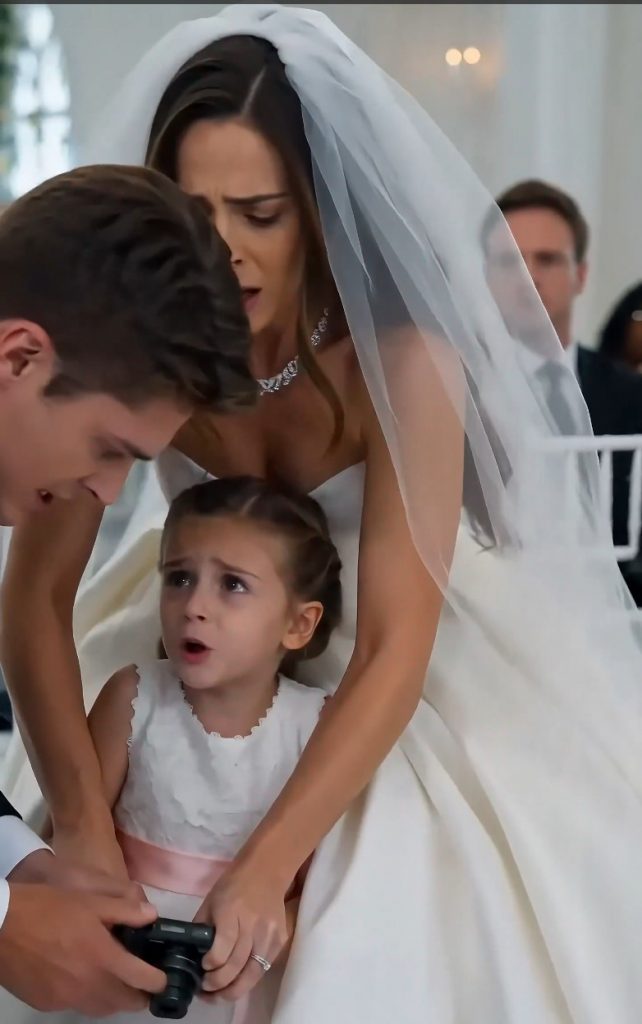
The little girl ducked behind the bride’s skirt and pressed herself against the layers of white fabric, hiding from Adrian while still clutching the camera like it was the only thing keeping her safe.
Adrian’s face tightened.
“She’s lying,” he snapped.
No one had asked what she was saying yet.
That was the first mistake.
He reached down for the camera.
Grace moved faster.
She placed her hand over Mia’s tiny fingers and blocked him with her body.
“Adrian,” she said, voice trembling, “what are you doing?”
Mia looked up at her, eyes huge and terrified.
“The camera heard you,” she sobbed. “He said he used you.”
The chapel seemed to tilt.
Adrian lunged again. “Give it to me. Don’t touch that.”
Grace stared at him.
Then she looked down at the camera in Mia’s hands.
And for the first time that day, the bride wondered if the man at the altar had been more afraid of a child than of losing her.
Act II
Grace Whitmore had not grown up believing in fairy tales.
She grew up in a house where love was practical.
Her father, Henry Whitmore, owned three hotels, two restaurants, and one stubborn belief that money meant nothing if it did not protect the people who worked for it. Her mother died when Grace was fourteen, and after that, Henry raised her with a strange mix of tenderness and steel.
He taught her to read contracts before she learned to drive.
He taught her to notice who spoke kindly to waiters.
And on the night of her twenty-first birthday, he gave her a small silver camera that had belonged to her mother.
“Your mom took pictures of everything she was afraid of forgetting,” he said. “Sometimes proof matters, Gracie. Even when it’s just proof that something beautiful happened.”
Grace kept that camera for years.
After her father died suddenly from a stroke, she kept it in the drawer beside his letters. Then one afternoon, Mia found it while playing dress-up in Grace’s bedroom.
Mia was Grace’s niece, the daughter of her older sister, Caroline. Small, curious, fearless in the way children are before adults teach them fear. She loved buttons, screens, and anything that made a clicking sound.
“Can I take wedding pictures?” Mia had asked.
Grace laughed and said yes.
That was how the camera ended up in Mia’s hands.
That was also how the truth survived.
Adrian Vale entered Grace’s life two years after her father’s funeral, when grief had made her quieter than anyone wanted to admit. He was polished, patient, and excellent at appearing wherever she needed someone.
At charity dinners, he knew when to place a hand on her back.
At board meetings, he whispered the right reassurance.
When reporters asked about the Whitmore Foundation, he spoke of “legacy” and “service” with the kind of sincerity that photographed well.
Grace’s friends called him steady.
Her aunt called him ambitious.
Her sister Caroline never liked him.
“He watches the room before he looks at you,” Caroline said once.
Grace had dismissed it.
Maybe because she wanted to be loved without suspicion.
Maybe because after years of being Henry Whitmore’s daughter, trustee, heiress, and public face of a family name, she wanted one person who did not make her feel like a responsibility.
Adrian knew that.
He learned her loneliness carefully.
He proposed in the garden of her childhood home beneath the magnolia tree her mother had planted. Grace cried before she said yes. Adrian cried too, or seemed to.
The engagement moved quickly after that.
Too quickly, Caroline said.
Perfectly, Adrian insisted.
By the wedding morning, everything had been arranged with almost frightening precision. The venue. The guest list. The press release. The foundation board members seated near the front. The private appointment scheduled for Monday morning, when Grace would sign a spousal authorization giving Adrian temporary access to several Whitmore business accounts while they “planned their future together.”
Grace barely questioned it.
Marriage was trust, he told her.
Trust had always been the word people used right before asking her to sign something.
Mia had been in the bridal suite that morning, wandering from room to room with the camera pressed to her chest, taking blurry pictures of shoes, flowers, cupcakes, and the bride’s veil.
No one noticed when she slipped into the side hall.
No one noticed when she followed Adrian’s voice toward the groom’s waiting room.
No one noticed the tiny red light on the camera.
But Adrian noticed her afterward.
And that was why he screamed when she came running down the aisle.
Act III
Grace took the camera from Mia with both hands.
Adrian’s breath sharpened.
“Grace,” he said, forcing his voice lower now, smoother. “She’s a child. She doesn’t understand what she heard.”
Mia whimpered and clung to the bride’s dress.
Grace looked at the little girl’s face.
There was flour-white fear beneath the lace and ribbon, the kind of fear children only wear when an adult has frightened them badly enough to make the whole world feel unsafe.
“What did you say to her?” Grace asked.
Adrian’s jaw flexed. “Nothing.”
“Then why is she hiding from you?”
The guests began to murmur.
Adrian looked out at them, and Grace saw the calculation move across his face. The chapel was full. His mother was in the second row. Several board members were there. Donors. Lawyers. Friends. People who had come to watch him marry into the Whitmore name.
Not marry Grace.
Marry into.
The thought landed cold in her chest.
Adrian stepped closer, lowering his voice so only she and the first row could hear.
“Do not embarrass me.”
Grace stared at him.
There it was.
Not “Are you okay?”
Not “Mia, what happened?”
Not “Please, let me explain.”
Only a command.
The camera felt heavy in Grace’s palm.
Mia sniffled. “Press the little triangle.”
Grace looked down at the screen.
Her thumb hovered over the playback button.
Adrian moved.
Grace stepped back.
“Don’t,” she said.
One word.
Quiet, but final.
Then she pressed play.
For a second, there was only static and the muffled sound of movement. Fabric brushing. A door closing. Adrian’s voice, faint at first, then clearer.
“After the wedding, I’ll take control of the foundation accounts.”
A woman’s voice answered. Grace recognized it immediately.
Adrian’s mother.
“You’re certain she’ll sign?”
Adrian laughed softly in the recording.
“She signs whatever I put in front of her when I say it’s about her father’s legacy.”
Grace stopped breathing.
The chapel became so silent the camera’s tiny speaker sounded impossibly loud.
On the recording, his mother spoke again.
“And the house?”
“Sold within six months,” Adrian said. “She’s sentimental. She’ll cry. Then she’ll do what I tell her.”
A gasp rippled through the guests.
Grace’s hand began to shake.
The recording continued.
“She thinks you love her,” his mother said.
Adrian’s reply came cold, casual, devastating.
“I love what marrying her gives me.”
Mia began crying again, quietly now.
Adrian’s face had gone pale.
The camera clicked as the file shifted, catching another sound: a door creak, a small breath, and Adrian’s voice changing instantly.
“Were you listening?”
Mia’s tiny recorded gasp played through the chapel.
Then Adrian again, low and threatening.
“You didn’t hear anything. Give me that camera.”
The recording cut off in a burst of movement.
Grace lowered the device.
Her veil trembled around her shoulders.
For a long moment, she did not look at Adrian. She looked at the white aisle, the flowers, the guests, the altar where she had almost tied her life to a lie.
Then she looked at Mia.
The little girl had run through a chapel full of adults because she believed Grace needed saving.
And she had been right.
Act IV
Adrian tried to recover with a smile.
It was the ugliest thing Grace had ever seen.
“Grace,” he said softly, spreading his hands. “That sounds terrible out of context.”
Someone in the back row whispered, “Out of context?”
His mother stood. “This is absurd. That device has clearly been tampered with.”
Caroline rose from the front pew before Grace could speak.
“No,” she said. “It hasn’t.”
Grace turned.
Her sister’s face was white with fury.
Caroline stepped into the aisle, one hand resting protectively on Mia’s shoulder as soon as she reached her daughter. “That camera was my mother’s. Grace brought it to the bridal suite this morning. Mia has been using it all day. I saw the files.”
Adrian’s eyes flashed. “You always hated me.”
“I distrusted you,” Caroline said. “Thank you for proving there’s a difference.”
Grace looked down at the camera again.
Her father’s voice seemed to rise from memory.
Sometimes proof matters.
Adrian moved toward her. “Baby, listen to me.”
Grace lifted her eyes.
“Do not call me that.”
The words cracked through the chapel more sharply than any shout.
Adrian stopped.
The guests were no longer whispering with confusion. They were watching him with recognition. The spell had broken. The handsome groom, the perfect tuxedo, the polished smile—all of it looked suddenly thin, like expensive paper held up to fire.
The officiant stood frozen beneath the floral arch.
Grace took one step away from Adrian.
Then another.
Her train dragged softly over the white runner.
“I want you to leave,” she said.
Adrian’s expression hardened. “You’re emotional.”
A bitter laugh escaped her before she could stop it.
“Yes,” she said. “I am.”
Her voice shook, but it did not weaken.
“I am humiliated. I am heartbroken. I am furious. But I am not confused.”
He looked around, searching for someone who might still be on his side.
His mother stood rigid in the second row, lips pressed tight, already understanding that damage control would not save them from a room full of witnesses.
One of the Whitmore Foundation board members rose.
Then another.
A man in a navy suit near the front took out his phone and stepped into the side aisle, speaking quietly but urgently. Grace recognized him as the family attorney.
Adrian saw him too.
Panic returned to his face.
“Grace,” he said, voice lower now. “Don’t do this publicly.”
She looked around the chapel.
At the guests he had planned to impress.
At the flowers paid for by the estate he wanted to sell.
At the child he had tried to silence.
“You made it public when you tried to marry me in front of everyone you intended to fool.”
Adrian’s mouth opened.
No answer came.
Mia reached for Grace’s hand.
Grace took it.
The little girl’s fingers were damp and trembling, but she held on with surprising strength.
“I was scared,” Mia whispered.
Grace bent down, veil falling forward. “I know.”
“He yelled.”
Grace’s eyes burned as she glanced back at Adrian. “I know.”
Mia’s chin quivered. “But I remembered Aunt Grace says cameras keep memories.”
Grace pulled her close.
“They keep truth too,” she whispered.
And that was when the bride turned away from the altar.
Act V
Grace did not run from her wedding.
She walked.
That mattered.
She walked down the aisle holding Mia’s hand, her veil trailing behind her, her diamond choker shining against a throat tight with grief. Caroline followed on Mia’s other side. Behind them, the chapel remained stunned, all white flowers and ruined silence.
No one clapped.
No one needed to.
By the time Grace reached the back doors, the first guest stood.
Then another.
Not for spectacle.
For respect.
The sound of people rising moved through the chapel like a slow wave.
Adrian remained at the altar with his hands at his sides, looking less like a groom than a man abandoned by the stage he had built for himself.
Outside, the air was cold and bright.
Grace stopped beneath the stone archway, finally letting the weight of the dress pull at her. For one second, she looked like she might collapse.
Caroline wrapped an arm around her.
Mia pressed the camera into Grace’s hands.
“I didn’t want him to take it,” she said.
Grace looked down at the little black device.
Such a small thing.
Small enough for a child to carry.
Strong enough to stop a lifetime from being stolen.
“You were very brave,” Grace said.
Mia shook her head. “I was crying.”
Grace knelt carefully despite the gown. “Brave people cry.”
Mia considered that, then nodded as if filing it away for later.
Inside the chapel, voices rose. Adrian’s mother was demanding that no one share the recording. The family attorney was already speaking with venue security. Guests who had arrived expecting cake and champagne were now leaving with a story that would move faster than any wedding announcement.
But Grace did not care about the gossip yet.
The shock had not become pain fully. Not yet.
For now, she could only feel the strange emptiness of a disaster avoided at the last possible second.
Her phone buzzed.
A message from the attorney.
Do not speak with him alone. I have the recording. We’ll secure everything.
Grace closed her eyes.
Her father had prepared for betrayal in every contract, every trust clause, every foundation safeguard.
But not in the one place she had wanted to believe she was safe.
Her heart.
That evening, the reception hall was never opened.
The flowers were sent to a children’s hospital. The untouched food went to a shelter Henry Whitmore had funded for twenty years. The band packed up quietly. The cake, tall and white and absurdly beautiful, was cut in the kitchen and handed out to staff who had seen enough rich sadness to know that sweetness should never go to waste.
Grace changed out of her gown in the bridal suite while Caroline sat beside her on the floor.
For a while, neither sister spoke.
Then Grace removed the diamond choker and set it on the vanity.
“He picked this,” she said.
Caroline looked at it. “Then don’t wear it again.”
Grace almost smiled.
Almost.
Mia sat on the sofa nearby, asleep under Caroline’s coat, the camera still tucked against her side like a stuffed animal.
Grace watched her for a long time.
“She saved me,” she whispered.
Caroline’s eyes filled. “She loves you.”
Grace nodded.
That was the part that hurt most beautifully.
Love had been there all morning. Not at the altar. Not in the vows Adrian never got to say. Not in the tuxedo or the staged smile or the man who knew exactly which wound to touch.
Love had been in a little girl running while terrified.
Love had been in small hands refusing to let go of proof.
Love had been in the truth arriving breathless and crying down a white aisle.
Weeks later, the headlines faded.
Adrian tried to claim the recording was misunderstood. Then more evidence surfaced from emails, financial drafts, and messages his mother had been careless enough to keep. The foundation board removed every access point he had been promised. The house stayed in Grace’s name. The wedding license was never filed.
There was no divorce.
Only an escape.
One spring afternoon, Grace returned to the chapel alone.
Not for closure exactly.
For ownership.
The white flowers were gone. The chairs had been rearranged for another ceremony. Sunlight still entered through the same windows, indifferent and golden.
Grace stood at the end of the aisle and imagined Mia running toward her again.
The panic.
The camera.
The warning.
This time, instead of feeling the old humiliation, Grace felt something steadier.
Gratitude.
Her phone chimed.
A photo appeared from Caroline.
Mia, grinning, holding the old black camera in both hands with a new pink strap around her neck.
Grace laughed softly through sudden tears.
Then she typed back:
Tell our little photographer I’m keeping her on every important assignment.
Outside, the chapel bells rang for someone else’s wedding.
Grace listened without bitterness.
She still believed in love.
Just not the kind that demanded blindness.
The next time love came close, it would not be threatened by proof. It would not fear a camera, a child, a question, or the truth. It would stand in daylight and stay standing.
And Grace would remember the day a flower girl ran down the aisle before the vows could become a trap.
Not because the wedding was ruined.
Because she wasn’t.