Act I
The first strike did not break the lock.
It only made the metal door scream.
Ryan Cole swung the axe with both hands, bringing it down against the chain wrapped around the corrugated garage door. The impact rang through the alley so loudly that a dog started barking somewhere behind the neighboring houses.
Behind the gray wooden fence, a red-haired woman clung to the top rail with both hands.
“WHAT ARE YOU WAITING FOR?!” she screamed. “Break it!”
Ryan did not look back.
He could not.
If he looked at Claire Donovan’s face again, if he saw the raw terror in her eyes, he might lose the last piece of focus keeping his hands steady.
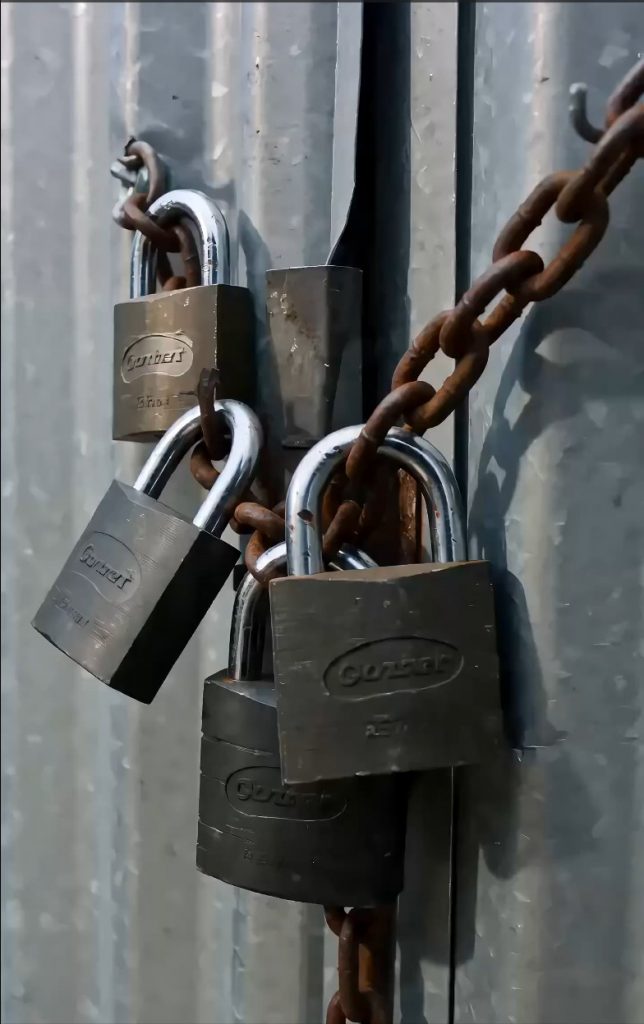
The small storage garage stood at the back of an ordinary middle-class house, tucked between a row of fenced yards and a narrow strip of cracked pavement. In any other moment, it would have looked harmless. A weathered metal door. A chain. Three padlocks. A few weeds growing along the concrete.
But someone was inside.
Ryan had heard it himself.
A muffled thump.
Then another.
Then a child’s faint cry, swallowed by metal.
Now the whole neighborhood had gathered in fragments. Two men leaned over the fence beside Claire, shouting for help. A woman across the alley had one hand over her mouth and the other pressed to her phone, speaking frantically to emergency dispatch.
Ryan raised the axe again.
His gray jacket clung to his back with sweat. His hands burned around the wooden handle. His lungs felt too tight, but he swung anyway.
Clang.
The chain jumped.
One of the padlocks struck the door and bounced back, still holding.
“Again!” one of the men shouted.
Ryan grunted and struck again.
Clang.
The blade glanced off the hasp, scraped down the corrugated panel, and bit into the seam between two metal ridges. For one horrible second, the axe stuck.
“No,” Ryan breathed.
He yanked the handle. The blade would not move.
Claire screamed his name.
“Ryan!”
He planted one boot against the lower panel and pulled with everything he had. The axe came free with a shriek of metal so sharp several people flinched.
Then he heard it.
Not from the fence.
Not from the crowd.
From inside the garage.
Three slow knocks.
Ryan froze with the axe in his hands.
Claire’s voice cracked. “Mia? Baby, is that you?”
The door answered with another thump.
Then the locks began to shake.
All three of them.
The chain snapped hard against the metal, rattling like something on the other side had suddenly grabbed the door and was fighting to get out.
Ryan stepped back, breath caught in his throat.
Because beneath the rattle, beneath Claire’s desperate sobbing, another sound came through the door.
A voice.
Not Mia’s.
Act II
Thirty minutes earlier, Claire Donovan had been folding laundry in a kitchen full of sunlight.
Her daughter Mia had been in the backyard, humming to herself while drawing chalk stars on the patio. At seven years old, Mia lived half in the real world and half in a world she built from colors, songs, and questions no adult could answer properly.
“Mom,” she had asked that morning, “do you think people can hear you if they’re really far away?”
Claire had smiled without turning from the laundry basket.
“I think the people who love you always listen hard.”
Mia had accepted that like it was science.
Then she ran outside.
The neighborhood was quiet that afternoon. It was the kind of place where people waved from driveways but rarely entered each other’s homes. Lawns were trimmed. Mailboxes matched. Everyone knew which trash cans belonged where.
And everyone knew not to ask too much about the house behind the gray fence.
It belonged to Howard Vance, a retired contractor with a spotless driveway, tinted windows, and a temper that had taught the block to keep its distance. He complained about children’s bicycles near the curb. He photographed delivery drivers if they parked too close to his mailbox. He had once threatened to sue a ten-year-old for kicking a soccer ball against his fence.
Claire hated that fence.
It bordered the back of her yard, tall and gray, blocking the old storage garage Vance kept locked behind it. Three padlocks. A chain. No windows.
When Mia’s chalk rolled under a loose board in the fence, Claire did not see it happen.
She only heard the silence afterward.
Any mother knows the weight of sudden quiet.
Claire stepped out onto the patio, laundry still in her arms.
“Mia?”
No answer.
At first, she thought her daughter was hiding as a game. Then she saw the chalk dust near the fence. The disturbed dirt beneath the warped board. The small pink sneaker print on the other side.
The laundry fell from her arms.
Claire ran to the fence and pulled herself up just high enough to see over.
“Mia!”
The storage garage stood shut.
The locks were in place.
But from behind the metal door came a sound that stopped her heart.
A child crying.
Claire screamed for help until the neighbors came running.
Ryan Cole had been two houses down repairing a broken gate for Mrs. Ellis when he heard her.
He had not spoken to Claire in almost a year, not properly. Once, they had been friends. More than friends, if either of them had been brave enough to say it. But life had a way of turning almost into never.
Ryan had been a firefighter before the accident that ended his career. A factory rescue gone wrong. A roof collapse. A teenager he could not reach in time.
After that, he left the department, stopped answering calls from old colleagues, and began taking small repair jobs around the neighborhood. Fences. Cabinets. Doors. Anything that stayed still and did not scream back.
But when Claire screamed Mia’s name, Ryan moved before he remembered he was afraid.
He grabbed the axe from his truck.
He climbed the fence.
And when he reached the locked metal door, he pressed his ear to it.
“Mia?” he called.
A small voice answered, muffled and shaking.
“Mommy?”
Claire nearly collapsed on the other side of the fence.
Ryan looked at the three padlocks, then at the chain.
Something about them felt wrong.
Not just locked.
Reinforced.
Like someone had wanted to make sure no one opened that door quickly.
Ryan tightened his grip on the axe.
Then he started swinging.
Act III
The third lock cracked first.
It did not break cleanly. It twisted sideways with a hard metallic snap, then hung crooked from the chain like a broken tooth.
Ryan swung again.
His shoulders screamed. His palms were blistering. Every strike sent pain up his arms, but he kept going because Mia had stopped answering.
That terrified him more than the locks.
“Mia!” Claire cried from the fence. “Talk to me, baby!”
For two seconds, there was nothing.
Then came a faint knock.
One.
Two.
Three.
Ryan leaned close to the door.
“Mia, can you hear me?”
A tiny voice came through. “It’s dark.”
Claire sobbed.
Ryan shut his eyes for one heartbeat, then opened them harder.
“I’m getting you out,” he said. “Stay away from the door.”
The chain shifted again.
But this time, Ryan saw something that made his stomach tighten.
The movement was too strong.
Too high.
A seven-year-old child could kick, push, pound with her fists. But the chain had jerked as if someone taller had hit the door from the inside.
Ryan stepped back.
“Who else is in there?” he called.
Silence.
The bystanders quieted.
Even Claire stopped breathing for a moment.
Then a second voice came through the door.
Low.
Hoarse.
Barely human from fear and disuse.
“Help her first.”
Claire’s hands slipped on the fence.
“What was that?” one of the men whispered.
Ryan’s face changed.
He looked at the garage, then at the house beyond it. Howard Vance’s curtains were drawn. His driveway was empty. His old white van was gone.
The woman on the phone shouted that police were minutes away.
Minutes felt impossible.
Ryan lifted the axe again.
But before he could swing, something slid under the bottom edge of the garage door.
A small piece of paper.
Wet with dust.
Folded once.
Ryan stared at it.
Then he crouched and picked it up.
Claire cried out, “What is it?”
Ryan unfolded the paper with shaking fingers.
On it, written in a child’s uneven hand, were two words:
Tell Mom.
Below that was a name.
Evan Donovan.
Claire made a sound that did not belong in the bright daylight.
Not a scream.
Not a sob.
Something deeper.
Her knees weakened, and the men beside her grabbed her arms before she fell.
Ryan turned slowly toward her.
“Claire?”
Her mouth moved, but no words came at first.
Then she whispered, “Evan was my son.”
The whole alley seemed to go still.
Everyone in the neighborhood knew Claire had lost a child.
Six years ago, her nine-year-old son vanished on the walk home from the corner store. Police searched fields, parks, drainage ditches, empty houses. Posters went up on every telephone pole. Volunteers wore bright orange vests and carried flashlights until their batteries died.
No one found Evan.
Eventually, people stopped saying missing and started saying gone.
Claire never did.
She kept his room untouched. She kept his baseball glove near the front door. She celebrated his birthday with one cupcake and a candle she never lit.
People called it grief.
Some called it denial.
Now Ryan stood in front of a locked garage with Evan’s name in his hand, and the chain began to shake again.
Act IV
Ryan stopped thinking like a handyman.
He started thinking like a firefighter.
Not the broken man who avoided sirens. Not the man who woke at night hearing metal collapse. The man he used to be before failure convinced him he had no right to run toward danger.
He threw the paper aside, tightened his grip on the axe, and struck the damaged lock with everything left in him.
Clang.
The second padlock snapped open and hit the concrete.
The chain sagged.
Behind the fence, Claire was crying Evan’s name now, over and over, as if saying it enough times could pull six years back into her arms.
“Mia!” Ryan shouted. “Evan! Move away!”
The hoarse voice answered, “She can’t. She’s scared.”
Ryan looked at the narrow gap under the door.
“Can you pull her back?”
A pause.
Then, “I’m trying.”
Something scraped inside.
The sound was small and terrible. Not violent. Not dramatic. Just the sound of children trapped behind a door adults had failed to open in time.
Ryan’s jaw clenched.
He swung again.
The final lock did not break.
The axe head bounced off, and Ryan nearly lost his grip.
One of the bystanders climbed over the fence despite his age, landing hard in the alley beside him. His name was Mr. Alvarez, a quiet widower who lived at the corner and never involved himself in neighborhood arguments.
He grabbed the chain with both hands.
“Hit it when I pull,” he said.
Ryan did not argue.
Mr. Alvarez pulled the chain taut.
Ryan raised the axe.
The first strike bent the hasp.
The second tore it halfway from the metal.
The third made the whole door buckle inward with a groan.
Then sirens rose in the distance.
Claire looked toward the sound, then back at the garage, wild with fear. “No, no, don’t stop!”
Ryan did not stop.
He wedged the axe into the damaged seam and pulled. Mr. Alvarez grabbed beside him. Another man jumped down and helped. Together, they forced the warped door up just enough for daylight to slice across the floor inside.
A small hand reached through.
Claire screamed.
Ryan dropped to his knees.
“Mia!”
He caught her first.
Mia came out coughing and crying, dusty but alive, her pink shirt streaked with grime, her arms reaching blindly for her mother. Ryan lifted her through the gap and passed her over the fence into Claire’s waiting arms.
Claire held her daughter so tightly Mia squeaked.
But Ryan stayed on his knees.
Because another figure was still inside.
At first, the boy seemed too thin to be real.
He crawled toward the light slowly, blinking as if the sun hurt him. His hair was longer than the boy on the missing posters. His face had changed. Six years had stretched him from child toward teenager.
But Claire knew him before anyone said his name.
A mother does not need proof for the child she has cried for in every room of her house.
“Evan,” she whispered.
The boy looked toward the fence.
His eyes found her.
And the world broke open.
Act V
When Evan Donovan was lifted into the daylight, no one in the alley cheered.
They cried.
Even the men who had been shouting moments earlier stood with their hands over their mouths, unable to understand how a normal backyard, on a normal afternoon, in a normal neighborhood, had hidden the impossible.
Police arrived just as Ryan and Mr. Alvarez pulled the door wider.
Paramedics followed.
They moved quickly but gently, speaking to Evan and Mia in calm voices, wrapping them in blankets, asking simple questions, giving them space when the answers would not come.
Claire sat on the ground with both children pressed against her.
Mia clung to her left side.
Evan sat on her right, stiff at first, as if he no longer remembered how to be held. Then Claire touched his hair and whispered the nickname only she had ever used.
“Evie.”
His face crumpled.
He folded into her arms like a boy who had been waiting six years to become someone’s child again.
Ryan turned away, one hand braced against the metal door.
His chest hurt.
Not from swinging the axe.
From the sight of what rescue looked like when it came late but still mattered.
Inside the garage, police found more than a locked room.
They found old blankets. Cans. A weak battery lantern. A child’s drawings scratched onto cardboard. Dates marked in pencil. A small collection of objects Evan had kept like proof he existed: a broken toy car, a blue shoelace, a faded supermarket receipt from the day he disappeared.
They found the truth in pieces.
Howard Vance had taken Evan six years earlier after the boy saw him arguing with another man behind the corner store. Vance had panicked. Then panic became control. Control became years. Years became a locked door everyone had learned not to question.
Mia had found the loose board in the fence that afternoon. She had squeezed through after her chalk and heard someone whisper from the garage.
When she came closer, the old side latch gave way just enough for her to slip inside.
Then the door shifted.
The chain outside caught.
The darkness swallowed her too.
But Evan had kept her calm.
He told her stories. He told her to knock three times. He pushed the paper beneath the door when he heard voices. He used what little strength he had to shake the chain when Ryan paused.
He had saved his sister before anyone even knew he was alive.
Howard Vance was arrested that evening on a road two towns over.
The news vans came before sunset. Reporters stood in the alley using careful voices and serious faces. Neighbors gave interviews about how shocked they were, how quiet Vance had been, how no one could have imagined.
Claire refused to speak to them.
She had spent six years begging people to imagine.
At the hospital, Evan slept for fourteen hours.
Claire did not leave his side.
Mia slept in the chair beside her, one hand curled around her brother’s sleeve as if afraid he might vanish if she let go.
Ryan came the next morning with a bandage around one palm and a bag of muffins from the cafeteria because he did not know what else to bring.
Claire looked up when he entered.
For a moment, neither of them spoke.
Then she stood and crossed the room.
She wrapped her arms around him.
Ryan froze, then slowly held her back.
“You got them out,” she whispered.
He closed his eyes.
This time, he let himself hear it.
Not as forgiveness for every rescue he had failed.
Not as proof that pain could be erased.
But as truth.
He had been there.
He had heard the thumping.
He had swung until the door opened.
Weeks later, the gray fence came down.
Claire could not stand looking at it anymore. Neither could the neighbors. The alley filled with people carrying boards, tools, trash bags, and flowers. Someone painted over the side of Vance’s garage. Someone else planted a row of young trees where the fence had stood.
Ryan removed the old metal door himself.
He did not keep the axe.
He did keep the folded paper.
Claire asked him to.
Tell Mom.
Evan had written it in the dark, not knowing whether anyone would read it, not knowing whether the world outside still remembered his name.
Ryan framed it behind glass and gave it back to Claire on Evan’s thirteenth birthday.
This time, there was a cake.
This time, the candle was lit.
Evan stood beside his mother and sister in a room full of neighbors who no longer looked away from one another’s pain. His face was still quiet. His recovery would not be simple. No one pretended it would be.
But when Claire handed him the knife to cut the cake, his hand was steady.
Mia leaned against him and whispered something that made him smile.
Claire saw it and covered her mouth.
For six years, she had imagined impossible reunions. She had pictured doors opening, phones ringing, strangers calling with news. But she had never imagined this exact kind of miracle.
Not clean.
Not easy.
Not untouched by pain.
A miracle with dust in its hair, fear in its eyes, and a folded note in its hand.
Ryan watched from the doorway, no longer hiding from the sound of people needing help.
Outside, the alley was bright.
The fence was gone.
And where three padlocks once shook against a metal door, sunlight now fell across open ground.