Act I
The cemetery was so quiet that even the wind seemed reluctant to disturb the rows of white headstones.
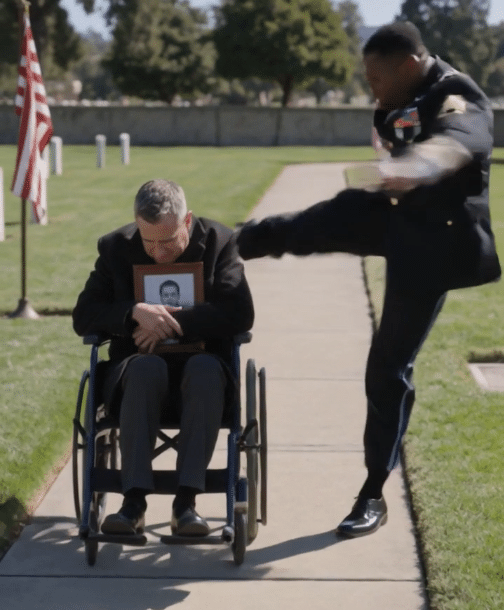
Margaret, a seventy-six-year-old widow, slowly guided her wheelchair along the narrow path, carrying fresh flowers and a framed photograph of the son she had lost in military service. Every visit followed the same ritual—a few minutes of silence, a whispered prayer, and a promise that he would never be forgotten.
Then the silence shattered.
An impatient visitor in an expensive coat complained that her wheelchair was blocking the walkway. Without waiting for her to respond, he knocked her bouquet to the ground, sending flowers across the grass.
“Even here,” he scoffed, “people like you are always in the way.”
Visitors froze.
No one expected anyone to speak to a grieving mother like that.
Margaret simply reached for the fallen photograph, refusing to answer.
But someone else had already seen everything.
Act II
Margaret wasn’t just another elderly visitor.
For more than fifty years, she had stood beside her husband through military deployments, family sacrifices, and unimaginable loss. Together they had buried the son who chose to follow his father’s path of service.
She rarely mentioned her family’s history.
To her, rank and medals belonged to the past. What mattered now was remembering the people she loved.
The man confronting her couldn’t have known any of that.
He judged her only by her age, her wheelchair, and how inconvenient she seemed.
Around them, several visitors looked uncomfortable but remained silent.
Then the distant sound of military vehicles echoed through the cemetery.
Act III
A convoy entered slowly through the cemetery gates.
Uniformed personnel stepped out first, followed by a decorated general wearing a chest full of service ribbons.
Conversations stopped immediately.
The general ignored everyone else.
His eyes found Margaret sitting beside the grave, gently holding the photograph against her chest.
He crossed the path without hesitation, knelt beside her, brushed the dirt from the picture frame, and quietly helped her gather the scattered flowers.
Only after making sure she was alright did he stand.
The expression on his face remained calm.
His eyes, however, carried unmistakable disappointment.
Act IV
The wealthy visitor suddenly seemed uncertain.
He attempted to explain himself, but the general raised a hand.
His voice never became loud.
It didn’t need to.
“Who thought it was acceptable to disrespect my wife?”
The words settled over the cemetery like a heavy silence.
Several witnesses stepped forward and described exactly what had happened.
The man’s confidence disappeared.
Moments earlier, he had believed he was confronting a powerless widow.
Now he realized she was the wife of one of the nation’s most respected military leaders—and, more importantly, the mother of a fallen service member whose sacrifice had earned the respect of everyone standing there.
Act V
The general gently placed the flowers back beside their son’s headstone.
He took Margaret’s hand before turning once more toward the crowd.
“A person’s dignity,” he said quietly, “is not measured by age, appearance, or whether they stand or sit.”
No one spoke.
The visitor lowered his eyes, no longer able to meet anyone’s gaze.
His earlier arrogance had vanished, replaced by a realization that would stay with him far longer than embarrassment.
As the general wheeled his wife toward their son’s memorial, every person nearby stepped aside in silent respect.
The cemetery returned to the peaceful stillness it deserved.
And the loudest lesson that afternoon came not from anger or authority, but from the simple act of honoring someone who had already sacrificed more than most people could ever imagine.