Act I
The first rule of the cell block wasn’t written anywhere.
Everyone simply knew it.
Touch the wrong bunk, and someone would make you regret it.
When the heavy steel door slammed shut behind the newest inmate, dozens of eyes followed him in silence. He carried a small duffel bag, spoke to no one, and calmly sat on the nearest lower bunk after a long day of processing.
That single decision changed everything.
Marcus Kane, the unofficial boss of the block, strode across the concrete floor with a grin that never reached his eyes.
No warning.
No questions.
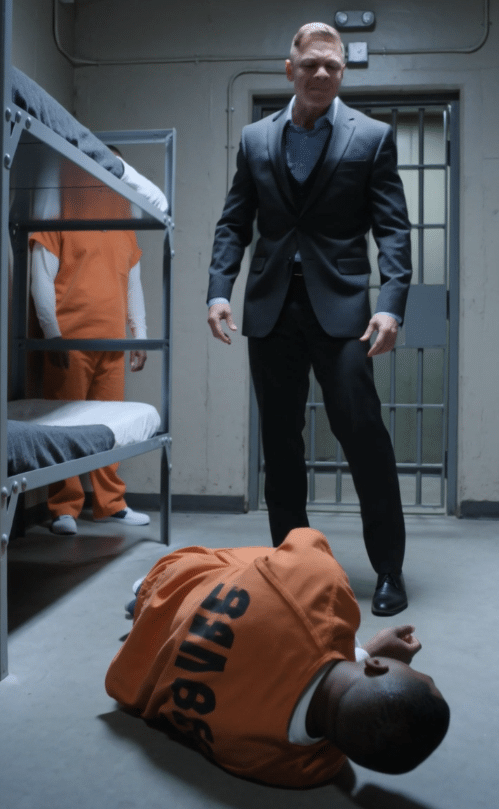
He struck first, knocking the newcomer violently from the bunk. The man hit the concrete hard, scraping his elbow as the room erupted in startled murmurs.
Marcus planted a boot beside him and laughed.
“Trash.”
“That’s my bed.”
The other inmates looked away.
Not because they approved.
Because surviving prison often meant pretending not to see.
The new inmate slowly pushed himself onto one elbow.
He didn’t beg.
He didn’t threaten.
He simply watched.
That calmness only fueled Marcus’s arrogance.
He believed he’d already won.
He had no idea the ceiling had been watching every second.
Act II
Violence ruled the housing unit more effectively than any posted regulation.
Marcus had spent years building his reputation through intimidation.
New arrivals surrendered their bunks.
Their food.
Sometimes even their dignity.
Those who resisted quickly learned the cost.
Correctional officers rarely arrived before the damage was done, and rumors spread that complaints disappeared long before they reached anyone with real authority.
The newcomer seemed different.
He observed everything.
Which inmates stayed silent.
Which ones looked frightened.
Which security camera covered the bunks.
Marcus mistook composure for weakness.
He leaned over the man lying on the floor.
“You sleep on the floor now.”
The insult echoed through the block.
A heartbeat later, the heavy locking mechanism on the cell door began to turn.
Most inmates barely noticed.
Marcus didn’t notice at all.
He was too busy proving his power.
The balance inside the cell was about to change forever.
Act III
The barred door swung open with unusual force.
It wasn’t routine count.
It wasn’t meal service.
A senior correctional officer entered first, followed by several members of a federal oversight team carrying inspection folders and evidence kits.
Every conversation stopped.
Marcus frowned.
Unscheduled inspections almost never reached the housing units without warning.
The lead monitor ignored everyone else.
He walked directly to the fallen inmate and offered a hand.
Only after helping him to his feet did he speak.
“Agent, are you injured?”
The entire cell block froze.
Marcus stared blankly.
Agent?
The quiet newcomer gave a brief nod before glancing toward the security camera mounted in the corner of the ceiling.
The lead monitor followed his gaze.
“So it captured everything.”
The correctional officers immediately understood.
This wasn’t an ordinary prisoner.
Months earlier, federal authorities had launched a confidential investigation into repeated allegations of organized violence, extortion, and staff failures inside the facility.
The newest inmate hadn’t arrived to serve a sentence.
He had arrived to uncover the truth.
And the truth had just unfolded directly beneath a recording camera.
Marcus suddenly realized every second of his confidence had become evidence.
But the investigation reached even deeper than he imagined.
Act IV
The undercover operation had been carefully planned.
The agent had entered the prison under an assumed identity after multiple witnesses described a pattern that official reports never seemed to capture.
Victims stayed silent.
Potential witnesses feared retaliation.
Complaints vanished.
The only way to expose the system was to experience it firsthand.
The assault happened faster than investigators expected.
Faster than anyone hoped.
But it confirmed exactly what the federal team needed.
The lead officer quietly instructed staff to secure the surveillance footage before it could be overwritten.
Several inmates, seeing the truth finally acknowledged, stepped forward for the first time.
One admitted Marcus had controlled the bunk assignments for years.
Another described routine intimidation.
A third quietly pointed toward correctional staff who had ignored repeated warning signs.
The investigation widened within minutes.
Marcus looked around the cell.
The men who had always feared him no longer avoided eye contact.
They had spent years believing nobody would ever challenge him.
Now federal investigators were standing only a few feet away.
Power built on fear rarely survives the arrival of accountability.
Act V
The agent declined immediate medical attention, insisting that every inmate who had previously reported abuse be interviewed before memories faded or intimidation resumed.
The request revealed exactly why he had volunteered for the assignment.
He hadn’t entered the prison to catch one violent inmate.
He had come to expose an entire culture that allowed violence to flourish.
Over the following weeks, surveillance records, witness interviews, and institutional reviews painted a far broader picture than anyone outside the prison had imagined.
Policies were rewritten.
Supervision increased.
Independent monitoring expanded.
For many inmates, it was the first sign that someone beyond the prison walls had finally listened.
The bruises would heal.
The evidence would remain.
As officers escorted Marcus away from the housing unit, the confidence that had ruled the block for years disappeared completely.
Only moments earlier, he had believed the newest inmate was another easy target.
Now he understood he had assaulted the very person sent to document his crimes.
His breathing became shallow.
His lips trembled.
His eyes drifted from the federal team to the silent security camera mounted above the bunk area.
Then back to the man he had mocked.
One broken whisper escaped his mouth.
“Agent…?”
No one answered.
They didn’t need to.
Because the camera above them already had.
And for the first time in years, the truth inside that prison cell no longer belonged to rumors.
It belonged to the evidence.