Act I
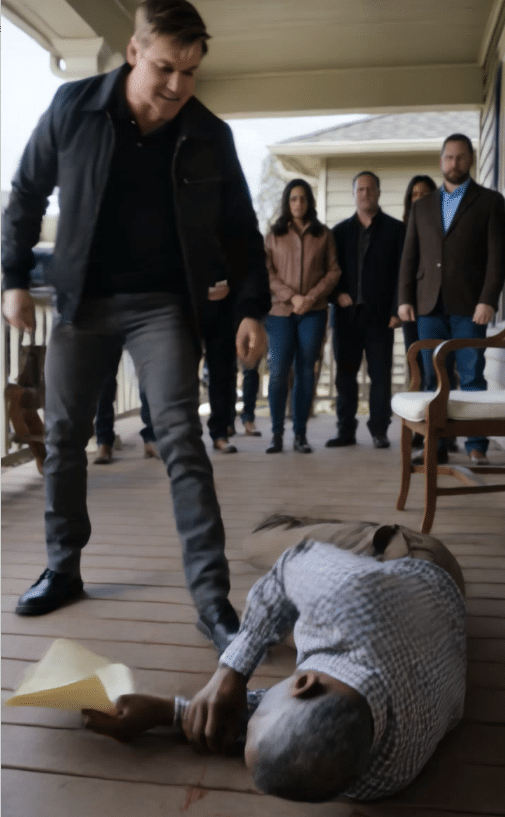
The sale documents fluttered across the old wooden porch before anyone even realized what had happened.
An elderly man staggered backward, one trembling hand still reaching toward the papers that carried decades of memories. His voice had barely faded.
“I don’t agree.”
That single sentence was enough.
His son exploded.
The kick came without warning, driving the old man backward until he crashed onto the porch boards. The documents scattered into the afternoon breeze, sliding beneath rocking chairs and flower pots that had stood outside the family home for years.
The seventy-eight-year-old father tried to catch himself, but age had stolen the speed his heart still believed he possessed.
A scrape burned across his forearm.
His eyes watered—not only from pain.
From betrayal.
The man standing above him wasn’t a stranger.
It was the little boy he had once carried on his shoulders through this very yard.
Now that same child looked down at him with complete contempt.
“Trash,” his son spat. “You’ll rot in a nursing home anyway.”
The neighborhood fell strangely quiet.
No one stepped forward.
The old man lowered his head.
Not because he accepted the words.
Because hearing them from his own son hurt more than the fall itself.
But the cruelty had only begun.
Someone else was about to arrive.
Act II
The little house wasn’t valuable because of its size.
It was valuable because of what it represented.
Forty-six years earlier, the old man and his late wife had purchased the property with money saved from double shifts, weekend jobs, and years of sacrifice.
Every room carried a memory.
The pencil marks measuring a growing child.
The tree planted after a graduation.
The front porch where his wife drank coffee every morning until cancer quietly took her away.
After the funeral, everyone assumed the father would sell.
He never could.
This wasn’t simply real estate.
It was the last place where her laughter still seemed to exist.
His son never understood that.
Or perhaps he stopped caring.
Years of reckless investments had buried him beneath debt.
Luxury cars.
Risky business deals.
A lifestyle built on appearances instead of stability.
The bank wanted payment.
Creditors wanted answers.
The easiest solution stood directly beneath his feet.
Sell the old house.
When persuasion failed, pressure followed.
Then threats.
Today had been supposed to end everything.
The contract was already prepared.
All the father needed to do was sign.
Instead, he refused.
That refusal shattered whatever humanity remained inside his son.
The older man curled protectively as another blow came.
Then another.
“Sign it,” the son growled. “Or I’ll throw you out myself.”
The father’s lips trembled.
He still didn’t answer.
Because some promises survive even after the person you made them to is gone.
Then tires screamed outside.
And every head turned.
Nothing would ever be the same again.
Act III
A black SUV stopped so abruptly in front of the porch that dust drifted across the driveway.
The engine fell silent.
So did everyone else.
The driver’s door never opened.
Instead, the rear passenger door swung wide.
A sharply dressed woman stepped out.
Elegant.
Composed.
Entirely out of place in the quiet suburban neighborhood.
Behind her came a driver and another suited assistant, both remaining several respectful steps behind.
Neither spoke.
Neither needed to.
The confidence in their silence said enough.
The woman didn’t waste a second studying the son.
She hurried directly to the elderly man still struggling to rise.
“Easy,” she whispered as she helped him sit upright.
Her expression changed the instant she noticed the scattered sale papers.
Then she looked at the son.
Not angrily.
Coldly.
As if she’d already reached a conclusion.
The son forced an uneasy laugh.
“This is a family matter.”
She ignored him.
Instead, she carefully picked up one of the documents from the porch.
Her eyes moved across every line.
Then they stopped at the father’s signature space.
Still blank.
She looked back at the elderly man.
“You refused.”
He nodded.
“I promised my wife this house would always stay in the family.”
For a brief second, genuine sadness crossed the woman’s face.
Then it disappeared.
Replaced by something far more dangerous.
Resolve.
The son suddenly realized she wasn’t just another passerby.
And that realization arrived a moment too late.
Because she already knew exactly who he was.
Act IV
Months earlier, the elderly father had quietly volunteered at a neighborhood veterans’ outreach center.
He rarely spoke about himself.
He simply fixed broken chairs, served coffee, and listened to lonely people who had nowhere else to go.
One afternoon, he had met a woman overwhelmed by legal paperwork involving an elderly relative.
Without expecting anything in return, he spent hours helping organize documents, making phone calls, and calming frightened seniors waiting for assistance.
That woman had never forgotten.
She happened to oversee one of the state’s largest elder advocacy foundations.
When the father suddenly stopped showing up each week, she became concerned.
A neighbor eventually explained what had been happening.
The pressure.
The threats.
The attempt to force a property transfer.
She came immediately.
Now she stood only a few feet from the son.
“You’ve made a terrible mistake.”
His confidence vanished.
“You don’t know anything.”
“I know enough.”
She handed one document to her assistant.
“Call the attorneys.”
Another went to the driver.
“Photograph everything.”
The son blinked.
“What are you doing?”
She finally looked him directly in the eyes.
“Protecting someone who protected countless others.”
The old man stared at her in confusion.
“You remembered me?”
She smiled gently.
“Kindness doesn’t disappear simply because the person giving it expects nothing back.”
Neighbors slowly stepped onto their porches.
No one looked at the father with pity anymore.
Every eye had shifted toward the son.
For the first time that afternoon…
He understood he wasn’t controlling the story anymore.
Act V
The woman carefully gathered every scattered page from the porch.
Then she placed them into a neat stack.
She didn’t tear them.
She didn’t throw them away.
She simply handed them back to the son.
“They’re worthless without his free consent.”
The sentence landed harder than any threat.
The son looked around.
His expensive confidence had evaporated.
His father—whom he had treated like an obstacle only moments before—was no longer alone.
He had witnesses.
Protection.
Respect.
Most importantly, he had someone willing to stand beside him when his own family refused.
The elderly man slowly stood.
His shoulders still ached.
His eyes remained red.
But something had returned that the assault couldn’t take.
His dignity.
He looked at the house behind him.
The weathered porch.
The faded front door.
The flowers his wife had planted years ago.
For the first time in months, he believed he wouldn’t lose them.
The woman gently rested a reassuring hand on his shoulder.
“We’ll make sure you’re safe.”
The son swallowed hard.
Every excuse he’d prepared suddenly sounded ridiculous.
Every threat now felt empty.
His lips trembled as he stared at the mysterious woman who had arrived from nowhere and dismantled everything he thought he controlled.
Only one question remained.
“…Who are you?”
She didn’t answer.
She didn’t have to.
Some people announce their power with titles.
Others reveal it simply by standing beside the person everyone else abandoned.
And sometimes, that is the only answer justice ever needs.