Act I
The first thing people noticed wasn’t the old man’s cane.
It was the approaching train.
Its headlights cut through the darkness of the tunnel as commuters instinctively stepped behind the yellow safety line. Most did it without thinking. Years of routine had taught them that a single careless step could change a life forever.
Everyone except one man.
Dressed in a tailored navy suit with polished Italian shoes and a watch that cost more than most families earned in months, he stood with his toes hanging dangerously over the edge. His expression carried the kind of confidence that came from believing rules existed for everyone else.
A few people glanced at him.
Nobody said anything.
Nobody except the man standing several feet away.
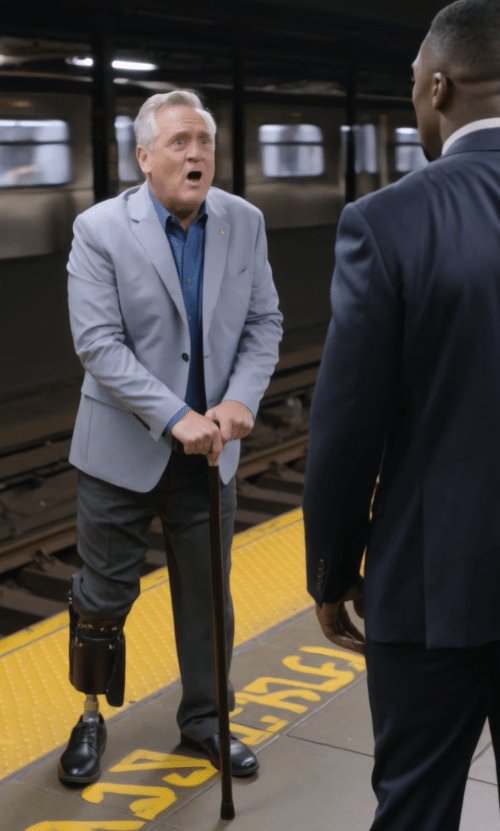
He was sixty-three years old, leaning lightly on a worn aluminum cane. One pant leg ended above a carbon-fiber prosthetic leg that had clearly seen years of use. His posture was steady despite the limp, and his eyes never left the approaching train.
His voice was calm.
“Step behind the yellow line.”
It wasn’t an order.
It wasn’t criticism.
It was simply the kind of warning someone gives another human being.
The businessman slowly turned.
His face twisted with irritation, as though he had just been interrupted by someone beneath him.
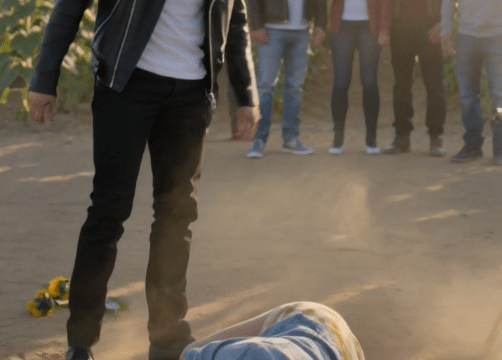
Without another word, he drove a brutal kick straight into the veteran’s chest.
The impact threw the older man backward across the platform, far from the tracks. His cane clattered across the concrete while commuters gasped in horror.
For a heartbeat, nobody moved.
Then everything became even worse.
Because the attack wasn’t over.
But the businessman had no idea whose life he had just kicked to the ground.
Act II
The veteran struggled to breathe as he landed hard on the platform.
His elbow scraped against the rough concrete, leaving only a shallow abrasion, but the pain shooting through his ribs reminded him of injuries that had never fully healed. His prosthetic shifted awkwardly beneath him, forcing him to pause before trying to sit up.
The businessman walked closer.
Towering over him.
Looking down as if he were staring at garbage someone had forgotten to remove.
“Trash. Don’t tell me where to stand.”
Several people reached for their phones.
Others looked away.
One young college student took a hesitant step forward before his frightened girlfriend grabbed his arm.
“No,” she whispered. “He’ll hit you too.”
The businessman sneered.
Then he delivered another kick into the veteran’s back.
The older man’s body lurched forward.
A second kick landed against his ribs.
Exactly two.
Nothing more.
Nothing less.
The businessman adjusted his expensive jacket as though he had merely brushed dirt from his sleeve.
“Stay out of my way.”
His words echoed across the suddenly silent platform.
What nobody there understood was that the veteran had spent forty years refusing to let anger make his decisions.
He had survived overseas deployments.
He had survived losing friends.
He had survived losing his leg while pulling two younger soldiers away from an explosion that should have killed all three.
Compared to those memories, humiliation hurt far less.
He simply reached toward his fallen cane.
That quiet dignity would soon become the reason an entire station remembered this day forever.
Because another set of footsteps had just begun echoing down the station stairs.
Act III
The first sound was fast.
The second was disciplined.
Within seconds, several men in dark suits descended the staircase with practiced precision. They weren’t running in panic.
They were clearing a path.
Commuters instinctively stepped aside.
Station employees immediately straightened.
Even the transit police, who had been moving toward the disturbance, paused and respectfully shifted to one side.
Then she appeared.
A woman in a perfectly tailored gray suit walked through the opening without raising her voice or rushing her pace.
She didn’t need to.
Authority surrounded her long before anyone recognized her face.
The station manager lowered his head slightly.
Police officers stepped back.
Security personnel silently formed a perimeter.
Only then did several commuters finally whisper the name they had seen on news broadcasts countless times.
She wasn’t simply another executive.
She was the director responsible for the city’s entire transit system.
Ironically, she had arrived that morning for an unannounced inspection focused on one issue above all others.
Platform safety.
The businessman still hadn’t noticed.
He remained convinced the crowd was staring at him because of the fight.
He couldn’t have been more wrong.
The director ignored him completely.
Instead, she walked directly toward the veteran lying on the concrete.
For just a moment, something in her composed expression changed.
Recognition.
Years earlier, before entering public service, she had worked in veterans’ outreach programs. She remembered meeting a quiet former soldier who refused special treatment despite helping rewrite safety protocols after suffering permanent injuries.
She never forgot his name.
Nor the reason he always insisted that strangers stay behind the yellow line.
He had once watched another commuter die after ignoring the exact same warning.
The memory had haunted him ever since.
She gently picked up his cane before offering him a hand.
Only after he was standing again did she finally turn toward the businessman.
The temperature on the platform seemed to drop.
And with two simple words, the balance of power completely changed.
Act IV
“Step back.”
She didn’t shout.
She didn’t threaten.
She simply spoke with absolute certainty.
The businessman laughed at first.
It was the nervous laugh of someone who still believed money solved every problem.
Then he noticed something unusual.
The transit police weren’t looking at the veteran anymore.
They were watching him.
Security officers quietly positioned themselves behind the woman.
The station manager avoided making eye contact with the businessman entirely.
Every employee seemed to be waiting for a single instruction.
Confusion slowly replaced arrogance.
“Who exactly do you think you are?” he demanded.
She answered without emotion.
“I’m the person responsible for every station, every employee, every security camera, and every safety policy in this system.”
His smile disappeared.
She continued.
“You assaulted a disabled veteran.”
“You ignored a federally required safety boundary.”
“You committed the assault directly beneath multiple high-definition security cameras.”
She nodded slightly toward the ceiling.
Only then did the businessman finally look up.
There they were.
Several cameras.
Every angle covered.
Every second recorded.
There would be no argument about what happened.
No edited version.
No convenient misunderstanding.
The veteran quietly stood beside her, saying nothing.
He didn’t need revenge.
The truth was already doing the work for him.
One officer stepped forward.
Another began speaking into his radio.
The businessman instinctively took a step backward.
For the first time all morning, he realized he was no longer the most powerful person on the platform.
Not even close.
Then the silence became far more frightening than any shouting ever could have been.
Act V
As the arriving train finally stopped beside the platform, its doors opened onto a scene no passenger expected.
No one boarded immediately.
Every eye remained fixed on the businessman.
His expensive suit suddenly looked meaningless.
His luxury watch couldn’t buy back the last five minutes.
His confidence had vanished completely.
The director turned once more toward the veteran.
“Are you injured?”
He gave the same quiet smile he had offered strangers for decades.
“I’ve survived worse.”
She nodded with deep respect.
“So has this city because people like you keep speaking up.”
Paramedics arrived to examine the scrape on his elbow and ensure his earlier injuries hadn’t been aggravated. Around them, witnesses voluntarily approached transit police, eager to provide statements before anyone even asked.
Not because they wanted attention.
Because they wanted justice.
The businessman finally looked beyond the director.
Standing directly behind her were uniformed transit officers, station supervisors, and suited investigators waiting patiently for instructions.
That was the moment reality finally reached him.
His face drained of color.
His lips trembled.
His voice, once so loud, barely escaped as a whisper.
“Who are you…?”
The director didn’t answer.
She didn’t need to.
Everyone else already knew.
What remained unforgettable wasn’t the authority she carried.
It wasn’t the security team.
It wasn’t even the inevitable consequences awaiting the businessman.
It was the quiet courage of a sixty-three-year-old veteran who had risked being mocked simply to protect a complete stranger from standing too close to danger.
He had asked for nothing.
Expected nothing.
And when violence answered kindness, he refused to become bitter.
In the end, that dignity became the one thing the businessman could never understand.
Because power built on wealth can disappear in an instant.
Character cannot.
Long after the train departed and the platform returned to its ordinary rhythm, people remembered only one lesson from that morning.
Sometimes the strongest person in the station isn’t the loudest voice.
It’s the one who quietly chooses to protect someone else—even when the world refuses to notice until it’s far too late.