Act I
The flower stand crashed to the ground before anyone could stop it.
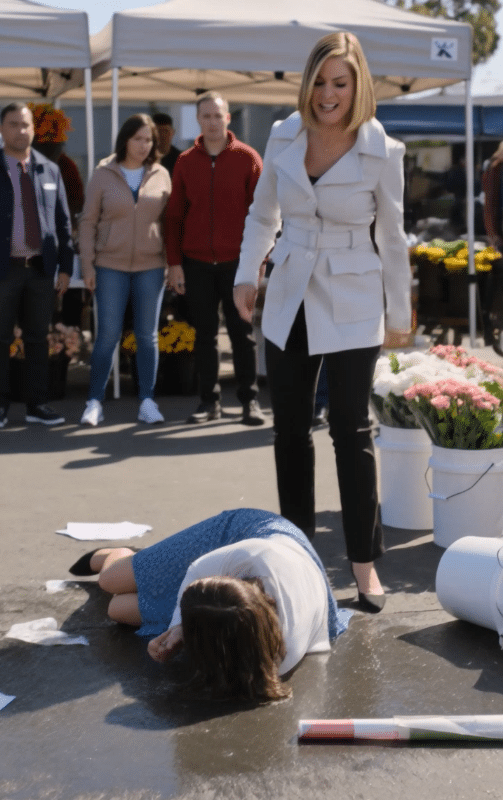
Buckets of fresh roses, lilies, and sunflowers tipped over the pavement, sending water rushing across the market walkway. Wrapping paper slid beneath hurried footsteps as colorful blooms scattered in every direction.
The widow barely had time to look up.
A violent kick struck her square in the chest, throwing her backward into the overturned buckets. Metal clanged against concrete as shoppers gasped and instinctively stepped away.
Her forearm slammed against the sharp rim of a bucket, leaving only a thin streak of blood across her skin. She curled beside the ruined flowers, struggling to catch her breath.
“I never touched your wallet…”
Her voice trembled more from humiliation than pain.
Standing over her in a pristine white coat and designer heels, the wealthy customer tightened her grip on an expensive handbag.
Her expression held no uncertainty.
Only contempt.
“Trash. You smiled while stealing.”
The accusation spread through the weekend flower market faster than the spilled water beneath everyone’s feet.
People whispered.
Some stared.
Others quietly stepped back, unwilling to become involved.
The widow looked around desperately.
These weren’t strangers.
Many had bought flowers from her every weekend for years.
Yet not a single person spoke in her defense.
The flowers she had spent hours arranging now lay crushed beneath hurried shoes.
For most people, they were just bouquets.
For her, they were this week’s rent.
And perhaps the last gift many families would place beside someone they loved.
The rich customer wasn’t finished.
Not even close.
Act II
The widow tried to push herself upright using trembling hands still wet from arranging fresh flowers.
Another kick struck her side.
She fell back among the scattered roses.
A second followed, driving the air from her lungs.
The market froze.
Nobody intervened.
The wealthy customer pointed toward the ruined stand as though she had already proven her case.
“Pay me back.”
The words landed harder than the kicks.
Everyone assumed the missing wallet must have disappeared while the flowers were being wrapped.
After all, who would believe a widow selling flowers over a woman who drove a luxury SUV and carried designer handbags?
Appearances made the verdict before facts ever could.
The widow had worked this corner of the market since her husband died eight years earlier.
He had been a firefighter.
One emergency call had taken him away forever.
The insurance barely covered the funeral.
Debt swallowed nearly everything else.
Rather than surrender to grief, she opened a small flower stall using the only savings they had left.
Every bouquet she sold carried a handwritten ribbon.
Every arrangement was tied by hand.
Every customer was greeted with the same gentle smile.
Not because life had been kind.
Because kindness was all she still had to give.
Ironically, that same smile had now become evidence against her.
The wealthy customer believed only one thing.
People without power were always guilty first.
The crowd continued watching.
Then someone appeared from the direction of the luxury SUV.
And the atmosphere shifted instantly.
Act III
Market security walked through the crowd with calm determination.
Behind them came the market manager.
He wasn’t running.
He didn’t need to.
Confidence alone parted the sea of onlookers.
In one hand, he carried a wallet.
He said nothing about where it had come from.
Not yet.
Instead, he looked directly at the wealthy customer.
“You should check your own car first.”
Silence spread across the market.
The woman frowned.
For the first time since the confrontation began, certainty disappeared from her face.
Security immediately stepped between the widow and her accuser, quietly shielding the flower seller while the manager raised the wallet high enough for everyone to recognize it.
Still, he refused to explain.
That mystery unsettled the crowd even more.
If the wallet had been found with the widow, there would be nothing left to discuss.
So why hadn’t the manager said so?
The wealthy customer felt dozens of eyes turning toward her instead.
The balance of power had shifted.
The widow remained seated among crushed flowers, unable to understand what was happening.
Neither could anyone else.
Until the manager finally revealed why he had walked in carrying the wallet himself.
Act IV
Earlier that morning, the market’s security cameras had captured more than anyone realized.
The wealthy customer had finished paying for her flowers while answering a phone call.
Distracted, she placed her wallet on the edge of her SUV’s open trunk as she rearranged several shopping bags.
She closed the trunk.
The wallet slipped into a hidden storage compartment beneath the cargo cover.
Completely unnoticed.
Minutes later, she returned to the flower stand.
Unable to find her wallet, she reached the only conclusion that matched her prejudice.
The poor widow must have stolen it.
Instead of asking questions, she chose humiliation.
Instead of searching, she chose violence.
Instead of truth, she chose pride.
The market manager had been alerted after security noticed the disturbance.
Before approaching, he quietly inspected the SUV.
When the trunk was opened again, the wallet was exactly where the cameras suggested it would be.
Untouched.
Undisturbed.
Never anywhere near the flower seller.
The manager still refused to lecture the crowd.
He simply held up the recovered wallet.
Sometimes evidence speaks louder than anger ever can.
Shoppers who had remained silent moments earlier lowered their eyes.
Several recognized the widow as the woman who had donated leftover flowers to the nearby hospital every Sunday evening.
Others remembered how she quietly provided bouquets for military funerals when grieving families couldn’t afford them.
She had spent years helping strangers celebrate births, weddings, anniversaries, and farewells.
Yet it had taken only a single accusation for people to doubt her character.
The crushed flowers at her feet suddenly represented something far greater than lost merchandise.
They represented the price of judging someone before knowing the truth.
Only one person still struggled to understand what had happened.
The wealthy customer.
Act V
The widow slowly stood with security beside her.
Her cardigan was damp.
Her apron was stained with dirt and flower petals.
A thin line of blood remained on her forearm, but she paid it no attention.
Instead, she quietly began gathering broken stems from the pavement.
Not because she had done anything wrong.
Because tomorrow she would still need to earn a living.
The market manager watched for a long moment before kneeling to help collect the scattered bouquets.
Around him, vendors who had stayed silent finally joined in.
One by one, they picked up flowers.
Straightened buckets.
Folded fresh wrapping paper.
Without a single word, the market began rebuilding the little stand that had been destroyed in minutes.
The widow’s eyes filled with tears.
Not from pain.
From finally realizing she wasn’t invisible after all.
Across the walkway, the wealthy customer remained frozen.
The recovered wallet rested only a few feet away, making every accusation she had shouted echo back at her.
Her expensive clothes, polished heels, and luxury SUV suddenly meant nothing.
All that remained was the weight of public shame.
She slowly turned toward the parking area.
The same parking area she should have searched before destroying another person’s livelihood.
Her lips parted.
Her confidence vanished.
Barely above a whisper, she asked,
“My car?”
No one answered.
The silence was enough.
Because everyone now understood the real theft that morning.
It wasn’t a missing wallet.
It was the dignity stolen from a hardworking widow simply because someone believed wealth made her own assumptions more valuable than another person’s honesty.
And while flowers can be replanted, trust—once crushed beneath pride—is far more difficult to grow again.