Act I
The classroom fell silent the moment the shouting began.
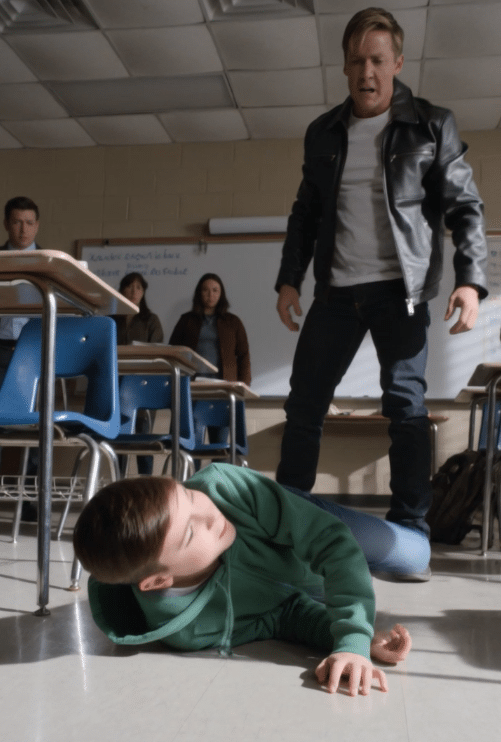
Books slid across the floor as a frightened twelve-year-old stumbled backward beside his desk, clutching the straps of his worn backpack. His faded green hoodie and old sneakers suddenly became the center of everyone’s attention—not because of who he was, but because of what someone believed he had done.
“I didn’t take any headphones…” he pleaded, his voice shaking.
Across from him, an angry parent pointed a trembling finger in his face.
“Trash. Poor kids steal nice things.”
No one spoke.
The final bell had already rung, yet dozens of students remained frozen in place, watching an accusation unfold before anyone had checked a single fact.
The boy lowered his eyes.
He had learned long ago that people often judged his clothes before they listened to his words.
What he didn’t know was that someone else was already on the way.
And within moments, the entire room would discover just how dangerous assumptions could be.
Act II
Ethan Carter had never owned the newest phone or the latest shoes.
His mother worked two jobs after his father passed away years earlier, stretching every paycheck just enough to keep food on the table and rent paid. The hoodie he wore had belonged to an older cousin. His backpack had been patched twice with careful stitches his mother made late at night.
He never complained.
He studied quietly, earned respectable grades, and usually stayed after class to help stack chairs or erase the whiteboard.
Yet to some people, poverty looked suspicious.
When a pair of expensive wireless earbuds disappeared after class, whispers spread almost immediately.
Someone mentioned Ethan had been the last student near the desks.
Someone else noticed his old backpack.
Within minutes, suspicion transformed into certainty.
The parent of the missing earbuds never asked the teacher to search the room.
Never requested security footage.
Never considered another explanation.
Instead, they walked into the classroom convinced they already knew the truth.
For Ethan, it felt painfully familiar.
He wasn’t being judged for evidence.
He was being judged for appearances.
But the hallway outside the classroom had quietly recorded something that no one inside had considered.
Act III
The classroom door burst open.
The principal entered first, followed closely by Ethan’s homeroom teacher and two school security officers.
Every conversation stopped.
The principal held a school device in one hand, its screen turned away from everyone in the room.
He looked directly at the angry parent before speaking.
“You accused the wrong student.”
Only six words.
Yet they instantly shifted every ounce of authority inside the classroom.
One security officer immediately moved beside Ethan, calmly guiding him behind the adults while making sure he felt safe.
The principal never raised his voice.
“The hallway cameras have already been reviewed.”
No one could see the screen.
No footage was shown.
But the confidence that had filled the room only seconds earlier suddenly disappeared.
The angry parent glanced toward the hallway.
Then toward their own child.
For the first time, uncertainty replaced certainty.
And fear began replacing anger.
Act IV
The principal folded his hands calmly.
“Before accusing a child,” he said, “you verify the facts.”
The room remained silent.
The teacher quietly gathered Ethan’s scattered books while another staff member picked up his backpack.
No one rushed to reveal what the cameras had captured.
That wasn’t the point.
The evidence already existed.
The truth no longer depended on assumptions.
The principal continued.
“Our responsibility is to protect every student equally.”
The parent’s expression slowly changed.
They remembered something they had ignored.
Their own child had left the classroom briefly, saying they needed to stop by the gym lockers before heading home.
No one had thought much about it at the time.
Now, that small detail suddenly carried enormous weight.
Without showing the footage, the principal explained that the missing earbuds had never been in Ethan’s possession.
The accusation had been directed at the wrong child from the very beginning.
Everything else would be addressed privately according to school policy.
Act V
Later that afternoon, school staff confirmed that the earbuds had been recovered after a misunderstanding involving the gym locker area.
Ethan had never taken them.
Not for a single moment.
The principal met privately with Ethan and his mother, assuring them the school would fully document the incident and provide any support they needed.
He also addressed the entire seventh grade the following week.
Without naming anyone involved, he reminded students that kindness begins long before proof is needed.
“It is easy to accuse,” he told them.
“It is much harder—and far more important—to be fair.”
For many students, the lesson stayed with them long after middle school ended.
They remembered the quiet boy with the patched backpack.
They remembered how quickly people believed the worst simply because he looked different.
And they remembered the moment everything changed when one calm voice entered the room and refused to let prejudice become truth.
“You accused the wrong student.”
Sometimes justice arrives loudly.
Sometimes it walks through a classroom door, carrying nothing more than the courage to insist that every child deserves to be believed until the facts say otherwise.