Act I
“That was for my child…”
The woman’s voice barely rose above the rain.
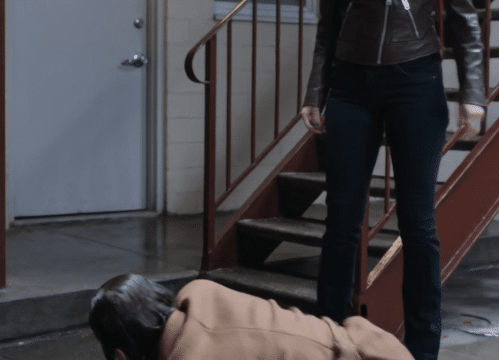
She was on the ground beneath an old railway bridge, one arm wrapped around her aching ribs, her faded apron soaked through. Beside her, the small metal soup cart rocked on its crooked wheels, and the last pot of steaming soup lay overturned in the gutter.
Warm broth mixed with dirty rainwater, disappearing between the cracks in the pavement.
For a moment, the forty-five-year-old woman simply stared at it.
Then she reached toward the spilled food with trembling fingers, as though she could somehow gather it back into the pot. Her gray scarf had slipped from her neck, and her old brown coat was stained with mud. A thin trace of blood marked her forearm where it had struck the cart’s metal frame.
She didn’t seem to notice.
All she could see was the soup.
It had taken her nearly three hours to prepare. She had scraped together what little money remained in her purse, bought the cheapest ingredients she could find, and spent the evening serving bowls to exhausted commuters and people sheltering beneath the bridge.
Every dollar mattered.
Every bowl mattered.
And the last portion had never been meant for a customer.
It was for her eight-year-old son, Daniel, who was waiting at a temporary shelter several blocks away. He had been coughing all day, and she had promised him something warm before he went to sleep.
She had promised.
Now the food was gone.
Standing over her, a man in a black leather jacket glanced at the ruined cart with open disgust. He was thirty-six, clean-shaven, well dressed, and wearing the kind of expression that suggested the world existed to serve him.
He looked at the woman as if she were something the rain had washed into his path.
“Trash,” he said. “Your soup tastes like begging.”
The woman tried to push herself upright.
“Please,” she whispered. “I wasn’t bothering anyone.”
That only seemed to irritate him further.
He had noticed her cart when he came through the underpass. Its dented metal sides, mismatched wheels, and handwritten menu offended his sense of what belonged in public. To him, the people gathered beneath the bridge were an eyesore, and the woman selling soup was the worst part of it.
He didn’t know her name.
He didn’t ask.
He simply decided she had no right to be there.
A moment earlier, he had driven his boot into her chest, knocking her backward into the cart. The impact had sent the pot tumbling onto the pavement. Now, as she curled over the spilled soup, he stepped around the mess and kicked her twice more in the back and side.
The people nearby recoiled.
An elderly man covered his mouth. A young commuter stumbled backward beneath a bridge column. Someone lifted a phone, then froze, uncertain whether to intervene or remain invisible.
Nobody came forward.
The woman drew a sharp breath and folded around herself, one hand pressed against her side.
“Please,” she said again.
The man leaned over her.
“Serve hunger somewhere else.”
His words hung in the cold air.
Then a different sound cut through the rain.
Tires screeched against the wet pavement.
A clean white van stopped hard beneath the bridge, its headlights sweeping across the overturned cart and the woman lying beside it. The sliding door opened, and several kitchen staff members stepped out, followed by an older man in a long black coat.
He was sixty-two, silver-haired, and carried himself with the quiet certainty of someone accustomed to being heard without raising his voice.
He took one look at the soup soaking into the gutter.
Then he saw the woman.
His expression changed.
He crossed the pavement immediately, removing his coat and placing it around her shoulders before positioning himself between her and the man in leather.
Only then did he turn toward the van.
“Bring the whole kitchen here.”
The staff moved at once.
Behind him, the bully gave a short, disbelieving laugh.
“Whole kitchen?”
He still thought he was the most powerful man beneath that bridge.
He had no idea whose food he had just destroyed.
And he had even less idea what the old man was about to uncover.
Act II
The woman’s name was Margaret Ellis.
For most of her adult life, Margaret had been the kind of person other people described as dependable. She remembered birthdays, brought casseroles to grieving neighbors, and worked double shifts without complaining because there was always someone who needed something.
She had never been wealthy.
But until three years earlier, she had never imagined she would be standing beneath a bridge, trying to salvage dinner from a rain-filled gutter.
Her husband, Thomas, had died unexpectedly after a heart condition left him unable to work. The medical bills consumed their savings, and the small house they rented became impossible to afford. Margaret took cleaning jobs, worked in a diner, and eventually started selling homemade soup from a cart she had purchased secondhand.
Then the diner closed.
A landlord raised the rent on the small apartment where she and Daniel lived. After several missed payments and a notice she could not afford to fight, they lost the apartment too.
Margaret never told Daniel how frightened she was.
She told him they were having an adventure.
They moved between temporary shelters, borrowed rooms, and the occasional night spent with people who had little more than they did. Daniel learned to keep his schoolbooks inside a plastic bag when it rained. Margaret learned which public buildings stayed warm longest and which grocery stores marked down their bread before closing.
She also learned how to stretch a pot of soup.
A handful of potatoes, a few carrots, broth made from saved bones, and whatever vegetables she could buy at the end of the day. She made every ingredient count, seasoning the mixture carefully until it smelled like the kitchen she remembered from her old home.
Customers began returning.
Some came because the soup was good. Others came because Margaret never made them feel ashamed of being hungry.
If someone couldn’t pay, she filled the bowl anyway.
Once, a homeless veteran tried to leave a handful of coins on her cart after she had given him a free meal. Margaret pushed them gently back toward him.
“Keep it,” she said. “You might need it more than I do tomorrow.”
He never forgot her.
Neither did the other people who gathered beneath the bridge.
But kindness didn’t pay for Daniel’s medicine, and it didn’t make the nights warmer. Margaret had begun working later, selling soup until the last commuters disappeared, saving enough for one hot meal for herself and her son.
On the night of the attack, she had counted the money twice.
There was barely enough for tomorrow.
Still, she had smiled when Daniel asked whether there would be soup waiting for him.
“Of course,” she had promised.
Now, as the older man knelt beside her, that promise was the only thing she could think about.
“Is your child nearby?” he asked.
Margaret nodded weakly.
“At the shelter. His name is Daniel.”
“Has anyone called for medical help?”
She shook her head, embarrassed by how difficult it was to speak.
The man looked toward his staff.
“Call emergency services. Tell them we have an injured woman. Get blankets, warm drinks, and food ready for everyone here.”
Then he looked directly at Margaret.
“Don’t try to get up. You’re not alone anymore.”
Something in his voice made her eyes fill.
Not because he sounded wealthy. Not because the van was clean or the staff obeyed him immediately.
It was because he had spoken to her as though her pain mattered.
For the first time that evening, Margaret stopped trying to apologize.
Across the pavement, the man in leather shifted his weight.
“This is ridiculous,” he said. “She was blocking the walkway with that junk.”
The older man didn’t answer immediately.
He adjusted the coat around Margaret’s shoulders, making sure it covered her soaked clothing. One of his staff members knelt nearby with a thermal blanket while another brought a sealed bottle of water.
Only when Margaret was protected did the old man rise.
“My name is Arthur Bennett,” he said.
The name meant nothing to the bully at first.
Then one of the bystanders looked up sharply.
Arthur Bennett was the founder of Harbor House Kitchens, a charitable organization that operated community kitchens, emergency meal programs, and temporary housing partnerships across the city. His face appeared in local newspapers every winter when temperatures dropped and the organization opened additional shelters.
His kitchens served thousands of meals every week.
His name was on buildings the bully had driven past without a second glance.
And Arthur had not built his organization by ignoring people in distress.
For twenty years, he had worked alongside volunteers who fed families after factory closures, supplied meals during winter storms, and helped people find their way back into permanent housing.
He had learned something early: hunger rarely arrived alone.
It came with medical bills, eviction notices, lost jobs, and the quiet shame of people who had spent their entire lives believing they should be able to manage on their own.
Arthur had made it his life’s work to meet those people where they were.
Which was why he had been driving through the neighborhood that night.
His team had been checking the locations where people gathered during the cold snap, making sure the emergency meal stations had enough supplies.
He had expected to find a few hungry families.
Instead, he had found a woman bleeding beside a destroyed soup cart while a man stood over her with contempt.
Arthur looked down at the overturned pot.
Then he noticed something beside the cart: a small paper bag, soaked through but still tied with a piece of string.
Inside was a child’s plastic spoon and a folded note written in careful handwriting.
Arthur picked up the note.
Four words had been written across the front.
For Mom. Love, Daniel.
His jaw tightened.
He looked back at Margaret, who was watching him with frightened eyes.
“Was this from your son?” he asked softly.
She nodded.
“He made it for me at school,” she whispered. “He said it was so I wouldn’t forget that someone was waiting for me.”
Arthur folded the note carefully and returned it to the bag.
Then he stood.
“Bring the kitchen,” he repeated, this time to his staff. “Every available vehicle. Meals, medical supplies, blankets. And call our housing coordinator.”
The bully laughed again, but the sound was weaker now.
“You can’t just turn this place into a restaurant.”
Arthur finally faced him.
“No,” he said. “But I can make sure nobody here goes hungry tonight.”
Then he added, almost casually, “And I can make sure what happened here doesn’t disappear with the rain.”
The bully’s smile faltered.
Because for the first time, he realized the old man wasn’t merely offering help.
He was paying attention.
And Arthur Bennett had spent twenty years learning how to turn attention into action.
Act III
Within minutes, the bridge began to change.
The van’s side door opened fully, revealing insulated containers, folding tables, stacks of bowls, and crates of fresh ingredients. Staff members moved through the rain with practiced efficiency, carrying equipment beneath the bridge and setting up a temporary service station beside the columns.
Another vehicle arrived.
Then another.
A medical team began assessing Margaret while Arthur remained nearby, refusing to leave until he knew she was receiving proper care. He spoke quietly with the responders, giving them the details of the assault and asking them to check her injuries thoroughly.
Margaret kept looking toward the street.
“Daniel,” she whispered.
Arthur heard her.
“Someone is going to get him,” he assured her. “We’ll make sure he’s safe.”
She caught his sleeve.
“Please don’t tell him what happened until I can explain it. He worries about me.”
Arthur lowered himself beside her again.
“I won’t make promises about what we can control,” he said gently. “But I will make sure he isn’t left wondering where you are.”
For the first time, Margaret believed him.
Meanwhile, the bully had begun to retreat.
He took a step toward the road, glancing at the growing number of people around the van. His confidence had depended on the assumption that nobody would challenge him.
Now there were witnesses everywhere.
Several had started speaking to the arriving officers. One man described the first kick. A woman in a blue scarf explained how the bully had continued after the soup spilled. Another witness admitted that she had frozen in fear, then offered to give a statement.
The man in leather looked at them with growing anger.
“You people saw nothing,” he snapped.
Nobody answered.
That silence frightened him more than an argument would have.
Arthur’s operations director, a woman named Denise Carter, approached with a tablet in her hand. She had been with Harbor House for eleven years and knew the organization’s records almost as well as Arthur did.
“There’s something else,” she said quietly.
Arthur turned.
Denise had recognized the cart.
Not the battered metal frame itself, but a small emblem painted on its side: a faded blue lantern surrounded by three white stars.
It was nearly hidden beneath rust and grime.
Denise had seen that symbol before.
Years earlier, Harbor House had operated a community cooking program called the Lantern Project. It provided small equipment grants, ingredients, and training to neighborhood cooks who wanted to establish independent meal services for low-income residents.
The program had ended after its funding was cut.
Its records, however, remained in the organization’s archives.
Denise enlarged a photograph of the cart on her tablet.
“Arthur, I think this is one of the original Lantern Project carts.”
Arthur leaned closer.
The emblem brought back a memory he hadn’t thought about in years: a young woman standing in a church basement, serving soup from a dented pot while volunteers packed groceries for families displaced by a winter fire.
He remembered her hands, red from the heat.
He remembered how she had insisted on serving the children first.
And he remembered the name on the application.
Margaret Ellis.
Arthur looked toward the woman beneath the blanket.
“Was your cart part of a community kitchen program?” he asked.
Margaret nodded slowly.
“Years ago. They helped me get started when Thomas was still alive. I thought the program had closed for good.”
“It did,” Denise said softly. “But the records are still there.”
Margaret looked ashamed.
“I didn’t want to ask anyone for help again. I thought I could manage.”
Arthur studied her face.
“How long have you been selling soup here?”
“Almost a year.”
“And how many people do you feed on an average night?”
She hesitated.
“I don’t know. Twenty, maybe thirty. More when it’s cold.”
Denise looked at Arthur.
The answer mattered.
Margaret wasn’t simply someone who had lost everything. She was someone who, even after losing her home, had continued feeding other people.
She had been running a tiny, unofficial community kitchen beneath a bridge without knowing that the very organization that had once helped her still existed, still had resources, and still had a place for her.
Arthur looked at the spilled soup.
He thought about how many bowls she had served without payment.
He thought about the child waiting at the shelter.
And he thought about the man who had destroyed the one meal Margaret had saved for her son.
“Find her original application,” Arthur told Denise. “And bring me the Lantern Project files.”
Denise nodded and stepped aside to make the call.
The bully heard enough to become curious.
“What files?” he demanded.
Arthur didn’t look at him.
“Not your concern.”
That answer infuriated the man.
“You think because you’ve got a charity and a few vans, you can tell everyone what to do?”
Arthur finally turned.
“No. I think you made a choice tonight, and other people saw it.”
The bully’s expression hardened.
“She’s nobody.”
The words landed heavily beneath the bridge.
Margaret closed her eyes.
She had heard versions of that sentence for months. From landlords who wouldn’t return calls. From employers who stopped answering applications. From strangers who stepped around her cart as though hunger were something contagious.
Arthur heard it too.
And this time, he refused to let it pass.
“Her name is Margaret Ellis,” he said. “She feeds people who have less than she does. Her son is waiting for her. And you don’t get to decide whether her life matters.”
The surrounding crowd fell silent.
The bully looked from Arthur to the staff, then toward the approaching officers.
He tried to laugh, but it came out as a short, strained breath.
“Whole kitchen?” he muttered again.
He still didn’t understand what Arthur was planning.
But Denise was already returning with a folder from the van.
And the first page contained a detail that would change the entire night.
Act IV
The folder was old enough that its edges had begun to soften.
Arthur opened it beneath the shelter of the van’s rear doors while Denise held a light over the pages. The original Lantern Project application lay inside, along with photographs, inspection reports, and a series of handwritten notes from the program’s former coordinator.
Margaret’s name appeared on the first page.
So did a recommendation from a volunteer who had described her as an unusually resourceful cook with a gift for making people feel welcome.
There was even a photograph of Margaret standing behind a younger version of her cart, smiling beside a table covered in bowls.
She looked different then.
Not because she had been wealthy or carefree, but because she had not yet learned how quickly life could strip a person of everything familiar.
Arthur turned to the next page.
A note in the margin caught his attention.
Applicant offered to return equipment grant after securing employment. Declined to withdraw from program because neighborhood meal service remains essential.
He read it twice.
Margaret had once tried to give back the money that helped her start, even though she had qualified for it. She had wanted the funds to go to another family who needed them.
Arthur looked toward her.
“You remember this?”
Margaret stared at the page.
“I thought I’d forgotten about it.”
“You offered to give back your grant.”
“I was working again at the time. I thought somebody else might need it more.”
Arthur shook his head.
“You didn’t have to do that.”
“I know,” she said. “But I also knew what it felt like when there wasn’t enough food.”
For a moment, Arthur said nothing.
He had founded Harbor House after watching his own mother stand in a grocery line with a handful of coins and quietly put food back because the total was too high. He had spent decades building kitchens so that other families wouldn’t have to experience that same humiliation.
But somewhere along the way, the organization had become larger than the people who inspired it.
Budgets replaced conversations. Funding deadlines replaced familiar faces. Programs closed when grants ended, even when the need remained.
And Margaret had continued serving soup long after the program that helped her had disappeared.
She had never stopped doing the work.
The system had simply stopped seeing her.
Arthur closed the folder.
“Denise, contact the board chair. I want the emergency community kitchen fund activated tonight. We have unused equipment in storage, a mobile unit available next week, and a housing partner who can take referrals immediately.”
Denise was already making notes.
“And Margaret?” she asked.
Arthur looked toward the medical team.
“First, we make sure she gets the care she needs. Then we find her and Daniel a safe place to stay. After that, we talk to her about what she wants to do.”
He paused.
“Not what we want her to do. What she wants.”
That distinction mattered to him.
Too many charitable programs treated people as problems to be solved rather than individuals with their own ambitions, histories, and dignity. Arthur had made that mistake before, and he had no intention of repeating it with Margaret.
She needed medical attention.
Daniel needed a secure home.
And Margaret needed the freedom to decide what came next.
Across the pavement, the bully was speaking rapidly to one of the officers.
He claimed the woman had been aggressive. He said she had blocked the walkway and refused to move. He insisted that the situation had been exaggerated by people who wanted to make him look bad.
But the witnesses were beginning to tell their stories.
The commuter who had seen the first kick stepped forward. The elderly man described the two additional blows. A delivery driver who had been waiting at the traffic light offered footage from his dashboard camera.
The evidence was no longer dependent on anyone’s willingness to believe Margaret.
It existed independently of her.
When the officer asked the bully to explain why he had attacked an unarmed woman, his answer changed twice.
First, he said he had been defending himself.
Then he said he had only been trying to move her cart.
Finally, he muttered that she shouldn’t have been selling food there in the first place.
Arthur listened without interrupting.
He did not threaten the man. He did not order his staff to surround him. He did not use his money to manufacture a punishment.
Instead, he gave the officers the information they requested, identified the witnesses willing to speak, and ensured that the camera footage would be preserved.
The consequences would be handled through the proper authorities.
But Arthur wasn’t finished with the night.
The mobile kitchen was now operating beneath the bridge.
Steam rose from enormous insulated containers. Volunteers distributed hot meals to the people who had gathered, and fresh blankets were passed along the line. For the first time in hours, the smell of warm food replaced the damp odor of concrete and rain.
No one was asked to prove they deserved a bowl.
No one was told to move along.
Margaret watched from the medical team’s vehicle, wrapped in Arthur’s coat, her eyes following the people receiving food.
A volunteer approached with a fresh bowl.
Margaret shook her head.
“Give it to someone else.”
The volunteer smiled.
“We have enough.”
Margaret looked down at the bowl.
Then she began to cry.
Not because she was hungry.
Because, for once, someone had prepared more food than they needed, and she didn’t have to calculate who would go without.
A few minutes later, Arthur returned to her with Denise beside him.
“We found your old application,” he said. “Your work with the Lantern Project is still documented. We can help you restart a proper meal service, if that’s something you want.”
Margaret blinked.
“You mean the cart?”
“The cart, if you want it. A safer setup, if you’d prefer. We can discuss a mobile kitchen partnership, paid work, training, and housing support.”
She stared at him as if he had spoken in a language she had forgotten how to understand.
“Why would you do all that for me?”
Arthur glanced at the crowd beneath the bridge.
“Because you were doing it for everyone else when nobody was doing it for you.”
Then he added something that made her grip the blanket tightly.
“And because the Lantern Project wasn’t supposed to end with people like you being left behind.”
The bully, still nearby, overheard the exchange.
His face had lost its color.
He had assumed the old man was simply a wealthy philanthropist who happened to be in the right place at the right time. He hadn’t realized that Margaret had a documented history with the organization, that the organization had records of her work, or that the people now standing around the cart were prepared to support her long after the rain stopped.
He had mistaken poverty for worthlessness.
And he had mistaken kindness for weakness.
But the greatest revelation was still waiting.
Because when Denise opened the final document in the folder, Arthur recognized the signature at the bottom.
It belonged to the woman who had first taught him what a community kitchen was supposed to be.
His mother.
Act V
Arthur stared at the signature for a long moment.
His mother, Eleanor Bennett, had been the first volunteer in what eventually became Harbor House Kitchens. Before there were buildings, vans, grants, or paid staff, there had been a church basement, a borrowed stove, and a handful of people who refused to let their neighbors go hungry.
Eleanor had believed that feeding someone was never just about food.
It was about giving people a place where they didn’t have to explain themselves.
She had helped establish the Lantern Project because she wanted neighborhood cooks to become independent, using their skills to serve the communities they already knew. She had believed that the best way to fight hunger was not always to build something enormous, but to support the people already doing the work.
Margaret had been one of those people.
Arthur looked at the signature again, then at the photograph of Margaret standing beside her original cart.
The years between them suddenly felt smaller.
His mother had been gone for nearly a decade, but her handwriting remained in the archive, preserving a promise the organization had failed to keep.
Arthur turned to Denise.
“Make sure this goes into the board report,” he said. “The Lantern Project isn’t just coming back. We’re rebuilding it around the people it was created to serve.”
Denise nodded.
“And Margaret?”
Arthur looked at the woman sitting in the van.
“She gets to be part of that decision.”
When he approached her, Margaret was holding Daniel’s little paper bag in both hands. The medical team had finished its initial assessment and arranged for her to receive further care. She was sore and exhausted, but she was no longer alone.
Arthur sat beside her.
“I found something in your old records,” he said. “My mother signed your original application.”
Margaret looked up.
“Your mother?”
“Eleanor Bennett. She started the program with a few volunteers years ago.”
Margaret’s expression changed as recognition slowly emerged.
“Eleanor,” she whispered. “She used to visit the church kitchen. She remembered everyone’s name.”
Arthur smiled faintly.
“That sounds like her.”
“She helped me when Thomas was sick,” Margaret said. “I didn’t know how to keep everything going. She told me I could start small and still make a difference.”
Margaret looked toward the overturned cart.
“I suppose I kept trying.”
Arthur followed her gaze.
“Yes,” he said. “You did.”
Then he made her an offer.
Not a check pushed into her hands. Not a promise that would disappear when the news cameras left. Not a speech about how fortunate she should feel.
He offered to help her and Daniel find stable housing through Harbor House’s partner network. He offered to cover the immediate needs that had brought her to the edge of desperation, arrange paid training for her community cooking work, and help establish a properly equipped mobile meal service if she wanted to continue.
There would be paperwork, planning, and practical decisions.
There would also be choices.
Margaret could decide how much she wanted to share about her story. She could choose whether to work with the organization or simply accept housing assistance. She would not have to turn her suffering into a public spectacle to receive help.
For a woman who had spent months being told where she could stand, where she could sleep, and when she had to move, the freedom to choose felt almost unfamiliar.
“What about the cart?” she asked.
Arthur looked at its bent wheel and dented frame.
“We’ll see whether it can be repaired.”
Margaret swallowed.
“It belonged to Thomas. He fixed it for me.”
Arthur nodded.
“Then we’ll do our best to save it.”
That answer meant more to her than a new cart would have.
The old one had been ugly and inconvenient. Its paint was peeling, its wheels were uneven, and its metal surface had been scratched by years of work. But Thomas had repaired it with his own hands, tightening every bolt and making sure it would hold steady when she stirred a heavy pot.
It was one of the last things he had made for her.
Arthur understood that some possessions carried more than their practical value.
Sometimes they carried the people who were gone.
Outside, the rain began to ease.
The kitchen team continued serving food beneath the bridge, and the crowd grew quieter as hunger gave way to relief. Officers spoke with the witnesses and continued their investigation into the assault. The bully was no longer shouting. He stood apart from the gathering, his earlier arrogance replaced by the uneasy realization that his actions had been seen, recorded, and reported.
He glanced toward Arthur.
“You’re really going to make a big deal out of this?” he asked.
Arthur’s expression remained steady.
“You kicked a woman because you thought she didn’t matter.”
“She was selling soup in the street.”
“And you chose violence.”
The bully opened his mouth, then closed it.
Arthur didn’t need to say anything else.
He had no interest in humiliating the man in return. He wasn’t there to create another spectacle or prove that a powerful person could be cruel more effectively than an ordinary one.
He wanted the assault addressed, the evidence preserved, and the woman protected.
The rest would follow through the appropriate process.
As the officers moved the investigation forward, the staff began preparing a place for Margaret to rest while arrangements were made for Daniel.
Then a volunteer arrived with a phone.
“She’s on her way,” he told Arthur.
A few minutes later, a small figure came hurrying beneath the bridge, wearing an oversized blue jacket and carrying a backpack with a broken zipper.
Daniel.
He stopped when he saw the medical vehicle, the staff, and the unfamiliar crowd.
Then he spotted his mother.
“Mom?”
Margaret pushed herself upright despite the discomfort.
“Daniel!”
He ran to her, stopping only when a medical worker gently explained that she needed to move carefully. Margaret reached out, and Daniel folded himself into her arms, burying his face against her coat.
“Where were you?” he asked, his voice trembling. “They said somebody was coming, but I didn’t know if you were okay.”
“I’m here,” Margaret whispered. “I’m right here.”
He looked down and noticed the bowl of soup beside her.
“Did you save me some?”
Margaret’s face crumpled.
For one terrible second, she was back beneath the bridge, watching the only meal she had kept for him disappear into the rain.
“I tried, sweetheart.”
Daniel glanced at the empty cart.
Then he looked at the bowl beside her.
A volunteer had prepared it fresh, with potatoes, carrots, and warm broth. Someone had even found a clean plastic spoon.
Daniel picked it up and held it out to his mother.
“You eat first,” he said. “You always make sure I eat first.”
Margaret pressed her hand against his cheek.
“I promised you dinner.”
“You’re here,” he answered. “That’s what I wanted.”
Arthur turned away for a moment.
He had witnessed hundreds of difficult nights during his years running Harbor House. He had seen families reunited after storms, parents find shelter after losing their homes, and people begin again after circumstances had convinced them that beginning again was impossible.
But the sight of a child offering his mother the first spoonful of a meal she had been desperate to give him brought him back to the reason he had started the organization.
Not the buildings.
Not the fundraising dinners.
Not the headlines or the annual reports.
This.
A mother who had done everything she could to keep a promise. A child who understood love better than most adults. And a bowl of soup that meant more than anyone passing beneath the bridge could have imagined.
Arthur crouched beside them.
“Daniel, my name is Arthur,” he said. “Your mother has been taking care of a lot of people. We’d like to help take care of both of you for a while.”
Daniel studied him cautiously.
“Does that mean we get a home?”
Arthur didn’t make a promise he couldn’t guarantee on the spot.
“It means we’re going to work with your mom to find you somewhere safe. And we’re going to make sure you have food while we do.”
Daniel considered this.
Then he nodded and held the spoon toward his mother again.
“Okay,” he said. “But she gets the first bite.”
Margaret laughed through her tears.
It was a small, exhausted sound, but it was the first real laugh she had managed all night.
She took the spoon.
And beneath the railway bridge, surrounded by strangers who had finally stopped walking past, she tasted warm soup again.
Not the soup she had made that evening.
Not the last portion she had saved for her son.
But something just as important.
The knowledge that the night had not ended with her lying alone in the rain.
In the weeks that followed, Harbor House helped Margaret and Daniel secure temporary housing while working with them toward a more permanent arrangement. Margaret received medical follow-up and began training with the organization’s community kitchen team.
The damaged cart was recovered.
Its bent wheel was repaired, its frame cleaned, and its faded blue lantern emblem restored as carefully as possible. Arthur insisted that it remain part of Margaret’s new kitchen, not as a reminder of the night she had been attacked, but as a tribute to the years she had spent feeding others with almost nothing.
The revived Lantern Project eventually supported several neighborhood meal services.
Margaret became one of its paid community kitchen coordinators, helping train volunteers and advising the organization on what families actually needed when money ran out. She still made her soup the old way, measuring ingredients by instinct and tasting the broth until it reminded her of home.
And every evening, she made one extra bowl.
Sometimes it went to an exhausted delivery driver. Sometimes to an elderly man who had missed dinner. Sometimes to a young mother who stood near the serving table, counting the coins in her pocket and hoping nobody would notice.
Margaret never asked why someone needed help.
She simply set the bowl down.
As for the man in the leather jacket, the witnesses’ statements and available footage became part of the investigation into his assault. His money and indignation could not erase what had happened beneath the bridge, and he was required to answer for his actions through the proper legal process.
He had once believed that poverty gave him permission to treat another human being as less than himself.
Now he had to confront the consequences of that belief.
But Margaret never made her recovery about him.
She had a son to raise, a home to rebuild, and a kitchen to run. She had no desire to spend the rest of her life measuring her happiness against the punishment of the man who had hurt her.
One cold evening, several months later, Arthur stopped by the new community kitchen.
He found Margaret stirring a large pot while Daniel sat at a nearby table, doing his homework. The room was warm, the windows were fogged with steam, and volunteers moved between the counters carrying bowls of freshly prepared soup.
Arthur watched for a moment before Margaret noticed him.
“You’re early,” she said with a smile.
“I was told there might be soup.”
“There might be,” she replied. “If you help wash the dishes.”
Arthur laughed and rolled up his sleeves.
As they worked, Margaret glanced at the old cart resting against the wall. The blue lantern emblem had been repainted, but the scratches remained. So did the small dent near the wheel where Thomas had once repaired the frame.
She had considered replacing it.
In the end, she couldn’t.
It reminded her of the woman she had been before the bridge, before the eviction notices, before the night she had watched her last pot of soup disappear into the gutter.
It also reminded her of the woman she had become.
Not someone rescued from a life without worth, but someone whose worth had been there all along, waiting for the world to recognize it.
Arthur followed her gaze.
“Your mother would have been proud,” Margaret said.
He looked at her.
“My mother?”
Margaret nodded toward the emblem.
“She believed a kitchen could give people their dignity back.”
Arthur smiled softly.
“No,” he said. “She believed people never lost their dignity in the first place. Sometimes they just needed a place where nobody treated them as if they had.”
Across the room, Daniel lifted his bowl.
“Mom! You forgot something!”
Margaret turned.
“What did I forget?”
He grinned.
“Your soup.”
She looked at the pot, then at her son.
For the first time in a very long time, there was enough.
Enough food for Daniel. Enough for the customers waiting outside. Enough for the volunteers working late. Enough for a second bowl when someone came back hungry.
Margaret filled a small bowl and carried it to him.
And when the steam rose between them, she remembered the night beneath the bridge—not because it had defeated her, but because it had revealed the truth she would never forget.
The bully had seen a poor woman with a cheap cart and believed he was looking at someone who didn’t matter.
Arthur had seen the same woman and recognized someone worth protecting.
But Margaret’s son had understood something neither man needed to teach him.
His mother had mattered before the van arrived.
Before the witnesses spoke.
Before the records were found, the kitchen reopened, or the world began paying attention.
She had mattered when she stood alone in the rain, guarding one last pot of soup.
And she had mattered even when that soup was gone.