Act I
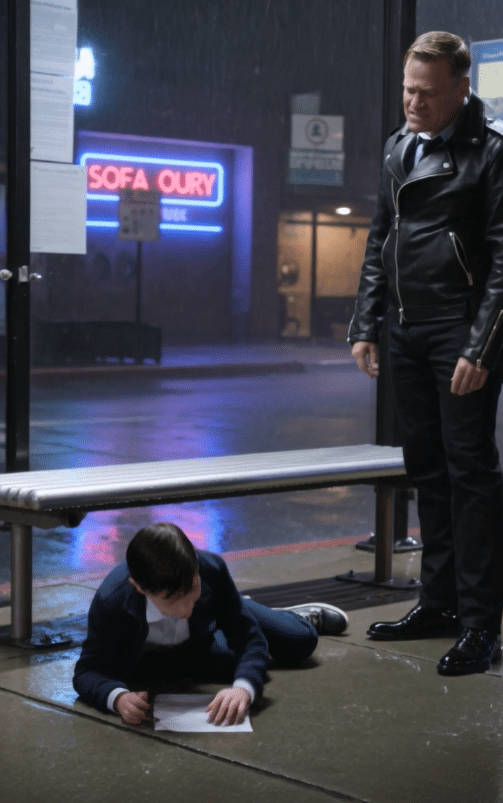
The rent envelope slipped beneath the bus bench just as the man in the expensive leather jacket grabbed it from the boy’s hands.
“No! Give it back!”
Thirteen-year-old Noah Bennett dropped to his knees on the rain-soaked pavement, reaching beneath the metal bench as the envelope skidded through a shallow puddle. Lottery tickets spilled from his old crossbody bag, scattering across the sidewalk beneath the harsh glow of a flickering neon sign.
The man laughed.
Rain dripped from the collar of Noah’s thin jacket. His fingers trembled as he tried to pull the envelope out from beneath the bench without tearing it. Inside was nearly every dollar he had earned over the past two weeks, money he had promised to deliver to his sick aunt before the rent deadline.
“Please,” Noah begged. “That’s not yours.”
The man glanced at the envelope as if it were something he had found lying in the street.
“What’s a kid like you doing with this much money?”
“It’s for my aunt.”
“Your aunt?”
The man’s expression twisted into a mocking smile.
“Sure. And I’m the president.”
A few people waiting at the bus stop turned toward them. One woman lowered her umbrella. An older man shifted uncomfortably on the bench.
Noah hardly noticed.
He was focused on the envelope.
His aunt Margaret had been sick for weeks. She had raised him after his mother died, working double shifts as a hotel housekeeper until her health finally gave out. Now she could barely climb the stairs to their apartment, and the landlord had already warned them that another missed payment could put their home at risk.
Noah had started selling lottery tickets at a licensed neighborhood kiosk after school, helping the owner restock displays and deliver orders to nearby shops. Every dollar he earned went toward groceries, utilities, and rent.
He had kept the money in a sealed envelope because he was afraid of losing it.
Now a stranger had taken it simply because he believed a poor child couldn’t possibly have an honest reason to possess it.
“Give it back,” Noah repeated, his voice cracking.
The man shoved the envelope away.
Noah lunged toward it, trying to keep it from sliding into the gutter.
That was when the kick came.
The man struck him hard in the back, knocking him face-first onto the wet pavement beside the bench. Noah’s palms slapped against the concrete, and a sharp cry escaped him as his elbow scraped across the rough surface.
The envelope landed in a puddle.
Lottery tickets fluttered into the street.
Noah struggled to breathe through the shock. He curled onto his side, grimacing, one hand pressed against his back while the other reached desperately toward the money.
The man stepped closer.
“Get up.”
Noah tried.
Pain forced him down again.
“Please,” he whispered. “My aunt needs that rent.”
The man stared at him with open contempt.
“Trash. Kids like you always scam.”
A shocked gasp rose from the bus stop.
Before anyone could move, the man delivered two more forceful kicks into Noah’s back and side. The boy curled inward, trying to protect himself while reaching for the envelope with trembling fingers.
His elbow stung. A thin trace of blood appeared on the scrape, quickly diluted by the rain.
He did not look at it.
He looked at the envelope.
“Pay rent with tears,” the man sneered.
Noah’s eyes filled, but he kept trying to reach the money.
The people around them had gone silent. One commuter covered her mouth. Another turned away, unable to watch. A young man raised his phone, uncertain whether to record the assault or call for help.
Then the sound of a powerful engine cut through the rain.
A black sedan braked sharply beside the bus stop.
The rear door opened, and a sixty-three-year-old man in a long black coat stepped onto the pavement. His assistant hurried out behind him, holding a tablet beneath her jacket to keep it dry.
The older man took in the scattered tickets, the soaked envelope, and the boy curled beside the bench.
His expression changed.
Without addressing the attacker, he moved directly toward Noah and positioned himself between the boy and the man in the leather jacket.
“Don’t try to stand yet,” he told Noah quietly. “Let someone check you first.”
Noah looked up at him, bewildered.
The stranger turned to his assistant.
“Find me his information.”
The assistant immediately opened her tablet.
The man in the leather jacket scoffed, but his confidence had begun to slip.
He had no idea who had just arrived.
And he had no idea why a wealthy property owner would recognize the name of a thirteen-year-old boy he had never met.
Act II
Noah Bennett had learned to count money before he learned to trust promises.
His aunt Margaret had taught him arithmetic at their kitchen table, using grocery receipts and loose change. She made a game of calculating discounts, comparing prices, and figuring out how far a few dollars could stretch.
“Money doesn’t make you a good person,” she used to tell him. “But knowing where it goes can keep you from being cheated.”
Noah had remembered that lesson.
He remembered it when he counted the bills in his rent envelope every night. He remembered it when he helped the lottery kiosk owner organize tickets and reconcile deliveries. And he remembered it when customers assumed that a boy in a thin jacket must be lying if he said he had earned money honestly.
His mother had died when he was eight.
Afterward, Margaret had taken him in without hesitation. She was his mother’s older sister, a quiet woman with tired eyes and a habit of keeping spare blankets folded in the hall closet.
She had never treated Noah like a burden.
When he had nightmares, she sat beside his bed. When he struggled in school, she helped him study. When he worried about being different from the other children, she reminded him that his circumstances did not determine his worth.
“You’re allowed to have a hard life,” she told him once, “without deciding that your life is a bad one.”
For years, she managed to keep their little household running.
Then her health began to deteriorate.
At first, it was fatigue. She would come home from work and sit at the kitchen table for several minutes before taking off her shoes. Then came the doctor’s appointments, the prescriptions, and the days when she could barely manage the stairs.
Eventually, she had to stop working.
The rent did not stop.
Neither did the electricity bill.
Noah tried to help in small ways. He packed his own lunches, cleaned the apartment, and learned how to prepare the simple meals Margaret could still eat when she was tired.
But he knew the numbers were getting worse.
One evening, he had overheard Margaret speaking to the landlord on the phone. She apologized repeatedly and promised that she would make a payment as soon as she could.
After she hung up, she sat very still.
Noah pretended not to notice.
The next morning, he asked the owner of a small lottery kiosk near the neighborhood shops whether he needed help after school.
The owner, Mr. Alvarez, knew Noah from years of passing by the store. He offered him legitimate part-time work organizing stock, cleaning the display, and making supervised deliveries to nearby businesses.
The money wasn’t much.
But it was honest, and it gave Noah a way to contribute without missing school.
He placed his first earnings in an envelope and wrote RENT across the front in block letters.
Margaret discovered it beneath his schoolbooks.
She had stared at the envelope for a long time before asking where the money had come from.
Noah explained everything.
Her eyes filled with tears.
“You’re a child,” she whispered.
“I’m thirteen.”
“That is still a child.”
He tried to smile.
“I know. But I’m also part of this family.”
Margaret hugged him so tightly that he could barely breathe.
She wanted to refuse his help. She wanted to tell him that school and childhood should be enough for him to worry about.
But she could not deny the reality of their situation.
So she made him promise that he would keep his schoolwork first and never take a job that put him in danger.
Noah promised.
The envelope became his symbol of responsibility. Every time he added another bill, he imagined the relief on Margaret’s face when she could finally stop worrying about the landlord.
That evening at the bus stop, he had been on his way home after delivering an order from the kiosk. He was carrying the envelope in his old crossbody bag because he intended to stop at the apartment office and make the payment the following morning.
Then the man in the leather jacket had accused him of scamming people.
Noah had tried to explain.
The man had decided not to listen.
Now, beneath the black sedan’s headlights, Noah struggled to sit upright while the wealthy stranger kept watch over him.
The assistant knelt a short distance away and introduced herself as Claire.
“My name is Claire. I’m going to call for medical assistance, okay?”
Noah nodded weakly.
“Can you tell me your name?”
“Noah.”
“Do you know where you’re hurt?”
“My back. And my arm.”
Claire contacted emergency medical services and notified the driver’s office that they would be delayed.
The older man removed his coat and carefully draped it around Noah’s shoulders without moving him unnecessarily.
“I’m Edward Whitmore,” he said. “You’re safe right now.”
Noah recognized the surname.
He had seen it printed on construction signs around the city, usually beside the name Whitmore Properties. The company owned several commercial buildings and apartment complexes, and its founder was frequently mentioned in local business news.
But Noah did not understand why someone like Edward Whitmore was standing in the rain beside him.
He looked toward the envelope.
“Please,” he said. “I need to get that money.”
Edward followed his gaze.
The envelope was lying in the puddle, its paper darkening as water soaked through it.
Edward asked Claire to retrieve it carefully, preserving its contents and avoiding any unnecessary disturbance.
She lifted it from the pavement and placed it inside a clean document sleeve from her work bag.
Noah exhaled shakily.
“Thank you.”
Edward looked at the boy for a moment.
“You were trying to protect your aunt’s rent money.”
Noah nodded.
“She’s sick. If we don’t pay, we might lose our apartment.”
Edward’s face grew serious.
He had heard that sentence before.
Not from a stranger at a bus stop, but from people who had stood in his office with folders of overdue bills, maintenance complaints, and notices they could not afford to ignore.
He owned properties throughout the city. Some were commercial buildings. Others were residential complexes where families lived paycheck to paycheck.
He had built his company by acquiring distressed properties and renovating them. He liked to believe that a building was more than a line on a balance sheet because every address represented someone else’s home.
Yet in recent months, his office had received a growing number of complaints about one particular residential portfolio.
The complaints had been summarized in reports that claimed most disputes were minor and resolved.
Edward had approved those summaries without personally examining every case.
Now he looked at a boy lying injured in the rain because he was trying to protect his sick aunt’s rent money.
And he wondered how many other people had been reduced to desperate choices while someone in his organization marked their problems as resolved.
He turned toward the man in the leather jacket.
“Stay where you are.”
The man gave an incredulous laugh.
“You don’t get to order me around.”
Edward’s expression did not change.
“No. The police will determine what happens next. But I can make sure the evidence is preserved.”
He nodded toward Claire’s tablet.
“Start with his information.”
The man in the leather jacket shifted uneasily.
He had assumed that a wealthy child would have parents who could defend him, or that a poor child would have nobody at all.
He had never considered that the boy’s circumstances might lead directly to a person with the power to examine his own world.
And the records Claire was about to uncover would turn a street-side assault into a much larger confrontation.
Act III
Edward Whitmore had spent forty years building a reputation as a businessman who understood property.
He knew how to negotiate purchases, evaluate risks, and turn neglected buildings into profitable investments. His company employed hundreds of people and managed properties across several neighborhoods.
He also knew that success could create a dangerous distance between a decision-maker and the people affected by that decision.
A report could say that a tenant had been contacted.
A spreadsheet could say that a complaint was closed.
A letter could say that a payment plan had been offered.
But none of those things necessarily meant that the person on the other end of the paperwork had been helped.
Edward had learned that lesson from his father, who had spent decades running a modest hardware store.
His father used to keep a notebook beneath the counter. Whenever a customer couldn’t afford an essential repair, he wrote down what they owed and allowed them to pay later.
Edward had once asked why his father bothered when some people never returned to settle their accounts.
His father had answered, “Because I want to know whether I made a decision I can live with.”
That answer had stayed with Edward.
Yet somewhere along the way, as his company grew, he had begun relying more heavily on systems and the people who managed them. He had assumed that professional reports reflected professional judgment.
Tonight, he decided he needed to know more.
Claire opened the tablet and asked Noah a few questions, careful not to distract him from the medical assessment that was now underway.
Noah provided his full name and his aunt’s address.
When Claire entered the information into the appropriate company records, she found a potential match.
Margaret Bennett was listed as a tenant in a residential building owned by a subsidiary of Whitmore Properties.
Edward leaned closer to the screen.
“What’s the status of her account?”
Claire reviewed the record.
“There’s a balance showing as overdue. The account notes say a payment arrangement was offered, but there’s no confirmation that the arrangement was completed.”
Edward frowned.
“Who manages that property?”
Claire read the name.
Then she opened a second set of records.
A complaint from Margaret appeared in the system, submitted several weeks earlier. It described her deteriorating health, her reduced income, and her request for additional time to make the rent payment.
The complaint had been marked as resolved.
But the file contained no clear record of a meaningful conversation with her after the initial submission.
Another note suggested that a notice had been prepared for the account.
Edward felt a cold anger rise inside him.
“Why was this marked resolved?”
Claire searched the activity log.
“The entry was made by the regional property manager’s office.”
Edward recognized the manager’s name.
Victor Sloane had worked for Whitmore Properties for nearly six years. He was known for keeping occupancy rates high and expenses low. His reports were polished, his presentations concise, and his performance reviews consistently strong.
Edward had considered him reliable.
But the records in front of him raised questions that could no longer be dismissed as routine administrative issues.
“Get me the full account history,” Edward said. “And preserve every version of the records.”
Claire began downloading the relevant documents.
The man in the leather jacket overheard enough to grow visibly uncomfortable.
“What’s all this got to do with me?” he demanded.
Edward turned toward him.
“Nothing has been established about you beyond what the witnesses and footage can show. The police will handle the assault. My company has a separate responsibility to examine its own records.”
The man scoffed.
“So you’re going to investigate everybody because some kid dropped an envelope?”
“No,” Edward replied. “I’m going to investigate because the records may indicate that someone in my organization failed to handle a tenant’s complaint properly. Those are separate issues.”
The distinction was important.
Edward would not use his position to invent a connection simply because he was angry. He would not accuse a stranger of participating in a corporate scheme without evidence.
But he would not ignore a credible question simply because answering it might damage his company.
An ambulance worker finished an initial assessment and advised that Noah receive further medical evaluation. The boy was shaken and sore, but conscious and able to answer questions.
Edward asked Claire to contact Margaret through the appropriate channels and explain that Noah was receiving medical attention.
When Margaret answered, her voice was frightened.
“Where is he? Is he all right?”
Claire reassured her that Noah was safe and that medical professionals were with him. She explained where he was and arranged for someone to accompany Margaret if she needed help reaching him.
Edward stayed nearby while Noah listened to his aunt’s voice.
“I’m sorry,” Noah whispered into the phone. “I lost the rent money.”
Margaret immediately interrupted him.
“Don’t you dare apologize for that. I don’t care about the money right now. I care about you.”
Noah closed his eyes.
Edward looked away, giving the boy a moment.
There was a time when he might have treated the overdue rent as a separate financial problem and the assault as an unrelated criminal matter.
Now the two issues stood in front of him as parts of a larger reality.
A child had been attacked while trying to protect his family’s housing.
And the records for that family’s apartment raised questions about whether the company that owned it had treated them fairly.
Claire found another document.
It was an internal report summarizing tenant complaints across several properties. A number of accounts had been categorized as resolved despite incomplete follow-up notes.
Some cases involved maintenance delays.
Others concerned payment arrangements.
The report did not prove misconduct on its own. There could be explanations for missing documentation, and each account required individual review.
But the pattern was serious enough to demand independent scrutiny.
Edward took the tablet from Claire and read the summary himself.
Then he handed it back.
“Contact our independent compliance counsel. Tell them to preserve the records and begin a review of this portfolio. No one involved in the disputed decisions is to alter the files or supervise the investigation.”
Claire nodded.
Edward looked at the name of the regional manager again.
Victor Sloane.
The man in the leather jacket watched him, suddenly aware that the encounter had grown beyond anything he could control.
Edward turned back to him.
“Now, tell me your name.”
The man’s jaw tightened.
“Why?”
“Because I want your statement documented, along with the witness accounts and the security footage from nearby businesses.”
The man looked at Claire’s tablet.
For the first time, his confidence seemed to falter.
“My information?”
He had thought the only question tonight was whether a poor boy could be trusted with money.
Now he was beginning to realize that someone might be asking very different questions about him.
Act IV
The man’s name was Grant Mercer.
He was forty years old and worked as a sales consultant for a luxury automobile dealership. He wore an expensive leather jacket, drove a polished sports car, and enjoyed reminding people that he was doing better than they were.
He had no connection to Noah’s family.
He had never met Margaret.
And he had no evidence that Noah was scamming anyone.
He had seen a child carrying money in an envelope, decided the sight was suspicious, and treated his assumption as permission to take control.
When Noah tried to explain, Grant interpreted the boy’s fear as proof of dishonesty.
When the envelope slipped beneath the bench, Grant had an opportunity to step back.
Instead, he kicked Noah.
Now, with police officers arriving at the bus stop, Grant’s excuses began to unravel.
He claimed he had been trying to prevent a scam. He said Noah had acted aggressively. He suggested that the boy had fallen while reaching for the envelope.
The witnesses contradicted him.
A commuter had seen Grant grab the envelope.
Another had watched him kick Noah after the boy bent down to retrieve it.
A nearby shop’s security camera captured part of the confrontation, including Grant standing over the boy while lottery tickets scattered across the pavement.
The officers collected statements and reviewed the available footage. Grant was required to answer questions about the assault, and the authorities would determine the appropriate legal next steps.
Edward did not interfere with that process.
He made sure that the evidence was preserved and that Noah received care.
Then he turned his attention to the records concerning Margaret’s apartment.
Within an hour, Claire had arranged a call with the company’s independent compliance counsel. Edward provided the information he had seen and requested a review of the disputed tenant accounts.
The counsel’s first recommendation was straightforward: preserve the original records, suspend routine deletion schedules for relevant communications, and prevent the managers involved from overseeing the review.
Edward approved each step.
He also asked for Margaret’s account to be reviewed by a separate team, with no presumption that the company was right simply because its own system said the complaint had been resolved.
The preliminary findings were troubling.
Margaret’s request for a temporary payment arrangement had been recorded, but the file did not contain the documentation expected to show that the arrangement had been properly explained to her. A later notice had been prepared without clear evidence that her circumstances had been reassessed.
Other tenant accounts showed similar gaps.
Some could be explained by incomplete data transfers or poor recordkeeping. Others required further investigation into decisions made by regional staff.
But the pattern raised a serious concern: the company had been measuring success by how quickly complaints were closed, not by whether the underlying problems were actually resolved.
Edward felt the weight of that failure.
He had built a company that owned people’s homes, and he had allowed polished reports to convince him that the people inside those homes were being treated fairly.
He could not undo that mistake with one phone call.
But he could stop pretending it wasn’t his responsibility.
He ordered an independent review of the affected portfolio and required a fresh assessment of tenant complaints, payment arrangements, and notices that had been issued without complete supporting records.
The company would contact affected tenants, correct verified errors, and provide appropriate remedies where mistakes had caused harm.
The review would be documented, and the findings would be reported to the board.
When Victor Sloane, the regional manager, learned that his decisions were under scrutiny, he called Edward directly.
“This is an overreaction,” Victor insisted. “We’ve always met our targets.”
“I’m not reviewing your targets,” Edward replied. “I’m reviewing the records behind them.”
“We have thousands of tenants. You can’t expect every file to be perfect.”
“No. I expect us to know when a family is asking for help and whether we actually responded.”
Victor tried to shift the discussion toward the company’s financial performance.
Edward stopped him.
“Your team marked complaints as resolved. I want to know whether they were resolved. An independent reviewer will determine that.”
The call ended without an agreement.
Victor was removed from direct oversight of the disputed portfolio while the review continued. The company made clear that the temporary measure was not a final finding of wrongdoing, but that no manager could supervise an investigation into decisions they had personally approved.
Meanwhile, Grant’s situation had changed dramatically.
His employer learned of the incident after the police began gathering evidence. The dealership initiated its own review of the matter, particularly after learning that Grant had been identified in witness statements and video footage.
His employment status was handled separately from the criminal investigation, but the public nature of the incident and the evidence against him made it impossible for him to dismiss the matter as a misunderstanding.
The man who had called Noah a scammer now found himself answering questions about why he had taken a child’s money and assaulted him in front of witnesses.
He had assumed that being dressed well would make people believe him.
Instead, the evidence spoke for itself.
But Edward was not interested in humiliating Grant in return.
He wanted accountability, not revenge.
Before leaving the bus stop, he checked that Noah had everything he needed for the immediate journey to medical care. Claire had protected the envelope in a document sleeve, and the money inside was being counted and checked with Noah’s permission.
Some bills were wet, but the contents appeared largely intact.
Noah looked at the envelope and began to cry.
“I thought it was all gone.”
Edward sat beside him, leaving enough space that the boy did not feel crowded.
“It’s understandable to be frightened,” he said. “But you don’t have to handle everything alone tonight.”
Noah wiped his face with his sleeve.
“What happens to my aunt’s rent?”
Edward paused.
He could not promise that every problem would be solved immediately, and he would not offer special treatment without understanding the facts.
But he could ensure that Margaret’s account received a fair review, that no decision was made on incomplete information, and that she had access to the company’s established process for requesting assistance.
“We’ll examine her account properly,” he said. “And we’ll make sure she has a clear answer about what is owed and what options are available.”
Noah nodded.
For the first time since Grant had grabbed the envelope, the boy seemed able to breathe without feeling that every second might cost his family their home.
Edward watched the rain slide down the bus shelter’s glass.
Then he asked Claire to arrange one final meeting.
Not with Grant.
Not with Victor.
With Margaret Bennett.
Because the most important part of the night had never been the man’s expensive jacket or the wealthy owner stepping from a black sedan.
It was the family whose life had been reduced to a wet envelope and a desperate boy on his knees.
And Edward intended to make sure that family was finally heard.
Act V
Margaret arrived at the medical center shortly before midnight, supported by a neighbor who had accompanied her from the apartment.
She looked exhausted and frightened, her cardigan pulled tightly around her shoulders. When she saw Noah sitting beneath a warm blanket, she hurried toward him as quickly as her aching legs allowed.
“Noah!”
He stood carefully and wrapped his arms around her.
Margaret held him as if she could protect him from everything that had happened simply by refusing to let go.
“I’m sorry,” he whispered. “I tried to keep the money safe.”
Margaret pulled back and looked directly into his eyes.
“You did nothing wrong.”
“But the envelope—”
“I don’t care about the envelope.”
She touched his face.
“I care that someone hurt you.”
Noah began to cry again.
Margaret held him until the tears passed, and Edward waited nearby without interrupting.
When she was ready, he introduced himself and explained why his company had been looking into her apartment account.
Margaret listened with guarded disbelief.
She had submitted her complaint weeks earlier. She had called the property office more than once and had been told that someone would get back to her.
Each time she called, she had felt a little more ashamed.
She worried that the company would see her illness as an excuse. She worried that the overdue balance would make them view her as irresponsible. She worried that if she asked too many questions, someone would decide she was not worth helping.
Edward listened without defending his staff.
When she finished, he apologized for the way her complaint had been handled.
“I can’t tell you yet exactly where the failure occurred,” he said. “But I can tell you that the records are being reviewed independently, and you will receive a clear explanation of your account. If the review finds errors, we will correct them.”
Margaret studied his face.
“Why are you doing this?”
Edward glanced at Noah.
“Because your nephew was trying to protect your home tonight. And because a company that owns people’s homes has a responsibility to treat them fairly.”
He did not offer her a dramatic promise that she would never have to worry about money again.
He offered a process she could understand, a direct contact for follow-up, and a commitment that her account would not be handled by the same people whose decisions were being reviewed.
For Margaret, that was the first meaningful reassurance she had received in weeks.
Over the following days, Noah recovered from his injuries. His back remained sore for a while, and he needed rest, but medical professionals found no evidence of a life-threatening injury.
The wet rent envelope was dried carefully, and the money was checked. Some of the bills were damaged by the rain, but the amount could be established.
Noah was able to return to school.
Mr. Alvarez, the lottery kiosk owner, held his position open and helped arrange a schedule that would not interfere with his classes. He also made sure Noah understood that he did not have to return to work before he was ready.
The boy had spent so much time worrying about everyone else that he had almost forgotten he was allowed to recover.
Meanwhile, the review of Margaret’s housing account continued.
The company eventually identified failures in the way her request had been processed. The complaint had been closed without adequate confirmation that she understood the available options, and the account records had not been updated consistently.
The company corrected the documented errors, provided Margaret with a clear accounting of the balance, and offered an appropriate payment arrangement under its revised procedures.
The wider audit also led to changes in how tenant complaints were tracked. A case could no longer be marked resolved solely because a response had been sent. The process required evidence that the issue had been addressed or a clear record of the remaining steps.
Victor Sloane remained under review while the company assessed his role in the failures. Any further employment decisions were based on the completed findings rather than speculation.
Edward also required the board to receive regular reports on the corrective measures.
He knew that a policy change on paper meant little if nobody checked whether it worked.
As for Grant Mercer, the police investigation proceeded through the appropriate legal channels. The witness accounts and video evidence were considered as part of that process, while his employer made its own decision about his future.
He could no longer claim that he had merely misunderstood a child’s intentions.
He had taken the envelope.
He had attacked Noah.
And he had done so because he believed that a boy with little money and no visible authority could be treated however he pleased.
The consequences followed him beyond that rainy bus stop.
But the most important change happened somewhere quieter.
Several weeks later, Noah sat at the kitchen table with Margaret, helping her organize the paperwork for the apartment account.
The rent envelope lay between them.
It had been replaced with a clean one, and Noah had written the amount on the front in careful block letters.
Margaret looked at it and shook her head.
“You know you don’t have to carry everything for me.”
Noah lowered his eyes.
“I just wanted you to be okay.”
“I know.”
She reached across the table and took his hand.
“But being family doesn’t mean you have to be the adult all the time.”
Noah looked up.
For months, he had believed that his value came from how much he could earn, how many problems he could solve, and how well he could hide his fear.
Now Margaret was reminding him that he was still a boy.
He was allowed to go to school.
He was allowed to laugh with friends.
He was allowed to have a future that wasn’t defined by an overdue bill.
He squeezed her hand.
“Okay,” he said quietly.
Then he smiled.
“But I’m still going to help.”
Margaret laughed through her tears.
“I wouldn’t expect anything less.”
The next time Noah passed the bus stop, the rain had stopped.
The metal bench was dry, and the neon signs reflected in the pavement without being broken by puddles. Commuters moved past with their heads down, hurrying toward buses and trains.
Noah paused beside the bench.
He remembered the envelope sliding beneath it. He remembered the pain of hitting the pavement and the terror of watching the money drift through the rain.
He also remembered the moment the black sedan stopped.
For a while, he had thought the most important thing about that night was that a wealthy man had appeared and changed everything.
But as the weeks passed, he understood that Edward’s arrival had mattered for a different reason.
Edward had listened.
He had protected Noah without demanding that the boy prove his worth first. He had examined the evidence instead of relying on appearances. And when the evidence raised questions about his own company, he had allowed those questions to be investigated.
That was what made the difference.
Noah adjusted the strap of his crossbody bag and continued toward school.
Inside the bag was a notebook, a packed lunch, and the clean rent envelope he and Margaret had prepared together.
He was still young.
His family still had challenges to face.
But he no longer believed that one cruel stranger could determine the value of his life.
Grant had looked at a thirteen-year-old boy with a wet envelope and seen a scammer.
Edward had looked at the same boy and seen someone worth protecting.
The difference had never been the money.
It had been the willingness to look beyond appearances—and the courage to act when the truth became impossible to ignore.