Act I
The delivery bag hit the wet marble floor, and a small medicine box slid out of it.
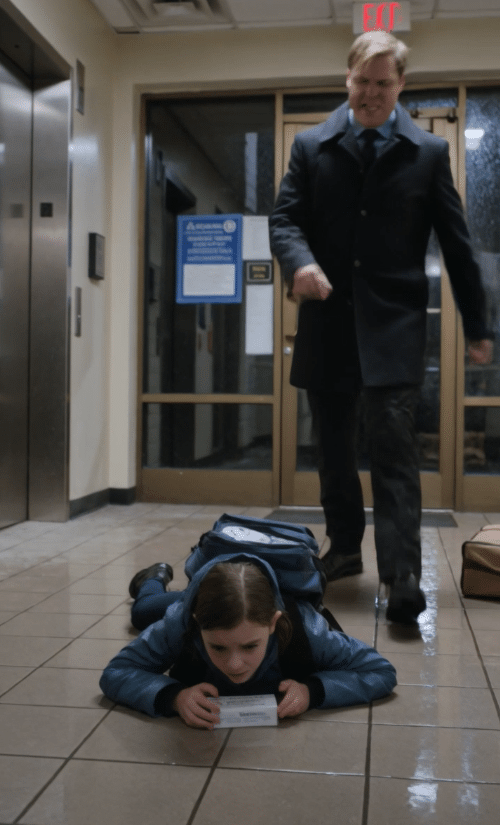
Fourteen-year-old Daniel Brooks dropped to his knees, reaching desperately for the box before it could slide into a puddle beneath the leaking lobby ceiling. Rainwater dripped from his thin jacket, his old backpack hung from one shoulder, and his sneakers left muddy prints across the polished tiles.
“Careful!” a man snapped. “Look what you’ve done!”
Daniel barely heard him.
He was watching the medicine box.
His grandmother had been waiting for that medicine all evening.
The man standing over him was forty-two-year-old Victor Lang, a resident of the building who wore an expensive black coat and carried himself as though every square inch of the lobby belonged personally to him. He had been complaining about the rain, the broken elevator, and the building staff since arriving home.
Now he had found someone he considered beneath him.
“You people have no respect for anything,” Victor said.
Daniel reached for the box.
Victor kicked him hard in the back.
The boy pitched forward onto the slick tile, his palms sliding against the floor. The medicine box skidded beside his chest, and his elbow scraped the rough edge of a tile. A thin trace of blood appeared along the scrape.
For a second, Daniel couldn’t catch his breath.
He curled onto his side, his face tightening with pain and shock. Rainwater dripped from his hair onto the floor beneath him, and he tried to pull his knees underneath himself without letting the medicine box slip farther away.
Victor stepped closer.
Daniel looked up, frightened, and reached for the box again.
Two more forceful kicks struck his back and side.
A woman near the mailboxes gasped. An older resident covered his mouth, while another person backed toward the elevator doors without saying a word.
Nobody moved to help.
Daniel finally dragged the medicine box against his chest.
“Please,” he whispered. “My grandma needs this medicine.”
Victor looked at the boy as if he had said something ridiculous.
“Trash. You ruined my lobby.”
Daniel blinked back tears.
“I can clean it up. I’ll clean everything.”
“That isn’t the point.”
Victor gestured toward the muddy footprints, the leaking ceiling, and the delivery bag lying open on the floor.
“You don’t belong in here tracking dirt everywhere.”
Daniel’s throat tightened.
He had been working for a neighborhood restaurant since his mother died two years earlier. His grandmother, Ruth, had raised him from the time he was a baby, and now that she was struggling with a serious illness, Daniel was trying to help cover the small expenses that kept their household running.
He delivered food after school and on weekends, often walking the last several blocks when his bicycle broke down. The money wasn’t much, but it bought groceries and helped pay for the things Ruth needed.
Tonight, one of his regular customers had learned that Ruth was sick and had given him the medicine box to bring home.
Daniel had promised he would deliver it safely.
Now he was lying on a wet floor, afraid that even one more second of delay might matter.
Victor bent toward him, not to help, but to make sure the boy understood who held the power.
“Deliver yourself outside.”
Daniel looked toward the glass entrance.
Rain hammered the pavement beyond it. The lobby doors were the only barrier between him and the storm, and the medicine box in his hands was the only thing he could think about.
“I just need to get home,” he said.
Victor’s face hardened.
“Then get out.”
The residents watched in silence.
Then headlights swept across the lobby windows.
A black car braked sharply at the curb outside.
The rear door opened, and a tall man in a long navy coat stepped into the rain. The building’s security manager hurried ahead, unlocking the glass entrance as the man crossed the threshold.
He took in the wet floor, the scattered delivery bag, and the boy curled around a medicine box.
His eyes stopped on Daniel’s scraped elbow.
Then he looked at Victor.
The man in the navy coat didn’t raise his voice.
He didn’t need to.
“Shut down his access card.”
The security manager froze for half a second before moving between Daniel and Victor.
Every resident in the lobby went silent.
Victor’s expression changed.
He knew the man who had just entered.
What he didn’t understand was why the owner of the entire building had arrived in the middle of a storm—and why his first order had been about Victor’s access card.
Act II
The man’s name was Jonathan Reed.
At sixty-one, he owned the building, along with several other residential properties across the city. He had built his company over three decades, beginning with a small apartment complex he bought after years of working in construction management.
He was wealthy, but he was not the sort of landlord who appeared only when rent was due or a property was sold.
Jonathan visited his buildings regularly, often without announcing himself. He spoke to maintenance workers, reviewed repair requests, and asked residents whether management had responded to their concerns.
He knew that a building could look immaculate in a brochure while the people living inside it dealt with broken elevators, unreliable heating, and leaking ceilings.
That was why the lobby’s condition bothered him immediately.
The ceiling was dripping into a plastic bucket near the mailboxes. A handwritten notice explained that the elevator was out of service again. One section of tile had been taped off, and the security desk was piled with unanswered maintenance forms.
Jonathan had received a report about the leak earlier that week.
He had expected it to be repaired.
Instead, he had arrived to find a boy being assaulted over the water on the floor.
“Is he injured?” Jonathan asked the security manager.
“I believe so, sir.”
“Then get him medical assistance. Call emergency services if needed, and keep that area clear.”
The security manager immediately turned his attention to Daniel, speaking gently and asking him not to move until someone could assess his injuries.
Jonathan removed his own coat and placed it around the boy’s shoulders.
Daniel looked startled.
“I’m getting your coat wet,” he said.
“Don’t worry about the coat.”
Jonathan crouched beside him.
“What’s your name?”
“Daniel.”
“Daniel, can you tell me where you’re hurting?”
“My back. My elbow.”
“And the medicine?”
Daniel looked down at the box pressed between his hands.
“I need to get it home.”
“We’ll make sure it gets there safely.”
Jonathan said it with such certainty that Daniel’s shoulders loosened slightly.
Then Jonathan looked at the delivery bag, the muddy footprints, and the man standing beside the elevator.
“Did he do this to you?”
Victor straightened his coat.
“This is a private building. He came in dripping water all over the lobby and refused to leave when I told him to.”
Jonathan studied him.
“So you threw his bag onto the floor?”
“He was blocking the entrance.”
“And kicked him?”
Victor’s jaw tightened.
“He was being difficult.”
Jonathan looked toward the witnesses.
“Did anyone see what happened?”
The older resident near the mailboxes lowered his hand.
“I did.”
A woman stepped forward.
“So did I.”
Their voices were hesitant, but their accounts were consistent. Victor had thrown the bag down. Daniel had bent to retrieve the medicine. Victor had kicked him, then continued after the boy fell.
There was no misunderstanding to resolve.
No accidental collision.
No reasonable interpretation that could turn what had happened into a dispute over muddy shoes.
Jonathan stood.
“Mr. Lang, I want you to step away from him.”
Victor looked incredulous.
“You can’t speak to me like that.”
“I’m asking you to move away from an injured child.”
“I live here.”
“I know.”
That answer seemed to reassure Victor for a moment.
He lived in one of the building’s most expensive apartments, on a high floor overlooking the river. He paid substantial rent, entertained business associates, and frequently reminded the staff that residents like him helped pay their salaries.
He had complained about the lobby’s condition repeatedly.
He had demanded that delivery workers use a side entrance, even though the designated service entrance had been locked for repairs. He had also complained about residents who left umbrellas near the doors, children who made noise, and maintenance workers who carried equipment through common areas.
Management had grown accustomed to his demands.
Some employees feared his temper. Others believed it was easier to accommodate him than to risk a formal complaint.
Over time, Victor had mistaken the staff’s reluctance to challenge him for proof that he was entitled to special treatment.
He had never asked who owned the building.
He had never needed to.
To him, the lobby was a stage on which everyone else was supposed to follow his instructions.
Now Jonathan Reed stood in front of him, and that assumption was beginning to collapse.
Jonathan turned toward the security manager.
“Disable Mr. Lang’s access card while we review what happened. Preserve the lobby footage and document every witness account.”
Victor’s face reddened.
“You’re suspending my access because of some delivery kid?”
“No,” Jonathan replied. “I’m responding to an assault that happened in my building.”
“That’s ridiculous. I pay to live here.”
“And Daniel deserves to leave here without being attacked.”
Victor glanced at the people watching.
He expected someone to defend him, or at least to remind Jonathan that a paying resident had rights.
Nobody did.
The security manager guided Daniel toward a dry seating area while another employee called for medical help. Jonathan stayed nearby until the boy was comfortable enough to answer a few questions.
“Where are you taking the medicine?” Jonathan asked.
“To my grandma. She lives a few blocks away.”
“Is she expecting you?”
Daniel nodded.
“She gets worried if I’m late.”
Jonathan’s expression softened.
“What is her name?”
“Ruth Brooks.”
“And is there someone who can meet you?”
“No. It’s just us.”
Jonathan glanced toward his assistant, who had followed him inside.
“Please arrange a safe way for Daniel to get home once he’s been checked by the medical team. Make sure the medicine stays with him.”
Then he looked toward the leaking ceiling.
“And find out why this repair hasn’t been completed.”
The security manager nodded.
Jonathan had come to the building that night because he wanted to inspect the property before an upcoming meeting with his management company. He had not expected to uncover a security incident, a maintenance failure, and a possible pattern of residents intimidating people who worked in the building.
But as he watched Victor arguing with the security manager, one detail troubled him more than the rest.
Victor seemed genuinely convinced that his rent gave him the right to decide who deserved to stand in the lobby.
Jonathan knew that kind of entitlement rarely appeared overnight.
And the building’s records would soon reveal how long it had been allowed to grow.
Act III
The first thing Jonathan requested was the lobby security footage.
The security manager brought him into the small office behind the reception desk. Rain rattled against the windows, and the fluorescent lights flickered whenever the old elevator motor started somewhere above them.
On the monitor, the incident played without sound.
Victor entered the lobby and stopped near the entrance. Daniel arrived moments later, wet from the storm, carrying his delivery bag and a small medicine box.
Victor pointed toward the floor.
Daniel began to move around him.
Then Victor seized the bag and threw it down.
The medicine box slid across the tile.
Daniel bent to retrieve it.
Victor kicked him.
The boy fell. Victor followed him and kicked him again.
Jonathan watched without speaking.
The footage showed no threat from Daniel, no physical confrontation, and no reason for Victor to use force. The witnesses’ accounts were accurate.
“Save the original recording,” Jonathan said. “Make a secure copy. I want the incident documented according to our procedures.”
The security manager nodded.
Then he hesitated.
“Sir, there’s something else.”
Jonathan turned.
“What?”
“We’ve had complaints about Mr. Lang before.”
“How many?”
The security manager opened a folder on the desk.
At first, the complaints appeared unrelated. One delivery driver had reported being verbally abused for using the main entrance. A cleaner had described Victor shouting at her over a wet floor sign. A family had complained that he had demanded their child be removed from the lobby because the child was playing near the mailboxes.
There were also reports of Victor confronting maintenance staff and insisting that they prioritize his requests over other residents’ repairs.
Some complaints had been marked resolved.
Others had been closed after management spoke privately with Victor.
A few had no documented outcome at all.
Jonathan read them carefully.
“Who approved these closures?”
The security manager looked uncomfortable.
“Mostly the previous property manager.”
“Why?”
“He said Mr. Lang was an important resident. He didn’t want small disagreements to become legal disputes.”
Jonathan closed the folder.
“An important resident is not exempt from the rules.”
The security manager lowered his eyes.
“No, sir.”
Jonathan asked for the property manager to be contacted immediately.
While they waited, he reviewed the maintenance reports. The leaking ceiling had been reported more than once. The broken elevator had a backlog of repair requests. There were also unresolved complaints about water accumulating near the lobby entrance whenever heavy rain struck.
The management company had been informed of these problems.
Some repairs had been delayed because contractors were waiting for approval. Other work had been postponed while the building reviewed competing maintenance priorities.
The records did not prove that Victor’s complaints had directly caused the delays.
But they revealed a culture in which loud, influential residents received immediate attention while other people waited.
Jonathan felt a familiar anger rising beneath his calm expression.
He had invested in the building because he believed good housing management required more than collecting rent. The company had policies for maintenance, safety, and resident conduct precisely because no single resident should be allowed to dictate how everyone else was treated.
Yet those policies had become flexible whenever someone complained loudly enough.
The property manager arrived twenty minutes later.
His name was Peter Walsh, and he looked as though he had been dragged out of bed.
He began explaining the incident before Jonathan could ask a question.
“Mr. Reed, I understand there was a confrontation. We’re still gathering information, but Victor can be difficult. He’s been frustrated with the state of the lobby for weeks.”
Jonathan stared at him.
“A fourteen-year-old boy was kicked on the floor.”
Peter stopped talking.
“I understand, sir.”
“Do you?”
Jonathan pushed the incident reports across the desk.
“How many complaints about this resident have been closed without a documented resolution?”
Peter looked down.
“Some of those were minor disputes.”
“Then documenting the resolution should have been easy.”
Peter shifted uncomfortably.
“We were trying to keep the building running smoothly.”
“By allowing a resident to intimidate delivery workers and staff?”
“That’s not how I would describe it.”
Jonathan pointed toward the monitor.
“Then describe what you see.”
Peter watched the footage.
His face tightened.
For the first time, he seemed to understand that this was not a complaint that could be settled with an apology and a discount on next month’s rent.
Jonathan instructed him to preserve all related records and cooperate with an independent review of the building’s complaint-handling procedures. He also placed Peter’s management decisions under review while the company investigated whether prior reports had been handled appropriately.
The property manager’s voice became smaller.
“Are you removing me?”
“I’m reviewing your performance. What happens next depends on what the records show.”
Jonathan returned to the lobby.
Daniel had been examined by medical personnel, who were determining whether he needed further care. His injuries appeared limited to bruising and the scrape on his elbow, but he was shaken and sore.
Jonathan made sure the boy’s grandmother had been contacted and that the medicine could be delivered safely.
Then he asked the security manager about Victor’s access card.
“Has it been disabled?”
“Yes, sir.”
“Good. Make sure the temporary restriction is handled under the building’s policies, and don’t let anyone use it to prevent emergency access or interfere with any legal rights he has as a resident.”
The security manager nodded.
Jonathan was angry, but he had no intention of turning his authority into another form of arbitrary punishment. Victor would face an investigation, and any further action would follow the lease, building policies, and applicable law.
What mattered was that he could no longer use his status to intimidate people without consequence.
As Jonathan returned to Daniel, the boy looked up at him.
“Am I in trouble?”
The question made Jonathan pause.
“Why would you be in trouble?”
“Because I got the floor dirty.”
Jonathan pulled a chair closer.
“Daniel, a wet floor can be cleaned. An injured child deserves help. Those are not the same thing.”
Daniel stared at him, trying to understand.
Then he looked down at the medicine box.
“Can I still take this home?”
“Yes,” Jonathan said. “That’s the first thing we’re going to make sure happens.”
But when the security manager returned with one final document, Jonathan realized that Victor’s access card was only one part of the problem.
The card had been issued under the building’s standard resident system.
What made the situation complicated was a special privilege attached to Victor’s account—one that had been approved after repeated complaints and had quietly given him influence over how the lobby was managed.
And now Jonathan wanted to know who had authorized it.
Act IV
The document was a resident-service exception form.
It had been created after Victor complained that the lobby was frequently crowded during the evening delivery rush. He argued that delivery workers brought water and dirt inside, blocked the entrance, and made the building look poorly managed.
Instead of enforcing the existing rules consistently, the former property manager had tried to satisfy him.
The resulting arrangement gave Victor permission to submit priority complaints about common-area cleanliness and request immediate intervention from security when he believed a visitor was violating building rules.
On paper, the exception did not give Victor the authority to physically remove anyone.
It did not authorize him to seize property, assault a delivery worker, or order someone out of the building.
But the way it had been implemented was troubling.
Security staff had been instructed to respond quickly whenever Victor complained. His requests were flagged for priority handling, while similar concerns from other residents were processed through the normal system.
The arrangement had never been properly reviewed.
Jonathan read the form twice.
“Who approved this?”
Peter Walsh stood nearby, pale and exhausted.
“The previous property manager recommended it. I inherited the arrangement.”
“And did you review it?”
Peter hesitated.
“Not formally.”
Jonathan placed the document on the desk.
“So a resident complained about wet floors, and management gave him a special channel to demand action.”
“Yes.”
“Did anyone explain to him that this did not give him authority over other people?”
Peter had no answer.
Jonathan looked toward the lobby.
Victor stood near the entrance with his arms crossed, arguing with the security manager about the disabled card.
“This is outrageous,” Victor said. “I’ve lived here for eight years. I have never been treated this way.”
The security manager remained professional.
“Your access restriction is temporary while the incident is reviewed. You will receive written information about the process and any steps required under the building’s policies.”
“I want to speak to the owner.”
Jonathan stepped into view.
“You’re speaking to him.”
Victor turned sharply.
For a moment, he seemed to forget the boy on the floor, the witnesses, and the footage that had already captured his actions.
He focused instead on his own inconvenience.
“You can’t disable my card because I complained about a mess.”
“Your card was restricted after you assaulted a delivery worker. Those are different issues.”
“He was tracking water everywhere!”
“He was delivering food and carrying medicine for his grandmother.”
“He shouldn’t have been in the lobby.”
Jonathan’s expression hardened.
“The building’s designated service entrance has been unavailable because of repairs. Management knew that. The main entrance remained the permitted route.”
Victor scoffed.
“Then management should have kept it clean.”
“And you should have behaved like an adult.”
The words echoed through the lobby.
Victor glanced at the residents watching from a distance.
He lowered his voice.
“I pay a substantial amount to live here. You can’t treat me like some criminal because of a misunderstanding.”
Jonathan took a measured breath.
“No one has declared you guilty of a crime. The incident is being documented, and the appropriate authorities can determine whether further action is warranted. But your status as a resident does not give you permission to hurt someone.”
Victor’s face reddened.
“So what happens now?”
“Your access privileges remain restricted as permitted by the applicable policies while the immediate safety issue is reviewed. You will receive written notice of the process. Your lease and legal rights will be respected, but you will not be allowed to use building privileges to intimidate other people.”
Victor stared at him.
Jonathan continued.
“We are also reviewing how your previous complaints were handled. If management gave you authority that you were never entitled to exercise, that arrangement ends.”
For the first time, Victor looked uncertain.
He had assumed the building would protect him because he paid more than most residents. He had assumed the staff would continue smoothing over his behavior because challenging him was inconvenient.
He had never considered that the same records he relied on to prove his importance could expose how the system had been bent around his demands.
Jonathan turned toward the security manager.
“Make sure Daniel and his grandmother are safely reunited. Arrange transport if needed. And document every step.”
Then he addressed Peter.
“I want an independent review of the complaint system, maintenance delays, and access privileges. No more exceptions without a written policy, a clear reason, and proper approval.”
Peter nodded.
“Yes, sir.”
“Every resident gets the same process. Every employee gets the same protection. Every visitor is entitled to basic safety.”
Jonathan paused.
“And no one gets to decide that a person’s worth depends on how much money they have.”
The residents stood quietly.
Several who had watched Victor’s earlier outbursts looked relieved. One woman admitted that she had stopped reporting maintenance issues because she feared being drawn into a confrontation with him. A delivery driver who had been waiting near the entrance quietly confirmed that Victor had yelled at him before.
Their accounts did not replace a formal investigation, but they showed that Daniel’s experience had not occurred in a vacuum.
The building had developed a pattern of looking away whenever a powerful resident made other people uncomfortable.
That pattern was now being examined.
In the days that followed, management reviewed the records, interviewed staff, and established clearer procedures for handling resident complaints. The special priority arrangement attached to Victor’s account was revoked, and the access-card system was revised so that no resident could use a personal complaint privilege to direct security staff against others.
Peter was removed from his role after the review found that he had failed to supervise the exception properly and had not ensured that complaints were handled consistently. The company began searching for a replacement with a stronger record of resident and staff management.
Victor received formal written notice concerning the incident and the building’s conduct procedures. The company preserved the footage and witness statements for any further proceedings.
Jonathan did not promise Daniel that Victor would lose his apartment overnight.
He promised that the case would be handled properly, that the boy’s injuries would not be dismissed as a minor inconvenience, and that the building would no longer allow the same behavior to go unchallenged.
For Daniel, those promises mattered.
But the most important moment came when he finally reached his grandmother’s apartment.
Act V
Ruth Brooks had been waiting by the door.
She was seventy-two, small and frail, with silver hair that she usually pinned neatly behind her ears. Since her health had begun to deteriorate, she had become increasingly dependent on Daniel for errands she once handled herself.
She hated that he had to work so hard.
He hated that she worried.
Every evening, he promised her that he was careful. Every evening, she told him that no amount of money was worth his safety.
Neither of them had found a way to stop worrying about the other.
When the door opened and Daniel appeared with a medical worker beside him, Ruth’s face changed.
“Daniel?”
“I’m okay, Grandma.”
He tried to smile, but his voice broke.
Ruth reached for him.
“What happened?”
Daniel hesitated.
He didn’t want her to imagine the worst, but he couldn’t hide the bruises or the scrape on his elbow.
“A man got angry about the lobby,” he said. “He threw my bag.”
Ruth looked at the medicine box in his hands.
“And this?”
“I kept it safe.”
Her eyes filled with tears.
“Oh, sweetheart.”
She pulled him into an embrace, holding him as carefully as she could. Daniel pressed his face against her shoulder and finally allowed himself to cry.
He had stayed quiet in the lobby because he was afraid that showing fear would make things worse. He had tried to be brave because he knew Ruth was waiting.
Now, with her arms around him, he no longer had to pretend that he hadn’t been frightened.
“I thought I wouldn’t get home,” he whispered.
Ruth closed her eyes.
“You’re home now.”
The medicine was handed over safely, and Ruth was given the information she needed to follow up with her healthcare provider. The building owner arranged for the appropriate support services to check whether the family needed additional assistance, without making promises about treatment or substituting for medical care.
Before leaving, Jonathan spoke with Ruth.
He explained what had happened in the lobby and apologized for the failures in the building’s management.
Ruth listened carefully.
When he finished, she looked at Daniel.
“He works too hard,” she said softly. “He shouldn’t have to be afraid just to bring something home.”
Jonathan nodded.
“He shouldn’t.”
Ruth turned back toward him.
“Then please make sure the next child doesn’t have to go through this.”
It was the same request Laura might have made, had she been there: don’t let this happen to someone else.
Jonathan had heard the demand in many forms over the years. It was easy to agree in the moment and difficult to carry out when the headlines faded and the paperwork became tedious.
This time, he wrote the commitment into the building’s corrective action plan.
The management company introduced a clearer procedure for delivery access during bad weather and repairs. Residents were reminded that they could report concerns but could not take enforcement into their own hands. Security staff received updated training on de-escalation, incident reporting, and the obligation to protect people from immediate harm.
The leaking ceiling was repaired, and the elevator’s maintenance schedule was reviewed. The company also began tracking unresolved complaints more carefully, so a request could not simply disappear because it came from someone without influence.
The changes were not dramatic enough for a television headline.
They were more important than that.
They made it harder for the next person to be ignored.
In the weeks that followed, Daniel returned to school and gradually resumed his delivery shifts. He was more cautious around the building, sometimes glancing at the lobby doors before entering.
But he no longer had to carry the entire weight of what happened alone.
The witnesses had provided statements. The building had preserved the evidence. Management had acknowledged its failures, and the incident was being handled through the appropriate channels.
Victor, meanwhile, discovered that the world he had grown accustomed to was changing.
His access privileges were no longer special. Security staff no longer treated his complaints as commands. When he raised concerns about common areas, they were logged and handled according to the same process used for everyone else.
The building did not become hostile toward him.
It simply stopped giving him a private set of rules.
That was what he had feared most.
Not humiliation.
Not even losing an argument.
He feared being ordinary in a place where he had spent years believing he was entitled to more.
The disabled access card had forced him to confront a truth he had never considered: paying to live somewhere did not make the people around him his servants.
It did not give him ownership of the lobby.
And it certainly did not give him the right to decide whether a fourteen-year-old boy deserved to be safe.
One month after the incident, Daniel returned to the lobby with a delivery bag over his shoulder.
Rain was falling again, though not as heavily as it had that night. Water shimmered on the pavement outside, and the entrance mats were damp.
Daniel paused at the door.
For a moment, he remembered the medicine box sliding across the floor. He remembered the pain in his back, the blood on his elbow, and the way the witnesses had stood frozen while Victor looked down at him.
Then he took a breath and walked inside.
The security guard greeted him.
“Evening, Daniel.”
“Evening.”
The guard moved aside to let him pass.
No one told him he didn’t belong.
No one treated his wet jacket as an offense.
At the reception desk, a maintenance worker was placing a fresh mat near the entrance. The ceiling above them was dry, and the elevator notice had been removed.
Daniel looked around.
It was still the same building.
But it no longer felt as though one person’s anger could decide what everyone else was allowed to do.
As he stepped toward the elevator, his phone vibrated.
A message from Ruth appeared on the screen.
Don’t forget to eat something before you come home. And be careful in the rain.
Daniel smiled.
He typed back, I will. Love you, Grandma.
Then he slipped the phone into his pocket and continued upstairs.
Jonathan Reed never forgot the image of the boy on the wet tile, holding a medicine box as if letting go of it would mean failing the only person who had always been there for him.
It reminded him that a building’s true condition could not be measured by polished floors, expensive apartments, or the size of its residents’ rent payments.
It had to be measured by what happened when someone vulnerable walked through the door.
Because the most revealing moment in any building was not when its wealthiest resident demanded attention.
It was when a frightened child needed help—and everyone had to decide whether they would look away.
That night, the owner had arrived in a black car.
But the real power shift had not begun when he ordered Victor’s access card disabled.
It had begun when he refused to let money determine whose dignity mattered.
And for Daniel Brooks, that difference meant he could finally carry medicine home without wondering whether the next person he met would decide he didn’t belong.