Act I
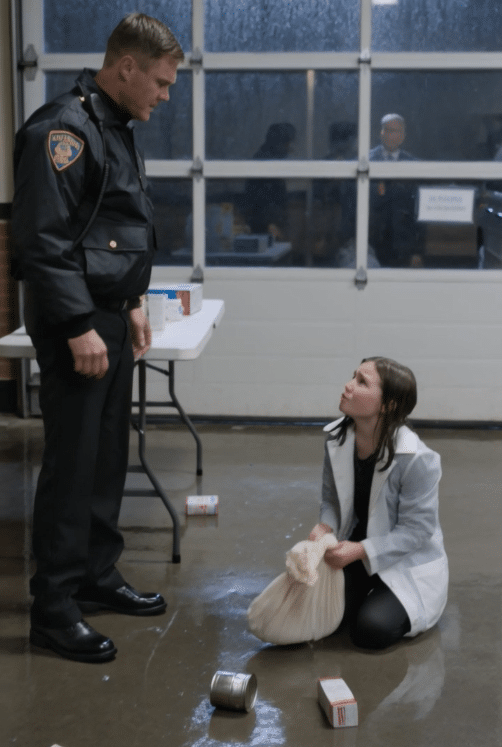
The cans were still rolling across the wet warehouse floor when fifteen-year-old Emily Carter realized she could no longer protect everything in the bag.
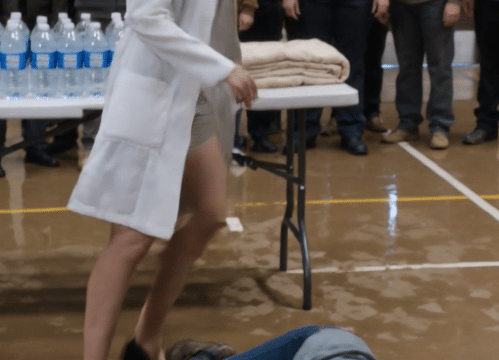
A can of soup spun beneath a metal table. Two tins of beans struck the concrete wall with a hollow clatter. A small white medicine box slid through a shallow puddle, stopping just inches from a drain.
Emily dropped to her knees, reaching desperately for the medicine.
“Please, don’t let it get wet.”
The man standing over her gave a contemptuous laugh.
He wore a black security jacket with a radio clipped to his shoulder. His name was Grant Mercer, and for the past three years, he had worked the night shift at the county’s largest storm-relief warehouse. He had a reputation for being strict, but the volunteers who worked with him knew the truth was uglier: Grant enjoyed making people feel small when he believed nobody important was watching.
He had already decided Emily was a thief.
“You think I didn’t see you taking extra supplies?” he demanded.
Emily looked up, rainwater dripping from her hair onto her pale cheeks.
“I didn’t take extra. They gave me this bag.”
“Who gave it to you?”
“The woman at the table. She said it was the last family package.”
Grant seized the torn handle of the bag and yanked it away from her. The remaining food spilled across the floor, mixing with rainwater tracked in by volunteers and families arriving from the flooded neighborhoods.
Emily scrambled to gather it.
“Please. It’s for my little brother.”
Grant kicked her hard in the back.
She fell face-down beside the scattered supplies. Her forearm scraped the concrete, leaving a thin trace of blood, but she barely noticed. She was staring at the medicine box, which had stopped near her hand.
She reached for it.
Grant stepped closer and kicked her again, then delivered another forceful blow to her back and side.
Emily curled instinctively, gasping as pain seized her body. Her fingers closed around the medicine box, and she pulled it against her chest as though it were the only thing left in the world she could save.
Several volunteers froze.
An older woman covered her mouth. A young man near the loading dock took one step forward, then stopped when Grant turned his head and glared at him.
Nobody wanted to become his next target.
Emily struggled to lift herself onto one elbow.
“Please,” she whispered. “My brother needs this.”
Grant looked down at her with open disgust.
“Trash. Orphans always take extra.”
The words hurt almost as much as the kicks.
Emily had heard people whisper about her being an orphan before. She had heard adults describe children like her as trouble, as charity cases, as problems that belonged to somebody else.
But she had never heard anyone say it while standing over her and the medicine her brother needed.
Grant pointed toward the warehouse entrance.
“Leave the charity for real families.”
Emily blinked back tears.
She wanted to tell him that her brother was a real family. That they had lost their parents in a highway accident two years earlier, and that since then, every meal, every doctor’s appointment, and every cold night had become something she had to figure out before she was old enough to understand how unfair the world could be.
She wanted to tell him that she had spent the afternoon walking through flooded streets to reach the warehouse because the storm had knocked out power in their apartment building and left her little brother coughing with a fever.
Instead, she gathered another can.
She had learned that explanations did not always make cruel people kinder.
Then a black SUV braked hard outside the warehouse.
The large entrance doors swung open, and a tall man in a long gray coat strode inside, accompanied by two senior volunteers and private security officers.
He saw the girl on the floor.
He saw the scattered medicine.
And he saw Grant standing over her.
The man crossed the warehouse without hesitation. He placed himself between Emily and the guard, then signaled to the security officers to protect the girl while the senior volunteers collected the food and medicine.
Only after Emily was safe did he turn toward Grant.
“Remove him from every relief site.”
Grant stared at him.
For the first time that night, the guard’s expression faltered.
“Every site?”
The man in the gray coat said nothing more.
He simply looked at Grant as if the decision had already been made—and as if the guard had no idea how much he had just lost.
Act II
The man’s name was David Whitmore, and he was the director of the Whitmore Relief Foundation, one of the largest privately funded disaster-response organizations in the region.
For nearly twenty years, David had overseen emergency shelters, mobile medical teams, food distribution centers, and rebuilding projects after floods, hurricanes, and winter storms. He had spent nights sleeping on warehouse floors and mornings meeting families who had lost everything.
He had learned that disasters did not create every hardship.
Sometimes they simply stripped away the walls that had hidden it.
That was why he insisted on visiting relief sites personally, especially during major emergencies. Reports could tell him how many meals had been distributed and how much money had been spent, but they could not tell him whether a frightened child had been turned away from a door.
Tonight, his team had warned him that the warehouse was running behind schedule. Several neighborhoods had been flooded, delivery trucks were delayed, and volunteers were struggling to keep supplies organized.
David had arrived expecting a logistical problem.
Instead, he had found a child on the floor while a security guard treated her like an enemy.
He knelt beside Emily, keeping his movements slow.
“My name is David,” he said gently. “Can you hear me?”
Emily nodded.
“What’s your name?”
“Emily.”
“Are you hurt?”
She tried to sit up, then winced and stopped.
“A little.”
David did not ask her to prove it. He asked one of the senior volunteers to contact the medical team stationed at the warehouse and make sure Emily was assessed promptly.
Then he looked at the medicine box in her hands.
“Is this medicine for you?”
Emily shook her head.
“My brother.”
“How old is he?”
“Seven.”
“What’s his name?”
“Noah.”
David nodded.
“Is he here with you?”
“No. He’s at home.”
The girl swallowed hard.
“He’s sick, and our apartment is cold. The power went out this afternoon. I thought if I came here before the warehouse closed, I could get food and the medicine the clinic told us to use.”
David glanced at the medicine label, then asked the volunteer to verify it with the medical team rather than assume what Noah needed.
“Did someone give you the relief bag?”
Emily nodded quickly.
“A lady with a blue scarf. She checked my name on a list. She said we were approved.”
David turned toward the senior volunteers.
“Find the distribution record. Please make sure we know exactly what was issued and why.”
One of them hurried to the relief table.
Grant remained several feet away, his face reddening.
“This is an internal security matter,” he said. “You can’t just walk in and make decisions without hearing my side.”
David looked at him.
“I have heard enough to know this girl needs help first.”
“She was taking supplies.”
“You said that. She says they were issued to her.”
“I know what I saw.”
“Then the records should settle it.”
Grant folded his arms.
“You don’t understand what happens here. People lie. They come back twice. They pretend they’re collecting for relatives. If we let everyone take whatever they want, there won’t be anything left for the people who actually need it.”
It was a familiar argument, and David had heard versions of it at relief centers across the country.
Resources were limited. Fraud was possible. Distribution rules mattered.
But rules were supposed to protect people from chaos, not give staff permission to humiliate anyone who looked poor.
“You have a procedure for suspected misuse,” David said. “You can report a concern. You can ask for verification. You can request another staff member to review the record.”
He glanced toward Emily.
“You do not get to kick a child because you suspect she has taken something.”
Grant’s jaw tightened.
“She should have known better.”
“Known better than what? Accepting a bag your own team may have issued?”
Before Grant could answer, the senior volunteer returned with a clipboard and a tablet.
Emily Carter’s name appeared on the distribution list.
Her household had been approved for one emergency food package and a basic medical supply referral. The entry had been signed by a volunteer named Laura Bennett, who was still working at the far end of the warehouse.
The record also showed that Emily had received no earlier package that day.
Grant looked at the tablet.
“That doesn’t prove she wasn’t trying to take extra.”
“It proves she was authorized to receive what was issued,” the volunteer replied.
Grant turned sharply toward him.
“You weren’t here when I stopped her.”
“No,” the volunteer said quietly. “But I was here when the package was approved.”
David took the tablet and reviewed the entry himself.
There was no evidence that Emily had stolen anything.
There was no record of a second package.
And the medicine referral had been documented before she reached Grant’s checkpoint.
The guard had not investigated a theft.
He had assumed one.
David returned the tablet.
“Who was supervising security tonight?”
A volunteer named Martha raised her hand reluctantly.
“I was coordinating the shift, sir.”
“Please preserve the records and arrange for the incident to be documented. I want the witness names and any available camera footage secured.”
Martha nodded.
Grant looked from one person to another.
“You’re all making this sound like I attacked her for no reason.”
David’s voice remained calm.
“You attacked her because you decided she was guilty before you checked.”
The words settled over the warehouse.
Grant had spent years using his position to make people obey. He was accustomed to seeing volunteers glance away when he became angry and families accept his decisions because they feared losing access to food.
He had mistaken their silence for respect.
Now the director of the foundation was standing in front of him, and every person in the warehouse was listening.
But the most important person in the room was still sitting on the floor, holding medicine for a little boy who had no idea what was happening to his sister.
David turned back to Emily.
“Your brother is waiting for you,” he said. “Let’s make sure he gets what he needs.”
Emily looked at the medicine box, then at the scattered cans.
“Can I take the food?”
The question made the senior volunteers go still.
David crouched until they were eye level.
“Yes,” he said. “You were approved to receive it.”
He paused.
“And no one should have made you afraid to ask.”
Emily nodded, but her eyes remained fixed on the floor.
David understood that an apology from the right person would not immediately erase the fear created by the wrong one.
He also understood that Grant’s removal from the warehouse would not be enough if the system that allowed him to act this way remained unchanged.
So he asked for the distribution records from the previous six months.
And what those records revealed would turn one girl’s terrible night into a much larger reckoning.
Act III
By midnight, Emily was being examined by the warehouse medical team while a volunteer packed her food into a new bag.
The team checked her injuries, assessed her pain, and recommended further medical evaluation based on her symptoms. A foundation driver was arranged to take her home once the medical staff confirmed that she could safely travel.
David stayed nearby, but he did not overwhelm her with questions.
He had learned that people who had been frightened often needed something more important than promises.
They needed to see that the promises were being kept.
While Emily rested, David met with Martha and the foundation’s regional operations manager in a small office overlooking the warehouse floor.
The incident report was straightforward.
Several witnesses had seen Grant pull the relief bag away from Emily. They had heard her explain that it was for her younger brother. They had also witnessed the assault.
One volunteer had recorded part of the confrontation on a phone. The warehouse’s security cameras had captured the area around the distribution table, though the team still needed to verify precisely what the footage showed and preserve the original files.
David instructed the operations manager to ensure that no recording was altered, deleted, or circulated casually.
“This is not a publicity exercise,” he said. “It’s an investigation. Protect the evidence and protect the child.”
Then he asked for Grant’s personnel file and recent incident reports.
The operations manager hesitated.
“Mr. Whitmore, there have been complaints.”
“How many?”
“Four formal complaints in the past six months. There were also two concerns raised informally by volunteers.”
David leaned back.
“What kind of complaints?”
The manager opened a folder.
The first involved an elderly man who had been accused of collecting food for two households. The complaint said Grant had shouted at him in front of other families and confiscated his package before another volunteer intervened.
The second concerned a mother who had arrived late after walking from a flooded neighborhood. Grant had refused to let her enter the distribution line, even though supplies remained and the site supervisor had authorized late arrivals to be assessed individually.
The third complaint had come from a volunteer who said Grant routinely referred to homeless families as “freeloaders” and “professional victims.”
The fourth involved a teenage boy who had been sent away after Grant accused him of lying about his address. A later review found that the boy’s registration had been entered incorrectly by a volunteer.
In each case, the initial complaint had been marked as resolved.
In each case, the resolution was vague.
And in each case, Grant had remained in his position.
David read the reports in silence.
“How were these investigated?”
The operations manager shifted in his chair.
“The site supervisor spoke to Grant. He said he was enforcing the rules. There wasn’t enough documentation to establish misconduct.”
“Did anyone speak to the families?”
“Not always.”
“Did anyone review the distribution records?”
“Only in the second and fourth cases.”
David closed the folder.
“So the complaints were treated as problems to clear, not warnings to examine.”
The manager did not respond.
David looked through the office window at the warehouse floor.
A volunteer was carefully arranging cans into a new bag for Emily. Another had found a dry blanket. The medicine box sat on a clean table beside a glass of water.
These were simple acts of care, performed by people who had no authority beyond their willingness to help.
And yet one man with a radio had managed to turn a place of refuge into a place of fear.
“Grant’s access must be suspended while the incident is investigated,” David said. “And the previous complaints need an independent review. We will contact the families where possible, preserve the records, and document what happened.”
The operations manager nodded.
“Understood.”
“Also, no one is to retaliate against volunteers who provide statements.”
“I’ll make that clear.”
David looked at him carefully.
“Make it clear in writing.”
The manager left to begin the process.
For the first time that evening, David allowed himself to feel the weight of what he had discovered. He had spent years building the foundation around the idea that emergency aid should be distributed with fairness and dignity.
He had also trusted local teams to carry that principle into practice.
The reports suggested that his trust had not been matched by adequate oversight.
He could blame Grant for his cruelty, and he should. But a director who responded only to the latest outrage would leave the conditions that allowed it untouched.
The following morning, David called an emergency meeting with the foundation’s senior leadership.
He did not begin with a speech about compassion.
He began with the records.
He showed them the documented complaints, the gaps in the review process, and the incident report from the night before. He explained that the foundation had a responsibility to distinguish genuine concerns about supply distribution from assumptions based on a person’s appearance, housing status, or family circumstances.
A food package could be checked.
A registration could be verified.
A medicine referral could be confirmed.
None of those procedures required humiliation.
One board member asked whether the foundation risked losing control of its sites if guards were no longer permitted to make quick decisions.
David answered without hesitation.
“Security staff can protect supplies and enforce reasonable rules. They cannot invent punishments because they dislike the people receiving aid.”
Another board member asked whether the organization should issue a public statement.
“Not before we have verified the facts,” David said. “The family deserves privacy, and the investigation deserves integrity. We will communicate what needs to be communicated when we know what we can responsibly say.”
The board approved the immediate suspension of Grant’s site access pending the investigation and authorized an independent review of the earlier complaints.
They also approved a revised procedure requiring a second staff member to review disputed eligibility decisions whenever practical, a clear route for families to challenge errors, and mandatory reporting of any allegation involving threats or physical force.
The changes were not dramatic enough to make headlines on their own.
But they would matter the next time a frightened parent arrived at a warehouse with a hungry child, or an elderly person struggled to explain a missing document, or a teenager came looking for medicine after a storm.
Meanwhile, Grant was summoned to a formal meeting.
He arrived expecting to defend himself against an overreaction.
He left understanding that his job, his access to relief operations, and his reputation were all under review.
Yet he still did not seem to understand the central issue.
“They’re making me the villain because I enforced the rules,” he complained to a colleague.
The colleague stared at him.
“You kicked a girl on the floor.”
“She was taking extra supplies.”
“She had a valid distribution record.”
Grant looked away.
For the first time, the story he had told himself no longer worked on everyone who heard it.
But the final consequence had not yet arrived.
Because David Whitmore was about to examine not only what Grant had done inside one warehouse, but also the authority that had allowed him to move between relief sites without meaningful accountability.
Act IV
The review took several weeks.
During that time, Grant was barred from working at the foundation’s relief locations while the organization examined the assault, interviewed witnesses, and reviewed the previous complaints.
The process was deliberately careful.
David refused to let anger replace evidence, even when the facts were difficult to hear. The foundation needed to know exactly what had happened, which policies had been breached, and whether the earlier complaints had been mishandled.
The witness statements were consistent on the essential points.
Emily had been carrying a relief bag.
Grant had accused her of taking extra supplies.
He had pulled the bag away, spilling its contents, and then assaulted her while she tried to gather the food and medicine.
Several witnesses had heard her explain that the supplies were for her little brother.
The distribution record confirmed that her package had been authorized.
The available footage corroborated key parts of the witnesses’ accounts, and the original files were preserved for the appropriate review.
Grant continued to insist that he had been trying to prevent theft.
But preventing theft did not explain why he had attacked a child who was on the approved distribution list.
Nor did it explain why he had used the word “orphans” as an accusation, as though losing parents made Emily less deserving of food.
The investigation concluded that his conduct violated the foundation’s standards and that the earlier complaints had not been handled adequately.
Grant’s employment with the foundation’s warehouse contractor was terminated following the formal process. The contractor was notified that he was not authorized to return to the foundation’s relief operations, and the organization reviewed its agreements to ensure that similar misconduct would be addressed consistently in the future.
David also made a separate referral to the appropriate authorities concerning the assault, providing the records and witness information requested. Any further legal consequences would be determined through the relevant process, not by the foundation’s director.
The decision to remove Grant from the relief sites was firm.
It was also only the beginning.
The foundation’s leadership issued new access requirements to its contracted security providers. Personnel assigned to relief operations would need to complete updated training on interacting with displaced families, verifying eligibility, de-escalating disputes, and reporting suspected misconduct.
The organization created a direct complaint channel that did not require families to speak first to the staff member they were reporting.
It also introduced a review process for unresolved distribution disputes, so a person could not be turned away solely because one employee decided they looked suspicious.
The changes required money, training, and extra administrative work.
Some managers complained that the process would slow down distribution.
David told them that an efficient system was not one that moved boxes quickly while leaving vulnerable people afraid to approach the table.
It was one that delivered supplies accurately, safely, and fairly.
Then came a meeting that David had not expected to affect him so deeply.
Laura Bennett, the volunteer who had originally approved Emily’s relief package, asked to speak with him privately.
“I need to tell you something,” she said.
David invited her to sit.
Laura explained that she had seen Grant dismiss people harshly before. She had reported his behavior to a supervisor, but after being told that the matter had been handled, she had returned to her work.
She had convinced herself that challenging him again would only create trouble for the team.
“I keep thinking about Emily,” Laura said. “I was the one who gave her the bag. She was doing exactly what she was supposed to do, and I still stood there while he hurt her.”
David listened without interrupting.
“You didn’t cause what happened,” he said.
“But I didn’t stop it.”
“That’s something we need to examine honestly. Not so we can blame every witness, but so we can understand why people felt they couldn’t act.”
Laura wiped her eyes.
“I was afraid I’d lose my position.”
David nodded.
“Then we need a system where reporting a concern doesn’t depend on someone being brave enough to risk everything alone.”
That conversation became part of the review’s final recommendations.
The foundation added clearer protections for volunteers who reported misconduct and required supervisors to document how complaints were resolved. It also established a confidential route for staff to raise concerns about intimidation or retaliation.
The goal was not to turn every volunteer into a security officer.
It was to ensure that the person responsible for enforcing rules could not use those rules as a shield against scrutiny.
When the news of Grant’s removal spread among the warehouse teams, several volunteers quietly admitted that they had been relieved.
Others felt ashamed that it had taken a serious assault for their concerns to be taken seriously.
David did not celebrate the decision.
He regarded it as a necessary correction—one that should have happened before Emily ever entered the warehouse.
As for Emily, she spent the next several weeks recovering and attending follow-up appointments as recommended by her medical providers. Her mother had died years earlier, and the couple who had been caring for her and Noah had recently lost their home in the storm, leaving the children temporarily without a stable place to stay.
With help from local social services and the foundation’s family-support partners, the siblings were connected with emergency housing assistance and a caseworker who could help coordinate food, school, and medical needs.
David ensured that the family was given information about available support, but he did not make them dependent on his personal attention.
He wanted the assistance to continue even when he was no longer in the room.
One afternoon, he visited the community center where Emily and Noah had been staying.
Noah was sitting at a table, drawing a picture of a house with a bright yellow roof. Emily sat beside him, coloring the windows blue.
David approached slowly.
“That’s a nice house,” he said.
Noah looked up.
“It’s our house.”
“Is it?”
“Not yet,” Noah replied seriously. “But it will be.”
Emily smiled at her brother.
David felt something tighten in his chest.
Children could endure astonishing uncertainty when they believed the people they loved would keep trying. Noah had no idea how many forms his caseworker had filled out or how many phone calls it had taken to arrange their temporary placement.
He only knew that someone was helping them move toward a home.
David crouched beside the table.
“What’s the yellow roof for?”
“Because yellow means sunshine.”
Noah returned to his drawing.
Emily watched David for a moment.
“Did the man get fired?”
David did not hide the truth, but he kept the explanation simple.
“He is no longer allowed to work at our relief sites. The foundation reviewed what happened and the earlier complaints, and we’ve changed some of our procedures so people can report problems more safely.”
Emily nodded.
“Will he do it to another kid?”
“That is exactly what we’re working to prevent.”
She looked down at the drawing.
“I don’t want anyone else to feel like I did.”
David understood that this was the real measure of what had happened.
Not whether Grant had been embarrassed.
Not whether the foundation’s director had demonstrated his authority.
Whether the next frightened child would find a warehouse that offered help instead of fear.
And that answer would depend on what the foundation did long after the story stopped attracting attention.
Act V
By the time the next major storm reached the county, the relief warehouse had changed.
The loading bays still smelled of cardboard and wet pavement. Volunteers still worked late into the night, moving canned food, blankets, hygiene kits, and medical supplies to the families who needed them.
But a new sign had been placed beside the distribution table.
Every eligible family deserves to be treated with dignity. If you have a concern about your supplies, ask a supervisor for a review.
It was not a grand statement.
It was a promise written in plain language, positioned where frightened people could see it.
A second staff member now reviewed disputed distribution decisions whenever possible. Volunteers had access to a confidential reporting channel, and supervisors were required to document complaints rather than simply mark them resolved.
No policy could guarantee that every person would behave with kindness.
But the foundation had made it harder for cruelty to hide behind an employee’s uniform and easier for someone to challenge it.
Emily returned to the warehouse one afternoon with her caseworker.
She was no longer wearing the thin coat she had worn on the night of the assault. Her injuries had improved, and she carried herself with a little more confidence, though she still grew quiet when someone raised their voice unexpectedly.
She had come to thank Laura, the volunteer who had originally approved her package.
Laura met her near the distribution table.
“I’ve been hoping to see you,” she said.
Emily gave her a small smile.
“I’m doing better.”
Laura nodded, visibly relieved.
“I am glad. And I want you to know that you should never have been treated that way.”
Emily looked at the table.
“I know.”
There was no dramatic speech.
No demand for an apology.
No promise that the past could be undone.
Laura simply asked whether Emily and Noah had enough food, whether their caseworker was helping them, and whether there was anything the foundation could do to make the next few weeks easier.
This time, Emily answered without fear that the wrong response would cost her the help she needed.
The foundation’s family-support team continued coordinating with local services. The siblings remained connected to medical care and school support, and their housing case was progressing.
They still had difficult days.
Emily still worried about money. Noah still asked questions about their parents that she could not always answer. The future remained uncertain in ways that no relief bag could fix.
But the children no longer had to face every problem alone.
And the warehouse had become a place where asking for help was not treated as a confession of failure.
David visited the site that evening.
He walked through the distribution area, checked in with volunteers, and reviewed the updated complaint process with the operations manager. He did not ask anyone to tell the story of Emily’s assault again for his benefit.
He knew the facts.
What mattered now was whether the lessons had become part of the way the organization worked.
As he turned toward the loading bay, he saw Emily helping Noah choose a packet of crackers from the family supplies table.
Noah held up two different boxes.
“Which one should we get?”
Emily studied them as if the choice were a matter of great importance.
“The cheese ones.”
“Why?”
“Because you always eat the other ones first.”
Noah grinned.
“That means they’re better.”
They laughed, and the sound traveled across the warehouse.
David stopped for a moment.
It was such an ordinary scene that someone passing by might not have noticed it. Two children choosing a snack. A volunteer arranging supplies. Rain tapping against the roof while trucks unloaded food near the entrance.
But ordinary moments were exactly what disaster relief was supposed to protect.
A child choosing dinner without fear.
A sister who could focus on her brother’s smile instead of counting cans on a wet floor.
A family being treated as a family, not as a burden that had to prove its worth before receiving help.
David thought about Grant’s final question.
“Every site?”
The guard had said it as though being removed from every relief location were an absurd punishment. He had assumed that one warehouse was a small territory and that his authority there was his to keep.
He had not understood that the foundation’s responsibility extended beyond a single building.
It extended to every person who walked through its doors believing that someone would help.
Grant’s removal was not revenge.
It was a boundary.
The foundation could not control every choice he might make elsewhere, and David would not pretend otherwise. But it could decide who was permitted to represent its mission, who was trusted with access to vulnerable families, and what conduct it would tolerate in the places it operated.
That decision had been made.
And it would remain in force.
Before leaving, David approached Emily.
“How are you doing tonight?”
She glanced at Noah, who was trying to persuade a volunteer to let him carry a box that was clearly too heavy for him.
“Better,” she said.
“Good.”
She hesitated.
“Mr. Whitmore?”
“Yes?”
“Why did you help me?”
David looked at her for a moment.
“Because you needed help.”
Emily seemed to consider that answer.
“But you didn’t know me.”
“I didn’t need to know you.”
He paused, choosing his words carefully.
“You were a child who had been hurt while trying to get food and medicine for your brother. That was enough.”
Emily lowered her eyes, then nodded.
For months, she had carried the memory of the warehouse floor: the cans rolling away, the medicine sliding through the water, the fear that if she failed to gather everything, Noah would go without.
She would probably remember the sound of Grant’s voice for a long time.
But now another memory stood beside it.
A black SUV arriving in the rain.
A man in a gray coat crossing the warehouse.
Hands gathering the scattered food.
Someone asking whether she was hurt before asking what she had done.
That memory could not erase the first.
It could, however, remind her that cruelty was not the only response the world could offer.
Outside, the rain began to ease.
Noah ran toward Emily, clutching his crackers, and asked whether they could go home.
Emily took his hand.
“Yeah,” she said. “Let’s go.”
They walked toward the waiting vehicle with their caseworker, carrying their supplies in a clean, sturdy bag.
David watched them leave before turning back to the warehouse.
The work would continue tomorrow. More families would arrive. More deliveries would need to be sorted, more complaints would need to be heard, and more decisions would have to be made under pressure.
The foundation would not always get everything right.
But it could refuse to confuse poverty with dishonesty, vulnerability with weakness, or authority with permission to humiliate.
Grant had looked at Emily and seen an orphan he believed would never be able to challenge him.
David had looked at the same girl and seen someone who deserved protection before she had to explain herself.
That difference changed the course of one night.
The consequences changed a warehouse.
And the lesson reached far beyond its doors.
Charity is not measured only by the food placed in someone’s hands. It is measured by whether that person is allowed to keep their dignity while receiving it.