Act I
The lunch tray hit the cafeteria floor so hard that the sound cut through the room.
Milk splashed across the bright tiles. A plastic fork skidded beneath a table, and a sandwich landed near the toe of an expensive white sneaker.
Fifteen-year-old Grace Miller stared at the mess in disbelief.
She had only asked one question.
“Please, I was just waiting in line.”
The girl standing in front of her, seventeen-year-old Madison Whitmore, turned with a slow, contemptuous smile. Madison wore a designer varsity jacket, a black skirt, and spotless sneakers that probably cost more than Grace’s entire wardrobe. Her high ponytail swung as she looked Grace up and down, lingering on the crutches beneath her arms.
“Trash,” Madison said. “Crutches don’t get you special treatment.”
Grace’s fingers tightened around the handle of her remaining crutch.
She had spent the entire morning navigating crowded hallways, trying not to bump into anyone or become the reason another student had to slow down. Her left leg was still recovering from a serious accident the previous winter, and every step required concentration.
Standing in a lunch line was difficult enough.
Being humiliated in front of three hundred students was something else entirely.
Madison had cut in front of her moments earlier, pushing past two younger students as though the line existed for everyone except her. Grace had politely asked whether Madison could wait her turn.
That was all it took.
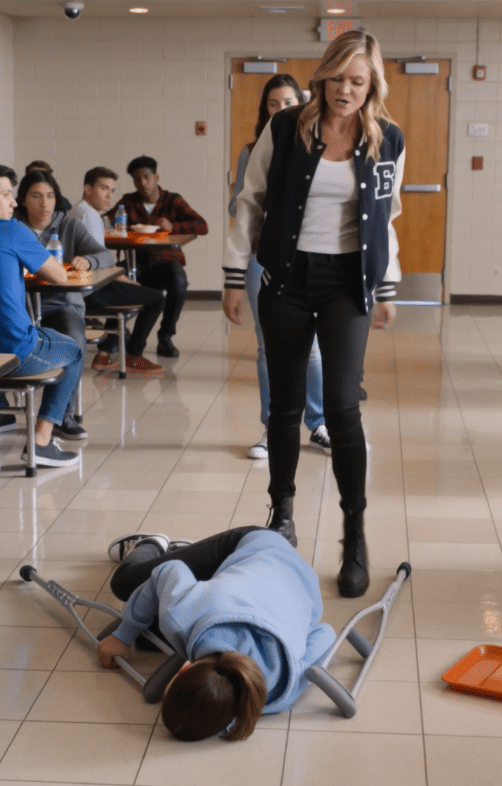
Madison grabbed Grace’s tray and threw it onto the floor.
When Grace bent down to keep her crutch from slipping, Madison drove a hard kick into her back.
Grace fell face-first beside the spilled food. Her crutch shot across the tiles, and her forearm struck the floor, leaving a thin trace of blood where the skin had scraped.
For a moment, she could not catch her breath.
She tried to push herself up, but pain tightened across her back and side. Her fingers trembled as she reached toward the crutch lying several feet away.
Then Madison stepped closer and kicked her again.
A second blow followed before the students around them could even process what they were seeing.
Someone gasped.
A boy at the nearest table stood halfway out of his chair, then froze when Madison turned toward him with a furious glare. Two girls covered their mouths. A cafeteria worker called for security, but nobody reached Grace before Madison delivered another cruel kick and stepped back.
Grace curled instinctively, struggling to protect herself.
Her eyes filled with tears, but she fought to keep her voice steady.
“Please,” she whispered. “I was just waiting in line.”
Madison looked down at her.
“Eat from the floor.”
The cafeteria went quiet enough for Grace to hear the hum of the vending machines and the distant clatter of trays from the kitchen.
She looked at the sandwich lying in the spilled milk.
It was the only lunch she had brought money for that day.
At home, she had skipped breakfast because she wanted to make sure there would be enough food for dinner. Her foster mother, Eleanor Hayes, had left early for a court hearing, and Grace had promised herself she would manage school without calling for help over every difficult moment.
She had been trying so hard to prove that she could handle things.
Now she was lying on a cafeteria floor while hundreds of students watched.
Madison straightened her jacket, apparently satisfied that the girl who had corrected her in public had finally been put in her place.
Then the cafeteria doors burst open.
The principal hurried inside, followed by two school security officers.
Beside him walked a woman in a sharply tailored black suit, her expression so controlled that it seemed to make the entire room colder. She moved quickly toward Grace, ignoring the students who stepped out of her path.
The woman was Eleanor Hayes, a nationally known civil-rights attorney who had spent decades confronting institutions that believed vulnerable people could be ignored without consequence.
But she was not entering the cafeteria as a lawyer arriving for a case.
She was entering as Grace’s foster mother.
Eleanor reached the girl and knelt immediately. Before asking a single question about what had happened, she picked up Grace’s fallen crutch and placed it within reach.
“I’m here, sweetheart,” she said softly.
She signaled to the principal to have the school nurse and emergency medical assistance come at once. One security officer moved between Madison and Grace while the other directed the students to step back.
Only when Grace was protected did Eleanor rise and turn toward the girl in the expensive jacket.
Her voice was quiet.
“Step away from my daughter.”
Madison’s face went blank.
She stared at Eleanor, then at the principal, then at the security officer blocking her path.
The word daughter seemed to confuse her more than the arrival of the entire school administration.
“Your daughter?”
For the first time in her life, Madison Whitmore looked as though she had no idea what to say next.
And she had no idea who Eleanor Hayes was about to call.
Act II
Grace Miller had not always lived with Eleanor Hayes.
For most of her childhood, Grace had moved between relatives and temporary placements after her mother died from complications following a long illness. Her father had disappeared from her life years earlier, leaving behind unanswered questions and a handful of old photographs.
Grace remembered her mother most clearly through small things: the way she hummed while cooking, the notes she tucked into Grace’s lunchbox, and the promise she made during her final months.
“Being different doesn’t make you less deserving of kindness.”
Grace had held on to those words through every move, every unfamiliar bedroom, and every adult who promised that the next home would finally feel permanent.
When the accident happened the previous winter, Grace had been crossing a street with her schoolbag over one shoulder when a driver lost control on an icy road. Her injuries required months of rehabilitation, and she returned to school with crutches, a revised schedule, and a quiet fear of falling in crowded places.
The physical recovery was difficult.
The social recovery was worse.
Some students were kind. Others stared. A few offered to help only when teachers were watching. Grace learned to refuse assistance politely because she hated the way some people looked at her afterward, as though she had become a responsibility they never asked for.
She did not want to be known as the girl on crutches.
She wanted to be Grace.
Eleanor understood that.
She had become Grace’s foster mother after volunteering with a legal-aid organization that helped children navigate the family court system. Eleanor was known for taking on difficult cases involving children whose voices had been overlooked by adults with more power.
Her home had not been perfect, and neither had their first months together. Grace was cautious about affection, while Eleanor was careful not to mistake silence for trust.
They built their relationship through small routines.
Sunday pancakes.
A lamp left on in the hallway.
A promise that Grace would never be punished for telling the truth about something that frightened her.
Eleanor did not demand that Grace call her Mom. She told the girl that family was not a word someone had to earn by behaving perfectly.
It was a commitment to show up.
Over time, Grace began leaving her schoolbooks on the kitchen table instead of keeping them packed in her backpack. She began asking Eleanor for advice rather than pretending she already knew the answers.
And one evening, after a difficult physical therapy appointment, Grace had fallen asleep on the couch with her head resting against Eleanor’s shoulder.
Eleanor had stayed there long after her arm went numb.
Neither of them had said much about it the next morning.
They did not need to.
At school, however, Grace rarely mentioned her foster mother.
She knew Eleanor was a prominent attorney. Her name appeared in newspapers, legal journals, and television interviews whenever a major civil-rights case reached a verdict. Eleanor had represented families against powerful employers, challenged discriminatory policies, and forced public institutions to answer questions they had spent years avoiding.
Grace did not want any of that to define her.
She worried that teachers might treat her differently if they knew Eleanor’s identity. She worried that classmates would assume she was receiving special favors.
Most of all, she wanted to earn her place at school without anyone believing she needed a powerful adult to fight every battle for her.
That was why she had not called Eleanor when Madison began bothering her.
At first, the cruelty had seemed small enough to endure.
Madison would move Grace’s crutch when she turned away, then pretend she had not touched it. She would imitate the careful way Grace walked when her friends were nearby. Sometimes she would make comments about the cost of Grace’s clothes or ask whether the school paid her to attend.
Grace had tried ignoring her.
When that failed, she asked a teacher for help.
The teacher spoke to Madison, who smiled through the conversation and promised to behave. For a few days, the harassment stopped.
Then it returned in subtler ways.
A chair moved just as Grace approached it.
A whispered joke about her limp.
A photograph taken without permission and shared among students with a cruel caption.
Grace reported the incidents, but she did not always know who had seen the messages or which students were repeating them. Each complaint seemed to require her to explain herself again, while Madison treated every warning as a temporary inconvenience.
Madison’s family had money, influence, and a long history with the school.
Her father, Richard Whitmore, was a major donor who had funded the renovation of the school’s athletic facilities. His name appeared on a brass plaque near the gym entrance. He attended fundraising dinners and spoke confidently about leadership, excellence, and personal responsibility.
Teachers knew he could be generous.
They also knew he disliked being told that his daughter had done something wrong.
Madison had grown accustomed to adults finding reasons to excuse her.
If she mocked a classmate, she was being playful.
If she broke a rule, she was misunderstood.
If another student complained, that student was usually accused of overreacting.
Her mother had died when Madison was young, and Richard had responded to his grief by giving his daughter almost everything she wanted. He had mistaken indulgence for protection, and Madison had learned that consequences were things that happened to other people.
The cafeteria incident was not an isolated explosion of anger.
It was the moment Madison finally believed she could do anything in public and still walk away untouched.
She had no idea that the school security camera had captured the confrontation from the moment she took Grace’s tray.
She also did not know that the principal had already received two earlier reports about her behavior.
And she certainly did not know that Eleanor Hayes had come to the school that afternoon for a meeting about Grace’s support plan.
The meeting had been scheduled weeks earlier.
Eleanor had expected to discuss accessibility, classroom arrangements, and a concern Grace had raised about repeated harassment. She had not expected to arrive in time to see her foster daughter lying injured on the cafeteria floor.
As the nurse hurried toward Grace, Eleanor looked at the principal.
“Please tell me the school has documented the previous reports.”
The principal’s expression tightened.
“We have some records.”
“Some?”
He glanced toward Madison, who was now being escorted away from the crowd.
“Ms. Hayes, I think we should discuss this in my office.”
Eleanor looked back at Grace.
The nurse was checking her injuries while another staff member retrieved a chair. Grace was pale and shaken, her hands wrapped tightly around the crutch Eleanor had recovered for her.
Eleanor took her hand.
“We’ll talk about everything later,” she whispered. “Right now, we’re going to make sure you’re safe.”
Grace nodded, but her eyes remained fixed on the cafeteria floor.
“I’m sorry,” she said.
Eleanor stared at her.
“For what?”
“For making a scene.”
For a moment, Eleanor could not speak.
Then she leaned closer.
“You did not make this scene, Grace. The person who hurt you did.”
Grace’s eyes filled again.
And when Eleanor finally stood and followed the principal toward his office, she carried one question that no one at the school would be allowed to avoid.
How many times had Grace been forced to suffer in silence because the adults responsible for protecting her had found it easier to look away?
Act III
The principal’s office was already crowded when Eleanor entered.
The school nurse had taken Grace for medical evaluation, and one of the security officers remained with her. Madison had been escorted to a separate room while the administration contacted her father.
Principal Robert Ellis stood behind his desk, visibly uncomfortable.
Eleanor did not sit.
“I want the incident documented immediately,” she said. “I want the security footage preserved, the witnesses identified, and the earlier complaints reviewed.”
“We are already taking steps,” Ellis replied.
“Then tell me what those steps are.”
He opened a folder.
The first report concerned a student who had seen Madison move Grace’s crutch in the hallway. The second involved a message circulated among several students mocking Grace’s disability. Both reports had been recorded as resolved after informal conversations with Madison.
Neither report included a meaningful follow-up with Grace.
Eleanor read the documents carefully.
“Who decided these incidents were resolved?”
“The assistant principal handled the first one. The second was discussed with the students involved.”
“Was Grace asked whether the behavior stopped?”
The principal hesitated.
“I believe someone spoke with her.”
“Do you have a record of that conversation?”
He searched the folder.
There was no detailed record.
Eleanor closed it.
“You have a student with a documented mobility impairment. She reports repeated harassment, and the response consists of informal conversations with the student accused of causing it. Now she has been physically assaulted in the cafeteria.”
Ellis rubbed his forehead.
“I understand how serious this looks.”
“This is not about how it looks.”
Her voice remained even, but the room seemed to grow colder.
“This is about what happened to a child under your supervision.”
The principal looked down.
Eleanor continued, “I am Grace’s foster mother. I am also an attorney. I will not confuse those roles, and I will not use my position to demand an outcome unsupported by evidence. But I expect the school to preserve the evidence, follow its policies, and ensure that Grace is not exposed to further harassment while this is investigated.”
Ellis nodded slowly.
“We will.”
“Please put that commitment in writing.”
A knock interrupted them.
The secretary opened the door and announced that Richard Whitmore had arrived.
Madison’s father entered moments later, carrying his phone in one hand and wearing the expression of a man who had been inconvenienced by an emergency.
“Where is my daughter?”
“The school is speaking with her,” Ellis said. “There has been a serious incident.”
Richard glanced at Eleanor.
“And you are?”
“Eleanor Hayes.”
Recognition flickered across his face.
He had seen her name in the news. He knew she had represented families in cases involving public institutions, including several disputes that had resulted in expensive settlements and significant policy changes.
His tone became more guarded.
“I see.”
Eleanor did not offer her hand.
“Your daughter assaulted my foster daughter in the cafeteria.”
Richard’s expression hardened immediately.
“That is a serious accusation.”
“It is also what the initial witness accounts describe. The school is preserving the footage.”
“My daughter tells me there was an argument.”
“An argument does not explain why Grace was on the floor with her crutch several feet away.”
Richard looked toward the principal.
“Have you actually reviewed the video?”
“We are in the process of preserving and reviewing it,” Ellis replied.
“Then perhaps everyone should stop making judgments until we know what happened.”
Eleanor nodded once.
“Agreed. Which is why I am asking the school to preserve the evidence rather than allowing anyone to minimize the incident before it has been reviewed.”
Richard disliked her answer because it gave him no opening to portray her as unreasonable.
He had expected anger, perhaps a threat to sue, or a demand that Madison be expelled immediately. Any of those would have allowed him to shift the conversation toward Eleanor’s behavior instead of his daughter’s.
Instead, Eleanor was asking for records.
And records were difficult to intimidate.
Richard sat down.
“My daughter has been under considerable pressure. She’s applying to colleges, and there have been conflicts with other students. I don’t believe she would deliberately hurt someone without a reason.”
Eleanor looked at him.
“Grace asked her not to cut the lunch line.”
Richard blinked.
“That’s all?”
“That is what Grace told us. The witness accounts and footage will help establish the sequence.”
He shook his head as though the explanation were too trivial to matter.
“Surely there is more to it than that.”
“Why should there need to be more?”
Richard said nothing.
Eleanor had spent years listening to people explain why a powerful person should be given the benefit of every doubt while a vulnerable person was expected to provide extraordinary proof before being believed.
She recognized the pattern immediately.
Madison’s cruelty had been enabled by more than money. It had been enabled by a family culture in which discomfort was treated as an injury and accountability as an attack.
The principal’s secretary returned with a message that the security footage had been secured and that several students had agreed to provide statements.
Richard’s face tightened.
“Statements from whom?”
“Students who witnessed the incident,” Ellis said.
Richard turned to Eleanor.
“Are you going to encourage children to say whatever you want them to say?”
“No,” Eleanor replied. “I am going to encourage the school to let them tell the truth.”
He stood abruptly.
“My daughter is not some monster.”
“I haven’t called her one.”
“You’re treating her like a criminal.”
“I am treating an assault as a serious matter that deserves an impartial investigation.”
The silence became uncomfortable.
Richard looked toward the office door, where a security officer stood waiting. He had arrived expecting to take Madison home and manage the situation privately.
Now the school was documenting the incident, witnesses were being interviewed, and Eleanor Hayes was refusing to let the conversation become a negotiation over whose reputation mattered most.
He lowered his voice.
“Perhaps we can resolve this without making it public.”
Eleanor’s eyes narrowed slightly.
“Grace’s privacy matters. So does a fair process. But we will not make the evidence disappear to protect anyone’s image.”
Richard stared at her.
For the first time, he seemed to understand that the school was not the only institution involved.
Eleanor had represented families in cases where schools failed to respond to repeated harassment. She knew what records mattered, how complaints should be documented, and why a student’s safety could not depend on the goodwill of the person accused of harming them.
But she also knew that Grace needed more than a powerful lawyer in a room full of adults.
She needed to be heard.
And when Grace returned from medical evaluation later that afternoon, she would be asked a question that could determine how the school handled everything that came next.
Whether she felt safe returning to the cafeteria.
Grace’s answer would change the investigation—and expose a problem far larger than Madison’s behavior.
Act IV
Grace returned to school two days later, accompanied by Eleanor.
Her medical evaluation had addressed her immediate injuries, and she was following the recommendations she had been given. She still moved carefully with her crutches, and the memory of the cafeteria floor remained painfully fresh.
The school had arranged for a staff member to meet them at the entrance.
Principal Ellis led them to a conference room where the assistant principal, school counselor, and district student-services coordinator were waiting. Madison was not present.
Eleanor had insisted that Grace be given the opportunity to speak without being forced into a confrontation with the student who had hurt her.
The counselor began gently.
“We want to understand what you need in order to feel safe here.”
Grace looked down at her hands.
She had spent two nights replaying the incident, wondering whether she should have kept quiet about the line. She knew the question was unfair, but that did not stop it from returning.
“If I hadn’t said anything, she might not have done it,” she whispered.
Eleanor remained beside her without interrupting.
The counselor shook her head.
“You are not responsible for Madison’s choice to hurt you.”
Grace swallowed.
“I know that. I just keep thinking about everyone watching.”
Her voice cracked.
“Nobody helped.”
The adults around the table lowered their eyes.
Grace continued, explaining that she had been afraid to report earlier incidents because she did not want to become known as a troublemaker. When previous complaints led only to brief conversations with Madison, Grace had assumed that speaking up would make things worse.
She described the moved crutch, the mocking messages, and the way Madison’s friends sometimes laughed before Grace even understood what had been said.
Then she said something that made the district coordinator put down her pen.
“I don’t want special treatment. I just want to come to school without wondering if someone is going to knock me down.”
Eleanor took a slow breath.
“That is not special treatment,” she said. “That is the minimum you should be able to expect.”
The school agreed to establish a written safety plan, including supervised transitions where needed, a clear process for reporting harassment, and a designated staff member Grace could contact without having to explain the entire history every time.
The district coordinator also requested a broader review of how earlier reports had been handled.
That review mattered because the cafeteria assault had not happened in isolation.
The records showed that Madison had been warned before, but the school had failed to document whether the behavior stopped. Several staff members had assumed that informal conversations were sufficient because Madison had promised to improve.
No one had established whether Grace felt safe.
No one had examined the cumulative effect of the incidents.
The administration had focused on closing individual reports rather than recognizing a pattern.
The new review would examine those failures separately from the investigation into Madison’s actions.
Meanwhile, the school completed its initial review of the cafeteria footage and witness statements. The evidence corroborated the central accounts: Madison had taken Grace’s tray, thrown it to the floor, and kicked her while she was trying to manage her crutch. The footage also showed additional kicks after Grace had fallen.
The school imposed disciplinary consequences under its established policies, and the matter was referred to the appropriate authorities for consideration under applicable procedures. The final legal outcome would depend on those authorities, not on Eleanor’s position or the school’s public image.
Madison was removed from regular campus attendance while the school determined the appropriate arrangements and disciplinary measures. She was prohibited from contacting Grace directly during the review, and the administration made clear that retaliation against witnesses would trigger further action.
For once, Madison could not turn the situation into a joke and wait for everyone to forget it.
The students who had witnessed the assault were interviewed individually. Some admitted that they had stayed silent because Madison was popular and her father was wealthy. Others said they had assumed someone else would intervene.
One student, a quiet junior named Hannah, told the counselor that she had wanted to help Grace but had been afraid Madison would target her next.
“I watched her fall,” Hannah said, crying. “I just stood there.”
The counselor did not shame her.
Instead, the school arranged additional training for students and staff on how to seek help, alert adults, and safely respond when someone is being harmed. The goal was not to demand that teenagers physically intervene in a dangerous situation, but to make sure fear and uncertainty did not leave a victim entirely alone.
The district also reviewed its accessibility procedures and complaint-tracking practices.
Eleanor did not threaten to sue the school during every meeting. She did not demand that the principal be fired simply to prove she had power.
She did, however, insist that the district provide a written response explaining what had gone wrong and what would change.
That response acknowledged shortcomings in the handling of earlier complaints and outlined measures for documenting repeat behavior, checking in with affected students, and escalating reports involving threats or physical aggression.
The changes would not erase what happened to Grace.
But they would make it harder for future reports to disappear into a folder marked resolved without anyone asking the student whether the harassment had actually stopped.
Madison, meanwhile, was struggling with a consequence she had never expected.
Her friends stopped laughing at her jokes.
Some avoided her entirely.
Others told her that what she had done was indefensible.
She initially blamed Grace for making the incident a bigger deal than it needed to be. She complained that the school had overreacted and that Eleanor’s presence had made it impossible for her to receive a fair hearing.
Then her father showed her a copy of the school’s written findings.
He had hoped to challenge the decision, but the footage and witness accounts left little room to dispute the essential facts.
Madison read the summary twice.
“You’re just going to let them do this to me?” she demanded.
Richard stared at his daughter.
For years, he had defended her because he believed that protecting her from consequences was the same as loving her. He had treated every complaint as a threat to the future he imagined for her.
Now he was looking at evidence that she had deliberately hurt a disabled classmate who had asked her to wait in line.
“What do you want me to do?” he asked.
“Fix it.”
“Fix what?”
“The school. The decision. All of it.”
Richard looked at her for a long time.
“I can hire attorneys,” he said. “I can challenge the process if there is a legitimate reason. But I cannot make that footage show something different.”
Madison’s expression hardened.
“So you’re taking her side?”
“No,” he said quietly. “I’m telling you that you did this.”
She looked away.
Richard had finally understood that he could not protect his daughter from the consequences of every choice without also protecting her from the chance to become a better person.
But understanding the problem was not the same as knowing how to repair it.
And when Madison eventually asked to speak with Grace, she would discover that the girl she had humiliated was not waiting for an apology to decide whether she deserved to move forward.
Act V
The first time Madison saw Grace again, it was through the glass doors of the school library.
Grace was sitting at a table near the windows, working on a history assignment. Her crutches rested beside her chair, within easy reach. A paper cup of tea sat near her notebook, and her phone lay face down beside a stack of textbooks.
She looked calm.
Not untouched by what had happened.
Not suddenly fearless.
Just calm enough to concentrate on something other than the cafeteria floor.
Madison stood outside the doors with the school counselor, who had arranged the meeting only after Grace agreed that she might be willing to hear what Madison had to say. Grace had been told that she could end the meeting at any time, and that she did not owe Madison forgiveness.
Madison’s hands trembled.
She had imagined this moment several times. In some versions, Grace cried. In others, she shouted or accused Madison of ruining her life.
Madison had prepared answers for all of them.
She had not prepared for the possibility that Grace might simply look at her and wait.
The counselor opened the door.
Grace closed her notebook.
Madison remained standing.
“I wanted to apologize,” she said.
Grace said nothing.
Madison swallowed.
“I know that doesn’t fix what I did. I shouldn’t have taken your tray. I shouldn’t have kicked you. And I shouldn’t have said those things about your crutches.”
Her voice became quieter.
“I was angry because you corrected me in front of everyone. I felt embarrassed, and I wanted you to feel worse than I did.”
Grace looked at her.
“That doesn’t make sense.”
“I know.”
“You made me feel like I didn’t belong there.”
Madison’s eyes dropped.
“I know.”
Grace took a breath.
“I was already trying not to fall. I was trying to carry my lunch and keep my crutch steady, and you made me feel like I was doing something wrong just by being there.”
Madison began to cry.
For a moment, Grace felt the old instinct to comfort her. She had spent so much of her life trying to keep other people from being upset that she sometimes forgot she was allowed to be angry.
But she did not reach across the table.
She did not tell Madison that everything was fine.
Instead, she said, “I’m not ready to forgive you.”
Madison nodded through her tears.
“I understand.”
“I don’t want you near me right now. I want the school to keep the safety plan.”
“I will.”
“And I don’t want you telling people I got you in trouble because my foster mother is a lawyer.”
Madison looked up.
“I won’t.”
Grace watched her for another moment.
“Then that’s all I have to say.”
The counselor ended the meeting.
Madison left the library without asking for another chance, and Grace returned to her history assignment.
It was not a triumphant scene.
There was no applause, no dramatic embrace, and no instant transformation that made the harm disappear.
There was only a girl who had finally said what she needed to say without apologizing for it.
For Grace, that was enough.
Over the following months, she continued her rehabilitation and gradually regained confidence moving through crowded spaces. The school followed the safety plan and checked in with her regularly. The district’s review led to clearer procedures for handling repeated harassment, and staff members received guidance on documenting concerns and following up with students who reported them.
Grace also began meeting with a counselor to process the fear and humiliation she had experienced.
Eleanor never pressured her to be brave.
Some days, Grace wanted to talk about the incident. Other days, she wanted to watch television, complain about homework, or argue about whether pancakes counted as dinner.
Eleanor let those ordinary moments return.
One Friday evening, Grace sat at the kitchen table with her math book open and her crutches resting against the chair.
Eleanor was reviewing a legal brief across from her.
After several minutes, Grace looked up.
“Can I ask you something?”
“Of course.”
“Were you really that angry when you came into the cafeteria?”
Eleanor set down her pen.
“Yes.”
Grace looked at the page in front of her.
“Because of what she did?”
“Because you were hurt. Because you were frightened. And because the adults responsible for keeping you safe had missed earlier warning signs.”
She paused.
“But anger doesn’t decide what happens next. We still have to make choices carefully.”
Grace nodded.
“Did you want to yell at her?”
“Very much.”
That earned a small smile.
“What stopped you?”
Eleanor considered the question.
“You needed me to protect you, not turn the moment into a battle about my feelings. And the school needed to follow a fair process, even though what happened made me furious.”
Grace was quiet for a moment.
“I’m glad you came.”
Eleanor reached across the table and took her hand.
“So am I.”
Grace squeezed her fingers.
For a long time, she had believed that needing help meant she had failed. She had tried to handle harassment alone because she did not want anyone to think she was weak or demanding special treatment.
Now she understood something she had not known before.
Independence did not mean enduring cruelty in silence.
Dignity did not mean pretending pain had not happened.
And asking for protection did not make her less capable of standing on her own.
As for Madison, her future remained uncertain. She had lost privileges, faced disciplinary consequences, and been required to confront behavior that her family had previously excused. Whether she would genuinely change would depend on what she did after the attention faded.
Her father’s wealth could pay for legal advice and protect some opportunities.
It could not force Grace to forgive her.
It could not turn an assault into a harmless argument.
And it could not erase the moment when hundreds of students had watched Madison reveal what she believed about people who seemed less powerful than herself.
Eleanor never used Grace’s experience as a public spectacle. She did not need to turn the girl into a symbol or retell the worst moment of her life to prove a point.
She kept her promise in quieter ways.
She showed up for school meetings.
She listened when Grace said she was frightened.
She made sure the written safety plan was followed.
And when Grace was ready, she helped her find ways to speak about disability, bullying, and self-advocacy without feeling that her entire identity had been reduced to what someone had done to her.
One afternoon near the end of the school year, Grace entered the cafeteria carrying her lunch tray.
For a brief moment, she stopped at the doorway.
The room was loud. Students moved between tables, chairs scraped across the floor, and someone laughed near the vending machines.
The memory returned.
The spilled milk.
The scattered food.
The sound of the tray hitting the tiles.
Grace tightened her grip on the tray.
Then she took a breath and moved forward.
A student at the nearest table noticed her and shifted a chair aside to make room. Hannah, the junior who had later admitted she was afraid to intervene, waved her over.
“There’s space here,” she called.
Grace walked toward the table.
Her crutches tapped steadily against the floor.
Nobody applauded. Nobody treated her like a hero.
They simply made room.
And as Grace sat down, she realized that this was what she had wanted from the beginning—not special treatment, not revenge, and not the humiliation of the girl who had hurt her.
She had wanted to stand in line, carry her lunch, and eat with her classmates without having to wonder whether her presence offended someone.
She had wanted the ordinary freedom to belong.
Across the room, the security camera watched over the cafeteria, recording a lunch period that looked much like any other.
But the school had changed the way it responded to what happened beneath that camera.
Reports were no longer supposed to disappear because a student was popular or a parent was influential. Staff were expected to follow up, document patterns, and take safety concerns seriously before they escalated.
Those changes could not guarantee that cruelty would never happen again.
They could ensure that the next student who asked for help would have a better chance of being heard.
Eleanor had entered the cafeteria that day as a mother, not merely as a famous attorney.
Her first action had not been to threaten Madison or display her own power.
She had picked up Grace’s crutch.
That small gesture said everything the girl needed to hear.
You are not a problem to be managed. You are my daughter, and you are worth protecting.
Madison had once believed that Grace’s disability made her an easy target and her foster status made her insignificant.
She had mistaken vulnerability for permission.
But the truth was never that Grace had secretly possessed more power than Madison.
The truth was that Grace had deserved dignity all along.
Eleanor’s arrival did not create that worth.
It made the people in the cafeteria confront what they had failed to recognize.
And in the end, the most important reversal was not that a wealthy girl had finally met someone who could challenge her.
It was that the girl she had tried to humiliate walked back into the same cafeteria, sat down with her lunch, and reclaimed the ordinary life Madison had tried to take from her.
Because real strength is not measured by how easily someone can make another person afraid.
It is measured by what they choose to protect when someone weaker is counting on them.