Act I
The appointment paper slipped from her fingers just before the second kick landed.
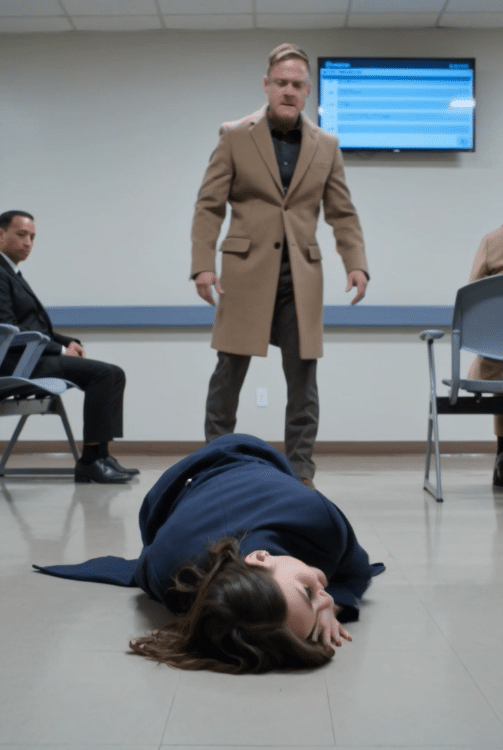
For several seconds, the hospital waiting room seemed to lose its breath. A phone skidded beneath a row of plastic chairs. Patients stared from their seats, a nurse froze beside the examination-room doorway, and a thirty-six-year-old woman in a navy coat lay on the cold floor, struggling to pull herself upright.
The man standing over her looked less like someone who had just committed an unforgivable act than someone irritated that an inconvenience had interrupted his evening.
His name was Richard Vaughn. At forty-two, he wore an expensive beige coat, polished shoes, and the unmistakable confidence of a man accustomed to having his frustrations treated as everyone else’s emergency. He had spent the last twenty minutes watching the patient display screen, checking his phone, and sighing loudly whenever another person was called ahead of him.
Then a nurse had called the woman’s name.
She hadn’t moved.
Richard had decided he knew exactly why.
He stepped forward and drove a brutal kick into her back. The woman fell face-first onto the hospital floor, her appointment paper scattering beside her and her phone sliding out of reach. When she tried to turn over, pain tightened her expression, and a thin trace of blood appeared along her forearm where it had struck the floor.
She reached toward the phone beneath the chair.
Richard moved closer.
“I’m Deaf. I didn’t know they called me.”
She communicated through visible distress, trying desperately to make him understand. Her hands trembled as she attempted to explain that she had not ignored the nurse. She simply hadn’t heard the announcement.
Richard stared down at her as if she had offered him an insult.
“Trash. You heard them.”
Before anyone could intervene, he delivered two more forceful kicks into her back and side.
A woman in the nearest chair covered her mouth. An elderly patient recoiled against the wall. One of the nurses took a step forward, then hesitated when Richard turned sharply toward the movement.
The victim curled inward, struggling to breathe steadily. Her eyes searched the room for someone willing to help.
Richard straightened his coat.
“Stop playing games with everyone’s time.”
He seemed to believe that his anger had become a justification all by itself. In his mind, the woman had delayed him, embarrassed him, and forced him to react. The fact that she was injured on the floor did not appear to change his calculation.
Then the staff elevator opened with a sharp metallic sound.
A sixty-two-year-old woman in a white coat beneath a long dark coat stepped into the waiting room, followed by the department chief and two hospital security officers. Her expression changed the instant she saw the injured patient.
She hurried toward the woman before looking at Richard.
Security moved between them. The department chief retrieved the fallen appointment paper while a nurse carefully recovered the phone from beneath the chair. Another staff member called for an immediate medical assessment.
Only after the injured woman was protected did the hospital director turn toward the man in the beige coat.
Her voice was controlled, but every person in the waiting room heard the words.
“She is the reason this wing gets funded.”
Richard’s face went pale.
“She funds this wing?”
The question hung in the fluorescent silence.
Because the woman he had treated as a worthless obstacle was not merely another patient waiting to be seen. And the director’s arrival was about to expose a truth Richard had never imagined.
Act II
Her name was Evelyn Carter.
To the patients who visited the hospital’s neurological and rehabilitation services, she was a familiar figure in a navy coat, usually carrying a slim folder and a phone with a bright screen. To the hospital’s executive team, she was one of the most important people connected to the institution’s future.
But none of that was why she had come to the hospital that night.
Evelyn had spent much of her adult life navigating a world that assumed communication had only one acceptable form. She had been profoundly Deaf since childhood, and she had learned early that people often mistook silence for indifference, confusion for incompetence, and a request for accommodation for an unreasonable demand.
She had also learned not to let those assumptions define her.
At twenty-three, she had joined a small nonprofit that helped Deaf adults access education, employment, and medical services. She began by helping people fill out forms and understand confusing instructions. Later, she worked with hospitals, public agencies, and technology companies to develop better ways of communicating with people who could not rely on spoken announcements.
Her work grew slowly.
She was never the loudest person in a meeting, and she rarely talked about the obstacles she had overcome. Instead, she arrived with detailed reports, patient interviews, and practical solutions. She could identify a communication failure that had been dismissed as an isolated inconvenience and demonstrate how it could endanger hundreds of people.
Eventually, she established the Carter Access Foundation, named for her late father, a public-school principal who had taught her that dignity was not something institutions should distribute according to convenience.
The foundation did not exist to place Evelyn’s name on walls. Its purpose was to make essential services accessible to people who were routinely overlooked.
When the hospital proposed expanding its neurological rehabilitation wing, Evelyn became involved in the planning process. She visited the facilities, spoke with Deaf and hard-of-hearing patients, reviewed the proposed communication systems, and challenged administrators to think beyond minimum compliance.
The original proposal included additional examination rooms and upgraded medical equipment.
Evelyn insisted on more.
She wanted visual patient notifications, reliable text-based communication, accessible appointment procedures, and staff training that treated communication access as part of patient safety rather than an optional courtesy.
The hospital initially considered several of her recommendations too expensive.
Evelyn returned with data, patient testimony, and a funding plan.
Over the following two years, the Carter Access Foundation committed substantial support to the project, helping finance equipment, accessible consultation rooms, staff education, and services for patients who might otherwise struggle to navigate the system.
The wing became a model for the hospital’s broader accessibility initiative.
Yet Evelyn had never demanded special treatment in exchange for the money. She had declined ceremonial privileges, asked that her name remain secondary to the work, and continued to attend appointments like any other patient.
That night, she had come to discuss a separate medical concern with a specialist.
She had arrived early, checked in at reception, and received an appointment paper. When she sat down, she placed her phone beside her, its screen ready for written communication. She expected the hospital’s visual patient display to guide her when her turn arrived.
But the display had not updated properly.
The nurse called her name aloud while the screen continued showing an earlier queue. Evelyn remained seated, reading a message on her phone, completely unaware that the staff member was trying to reach her.
It was a small failure.
It could have been resolved with a tap on the shoulder, a written note, or a simple adjustment to the display. It required neither confrontation nor punishment.
Richard Vaughn had chosen violence instead.
And what he did not know was that Evelyn’s work with the hospital had already brought her into contact with a problem much larger than a malfunctioning screen.
The very system that had failed to alert her was part of a broader accessibility review.
A review that was about to become impossible for the hospital to ignore.
Act III
Richard had not arrived at the hospital in a calm state of mind.
Earlier that evening, he had left a business meeting convinced that everyone around him was wasting his time. A property investment he had expected to close quickly had encountered delays, and his partners had begun questioning decisions he had once made without challenge.
He had spent years cultivating an image of effortless success. His expensive clothes, polished vocabulary, and habit of addressing service workers as though they were personal assistants were all parts of the same performance.
He expected people to move when he approached.
He expected questions to be answered immediately.
And when something did not happen according to his wishes, he tended to assume that someone was deliberately disrespecting him.
At the hospital, that assumption hardened into certainty.
He had seen Evelyn sitting quietly while other patients responded to the nurse’s call. He had watched the queue move forward and interpreted her stillness as arrogance. Instead of asking whether she needed assistance, he had constructed an explanation that made his anger feel justified.
By the time he stood behind her, he was no longer reacting to what she had actually done.
He was punishing her for the meaning he had assigned to it.
After the director arrived, those assumptions began to collapse.
The director was Dr. Margaret Lawson, a senior physician who had led the hospital for nearly a decade. She had built her reputation on combining clinical judgment with an unusually direct approach to institutional failures. She knew Evelyn personally, not simply because of the foundation’s financial support, but because the two women had spent countless hours debating what a genuinely accessible hospital should look like.
Margaret did not greet Evelyn as a wealthy benefactor whose comfort needed to be protected.
She addressed her as an injured patient.
She ordered the clinical team to assess her back and side, check her breathing, document her injuries, and arrange appropriate imaging. Security was instructed to keep Richard away from the treatment area while the hospital’s emergency procedures were activated.
Then Margaret faced him.
Richard tried to speak first.
He started with the waiting time. He complained that he had been sitting there for too long. He claimed the woman had ignored the staff and that he had simply lost his temper because she was holding everyone up.
But no one asked him to explain the queue.
The department chief had already seen the position of Evelyn’s fallen appointment paper. A nurse had witnessed the attack. Several patients had watched him strike a woman who was on the floor and then continue when she tried to explain herself.
The hospital’s security cameras also covered the waiting-room entrance and much of the seating area.
A security officer told Richard that the incident would be preserved and reported. Hospital staff would provide statements, and the footage would be made available to the appropriate authorities through the proper process.
For the first time, Richard seemed to understand that the room was no longer an audience he could intimidate into silence.
He looked at Margaret, then at the security officers.
“There’s been a misunderstanding,” he said, attempting to soften his voice.
Margaret did not raise hers.
“A misunderstanding does not explain what you did after she told you she was Deaf.”
Richard’s eyes flicked toward Evelyn.
She was being helped onto a stretcher by trained staff. Her face was tense with pain, and her phone rested in the department chief’s hand. A nurse was communicating with her through written messages while preparing her for further examination.
Evelyn had not asked the director to punish Richard.
She had not demanded that anyone reveal her identity.
She had simply tried to explain why she had not responded to a spoken announcement.
That was what made his behavior so difficult to defend. He had been given the information he needed, directly from the person he was attacking, and had chosen to continue anyway.
Then Margaret said something that changed the way the witnesses understood the entire incident.
“She is the reason this wing gets funded.”
The words were not a threat. They were a statement of fact about the woman Richard had treated as though she had no value.
Evelyn had helped make the hospital better for people like herself. She had funded equipment that could prevent future communication failures. She had spent years persuading administrators that patients should not have to fight for the basic ability to understand when care was available.
And now, inside the very wing her foundation had helped support, she had been attacked because the system failed to tell her it was her turn.
Richard swallowed.
“She funds this wing?”
No one answered him.
He had finally discovered who she was, but he had not yet understood what that revelation meant.
Because Margaret was not going to let the hospital’s financial relationship with Evelyn determine what happened next.
Act IV
The first decision Margaret made was to remove Evelyn from the waiting room and ensure she received appropriate care.
The second was to make certain the incident could not disappear into an internal report that no one ever read.
Security documented the scene, preserved the relevant footage, and recorded the names of the witnesses. The department chief arranged for the nurses involved to submit statements while their recollections were fresh. The hospital’s incident response team began reviewing the failure of the patient notification system separately from the assault.
Richard was kept away from Evelyn and the clinical staff.
Hospital personnel contacted law enforcement, and the available evidence was handled through the appropriate channels. The hospital did not pretend that it could decide criminal guilt by executive order. That determination belonged to the authorities and the courts, not to a director responding to an appalling scene.
But Margaret could decide how her institution would respond.
She instructed the hospital’s legal and compliance teams to cooperate with the investigation. She also ordered a review of the waiting room’s notification procedures, including why the visual display had failed to reflect the spoken call.
The assault and the accessibility failure were separate issues.
Both mattered.
One concerned a man’s decision to attack an injured person. The other concerned a system that had left a Deaf patient without reliable notice that her appointment was ready.
The hospital would not excuse the first because of the second, and it would not ignore the second simply because the first had drawn everyone’s attention.
Meanwhile, Richard tried to recover control of the situation.
He insisted that he had never intended to cause serious harm. He complained that security was treating him unfairly. At one point, he attempted to argue that his anger had been provoked by the waiting time.
The witnesses did not see it that way.
One patient had watched Evelyn try to reach for her phone after falling. A nurse had heard her explain that she was Deaf. Another witness remembered Richard stepping closer rather than giving her space.
The evidence was not a debate over whether Evelyn had responded quickly enough.
It was a record of what Richard had done after she could no longer stand.
As the investigation progressed, Margaret learned more about the minutes before the attack. Staff confirmed that Evelyn had checked in properly and had been waiting for her name to appear on the patient display. A technical review found a synchronization problem that had caused the visual queue to lag behind the spoken announcements.
It was the kind of fault that could easily have been dismissed as a minor inconvenience.
Now it had become impossible to overlook.
Margaret convened the relevant department leaders and asked a direct question: Why had the hospital relied on a spoken call when the visual system was supposed to provide an equivalent notification?
The answer was uncomfortable.
The display was intended to support patients who could not hear announcements, but staff had become accustomed to treating it as a secondary convenience rather than a critical communication channel. When the system fell behind, no reliable backup procedure required staff to notify patients individually.
The failure was not Evelyn’s.
It was institutional.
Margaret ordered immediate corrective measures. Staff were instructed to use written or visual notification when a patient could not hear an announcement, and the hospital began testing a more reliable queue system. The accessibility team was asked to review check-in, waiting-room, and examination-room procedures to identify similar gaps.
Evelyn’s foundation was invited to participate, but Margaret made it clear that the hospital would not place responsibility for fixing its own systems on the person who had been harmed.
When Evelyn was medically stable enough to receive visitors, Margaret went to see her.
She found her sitting upright in a treatment room, with a nurse nearby and her phone resting on the blanket. The pain had not disappeared, and the shock of the assault remained visible in the way she watched the doorway.
Margaret sat beside her.
She did not begin by discussing donations, construction costs, or the hospital’s reputation.
She apologized.
Not as a public statement designed to protect the institution, but as the person responsible for a hospital where Evelyn had expected to receive care and instead had been attacked while the staff’s communication system failed her.
Evelyn read the written message Margaret had prepared.
Then she typed her response.
I helped fund this wing so people would not have to fight to be seen.
Margaret read it twice.
For a moment, the director had no answer.
Evelyn continued typing.
Please make sure the next Deaf patient doesn’t have to explain herself while she’s lying on the floor.
Margaret looked up at her.
“I will.”
It was a promise that would require more than money, more than an apology, and more than a temporary burst of public outrage.
And for the first time that night, Evelyn allowed herself to believe that the hospital might understand what she had been trying to teach it all along.
Act V
Richard Vaughn did not walk away from the hospital that night with the power he had carried into it.
The incident was reported to law enforcement, and the hospital supplied the available evidence through the appropriate procedures. Witness statements and video footage helped establish what had happened, while investigators assessed the case under the applicable law.
Richard faced the consequences through that process. The hospital also reviewed whether his conduct warranted restrictions on his presence on its property, consistent with its policies and legal obligations.
His expensive coat could not make the footage disappear.
His complaints about the waiting time could not erase the nurse who heard Evelyn explain that she was Deaf.
And his sudden discovery of her financial importance could not transform the assault into an innocent mistake.
The hospital’s response did not depend on Evelyn being a major donor. The same standards applied to every patient, including those who arrived without money, influence, or anyone powerful enough to speak on their behalf.
That principle became central to Margaret’s next steps.
Within weeks, the waiting room had a more reliable visual notification system. The patient display was tested against the scheduling software, and staff received updated guidance on communicating with Deaf and hard-of-hearing patients. Written notifications and direct visual contact became standard alternatives when a spoken announcement could not be relied upon.
The hospital also created a clearer process for patients to indicate their communication needs at check-in, without having to repeat the same explanation at every stage of their visit.
These were not glamorous changes.
There was no dramatic unveiling, no grand ceremony, and no wall covered in photographs of executives congratulating one another. There were new procedures, staff training, equipment checks, and follow-up reviews to determine whether the changes actually worked.
Evelyn insisted on that distinction.
She returned to the hospital after her recovery, not to accept a special entrance or a private waiting room, but to test the revised system. She sat in the same general waiting area where the attack had happened, carrying an appointment paper and keeping her phone beside her.
This time, when her appointment was ready, the screen updated correctly.
A visual notification appeared.
A staff member approached her and made sure she knew it was her turn.
Evelyn stood.
Nothing about the moment was extraordinary. No one applauded. No executive rushed out of an elevator. The other patients continued reading, checking their phones, or waiting for their own names.
That was precisely the point.
She walked toward the examination door as any patient should have been able to do from the beginning.
Margaret watched from the staff corridor. She had learned that a successful accessibility measure was not one that attracted attention. It was one that allowed a person to get through an ordinary day without being forced to defend her existence.
Before Evelyn left, she met with the accessibility team and reviewed the changes. She pointed out what was working and identified two remaining problems that needed attention. The staff recorded her feedback and scheduled another review.
Her foundation continued supporting the hospital’s accessibility work, but Evelyn made one condition clear: future funding decisions would be based on measurable improvements, not promises.
Margaret agreed.
The wing would not become accessible simply because it carried the name of a generous donor. It would become accessible because the people responsible for running it had accepted that every patient deserved communication, safety, and respect.
Months later, the hospital completed its internal review and documented the changes made after the incident. The findings became part of a broader patient-safety initiative, ensuring that communication failures were treated as risks to be corrected rather than inconveniences to be tolerated.
Evelyn did not pretend that the assault had left her untouched.
For a time, the soundless movement of people behind her made her tense. She sometimes remembered the cold floor, the phone sliding beneath the chair, and the faces of people who had watched without stepping forward. The hardest part was not only the pain. It was the realization that a simple misunderstanding had given a stranger permission, in his own mind, to treat her as less than human.
But she refused to let Richard’s cruelty become the final meaning of that night.
She continued her work. She met with hospital administrators, helped other institutions improve their communication procedures, and reminded her colleagues that accessibility was not charity. It was part of providing competent care.
Margaret remained in contact with her, not merely as a hospital director grateful for financial support, but as a physician who had seen how quickly a preventable failure could become a crisis.
They never forgot the words spoken in the waiting room.
“She is the reason this wing gets funded.”
The sentence had shocked Richard because it revealed Evelyn’s influence. But over time, Margaret came to understand that the deeper truth was not about money at all.
Evelyn had helped fund the wing because she believed people should be treated with dignity before anyone knew their name, their wealth, or their importance.
She deserved protection before the director arrived.
She deserved to be believed before the witnesses fell silent.
And she deserved to have her Deafness understood as a fact about communication, not an invitation for someone else’s anger.
Richard had looked at a woman who did not respond to a spoken call and decided she was deliberately disrespecting him. He had mistaken a difference he did not understand for an insult he was entitled to punish.
By the time he discovered who she was, the damage had already been done.
The hospital could investigate the assault, repair its systems, and improve its procedures. Evelyn could recover and continue the work that mattered to her. The law could address Richard’s conduct through the proper process.
But none of those outcomes changed the simplest truth.
The woman on the waiting-room floor should never have needed a powerful friend, a generous foundation, or a hospital director stepping out of an elevator to deserve help.
She had deserved it when she was sitting quietly with her appointment paper.
She had deserved it when she explained, I’m Deaf. I didn’t know they called me.
And she deserved it long before Richard learned her name.
Because the real measure of a hospital—and of any person inside it—is not how quickly they respond when someone important is hurt.
It is whether they recognize the humanity of someone who has no way to make them care.