Act I
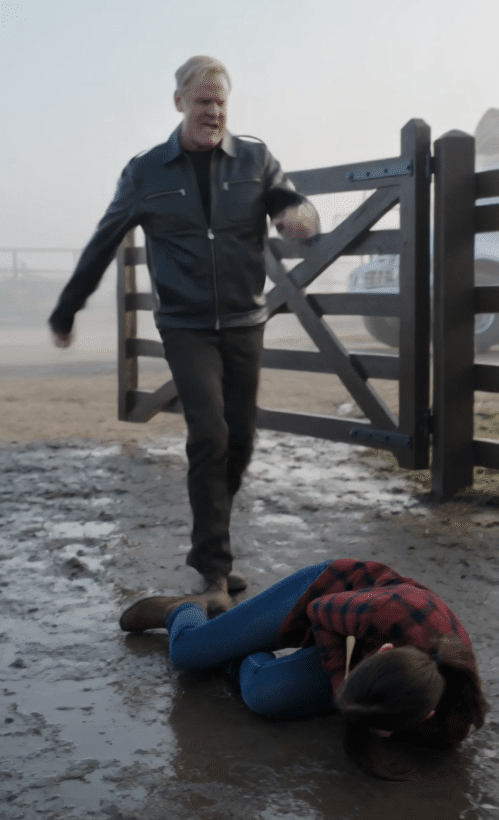
The wage envelope slipped from Grace Miller’s hand just before her father kicked her into the mud.
One moment, she was standing beside the wooden gate of the dairy farm, clutching the money she had earned after a grueling week of work. The next, she was sprawled on the wet ground, her red flannel shirt smeared with mud, while dollar bills scattered beneath the fence.
Cal Miller stood over her in his old leather jacket, his rough beard damp with the morning fog.
“Give me the money,” he demanded.
Grace, twenty-five, pressed one trembling hand against her chest. Her jeans were soaked, her rubber boots had slipped sideways, and a thin streak of blood marked her elbow where she had struck the ground. Still, her eyes searched desperately for the envelope.
She had worked every day that week before sunrise, helping feed the cattle, cleaning equipment, moving supplies, and preparing the morning routine before the milk truck arrived. Her hands were rough from the work, and her back ached from lifting heavy containers.
The weekend wages in that envelope were not extra spending money.
They were the rent she needed to pay, the groceries she had carefully planned, and the small amount she was trying to save so she could finally move somewhere without being afraid of the person waiting at her door.
Her father knew all of that.
He simply did not care.
“I worked all week for this,” Grace said, struggling to sit upright.
Cal sneered.
“Trash. My debt is tonight.”
He had lost another substantial amount gambling. A creditor had given him until the end of the day to pay what he owed, and Cal had spent the early morning searching for someone who could rescue him from the consequences of his own choices.
He had found his daughter instead.
Grace had refused to hand over her wages when he confronted her at the gate. She tried to pull the envelope away, but Cal grabbed at it with both hands. When he failed to tear it from her grasp, he kicked her hard in the chest, sending her backward into the wet mud.
Now he watched her crawl toward the money as though her determination were an insult.
“Please, Dad,” she whispered. “I need this.”
Cal stepped forward and kicked her twice more in the back and side as she curled over the envelope. Grace cried out, protecting the money with one arm even as she tried to shield herself with the other.
Several farm workers stood nearby, frozen between stacked supplies and the fence. One covered his mouth. Another stepped backward, his eyes fixed on Cal. They had seen arguments before, but this was different.
Cal was not simply shouting at his daughter.
He was beating her because she had refused to surrender the wages she had earned.
Grace finally reached the envelope and dragged it beneath her body. The bills had become damp, and one had stuck to the mud beside her hand.
She gathered what she could, breathing hard.
Cal leaned over her.
“You don’t say no to your father.”
For years, that sentence had been the final word in every argument. It was how he ended questions about his gambling, silenced objections to his drinking, and convinced Grace that protecting herself made her a disloyal daughter.
But this morning, something happened that Cal had not anticipated.
A milk truck came around the bend in the farm road and braked sharply beside the gate.
The driver’s door flew open.
Thomas Reed, the sixty-year-old owner of the dairy farm, jumped down from the cab and charged toward them. He took in the scattered bills, the muddy ground, and Grace curled around her paycheck.
Then he looked at Cal.
Thomas crossed the distance between them and struck him hard enough to send him staggering backward.
“Stay away from her.”
Cal clutched his mouth, stunned.
Thomas moved between him and Grace, his broad frame blocking the path to the young woman on the ground.
For the first time that morning, Cal looked frightened.
He had expected Grace to surrender.
He had not expected the man who signed her paychecks to stand between them—and he had no idea how much that decision would cost him.
Act II
Thomas Reed did not take his eyes off Cal.
“Step back,” he ordered.
Cal stumbled away, one hand pressed to his mouth. His anger returned quickly, but it no longer looked quite as convincing. He glanced at the workers, the truck, and the farm owner standing between him and his daughter.
“You had no right to hit me,” Cal snapped.
Thomas’s expression remained hard.
“And you had no right to assault her.”
“She is my daughter.”
“And she is an adult who earned that money.”
Cal gave a bitter laugh.
“You don’t know what she owes me.”
Thomas turned briefly toward Grace. She was trying to sit up, her hands shaking as she gathered the damp bills. Her face had gone pale, and every movement seemed to cost her effort.
Thomas lowered his voice.
“Don’t worry about the money right now. Let someone check your injuries.”
Grace looked at him with the wary expression of someone accustomed to promises that came with conditions.
“It’s my paycheck,” she whispered.
“I know. We’ll make sure it’s accounted for.”
A farm supervisor hurried over and called emergency services. Another worker began collecting the bills scattered beyond the gate, placing them on a clean cloth rather than letting them remain in the mud.
Thomas instructed them to preserve the scene and keep Cal away from Grace. He then stepped toward his pickup’s open door, where his phone was connected to the farm’s dispatch system.
Cal mistook the movement for an opportunity.
“She needs to learn respect,” he said loudly. “I’ve spent my whole life raising her. Now she thinks she can keep everything for herself.”
Thomas turned back.
“Did you pay her wages?”
Cal hesitated.
“That’s not the point.”
“Did you pay her rent?”
“It’s a family matter.”
“Did you earn that paycheck?”
Cal’s face darkened.
“You’re making a fool of yourself.”
“No,” Thomas replied. “I’m asking you a question you don’t want to answer.”
The workers stood silently around them. The fog was lifting, revealing the pasture beyond the fence and the long row of barns where the morning’s work was supposed to begin.
Cal pointed at Grace.
“She wouldn’t have anything if I hadn’t raised her. I fed her. I bought her clothes. I kept a roof over her head. She owes me.”
Thomas had heard this kind of argument before, though rarely delivered with such naked entitlement. He had grown up on a farm himself, in a family where children were expected to help and adults were expected to provide. He understood that families depended on one another.
But he also understood the difference between helping a relative and claiming ownership of that relative’s life.
“Raising a child isn’t a loan,” Thomas said. “You don’t get to collect the money back whenever you want.”
Cal’s jaw tightened.
“You have no idea what I’ve sacrificed.”
“Maybe not,” Thomas replied. “But I know what I just saw.”
He pointed toward the muddy ground.
“I saw you attack a woman who was trying to keep the wages she earned.”
Cal opened his mouth to argue, but a worker near the fence finally spoke.
“He kicked her after she fell.”
The admission seemed to break the strange spell that had kept the others silent. Another worker nodded. A third said he had seen Cal grab for the envelope before the first kick.
Thomas did not ask them to embellish their accounts. He told the supervisor to record their names and make sure any available security footage was preserved. The incident would be handled through the proper channels.
Then he turned back to Grace.
She had worked for Thomas’s farm for nearly three years. He knew her as a quiet, dependable employee who arrived before her shift and stayed late when a delivery was delayed. She rarely complained, even when the work was exhausting.
Thomas had once offered her additional hours when her car broke down. She had accepted only enough to cover the repair and insisted that another worker needed the remaining shifts more.
He had respected her for that.
But he had never known why she seemed so anxious whenever payday approached.
Now he understood that the money she earned at the farm did not necessarily mean she was free to use it.
Thomas crouched beside her, careful not to touch her without permission.
“Grace, can you tell me if anything hurts when you breathe?”
She nodded, then winced as she tried to straighten.
“Don’t force yourself to move,” he said. “The paramedics are coming.”
Cal watched them with increasing fury.
“You’re acting like she belongs to you now.”
Thomas rose slowly.
“No. That’s the problem. You keep acting like she belongs to you.”
The words settled over the gate.
Cal had spent years using the title of father as a shield. He believed it entitled him to Grace’s time, her wages, her silence, and her forgiveness. He had never considered that someone outside the family might look at the same behavior and call it what it was.
Abuse.
But the most damaging part of Grace’s story was not what Cal had done that morning.
It was how long she had been trying to escape a life in which every paycheck could become another reason to be afraid.
Act III
Grace had once believed her father could be a good man.
When she was little, Cal took her fishing at a nearby lake and taught her how to recognize the first signs of rain. He made pancakes on Sunday mornings and told her stories about his own childhood, when his family had struggled to keep their farm from failing.
He was not always cruel.
That was part of what made leaving him so difficult.
For years, Grace held on to memories of the father who had once carried her across a flooded field and laughed when she splashed mud on his boots. Whenever he apologized after an outburst, she searched those memories for proof that the real Cal was still there.
But as she grew older, gambling began to consume more of his life.
At first, the losses were small enough to hide. Cal would borrow money from a friend, sell an unused tool, or claim that an unexpected bill had emptied his account. Then the explanations became more elaborate, and the requests for help more frequent.
When Grace turned eighteen, she took a job at a grocery store. She was proud of her first paycheck, but Cal asked to borrow most of it before she had even cashed it.
He promised to return the money within a week.
He never did.
When she asked about it, he accused her of being selfish. He reminded her that he had paid for her childhood, as though food, clothing, and shelter had been gifts that came with an invisible contract.
Grace eventually stopped asking.
She told herself it was easier to help than to argue. If a small amount of money could keep him calm, perhaps she could avoid another night of shouting. If she covered a bill before he noticed it was overdue, perhaps he would stop gambling long enough to find steady work.
Instead, each sacrifice became the foundation for the next demand.
After losing her grocery-store job when the business reduced its staff, Grace found work at Thomas Reed’s dairy farm. The hours were hard, but the wages were reliable. She rented a modest apartment a short drive from the farm and began saving enough to imagine a future that did not involve asking Cal for permission.
She also made a quiet promise to herself.
Every payday, she would set aside rent and grocery money before spending anything else. Whatever remained would go into savings. She would no longer lend Cal money she could not afford to lose.
For a while, the arrangement worked.
Then Cal discovered that she had saved several hundred dollars.
He came to her apartment one evening, insisting that he had a gambling debt due by the next morning. Grace refused. He shouted that she had forgotten everything he had done for her, then left after threatening to make her regret turning her back on him.
She barely slept that night.
The next day, she changed her bank password and stopped telling him when she received her wages. She thought that if she kept her finances private, she could finally separate her life from his demands.
But Cal knew her routine.
He knew when the farm paid its workers. He knew where she parked. And he knew that, after a long week of physical labor, she would be tired enough to want to go straight home.
That was why he waited at the gate.
He did not come to ask for help. He came expecting to take the money before she could refuse him.
As Grace sat near the farm gate while the paramedics prepared to examine her, Thomas learned more about the pattern. She explained that Cal had demanded money repeatedly and that his gambling debts had become increasingly difficult to hide.
She admitted that she had been afraid to report him because she worried he would retaliate. She also feared that other people would see her as an ungrateful daughter rather than a woman trying to protect herself.
Thomas listened without interrupting.
He knew that an employer could not solve every problem in an employee’s private life. But he could make sure that the farm was not a place where she had to endure violence simply to collect her wages.
The supervisor confirmed that Grace’s pay had been issued correctly. The farm’s records showed the amount she had earned, and the witnesses could describe Cal’s attempt to seize the envelope.
Thomas asked the supervisor to secure the payroll documentation and preserve any relevant footage.
Then he returned to Grace.
“You don’t have to explain why you needed the money,” he told her. “You earned it. That’s enough.”
Grace looked at him, and for the first time that morning, her expression changed.
She had spent years preparing to defend herself against the accusation that she was selfish. She had rehearsed explanations for rent, food, utilities, and emergencies. She had learned to justify every dollar as if keeping enough money to survive were an act that required approval.
Thomas was not asking her to prove she deserved her wages.
He was telling her that the wages were hers.
The distinction was so unfamiliar that she began to cry.
She tried to turn her face away, embarrassed, but Thomas did not tell her to be strong or insist that everything would be fine. He simply gave her room to feel what she had been holding back.
Across the gate, Cal was still arguing with the supervisor. He claimed the money was owed to him, that Grace had been manipulated, and that the entire situation was being exaggerated.
But the workers had started giving their statements, and the evidence was no longer limited to his version of events.
For the first time, Grace’s silence would not protect him.
And once the authorities began examining what had happened, Cal would have to confront the consequences of treating his daughter’s wages as his personal property.
Act IV
The paramedics assessed Grace beside the milk truck before recommending that she be taken for further medical evaluation. She was sore, shaken, and reluctant to leave the farm before she knew what would happen to her paycheck.
Thomas reassured her that the money would be secured.
The workers had collected the scattered bills, and the supervisor had documented the envelope and its contents. The payroll records could confirm the amount issued to Grace, while witness statements and available footage could help establish how it had been taken from her.
Cal tried to interrupt every conversation.
“She wouldn’t be in this situation if she’d listened to me,” he insisted.
One of the officers asked him what he meant.
“She knows I have a debt to pay.”
“Did she agree to pay it?”
Cal stared at the officer.
“She should help her father.”
“That isn’t the same as agreeing to give you her wages.”
Cal’s face reddened.
He tried to return to the argument that had always worked at home. He spoke about his sacrifices, the cost of raising a child, and the disrespect he believed Grace had shown by refusing him.
But the officers were not there to decide whether Grace had been a good daughter. They were there to investigate an alleged assault and determine what had happened.
The distinction left Cal with very little to hide behind.
Thomas provided the farm’s records and cooperated with the investigation. He made it clear that no employee should be pressured to alter a statement, and he instructed the supervisor to preserve the evidence rather than attempt to mediate the dispute.
The farm also arranged for Grace to receive her wages securely, ensuring that the incident would not prevent her from accessing money she had already earned.
As the morning brightened, the fog began lifting from the pasture. A milk truck moved slowly toward the loading area, and workers resumed only the tasks that could safely continue while the gate remained under review.
Cal stood near the fence, his confidence fading.
He had expected the farm workers to stay out of what he called a family matter. He had expected Thomas to protect his business by sending everyone back to work. Most of all, he had expected Grace to do what she had always done: absorb the humiliation, gather what remained, and try to keep the peace.
Instead, Thomas had made the assault impossible to dismiss.
“You’re going to ruin my life over a little money,” Cal muttered.
Thomas looked at him steadily.
“Your daughter worked for that money. You chose to attack her for it.”
“It was a family debt.”
“No. It was your debt.”
The simplicity of the answer silenced him.
Thomas had grown up believing that a person’s word mattered. He had watched his own parents struggle through difficult seasons, and he knew what it meant to rely on family. But he had also learned that responsibility meant accepting the consequences of one’s choices instead of forcing someone else to carry them.
Cal had confused dependence with entitlement.
He had taken Grace’s kindness as permission to keep demanding more. When she finally set a boundary, he treated it as a betrayal that justified violence.
Thomas would not excuse that behavior merely because the person responsible shared her last name.
He also understood that striking Cal had not been the right way to respond. The punch had happened in a moment of anger, and it did not replace the need for a proper investigation. Thomas cooperated with the authorities about the entire confrontation, including his own actions, rather than pretending that his position as owner placed him above the rules.
His priority now was Grace’s safety.
He asked whether she had somewhere safe to stay and offered to help her connect with appropriate support services. He did not insist that she cut off her father immediately or tell her how she should feel about him. Those decisions belonged to her.
For Grace, that was another unfamiliar experience.
People had often told her what a good daughter should do. They had urged her to forgive, to help, to understand, and to remember the sacrifices Cal claimed to have made.
Few had asked what she needed.
She looked toward her father. He was no longer shouting, but she could see that he was still angry. His gaze moved between her and the envelope in Thomas’s hand, as though he could not understand how something so small had brought his authority into question.
Grace took a breath.
“I don’t owe you my paycheck,” she said.
Her voice was weak, but the words were clear.
Cal stared at her.
“You’re going to regret this.”
The threat might once have been enough to make her apologize. This time, she did not take it back.
Thomas stood beside her, not speaking for her, but making sure she had room to finish.
Grace continued.
“I worked for that money. I need it to live. You don’t get to hurt me because I said no.”
For several seconds, the only sound was the distant hum of the farm equipment.
Then an officer asked Cal to move away from the gate while the next steps were arranged.
He complied, but his expression had changed. The certainty was gone. He was no longer the only person telling the story, and he could no longer assume that family loyalty would erase the evidence.
As Grace was escorted toward medical care, Thomas handed the secured wage envelope to the appropriate staff member for safekeeping until it could be returned to her.
The money would be hers.
The investigation would proceed.
And the next decision—the one that would determine whether Grace continued living under Cal’s shadow—would belong to her.
Act V
Grace returned to her apartment two days later.
The injuries left her moving carefully, and she took several shifts off to recover. Her first evening home, she placed her wage envelope on the kitchen table and sat beside it for a long time.
The money was still there.
Rent could be paid. Groceries could be bought. The electricity bill would not have to wait another week.
Yet she could not stop thinking about the muddy gate, the scattered bills, and the moment she had realized that Cal might keep kicking her until she released the envelope.
For years, she had believed she could manage his behavior if she were patient enough. She thought that keeping him calm was a kind of protection, and that refusing him would inevitably make things worse.
Now she understood that no amount of careful wording could guarantee her safety when he had decided that her money belonged to him.
The next few weeks brought difficult decisions.
Grace spoke with a local support service about the repeated financial demands and threats. She changed her routines, made sure trusted people knew what had happened, and considered the appropriate legal protections available to her. She also made it clear to relatives that she would no longer give Cal money simply because he invoked his role as her father.
Some relatives supported her immediately.
Others said she should remember that Cal had raised her.
Grace no longer argued with them for hours.
“I do remember,” she replied. “That doesn’t mean he gets to hurt me.”
For the first time, she allowed that answer to be enough.
At the farm, Thomas followed through on his promises. The company preserved the records, cooperated with investigators, and reviewed procedures for visitors who approached workers at the gate after shifts. Supervisors were reminded to respond promptly when employees faced threats and to ensure that workers could leave safely without being forced into confrontations.
Thomas also made sure Grace could return to work without being treated as a source of embarrassment or trouble.
He did not present her as a symbol or ask her to tell her story to the entire staff. She was allowed to recover privately, return when ready, and continue doing the job she had always done well.
When she finally came back, the morning air smelled of wet grass and fresh milk. The pasture was bright beneath the rising sun, and the wooden gate had been repaired where the latch had bent during the confrontation.
Grace paused beside it.
For a moment, she could almost see the scattered bills lying in the mud.
Then she heard Thomas calling from near the truck.
“Morning, Grace.”
She turned.
“Morning.”
He asked how she was feeling. She answered honestly that some days were harder than others, but she was getting better. Thomas nodded and reminded her that she could speak with her supervisor if she needed adjustments while recovering.
He did not ask for gratitude.
He did not imply that his intervention had created a debt she now owed him.
That mattered more than he knew.
Grace had spent so much of her life around people who turned help into leverage that straightforward kindness felt almost unfamiliar. Thomas had protected her wages because they belonged to her, not because he expected loyalty in return.
She returned to her shift.
The work was still hard. The hours were still early, and the wages were still modest. Her problems did not disappear simply because one person had finally stood up for her.
But she began rebuilding her savings. She stopped sharing financial details with Cal. She learned to let calls go unanswered when she needed peace, and she sought advice before responding to messages that felt threatening.
Gradually, the fear began to loosen its grip.
One afternoon, Thomas found her checking a delivery list beside the loading area.
“I wanted to thank you,” Grace said before he could speak.
He looked at her.
“You don’t have to thank me for making sure you were safe.”
“I know.” She paused. “But nobody had ever told him that he couldn’t just take what I earned. Not where he could hear it.”
Thomas considered that.
“Then I’m glad someone finally did.”
Grace smiled faintly.
She was not suddenly free of every painful memory, and she did not know whether Cal would ever accept responsibility for what he had done. That part of the story was no longer something she could control.
The investigation would determine the legal consequences of the assault. Any further contact with her father would be handled on her terms, with her safety taking priority over other people’s expectations about family.
For the first time, Grace understood that she could care about what happened to Cal without sacrificing her own well-being to rescue him from every consequence.
She could remember the father who taught her to fish without pretending that the man at the gate had not hurt her.
She could be grateful for the childhood she once had and still refuse to let the past dictate her future.
And she could keep her paycheck.
Months later, Grace used part of her savings to enroll in a bookkeeping course. She had always enjoyed organizing records and understanding where money went. The course gave her a chance to develop skills that might eventually lead to a steadier job, one that would not leave her body aching after every shift.
She kept working at the dairy farm while she studied.
Each payday, she deposited her wages into her own account and set aside money for rent, food, and her future. The envelope no longer felt like something she had to defend against an inevitable demand.
It was simply her money.
On a cool morning, she stood at the farm gate as the milk truck approached. The driver slowed, lifted a hand in greeting, and continued toward the loading area.
Grace watched the truck pass through the mist.
She thought of the woman she had been on the day Cal attacked her: exhausted, frightened, and still trying to protect the money even while she was hurt. She wished she could reach back through time and tell that young woman something she had taken far too long to learn.
You do not have to earn the right to be safe.
You do not owe someone your wages because they once provided for you.
And saying no does not make you a bad daughter.
Cal had believed that fatherhood gave him permanent authority over Grace’s life. He had mistaken her patience for weakness and her willingness to help for an unlimited promise.
But the morning at the gate had exposed the truth.
The paycheck belonged to the person who earned it. The debt belonged to the person who made it. And the consequences belonged to the person who chose violence.
Thomas could not undo the years Grace had spent afraid, and no single act of protection could repair everything that had been broken. But he had helped create the moment in which she finally stopped believing that she had to surrender to remain a good person.
Grace walked toward the barn, her boots pressing firmly into the damp earth.
The future was still uncertain. There would be bills, long shifts, and days when old fears returned.
But the money she earned would go toward the life she was building—not toward another gambling debt, another threat, or another demand disguised as love.
Her father had told her she could never say no to him. That morning, in the mud beside the farm gate, Grace learned that she could—and that her future began the moment she did.