Act I
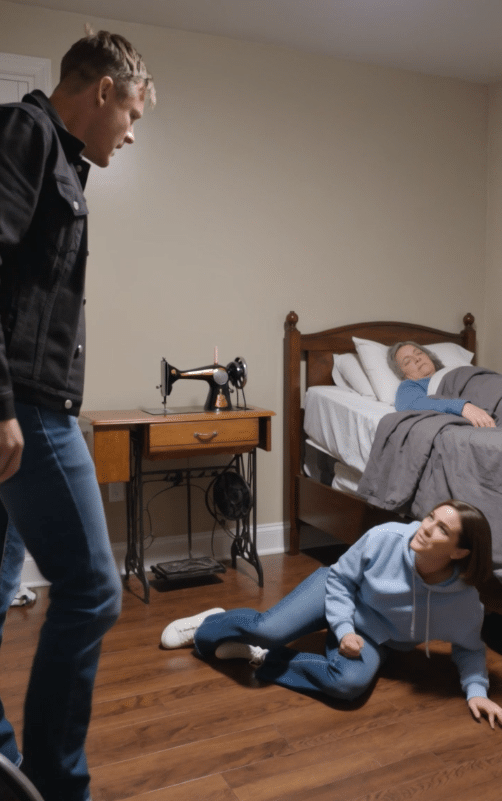
The old sewing machine was almost at the front door when Nora Evans threw herself into her father’s path.
“Put it down, Dad. Please!”
Doug Evans stopped with the machine gripped in both hands. His worn black jacket hung open, and his face carried the hard, restless look of a man who had spent too many nights worrying about debts and too few nights thinking about anyone but himself.
Behind Nora, in the dim bedroom, her mother lay beneath a thin blanket, too weak to rise. The light beside the bed cast a faint yellow glow across her pale face, while the rest of the rented house remained dark.
Nora was twenty-three, dressed in a light blue hoodie and faded jeans. Exhaustion had settled beneath her eyes, but she planted her feet firmly on the wooden floor.
“That sewing machine is Mom’s last thing,” she said.
Doug glanced at the machine as though he were inspecting a broken appliance he had finally decided to throw away.
“Trash. Sentiment doesn’t pay debt.”
Nora shook her head.
“You can’t sell it. It belongs to her.”
“It’s sitting in my house, isn’t it?”
“You left this house years ago.”
The words escaped before she could stop them.
For a second, Doug’s expression changed. Then anger rushed in to cover whatever the truth had touched.
He carried the sewing machine the last few steps toward the door.
Nora moved in front of him.
“Dad, please. She used that machine her whole life.”
Doug’s jaw tightened.
“She should have sold it years ago.”
Nora reached for the machine, trying to steady its weight before he could take it outside. Doug set it down beside the doorway with a hard clatter, then turned toward her.
“Get out of my way.”
“No.”
It was a small word.
But Nora had spent years avoiding that word because she knew what could follow it. She had learned to soften her voice, explain herself twice, and offer compromises before anyone had even asked for one.
Tonight, she had nothing left to bargain with.
Her mother was seriously ill. The rent was due soon. The future was uncertain, and the sewing machine was the last possession Margaret had held onto from the life she had built before illness took so much away.
Nora would not let Doug carry it out as if the years behind it meant nothing.
He drove a forceful kick into her chest.
Nora stumbled backward and fell hard onto the wooden floor near her mother’s bed. The sewing machine shook beside the doorway, its metal frame rattling against the floorboards.
A thin trace of blood appeared on Nora’s forearm where she scraped it against the floor.
For a moment, she could not draw a full breath.
From the bedroom, Margaret stirred.
“Nora?”
Her daughter tried to answer, but pain caught her voice.
Doug stood over her, breathing hard.
Nora pressed one hand against her chest and turned toward the sewing machine. She tried to crawl back to it, dragging herself across the floor.
“Please,” she whispered. “Don’t take it.”
Doug kicked her twice more in the back and side as she reached toward the machine.
Nora curled inward, grimacing, but she kept moving. She placed herself between her father and the one possession her mother had refused to surrender, even when the family had struggled to pay its bills.
Outside, a neighbor gasped.
The front door stood open, and several people had gathered on the walkway after hearing the commotion. One woman covered her mouth. An older man took a step forward, then hesitated when Doug turned toward the doorway.
Nobody moved quickly enough.
Doug looked down at Nora.
“You think this thing is going to save you?” he demanded.
Nora could barely lift her head.
“It’s Mom’s.”
“That doesn’t mean anything!”
He reached toward the sewing machine again.
Then headlights swept across the open doorway.
A sheriff’s patrol vehicle braked sharply outside the rented house.
The door opened, and Sheriff Mark Hale rushed inside, his tan uniform jacket catching the light from the porch. His eyes moved from Nora on the floor to the sewing machine near the entrance, then settled on Doug.
Mark was thirty-two, a familiar face in the small town, and a member of Margaret’s side of the family. He had grown up knowing Nora as the quiet little girl who followed her mother around the house, fascinated by the rhythmic clatter of the very machine Doug was now trying to steal.
He crossed the room and stepped directly between Doug and Nora.
“Step away from my aunt’s daughter.”
Doug froze.
His gaze dropped to the sheriff’s uniform, then returned to Mark’s face. The fury that had filled him seconds earlier faltered, replaced by the sudden realization that the situation had changed.
Mark did not shout. He did not need to.
He stood between the injured woman and the man who had hurt her.
Doug stared at him, his lips parting.
“A sheriff?”
For the first time that night, he looked frightened.
But the uniform was not what made Mark dangerous to him.
It was the fact that Mark knew this family—and that he knew exactly why the sewing machine mattered.
Act II
Mark had not come to the house expecting to find a crime unfolding in the doorway.
Earlier that evening, he had received a worried call from a neighbor who lived two houses down from Margaret and Nora. The neighbor had heard raised voices and a crash, followed by a woman crying out.
At first, she had thought the argument might settle on its own.
Then she heard Nora begging someone not to take the sewing machine.
She knew Margaret was seriously ill. She also knew Doug had been absent from the family for years, returning only occasionally when he needed something.
The neighbor did not know what he intended to do that night, but she recognized the desperation in Nora’s voice. She called for help.
Mark was nearby when the call came in.
When he reached the house and saw Nora on the floor, he understood that this was no ordinary disagreement over property.
He immediately called for medical assistance and additional support, then directed Doug away from Nora. He kept the scene secure while checking whether she was conscious and able to respond.
“Nora, can you hear me?”
She nodded weakly.
“Where does it hurt?”
“My chest. My side.”
“Don’t try to get up yet.”
He kept his voice calm, even as anger pressed hard against his ribs.
Nora was his aunt’s daughter. He had known her since childhood, attended family gatherings with her, and watched her grow into a young woman who rarely asked anyone for help.
But he was also the sheriff.
That meant his first responsibility was to protect Nora, establish what had happened, and make sure the incident was handled properly—not to let his family connection turn the situation into a personal confrontation.
He glanced at the sewing machine beside the door.
“Did he hurt you because you tried to stop him taking that?”
Nora swallowed and nodded.
“He said he was going to sell it.”
“Did your mother give him permission?”
“No.”
Doug scoffed from across the room.
“You’re acting like I broke into a stranger’s house. She’s my daughter.”
Mark turned toward him.
“Being her father doesn’t give you permission to assault her.”
“She’s making this into something it isn’t.”
“You can explain your version of events when the appropriate people speak with you. Right now, stay where you are.”
Doug looked toward the neighbors gathered outside.
“This is a family matter!”
The older man on the porch lowered his gaze. The woman beside him remained at the doorway, visibly shaken.
Mark did not allow the argument to distract him.
He asked one of the responding personnel to check Nora and make sure her mother was safe. Another responder would assess Margaret’s immediate condition and arrange appropriate medical care if needed.
Inside the bedroom, Margaret was awake now.
“Nora?” she called again.
Mark went to the bedroom doorway, careful not to crowd her.
“Margaret, it’s Mark. Nora’s getting help.”
Her eyes widened when she saw his uniform.
“What happened?”
“We’re going to make sure you’re both safe. The medical team is here.”
She tried to push herself upright, but weakness forced her back against the pillow.
“Where’s Nora?”
“Right outside. She’s conscious. They’re checking her injuries.”
Margaret closed her eyes briefly, fighting back tears.
Then she looked toward the front door.
“Did Doug take the machine?”
Mark followed her gaze.
“No. It’s still here.”
A breath escaped Margaret, so fragile it sounded almost like a sob.
That reaction told Mark something the machine alone could not.
It was not merely an old piece of equipment.
It was a symbol of the life Margaret had struggled to preserve after Doug left.
For years, she had used it to sew alterations for neighbors, repair children’s clothes, and make extra money whenever the household budget fell short. She could sit at it for hours, guiding fabric beneath the needle while Nora did homework at the kitchen table.
The machine had helped pay bills when Nora was little. It had provided a little independence when money was tight. And when Margaret’s health began to deteriorate, she kept it carefully maintained even after she became too weak to use it regularly.
She had once told Nora that she wanted the machine to stay in the family.
Not because it was valuable to a collector.
Because it reminded her that she had built something with her own hands.
Doug knew that history.
He had lived through part of it before he left.
Yet he had walked into the house and treated the machine as if its only purpose was to produce quick cash.
Mark returned to the front room.
Doug was pacing beside the wall, muttering about bills, people who owed him money, and how no one understood the pressure he was under.
“I just needed something to sell,” he said. “I wasn’t trying to start all this.”
Mark’s expression remained steady.
“You carried the machine toward the door. Nora tried to stop you. You kicked her.”
“She got in my way.”
“She has a right to protect herself and her mother’s belongings.”
Doug shook his head.
“You don’t understand what debt does to a man.”
Mark looked at him for a long moment.
“Debt doesn’t make another person responsible for your choices.”
The room fell quiet.
Nora lay nearby while the medical team continued assessing her. She could hear the conversation, but she felt too exhausted to join it.
She had imagined many times what might happen if her father returned. She had imagined him apologizing, perhaps asking to see her mother, perhaps finally explaining why he had left.
She had not imagined him arriving to carry away the last thing Margaret owned.
Nor had she imagined that, after years of trying to handle family problems privately, a uniformed officer would be standing between her and the man who had hurt her.
Mark glanced at the sewing machine once more.
Then he looked back at Doug.
“Why tonight?”
Doug’s eyes shifted toward the floor.
For a moment, he said nothing.
And in that silence, Mark realized that the machine was only the visible part of a much older problem.
Act III
Doug had left the family when Nora was still young enough to believe that every departing parent eventually came home.
At first, Margaret told her that he needed time to sort out his problems. Then she said he was working somewhere else. Eventually, she stopped explaining his absence unless Nora asked directly.
Nora remembered waiting by the window on certain evenings, watching headlights pass across the street and wondering whether one of them would turn into their driveway.
Most never did.
Margaret did not tell her everything about the separation. She wanted Nora to have a childhood that was not entirely defined by resentment, and she was reluctant to turn every family memory into a story about Doug’s failures.
But the financial strain was impossible to hide.
Margaret took extra sewing jobs, mended clothes late into the night, and learned to stretch a grocery budget further than Nora thought possible. When Nora was old enough, she began helping with simple tasks: winding thread, sorting fabric, and folding finished garments.
The sewing machine became part of their routine.
Its steady rhythm filled the small house after dinner. On cold evenings, Margaret would work while Nora sat nearby with a schoolbook, occasionally asking questions whenever she got stuck.
Sometimes Margaret would stop the needle and look at her daughter.
“You know, this machine has kept us going more times than I can count.”
Nora would smile.
“Then we should keep it forever.”
Margaret had laughed at that.
“Forever is a long time, sweetheart.”
“Then until we’re both old.”
It had been an ordinary promise made during an ordinary evening.
Years later, Nora remembered it with painful clarity.
When Margaret’s illness worsened, the sewing machine became one of the few things she could still look at and recognize as part of the life she had once enjoyed. She could no longer work at it for long, but sometimes Nora wheeled a chair beside the table so her mother could touch the worn metal body and talk about the garments she had made.
There were stories attached to it: a wedding dress repaired at the last minute, school uniforms altered for a neighbor’s children, curtains made from discounted fabric when the family could not afford new ones.
The machine held no secret fortune.
It was not a rare antique worth enough to solve every problem.
Its value was personal, practical, and irreplaceable in the way that ordinary objects sometimes become irreplaceable to the people who love them.
Doug understood enough of that to know Nora would resist.
But he was desperate.
He had accumulated debts through a series of bad decisions and promises he could not keep. When creditors began pressing him, he turned to the people he believed would be easiest to manipulate.
He told himself he was only borrowing.
He told himself that selling one old machine would make little difference.
He told himself that Margaret no longer used it, so keeping it was wasteful.
Each excuse allowed him to avoid the real question: why should his daughter and his former wife pay for problems they had not created?
He had returned to the house believing he could take the machine before anyone stopped him. He had assumed that Nora would be too frightened to stand in his way, just as she had been when he was younger and louder than everyone else in the room.
He had not counted on her refusing.
And he had certainly not expected Mark to arrive.
Now, with the sheriff watching him, Doug tried to recover his familiar tone of authority.
“Your aunt has been sick for a long time,” he said. “That machine is just taking up space.”
Mark stared at him.
“You know what it means to her.”
“She can’t even use it anymore.”
“That doesn’t mean you can take it.”
Doug gestured toward the bedroom.
“Look at her. What good is an old machine going to do for someone in that condition?”
From the doorway, Margaret heard every word.
She tried to speak, but her voice was weak.
Mark turned toward her.
“Don’t strain yourself, Margaret. You don’t have to explain anything right now.”
But she wanted to speak.
She had spent years allowing Doug’s choices to shape what the family could afford, where they could live, and how much she could ask of others. Even now, she worried about the consequences of confrontation.
She had tolerated his absence. She had accepted his excuses. When he occasionally returned with a request, she had sometimes listened longer than she should have because part of her still hoped he might finally act like the husband and father he had once promised to be.
But the machine was different.
It was the last possession she had held onto without having to justify why it mattered.
“Doug,” she called, her voice barely above a whisper.
He turned.
“Leave it.”
For a moment, the entire house seemed to stop.
Margaret looked directly at him.
“You left us with the bills, and Nora helped me survive. You don’t get to come back now and take the one thing I asked her to keep.”
Doug’s expression hardened.
“I didn’t leave you with nothing.”
“You left us without you.”
The words landed harder than a shout.
Nora stared at her mother from the floor, tears gathering in her eyes.
Margaret continued, each sentence costing her effort.
“That machine isn’t yours to sell. It never was.”
Doug looked away.
For the first time, his excuses seemed too small to fill the room.
Mark had expected anger from him. He had expected denial and perhaps a claim that Nora had exaggerated what happened.
He had not expected Margaret to speak so clearly about the past.
But he understood why she had done it.
She was too ill to stand, too weak to work at the machine, and too exhausted to keep fighting the same battle.
Yet she was still able to decide what belonged to her.
And Doug had no right to turn her illness into permission.
Mark moved closer to the front door, keeping himself between Doug and the sewing machine.
“The machine stays here while ownership and the circumstances are documented. You’re not taking it tonight.”
Doug looked at the sheriff’s uniform again.
He had thought the badge would be the only reason he had lost control.
He was about to learn that the truth was already catching up with him.
Act IV
Additional officers arrived to assist Mark, and the house was no longer left to the mercy of a single argument.
Nora received medical attention, and the responders evaluated her injuries before arranging further care. Margaret’s condition was also checked, with her immediate medical needs taking priority over the dispute at the doorway.
Mark made sure both women had space away from Doug.
The sewing machine remained inside the house.
Officers documented the scene, spoke with witnesses, and recorded the accounts of those who had heard or seen the confrontation. The neighbors who had gathered outside were asked to provide what they knew, including when the argument began and what they had heard before Mark arrived.
No one was encouraged to embellish the story.
No one was asked to decide Doug’s guilt on the spot.
The facts would be documented, and the appropriate authorities would determine the next steps.
Doug, however, seemed to believe that the presence of more officers gave him another audience to persuade.
“She attacked me first by blocking the door,” he insisted.
One officer asked him to explain exactly what he meant.
“She stood in front of the machine. I told her to move.”
“And then?”
Doug hesitated.
Mark watched him closely.
“And then you kicked her,” Mark said.
“She wouldn’t listen.”
“That isn’t an answer to the question.”
Doug’s face flushed.
He looked toward Nora, who was now sitting with support from the medical team. She had one arm held close to her body, and her face was pale from pain and exhaustion.
“Tell them,” he demanded. “Tell them you wouldn’t let me leave.”
Nora looked at him.
She remembered being a child and watching him leave without explanation. She remembered her mother pretending not to be hurt. She remembered the long evenings spent helping at the sewing machine, the bills stacked beside it, and the quiet promise that they would keep going.
She remembered crawling across the floor while he kicked her because she had refused to let him take the machine.
“I tried to stop you from taking Mom’s property,” she said.
Doug shook his head furiously.
“You always make me look like the bad guy.”
Nora’s voice trembled, but she continued.
“You did that yourself.”
The words left her visibly shaken.
Mark did not interrupt. Neither did the officers.
Doug stared at his daughter as though he could force her to retract the sentence by looking at her long enough.
Then he tried another approach.
“I am still your father.”
Nora lowered her gaze for a moment.
That sentence had followed her through much of her life. It had been used to demand money, silence, forgiveness, and access to things that did not belong to him.
But it could not erase what he had done.
“You’re my father,” she said quietly. “And you still hurt me.”
Doug opened his mouth.
Nothing came out.
Mark directed him away from Nora and ensured the officers handled the next steps according to procedure. He did not promise that a badge would automatically settle the matter, and he did not use his relationship with Nora as a substitute for evidence.
His role was to make sure the women were safe, the facts were preserved, and Doug could not continue intimidating them at the scene.
For the first time that night, the house grew quiet.
Nora looked toward the sewing machine.
Its familiar shape stood near the open door, a little crooked from where Doug had set it down. The machine had survived years of work, countless repairs, and long periods when Margaret could no longer sit beside it.
Now it had nearly been carried away in the middle of the night.
Nora’s eyes filled with tears.
“I thought he was going to take it.”
Mark crouched beside her, keeping enough distance that the medical personnel could continue their work.
“He isn’t taking it tonight.”
“But what happens now?”
“We’ll document what happened. The property question and the assault will be handled through the proper process. You don’t have to resolve everything before you leave this room.”
Nora nodded, though she was still frightened.
Mark’s presence did not erase her father’s history. It could not guarantee that Doug would never return or that the family would suddenly have enough money to make life easy.
But it gave Nora something she had not felt in a long time.
A moment in which she did not have to stand alone between her mother and the next crisis.
Before the medical team prepared to move her for further evaluation, Nora asked to speak to Margaret.
Mark helped arrange it.
Her mother was lying against the pillows, pale but alert. When Nora appeared in the doorway, Margaret reached toward her.
“Oh, sweetheart.”
Nora took her hand.
“I’m sorry.”
Margaret frowned.
“For what?”
“For not being able to stop him.”
Margaret tightened her fingers around Nora’s hand as much as her strength allowed.
“You stood in front of him when you were scared. You tried to protect something that mattered to me.”
Nora began to cry.
“I couldn’t protect you from everything.”
“You were never supposed to.”
For a long time, Nora had thought that caring for her mother meant preventing every possible hurt. She believed she had to keep the household together, manage the bills, anticipate every emergency, and somehow make up for the years Doug had been absent.
Margaret had never asked her to do all of that alone.
The expectation had grown quietly, fed by necessity and Nora’s own fear of what would happen if she let anything slip.
Now her mother was telling her that love was not measured by how much pain she could endure.
“You are my daughter,” Margaret whispered. “Not my shield.”
Nora pressed her mother’s hand against her cheek.
Outside, the officers continued their work. The neighbors slowly dispersed, leaving the porch light shining across the empty walkway.
And inside the little rented house, the sewing machine remained where it belonged.
For the first time that night, neither woman had to watch the door.
Act V
The days that followed were difficult, but they were different from the years that had come before.
Nora received medical follow-up for her injuries and gave a formal account of what had happened. The witnesses provided their statements, and the responding officers preserved the documentation from the scene.
Mark remained involved in ensuring that Nora and Margaret knew how to contact the appropriate people if Doug returned or attempted to pressure them. Because he was related to them, he also made sure the case was handled through the proper channels rather than relying on family assurances or private arrangements.
No one pretended that a single night could repair everything.
Margaret’s illness continued to demand attention. The rent still had to be paid, appointments still had to be kept, and Nora still needed to work when she was well enough.
The difference was that the family was no longer pretending Doug’s behavior was simply another inconvenience they had to endure.
Nora began telling a few trusted people what had happened. She had once been afraid that speaking openly would make others judge her mother or question why the family had tolerated Doug for so long.
Instead, she discovered that several people had noticed how much responsibility she carried.
A neighbor offered to help with transportation to medical appointments. Another brought groceries on a difficult week. Mark helped connect them with local services that could explain what support might be available for families managing serious illness and financial strain.
None of these gestures solved every problem.
But each one reminded Nora that accepting help was not the same as failing.
The sewing machine stayed in the house while the matter was documented and the ownership issues were clarified. It was not sold, pawned, or carried away to satisfy Doug’s debts.
A few days after the incident, Nora cleaned the small table where Margaret had kept it. She wiped away the dust, checked the cord, and placed the machine carefully where her mother could see it from the bed.
Margaret watched her from the doorway of the bedroom.
“You don’t have to keep it there if it gets in the way,” she said.
Nora smiled faintly.
“It’s not in the way.”
“It’s an old machine.”
“It’s your old machine.”
Margaret looked at it for a long time.
Then she began telling Nora about the first dress she had sewn on it after moving into the house. She remembered a neighbor who had needed a wedding hem repaired the night before the ceremony, and a little boy whose school trousers had torn just before the first day of class.
She remembered the money the machine had helped them earn when Nora was growing up.
But as she spoke, the memories changed. They became less about hardship and more about the life that had existed around it.
Nora sat beside her and listened.
For once, they were not discussing bills or medical instructions. They were remembering.
Later that week, Mark visited after finishing his shift. He did not arrive with a dramatic speech or a promise to make all of their troubles disappear. He brought information about the next steps in the case and asked whether they felt safe at home.
Nora said she did, though she was still nervous about Doug’s reaction.
Mark took that seriously.
They discussed a practical plan for what to do if Doug appeared again, whom to call, and how to avoid being drawn into a confrontation alone. Mark explained that any further threats or attempts to take property should be documented and reported rather than handled through another private argument.
Before leaving, he paused beside the sewing machine.
“Your mom still tells the story about how you used to fall asleep beside this thing.”
Nora laughed softly.
“I was little.”
“You used to insist you were helping.”
“I was helping.”
“You were holding the thread spool upside down.”
Nora laughed again, and this time the sound came easily.
From her bed, Margaret smiled.
For a few minutes, the room felt like the home they had once known—not because their problems had vanished, but because their lives contained something beyond fear.
A week later, Nora found a folded piece of fabric beneath the sewing machine’s worktable. It was an unfinished piece Margaret had started before becoming too ill to continue.
Nora carried it to her mother.
“Do you remember what this was supposed to be?”
Margaret studied the fabric, then touched its edge.
“A curtain for the kitchen window.”
“You never finished it.”
“I know.”
“Would you like me to help?”
Margaret looked surprised.
“You don’t know how to use the machine.”
“You can teach me.”
Her mother smiled, a small but unmistakable smile.
“I suppose I could.”
They did not attempt to finish the curtain that afternoon. Margaret was tired, and Nora still had work to do. Instead, they made a plan to begin when her mother felt stronger, even if all they managed was a few minutes at a time.
The machine was not going to restore Margaret’s health.
It would not pay every bill or undo the damage Doug had caused.
But it gave them something to look forward to, however small.
A few days later, Nora received a message from her father.
He complained that everyone had turned against him. He said the sheriff had embarrassed him and that Nora had destroyed whatever chance they had of repairing their relationship.
At the end, he asked whether she could lend him money.
Nora read the message twice.
The old instinct rose immediately: explain, apologize, remind him that she was struggling too, and perhaps offer a small amount just to stop the argument before it began.
Instead, she put the phone down and walked to her mother’s room.
Margaret was resting, her breathing steady.
Nora returned to the kitchen and typed a brief response. She would not give him money, and he was not to come to the house or take anything belonging to them. If he had something legitimate to discuss, it could be handled through appropriate channels without threats or pressure.
She sent the message.
Then she turned off the screen.
Her hands trembled, but she did not take the words back.
She could still wish that her father had been different. She could grieve the childhood she had wanted and the relationship she had hoped might one day be repaired.
But she no longer believed that loving him required letting him hurt her.
That evening, Mark stopped by to check on them.
He found Nora sitting beside the old sewing machine while Margaret rested in the next room. A small lamp illuminated the machine’s worn metal surface.
“Everything all right?” he asked.
Nora nodded.
“It’s been a hard week.”
“I know.”
She glanced toward the bedroom.
“Mom’s been talking about sewing again.”
Mark smiled.
“That sounds like her.”
Nora ran her fingers over the edge of the table.
“I used to think this machine was just something we couldn’t afford to replace. Now I think it’s more than that.”
“What do you think it is?”
She considered the question.
“Proof that she kept going.”
Mark nodded.
“Then I’m glad it’s still here.”
After he left, Nora sat quietly for another minute. She listened to the sounds of the house: the faint movement of her mother turning in bed, the hum of the refrigerator, and the distant traffic beyond the window.
The front door was closed now.
The sewing machine remained in the room.
And for the first time in years, Nora did not feel that she had to stay awake listening for the sound of someone returning to take something away.
She had not saved her mother from illness. She had not solved every financial problem. She could not force Doug to become the father she had needed.
But she had protected her mother’s last possession, told the truth about what happened, and accepted that their safety mattered more than keeping the peace with a man who refused to respect them.
The old sewing machine had once helped Margaret earn enough to keep food on the table and clothes on Nora’s back. It had carried them through lean years, long nights, and the quiet sacrifices that no one outside their little house had ever fully seen.
Doug had looked at it and seen a way to pay his debts.
Nora had looked at it and seen her mother’s life.
And Sheriff Mark Hale had looked at the scene and understood that protecting a family sometimes meant refusing to let the loudest person in the room decide what everyone else was worth.
The machine stayed.
So did the memories.
And in the little rented house where Nora had spent so many years trying to hold everything together, something finally began to change.
She was no longer protecting her mother by standing alone against the world.
She was learning that they both deserved to be protected, too.