Act I
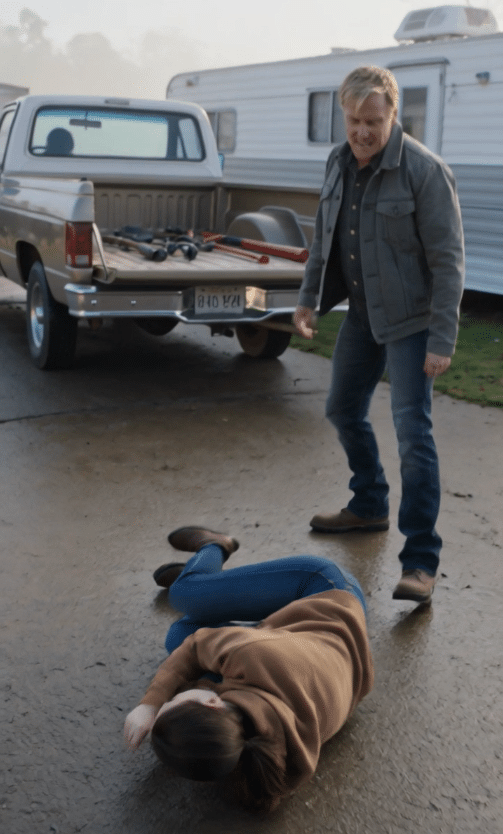
Olivia Hart was still clutching the pickup keys when her father kicked her to the ground.
The old truck stood beside her trailer, its faded paint damp with morning mist, a collection of work tools rattling in the open bed. Olivia had parked it there only hours earlier after finishing another exhausting shift. Now, before sunrise, Keith Hart was trying to take it away from her.
“Dad, stop! You can’t sell it!”
Keith lunged for the keys in her hand.
Olivia twisted away, holding them against her chest. Her brown hoodie was stained from work, and dark circles shadowed her eyes. At twenty-six, she looked older than she was—not because she lacked hope, but because she had spent years working two jobs and carrying responsibilities that should never have belonged to her alone.
“This truck is how I get to work,” she pleaded.
Keith’s expression hardened.
“Trash. It pays my debt today.”
“It’s my truck!”
“It’s a truck sitting on my property.”
“It’s registered to me!”
He ignored her, reaching for the keys again.
Olivia stepped between him and the driver’s door. The pickup wasn’t pretty. One headlight was newer than the other, the passenger window sometimes stuck, and the engine made a rough sound on cold mornings. But it started, it carried her tools, and it got her to the workshop where she earned the money that kept food in the refrigerator and helped pay for her mother’s prescriptions.
Without it, she would lose more than transportation.
She could lose her job.
And if she lost her job, she would have no reliable way to support the woman who had spent years trying to protect her from the consequences of Keith’s decisions.
“Please,” Olivia said, her voice breaking. “Just leave it alone.”
Keith gave a bitter laugh.
“You always have an excuse. Your mother needs money. You need gas. You need repairs. Everybody needs something, and I’m supposed to sit here with my debts?”
“You’re not paying your debts with my truck.”
His face changed.
For a second, the desperation behind his eyes gave way to anger. He grabbed for the keys again, and Olivia held on with both hands.
Then Keith stepped back and drove a forceful kick into her chest.
Olivia fell hard onto the damp ground in front of the pickup.
The keys slipped from her fingers and landed in the mud. In the truck bed, a metal wrench rattled against a toolbox. Olivia gasped, trying to draw a full breath, while a thin trace of blood appeared on her elbow where it had scraped against the rough ground.
She looked toward the keys.
Keith moved between her and the truck.
“Dad,” she choked out. “Don’t do this.”
He stared down at her without sympathy.
“Trash. It pays my debt today.”
Olivia tried to push herself up.
Keith kicked her twice more in the back and side as she crawled toward the keys. Pain forced her to stop, one hand pressed against her ribs, but she kept reaching across the wet ground.
The pickup was only a few feet away.
It might as well have been the entire future she had worked to build.
Across the narrow trailer lot, curtains shifted. A neighbor stepped onto a small wooden porch and immediately covered her mouth. Another resident emerged beside an old pickup of his own, then froze at the sight of Olivia on the ground.
Nobody intervened.
Keith looked toward them and raised his voice.
“Mind your own business!”
The neighbors stepped back.
Olivia stared at the keys lying in the mud.
She remembered buying the truck three years earlier, after saving for months and inspecting half a dozen vehicles that were either too expensive or too unreliable. The seller had warned her about the worn transmission. She had negotiated the price down, taken the truck to a mechanic, and driven it home with both hands gripping the wheel.
It was the first major thing she had ever owned entirely in her own name.
And Keith had always hated that fact.
“You can walk like everyone else,” he told her.
Olivia looked up at him.
“You know I work across town. You know Mom has appointments. How can you do this?”
“Because somebody has to solve my problems!”
The words hung in the cold morning air.
Olivia’s face went still.
There it was. Not a misunderstanding. Not a desperate father who had made one terrible decision. He had said it plainly: his problems mattered more than her job, her mother, or the future she had struggled to protect.
A small work truck came around the bend in the road.
Its brakes squealed as it stopped in front of the trailer.
The driver’s door flew open.
Daniel Foster, the forty-five-year-old owner of the workshop where Olivia worked, jumped out. He wore a black work jacket and dark jeans, and his expression turned furious when he saw her on the ground and Keith standing over her.
Daniel had come to collect a set of specialized tools Olivia had offered to bring in early that morning.
Instead, he found her crawling through the mud for her own truck keys.
He charged across the lot.
Keith barely had time to turn before Daniel struck him hard in the face. Keith staggered backward, a thin trace of blood appearing at the corner of his mouth.
Daniel stepped between him and Olivia, placing himself directly in front of the pickup.
Then he looked at Keith with a controlled fury that made the surrounding neighbors fall silent.
“You don’t deserve to be called a father.”
Keith stared at him, stunned.
He had expected Olivia to keep pleading. He had expected the neighbors to keep watching from a safe distance. He had expected the world to behave as it always had when he made his desperation someone else’s burden.
Instead, a stranger had crossed the lot and stood between him and the daughter he was trying to rob.
Keith’s lips parted.
“Who are you?”
Daniel did not move.
And as Keith finally noticed the way Olivia looked at the man who had come to help her, he realized the confrontation had taken a turn he could not control.
Act II
Olivia had learned to recognize the sound of her father’s truck long before she learned to recognize the difference between a bad day and a dangerous one.
When she was little, the sound meant she should hurry to finish her chores. If Keith came home in a good mood, the evening might pass without an argument. If he slammed the door, she and her mother learned to keep their voices low.
Her mother, Diane, had once believed Keith’s worst behavior was temporary.
He would find steady work, she told herself. He would stop borrowing money. He would learn to apologize without turning the apology into another accusation.
For a while, there were periods when life seemed to improve. Keith would bring home groceries, promise to pay the electricity bill, and talk about repairs he planned to make around the trailer.
Then the debts returned.
Sometimes they came from unpaid bills. Sometimes from money borrowed from acquaintances. Sometimes from choices Keith refused to explain. Whatever the reason, the outcome rarely changed: he expected the family to absorb the consequences.
Diane took extra cleaning jobs. Olivia started working weekends while she was still in school. When the household needed money, both women learned to postpone their own needs.
Keith called it family loyalty.
Olivia eventually understood that he meant obedience.
By the time she was twenty-three, she was working long hours and helping her mother with appointments and household expenses. She did not resent caring for Diane. Her mother had been the one person who quietly encouraged her to make plans beyond the trailer lot.
“You don’t have to live the same life I did,” Diane used to tell her.
Olivia would smile.
“I’m not planning to.”
The pickup was part of that plan.
It allowed her to take jobs that were too far away to reach reliably by bus. It let her carry work boots, tools, and supplies without depending on anyone. When Diane needed a medical appointment, Olivia could get her there without begging for a ride or waiting hours for public transportation.
The truck wasn’t a symbol of wealth.
It was freedom measured in miles.
Daniel Foster understood that better than most people.
He had spent years building a small automotive workshop from a rented industrial bay and a handful of secondhand tools. He knew how many workers relied on old vehicles to get to jobs that paid just enough to keep their families afloat.
A broken starter could mean a missed shift.
A failed transmission could mean the loss of a job.
And a vehicle sold out from under its owner could dismantle an entire household’s fragile financial balance.
When Olivia first applied at his workshop, she had arrived early with her résumé folded inside a plain envelope. She had experience changing tires, organizing parts, and assisting with basic maintenance, but she lacked formal certification.
Daniel gave her a trial period.
She proved herself quickly.
Olivia showed up on time, listened carefully, and never pretended to know something she didn’t. If she made a mistake, she admitted it and learned from it. If another employee was overwhelmed, she offered to help without expecting praise.
Daniel noticed that she often stayed late.
At first, he assumed she simply wanted the hours. Eventually, he learned she was supporting her mother and trying to keep her finances stable.
He offered her additional paid training.
Olivia accepted, then asked whether she could schedule the sessions around her other work.
Daniel respected that answer. She was not asking for a handout. She was trying to make a future possible with the time and money she actually had.
Over the next two years, she became one of the workshop’s most dependable employees. She learned to diagnose common engine problems, manage parts orders, and handle customer intake. Daniel began trusting her with more complex work.
He also noticed that she never talked about her father unless something had gone wrong.
Once, Keith appeared at the workshop demanding to know why Olivia hadn’t answered his calls. Daniel had watched her go pale when she saw him through the office window.
She stepped outside to speak with him, hoping to prevent a scene.
When she returned, she was quiet for the rest of the afternoon.
Daniel asked whether she needed anything.
“No,” she said quickly. “It’s fine.”
He did not push her.
But he remembered the expression on her face.
Now, standing in the damp trailer lot, he understood that whatever had happened between Olivia and Keith was far more serious than a disagreement over money.
Daniel turned slightly, keeping himself between Keith and the young woman on the ground.
“Olivia, can you hear me?”
She nodded, grimacing as she tried to sit up.
“Don’t rush,” he said. “Let me get the keys out of the mud.”
He crouched only after making sure Keith stayed back. He retrieved the keys and placed them on the edge of the pickup’s hood, where Olivia could see them.
Then he faced Keith again.
“You’re going to stay away from her.”
Keith wiped the corner of his mouth with the back of his hand.
“You don’t know what she’s like. She’s stubborn. She refuses to help her own family.”
Daniel’s eyes narrowed.
“Is that what you call trying to keep her vehicle?”
“It’s my daughter. I can deal with her however I need to.”
“No,” Daniel said. “You can’t.”
Keith looked around at the neighbors, searching for someone who might support him. Their faces remained tense. No one came forward to defend his version of events.
“You think you’re some kind of hero?” he demanded.
Daniel shook his head.
“I’m a man who showed up and saw you hurting someone.”
Olivia pressed one hand against her side. She was frightened, exhausted, and embarrassed that so many people had witnessed her at her most vulnerable.
But underneath those feelings was something she hadn’t expected.
Relief.
For once, she wasn’t the only person insisting that what Keith was doing was wrong.
And Daniel was about to discover why her father had chosen that particular morning to take the truck.
Act III
The explanation came in fragments.
First, Keith claimed he had only wanted to borrow the pickup.
Then he said Olivia had promised to help him.
Finally, when Daniel asked why a simple loan required physical violence, Keith admitted what he had been trying to hide.
He owed money.
A payment was due that day, and someone had told him they would buy the truck if he could deliver it before the morning was over.
Keith had decided that Olivia’s pickup was the fastest way to get cash.
He had not asked whether she agreed to sell it because he knew she would refuse.
Daniel listened without interrupting.
When Keith finished, Daniel asked a simple question.
“Whose name is on the title?”
Olivia answered from beside the truck.
“Mine.”
“And who paid for it?”
“I did.”
Daniel looked back at Keith.
“Then what exactly makes you think it’s yours to sell?”
Keith’s jaw tightened.
“She’s my daughter.”
“That doesn’t make her property.”
The sentence landed harder than Daniel intended.
For years, Keith had treated family relationships as a kind of permanent contract. He believed that being a father gave him a right to demand money, dictate choices, and claim whatever his children managed to earn.
He had never considered that a parent could lose the trust of a child without that child losing the right to say no.
Olivia stared at the keys on the hood.
She remembered the day she signed the truck’s title. She had checked the paperwork three times because she was nervous about making such a large purchase. The seller had handed her the keys, and for the first time in her life, she had driven away knowing that the vehicle belonged to her.
She had paid for every repair since.
New tires. A replacement battery. Brake work. Oil changes. Small fixes that added up over time.
The truck was old, but she knew its sounds and habits. She could tell when the engine was cold, when a belt needed attention, and when the steering felt different.
Keith knew none of that.
He knew only that it could be sold.
“You could have asked me,” Olivia said.
Keith laughed bitterly.
“And you would have said no.”
“Yes.”
“Exactly!”
He spread his hands as though her refusal proved his point.
Daniel stared at him in disbelief.
“You’re admitting you knew she wouldn’t agree, so you decided to take it by force?”
Keith’s expression hardened.
“I needed money.”
“So does she.”
“She can earn more.”
Olivia closed her eyes.
There it was again: the assumption that she could always work harder, lose more sleep, and somehow rebuild whatever he took. Her time was unlimited in his mind. Her energy was unlimited. Her ability to recover from the consequences of his actions was unlimited.
Only his needs were urgent.
Daniel turned toward Olivia.
“Did you give him permission to take the truck?”
“No.”
“Did you tell him he could sell it?”
“No.”
“Has he tried to take your money or belongings before?”
Olivia hesitated.
Keith immediately interrupted.
“Don’t you start making me sound like some criminal.”
Daniel raised one hand.
“Let her answer.”
Olivia looked at the neighbors, then down at her muddy hands.
“He’s asked me for money before. He says he’ll pay it back, but he doesn’t. When I refuse, he gets angry. Sometimes he shows up where I work.”
“Did you feel safe telling him no?”
She took a long breath.
“Not always.”
The admission seemed to surprise even her.
She had spent so long explaining away Keith’s behavior that she rarely used direct words for what it made her feel. She called it stress. She called it a family argument. She called it a difficult situation that would eventually settle down.
But the truth was that she had begun planning her life around avoiding his anger.
She kept some money separate because she feared he would ask for it. She checked the driveway before leaving home. She sometimes delayed going inside the trailer if she saw his truck parked nearby.
And she had never told Daniel the whole story because she worried he would think she was too distracted by family problems to be a good employee.
Daniel’s expression softened when he heard her answer.
“You don’t have to explain every detail to me right now,” he said. “But you shouldn’t have to be afraid of someone taking your property or hurting you.”
Keith scoffed.
“She’s exaggerating. I never meant to hurt her.”
Olivia looked up.
“You kicked me.”
Keith fell silent.
For a moment, there was nothing to hide behind. No complicated argument about debt, family duty, or who had helped whom in the past.
There was only the fact that he had used violence because his daughter would not hand over something she owned.
Daniel reached for his phone and called for emergency assistance. He gave the location, explained that someone had been assaulted, and requested medical evaluation for Olivia.
He did not attempt to decide what charges should follow or threaten Keith with a punishment he could not personally impose. He kept his distance, maintained a barrier between them, and made sure the neighbors understood that responders needed room to work.
One of the residents finally came closer, offering Olivia a clean towel for her scraped elbow.
Another confirmed that they had seen the confrontation from their porch.
Keith looked at them with disbelief.
“You’re all going to turn against me over this?”
No one answered.
He had spent years believing that other people would remain silent if he made enough noise. He had mistaken their reluctance to get involved for agreement.
Now their willingness to describe what they had witnessed threatened the story he wanted to tell.
Daniel looked at him.
“Whether people like you or not isn’t the question. What happened here needs to be addressed.”
Keith’s gaze shifted toward the old pickup.
He seemed to realize that the truck was no longer within his reach. The keys were back with Olivia, and the people around him were no longer treating his demands as something she was required to obey.
But he had one more accusation ready.
“You think she can survive without me?” he snapped. “Everything she has came from this family.”
Olivia slowly lifted her head.
“No, Dad,” she said. “Everything I have came from working for it.”
Keith stared at her.
And for the first time, she did not look away.
Act IV
The responding officers arrived as the morning sky began to brighten.
They separated Keith from Olivia and took statements from the people who had witnessed the assault. Olivia explained that the pickup was registered in her name and that she had never given her father permission to sell it.
The officers documented the scene and the visible injuries. They also recorded the neighbors’ accounts and asked whether there had been previous threats or attempts to take the vehicle.
Olivia answered honestly.
She did not exaggerate, and she did not try to make her father sound worse than he was. She simply stopped making excuses for him.
Daniel gave his account of what he had seen when he arrived. He acknowledged that he had struck Keith after finding Olivia on the ground, and he cooperated with the officers as they documented the entire confrontation.
He did not pretend his reaction had been part of some official duty. He had acted in anger, and he would answer questions about that action as well.
What mattered now was that the incident would not disappear into another private argument.
The officers determined the next steps based on the evidence and the applicable law. Keith was no longer in a position to decide unilaterally what happened to the truck, and Olivia was given information about reporting further threats and seeking protection if she felt unsafe.
After they had gathered the necessary information, Daniel helped Olivia arrange a medical evaluation and a safe way to get there. He did not let her climb into the truck simply because she insisted she could manage. Her pain needed to be assessed first.
“I can’t miss work for too long,” she murmured.
Daniel looked at her.
“Your health comes first.”
“But I have bills.”
“We’ll work out the schedule. You don’t have to choose between being injured and keeping your job.”
She looked at him, unsure what to say.
Olivia was accustomed to making herself useful before she allowed herself to need anything. She could change a tire, organize a parts order, cover a shift, and find a way to stretch a grocery budget. But when someone offered to help her, her first instinct was to calculate the cost of accepting it.
Daniel seemed to recognize that instinct.
“This isn’t a loan,” he said. “And you don’t owe me for showing up.”
She swallowed.
“I don’t know how to do this.”
“Do what?”
“Let somebody help me without feeling like I’m going to pay for it later.”
Daniel’s expression changed.
For a moment, the anger disappeared, replaced by the sadness of someone who had heard too much about the ways people could be made to feel indebted for basic kindness.
“You don’t have to earn the right to be safe, Olivia.”
She looked away, blinking back tears.
Those words followed her through the day.
At the workshop, Daniel informed the staff that Olivia would be away while she recovered and that her job remained secure. He asked the office manager to adjust the schedule without sharing private details, and he made clear that no one should pressure her to return before she was ready.
He also reviewed the workshop’s procedures for handling unauthorized visitors. Keith had shown up before, and although no previous incident had escalated this far, Daniel understood that the business needed a clear response if he returned and tried to intimidate Olivia.
Staff would contact management and, if necessary, law enforcement rather than confront him alone.
It was a practical step, not a dramatic promise that trouble would never come again.
Meanwhile, the truck remained where it belonged.
The officers had documented the vehicle and the keys, and Olivia retained control of her property. Once she was able to drive safely, she would be able to use the pickup to get to work and take her mother to appointments.
The thought of losing it had frightened her more than she had admitted.
Without the truck, she would have needed to rearrange her shifts, find rides, and somehow manage the cost of transportation while continuing to help Diane. It would have meant weeks of scrambling to rebuild the routine she had spent years creating.
Keith had dismissed all of that with one sentence.
You can walk like everyone else.
He had spoken as though her life were simple, as though every distance could be crossed on foot and every missed shift could be made up without consequences.
But Olivia’s life had never been that simple.
She had worked hard because she had responsibilities. She had bought the truck because she needed independence. She had protected it because it was essential to the life she was building.
None of that made her selfish.
Later that afternoon, Olivia returned to the trailer lot with Daniel after her medical evaluation. She moved carefully, still sore, but she insisted on seeing the pickup before she went inside.
She ran her fingers over the driver’s door.
The truck had a small dent near the rear wheel and a patch of paint that never quite matched the rest. One of the tools in the bed had shifted during the confrontation, but everything remained there.
Daniel stood nearby.
“You should get some rest,” he said.
“I will.”
She opened the driver’s door and sat behind the wheel for a moment.
The seat cover was cracked. The dashboard had a faded mark where an old phone mount had been. The engine would probably need another repair before winter.
But the keys were hers.
She started the engine.
It turned over with its familiar rough rumble.
Olivia closed her eyes.
She had not realized how deeply she had feared that she might never hear that sound again.
When she stepped back out, Daniel was watching her with a small, relieved smile.
“Still running,” he said.
“She’s stubborn.”
“Sounds like someone I know.”
For the first time that morning, Olivia laughed.
It was brief, and it hurt her side, but it was real.
Then she looked toward the trailer.
Her mother was inside, waiting to hear what had happened.
And Olivia knew that the hardest part of the day might still be ahead—not because she was afraid to tell Diane the truth, but because she would finally have to admit how long she had been living with the fear of Keith’s next demand.
Act V
Diane Hart was sitting on the edge of her bed when Olivia came inside.
She noticed the muddy jeans first, then the way her daughter moved cautiously and kept one arm close to her side.
“What happened?”
Olivia sat beside her.
For a moment, she considered giving the usual answer.
Nothing serious. Just an argument. Dad was upset. Everything would be fine.
Those words had protected her mother from worry before, or at least that was what Olivia had told herself. But every time she used them, she also protected Keith from consequences.
This time, she told the truth.
She explained that her father had tried to take the pickup to sell it. She told Diane that she had refused, that he had attacked her, and that Daniel had arrived and intervened before things could become even worse.
Diane listened with one hand pressed over her mouth.
When Olivia finished, her mother began to cry.
“I should have stopped him years ago.”
Olivia shook her head.
“You tried.”
“I should have done more.”
“You were trying to keep us safe.”
Diane looked down at her hands.
For years, she had hoped that if she stayed calm enough, forgave enough, and gave Keith enough chances, the man she had once loved would return. She had endured arguments over money and watched her daughters adjust their lives around his moods.
She had believed she was protecting her family by keeping the peace.
Now she understood the price of that peace.
It had asked Olivia to work harder, ask for less, and accept the unacceptable.
“I didn’t want you carrying all of this,” Diane whispered.
Olivia reached for her hand.
“I know.”
“I wanted you to have your own life.”
“I am trying to.”
Her mother’s fingers tightened around hers.
“Then you have to keep it.”
The sentence was simple, but Olivia felt something shift inside her.
She had spent so long believing that protecting her family meant absorbing whatever Keith did that she had nearly forgotten she was part of the family, too. Her safety mattered. Her work mattered. Her future mattered.
Caring for Diane did not mean surrendering everything she owned.
Being Keith’s daughter did not mean financing his debts.
And refusing to be hurt did not mean she had stopped loving anyone.
Over the next few days, Olivia rested and followed the medical guidance she had been given. She stayed in contact with the responding officers and provided any additional information they requested. Daniel checked in without demanding details, and the workshop adjusted its schedule while she recovered.
Keith tried to contact her.
At first, he sent messages claiming that everyone had misunderstood what happened. Then he said Daniel had humiliated him. Finally, he returned to the same argument that had started everything: he needed money, and Olivia was supposed to help.
She read the messages.
She did not answer.
Instead, she saved them and sought advice about the safest way to handle further contact. If Keith appeared at the trailer or the workshop again, she would not meet him alone or attempt to negotiate while he was angry.
It was a difficult boundary to establish.
Part of her still wanted to explain herself until he understood. Another part wanted to believe that one more conversation might somehow produce the father she had spent years hoping he could become.
But she began to understand that a boundary was not a punishment.
It was a decision about what she would allow in her life.
When she was ready to return to the workshop, Daniel met her by the entrance.
“How are you feeling?”
“Better. Still sore.”
“Then take it slowly.”
She nodded.
“I can handle the parts desk today.”
“That’s the plan.”
He handed her the schedule. Her hours had been adjusted, and the more physically demanding tasks would wait until she had recovered enough to handle them safely.
Olivia looked at the paper.
“You didn’t have to rearrange all this.”
“Yes, I did.”
She raised her eyes.
Daniel continued, “You’re a good employee. But you are also a person. The job has to fit around the fact that you were hurt, not the other way around.”
She folded the schedule carefully.
“Thank you.”
“You don’t have to thank me every time someone treats you fairly.”
She smiled faintly.
“I’m still learning that.”
“That’s all right.”
Work gave Olivia a familiar rhythm again. The parts desk was quieter than the service bays, and she spent the morning organizing orders, answering calls, and helping customers identify the components they needed.
For the first time in days, her attention was on something other than Keith’s next demand.
At lunch, she walked outside to the parking area.
Her old pickup sat where she had left it, its paint dull beneath the daylight. She unlocked the door and placed her work bag on the passenger seat.
Then she looked at the keys in her hand.
They were ordinary keys, scratched from years of use. They had no special engraving and no sentimental charm. But they represented something she had nearly lost: the ability to decide where she went, how she earned her living, and what happened to the things she had worked to own.
That evening, she drove home and parked beside the trailer.
Diane was waiting at the door.
“Everything okay at work?”
Olivia nodded.
“Yeah. Daniel’s been good about the schedule.”
“I’m glad.”
They stood together for a moment, looking at the pickup.
“I used to think if I could just keep everyone calm, things would get better,” Diane said.
Olivia turned toward her.
“Me too.”
“I’m sorry you had to learn this the hard way.”
Olivia shook her head gently.
“We’re learning it now.”
Inside, they made dinner together. It wasn’t an elaborate meal, and they did not have enough money to solve every problem waiting for them. The future remained uncertain, and the legal process surrounding the assault would take its own course.
But the house felt different.
They spoke openly about what they needed. Diane agreed that Keith would not be allowed to take the truck or enter their lives whenever he wanted. Olivia made plans to keep her vehicle paperwork secure and to protect her income from further demands.
They also discussed practical help for Diane’s appointments, including backup transportation in case the pickup ever needed repairs.
They were no longer building every plan around the possibility that Keith might decide to take something away.
Weeks later, Olivia drove her mother to an appointment in the same old truck.
The engine rattled when she started it, and the passenger window needed a firm pull before it closed properly. A small toolbox sat behind the seat, and a clean pair of work gloves rested on the dashboard.
Diane looked at her daughter as they waited at a stop sign.
“You know,” she said, “your father always thought strength meant making people do what he wanted.”
Olivia glanced at her.
“What do you think it means?”
Diane considered the question.
“I think it’s knowing what you won’t let someone take from you.”
Olivia looked through the windshield.
The road ahead was ordinary: a line of cars, a small gas station, the familiar route toward town. Nothing about it looked like a new beginning.
But she felt one anyway.
She had not become strong because someone punched Keith or because her boss arrived at exactly the right moment. Daniel’s intervention had mattered, and it had helped interrupt a dangerous situation. But the life Olivia built afterward would depend on her own choices, the support she accepted, and the boundaries she maintained.
She would keep working.
She would keep helping her mother.
She would repair the truck when it needed repairs and save for the things she wanted.
And she would no longer treat her father’s debts as her destiny.
When they reached the appointment, Olivia parked and switched off the engine. She took the keys out and slipped them into her pocket.
Diane smiled at her.
“Ready?”
Olivia looked at the old pickup one more time.
It was not valuable to a stranger. It would never make her rich. But it had carried her to work, helped her care for her mother, and given her a way forward when life offered few easy options.
That was enough.
“Ready,” she said.
And together, they walked inside.
Keith had looked at the truck and seen a quick payment for a debt he had created. He had looked at his daughter and seen someone he believed he could force to surrender.
Daniel had seen something else: a woman who had worked for everything she owned and who deserved the chance to keep building her life without fear.
The difference was not the truck’s market value.
It was the value of the person behind its steering wheel.
And this time, when Olivia turned the key and drove toward her future, the decision belonged to her.