Act I
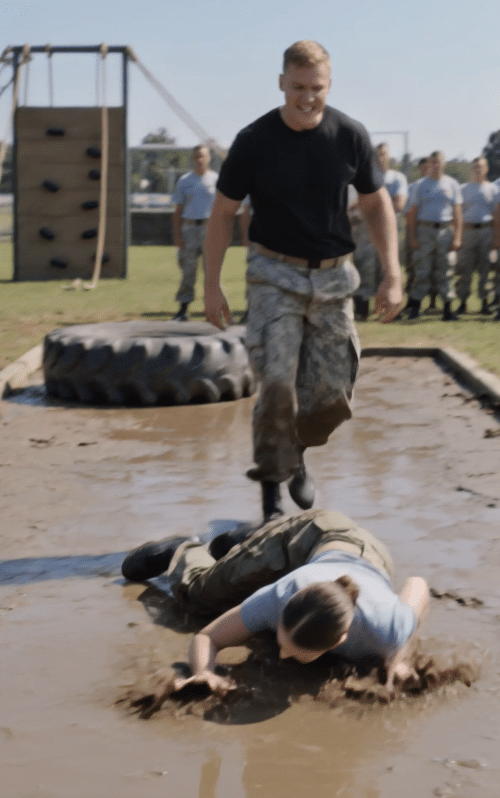
Emily Walker was still trying to push herself out of the mud when Derek Miles kicked her in the back.
She had slipped less than a second earlier, her combat boots sliding across the wet training lane as she struggled to regain her balance. One hand was planted in the mud, the other reaching toward a nearby training tire, when Derek came up behind her with a face twisted by contempt.
“Move! You’re slowing everyone down!”
Emily tried to rise.
Derek drove his boot into her back.
She hit the ground face-first, her elbow scraping across the rough surface. Mud smeared her gray training shirt and olive pants, and a thin trace of blood appeared where her skin had scraped the ground.
For a moment, she could only gasp.
Around them, cadets moved between the obstacle course’s climbing wall, rope line, and rows of heavy tires. The morning air carried the sharp commands of instructors and the rhythmic thud of boots against wet earth.
Then the entire training line seemed to stop.
Derek stood over Emily, his shadow falling across her.
“I can finish the course,” she managed to say.
Her voice trembled, but she forced herself to look up.
Derek laughed.
“Trash. You’re slowing down real soldiers.”
A few cadets exchanged uneasy glances. One young woman lifted a hand to her mouth. Another took a step backward, then froze when Derek turned his head toward the formation.
Nobody moved to help.
Emily planted her palm in the mud and tried to push herself upright. Her back hurt, her elbow stung, and humiliation burned hotter than the pain. She could feel dozens of eyes on her, watching her struggle to stand while the man who had knocked her down acted as if she had committed the offense.
Derek stepped closer.
“Get up.”
Emily drew a ragged breath.
“I’m trying.”
He kicked her again, then delivered one more forceful kick into her side as she curled instinctively to protect herself.
Emily cried out and folded around the pain.
The sound traveled farther than she intended. Across the field, a cadet near the climbing wall looked away. Someone whispered for an instructor, but no one stepped into the lane.
Derek stared down at Emily as if her pain offended him.
“Stay down where you belong.”
Emily squeezed her eyes shut.
She had spent months learning how to endure exhaustion, how to keep moving when her muscles shook, and how to finish a task after the easy part of her strength was gone. She had accepted blisters, bruises, sleepless nights, and the humiliation of making mistakes in front of people who seemed born to succeed.
She had expected the academy to test her.
She had not expected a fellow cadet to decide that her struggle gave him permission to hurt her.
Then a military command vehicle came around the edge of the training field.
Its brakes engaged sharply beside the mud lane.
The driver’s door opened, and a tall man in a formal dark-green uniform stepped out. Gray hair, polished black boots, prominent shoulder rank—the kind of presence that made experienced officers straighten before they consciously realized why.
General Robert Walker.
He took in the scene in a single glance.
Emily was on the ground. Derek stood over her. The surrounding cadets had frozen, and not one of them had moved close enough to help.
The general’s expression hardened.
He crossed the muddy lane quickly, never taking his eyes off the young man standing above his daughter.
Then he positioned himself between Derek and Emily.
“Step away from my daughter.”
The words cut through the field.
Derek’s face went blank.
The general did not shout. He did not need to. His shoulders were squared, his voice controlled, and his eyes held a fury that made the silence around them feel almost physical.
Emily looked up from behind him.
“Dad?”
It was barely a whisper.
But Derek heard it.
The confidence drained from his face as he looked from the mud-covered cadet to the decorated general standing between them. The people around the course seemed to disappear from his awareness.
His lips parted.
“Your daughter?”
And in that instant, Derek Miles understood that the woman he had treated as disposable might be connected to someone who could change the course of his entire future.
But what he did not yet understand was that her father’s rank would be only the beginning of his trouble.
Act II
Emily had never wanted anyone at the academy to know who her father was.
When she first arrived, she introduced herself simply as Emily Walker. She did not mention General Robert Walker, the decorated officer whose career had taken him across multiple commands, into rooms where national security was discussed, and through years of sacrifices her family had learned not to question.
She did not use his name to gain an advantage.
In fact, she had spent much of her life trying to escape the shadow it cast.
At school, teachers sometimes treated her differently after discovering who her father was. Adults who had barely noticed her would suddenly become attentive. Other children assumed she had connections, money, or a guaranteed future.
Some were friendly because they wanted something.
Others were cruel because they believed she had been handed everything.
Emily grew up learning that praise could carry suspicion and that a simple achievement could become an argument about privilege. If she won something, people wondered whether the judges had been influenced. If she failed, someone would suggest that the general’s daughter had finally been exposed.
Eventually, she stopped correcting people.
She wanted to earn her place without having to explain why she deserved it.
Her father understood the desire, even if it frightened him.
Robert Walker had built his career in an institution where discipline, accountability, and public trust mattered. He believed in standards that applied regardless of family background. He also knew that the child of a senior officer could be judged more harshly than other people, sometimes for reasons that had little to do with her own conduct.
When Emily told him she intended to attend the military academy, he did not celebrate immediately.
He sat across from her at the kitchen table and studied her face.
“Are you doing this because you want it,” he asked, “or because you want to prove something to everyone who thinks they know you?”
Emily considered the question.
“Both, maybe.”
Robert nodded.
“At least you’re honest.”
“I want to know who I am when nobody is making allowances for me.”
He understood that answer.
So he made one condition: he would not interfere in her training, ask instructors for special treatment, or use his position to protect her from ordinary consequences. If she struggled, she would be expected to learn. If she broke a rule, she would be accountable.
Emily agreed.
She had no intention of asking him for anything else.
At the academy, she worked hard enough to become known for her determination, though not always for her speed. She excelled at preparation, equipment checks, and the kind of tasks that rewarded patience and attention to detail.
The obstacle course was different.
It demanded explosive strength, coordination, and confidence on unfamiliar ground. Emily was improving, but she still struggled with certain sections, especially when rain turned the lanes slippery.
Derek Miles noticed.
At twenty-three, Derek was tall, muscular, and accustomed to being praised for his physical performance. He moved quickly through the course and enjoyed making sure everyone knew it. In his mind, physical ability was proof of character, and anyone who struggled had revealed a weakness that deserved to be exposed.
He initially mocked Emily with small remarks.
He called her slow when she took an extra second to secure a rope. He laughed when she misjudged a landing. During group exercises, he made comments about how some people were clearly not suited to military life.
Emily ignored him.
She told herself that Derek’s opinion did not matter. She concentrated on her training, repeated the difficult sections, and asked instructors for feedback when she needed it.
But Derek’s comments became more pointed as her performance improved.
He began treating every mistake as an insult to the entire group. If Emily fell behind, he blamed her for the team’s results. If she succeeded, he claimed she had been given easier conditions.
His hostility seemed irrational to everyone except himself.
Derek had grown up believing that strength was something people had to demonstrate publicly. His father had once been a demanding coach who praised winners and humiliated anyone who came last. Derek had carried that lesson into adulthood, mistaking cruelty for motivation and intimidation for leadership.
He wanted to be seen as the strongest cadet in the room.
Emily’s refusal to react made him feel challenged.
She did not beg for his approval. She did not answer every insult. And she did not quit.
That, more than her occasional mistakes, irritated him.
The morning of the assault began like dozens of other training days. Rain had left the obstacle course slick, and the cadets were moving through the lanes under the watchful eyes of instructors.
Emily slipped near the training tires.
It was an ordinary mistake.
She needed a few seconds to push herself up, steady her footing, and continue.
Derek turned that moment into an excuse to attack her.
He might have expected her to stay silent afterward. Perhaps he believed the other cadets would help him frame the incident as a training dispute. Perhaps he simply assumed that no one with authority would care about a struggling female cadet in the mud.
But there was one detail he had never bothered to learn.
Emily Walker was not merely a name on the roster.
She was the daughter of a general who believed that standards meant nothing if they disappeared whenever powerful people wanted to ignore them.
And when Robert Walker saw what had happened to his daughter, he would have to make a decision that tested not only his authority, but his integrity.
Act III
For several seconds after the general arrived, nobody spoke.
Emily remained on the ground behind her father, one hand pressed against her side. She tried to rise, but the pain forced her to pause.
Robert noticed immediately.
He turned just enough to look at her.
“Don’t get up yet.”
“I’m okay,” Emily whispered.
He knew that answer. It was the same one she had given after falling from a bicycle as a child, after spraining her wrist during a school competition, and after calling him late at night because she had failed an important examination.
Emily had always believed that admitting pain might make someone think she was weak.
Robert crouched beside her, careful not to pull her up before she was ready.
“Look at me,” he said. “Can you breathe comfortably?”
She took a slow breath and winced.
“Not really.”
“Then we’re going to have you checked.”
He kept his voice calm, but his eyes shifted briefly toward Derek. The young man stood several feet away, visibly shaken, trying to understand how quickly the situation had changed.
“General, sir,” Derek began. “There has been a misunderstanding.”
Robert rose slowly.
“What misunderstanding?”
Derek glanced toward the other cadets.
“She fell during the course. I was trying to get her moving. She was slowing down the line.”
Robert said nothing.
The silence forced Derek to continue.
“Training is supposed to be difficult, sir. We can’t stop every time someone gets hurt.”
“Is that what you believe happened here?”
Derek hesitated.
“I was maintaining standards.”
Robert looked toward the muddy lane, then at Emily’s scraped elbow and the way she was struggling to protect her side.
“Maintaining standards,” he repeated, “does not give you authority to assault another cadet.”
Derek’s face reddened.
“I didn’t assault her.”
Several cadets lowered their eyes.
Robert noticed.
He had spent decades learning to read a room full of people who had reasons to remain silent. Some were afraid of being targeted next. Others feared disciplinary consequences if they contradicted a fellow cadet. A few had convinced themselves that staying out of trouble was the same as staying neutral.
He did not need to decide what every witness had seen.
He needed the incident properly documented.
Robert turned toward the training staff.
“Secure the area. Have medical personnel assess Cadet Walker. Separate the involved cadets and preserve the training reports.”
His voice carried across the field.
The instructor in charge moved immediately to comply.
Derek looked startled.
“Sir, with respect, this is a training matter.”
Robert faced him.
“Then it should be easy to investigate.”
The words left Derek with nothing useful to say.
Until that moment, he had treated the field as a place where he could decide what strength meant. He had expected the cadets around him to accept his version of events because he was faster, stronger, and louder than Emily.
Now the matter was moving beyond his control.
He looked toward Emily.
“Tell him you slipped.”
Emily’s eyes widened.
Robert did not move, but the temperature in his expression seemed to drop.
“Do not speak to her.”
Derek swallowed.
“I just mean—”
“You will not pressure a witness while this incident is being addressed.”
For the first time, Derek seemed to understand that his own words could become evidence of what he had done and how he intended to avoid responsibility.
He fell silent.
Medical personnel arrived and began assessing Emily. She was conscious and able to answer questions, but the pain in her back and side required further evaluation. They helped her onto a stretcher so she could be taken for appropriate care.
Robert stepped aside to let them work.
He wanted to stay beside her. Every instinct told him to put his daughter in the command vehicle and take her somewhere safe, away from the stares and whispers.
But he also knew that this was not a private family emergency.
It had happened in a training environment. Other cadets had witnessed it. The response needed to protect Emily without turning her father’s rank into a shortcut around proper procedure.
He could insist that the incident be taken seriously.
He could ensure that she received medical attention.
He could make clear that retaliation would not be tolerated.
What he could not do was decide the outcome before the facts were established.
Robert had spent his career demanding that officers separate personal feelings from official responsibilities. Now that principle had come to the most painful place imaginable.
His daughter was the person on the ground.
And the man responsible was staring at him, frightened less by the harm he had caused than by the identity of the person who had witnessed it.
Robert watched as the medical team moved Emily away from the lane.
Then he turned back to Derek.
“You will remain available for the investigation. You will not approach Cadet Walker or contact other witnesses about their statements.”
Derek’s jaw tightened.
“Sir, you’re making this personal.”
Robert held his gaze.
“You made it personal when you decided another cadet’s difficulty gave you the right to hurt her.”
The surrounding field had gone silent.
Derek had spent months treating Emily as someone who did not belong. He had used the language of discipline to disguise his own contempt and the language of teamwork to justify his aggression.
Now, for the first time, he was being asked to answer for the difference between the two.
But the investigation would reveal something more troubling than one violent outburst.
Because several people had seen Derek’s behavior before—and had allowed it to become part of the culture around him.
Act IV
By the afternoon, the academy had begun a formal review of the assault.
Emily’s medical evaluation documented her injuries, and investigators collected statements from the cadets and staff who had been present. They reviewed the training schedule, the obstacle-course procedures, and any available records that could establish what happened before and after she fell.
Derek was removed from training duties while the matter was assessed.
He insisted that the incident had been exaggerated.
He claimed that Emily had fallen because she was unprepared, that his actions had been misunderstood, and that the general’s arrival had turned an ordinary training conflict into a career-threatening scandal.
But the witnesses did not all describe an ordinary conflict.
One cadet admitted that Derek had repeatedly mocked Emily’s performance. Another recalled him blaming her for group delays even when the training conditions affected everyone. Several had seen him standing over her after the fall.
Most damaging was the consistency of their accounts about the moment he continued the assault.
Emily had been trying to get up.
Derek had kicked her.
Then, when she was already on the ground, he had kicked her again.
Whatever he claimed his intentions had been, the sequence did not resemble an attempt to help a fellow cadet.
The review also raised questions about why nobody had intervened earlier.
Some witnesses admitted they had been afraid Derek would target them. Others said they had assumed an instructor would handle the problem. One cadet confessed that he had laughed at Derek’s jokes in the past because he wanted to avoid becoming the next target.
That admission troubled the academy’s leadership.
The assault was Derek’s responsibility, but a training environment could not be healthy if people believed that speaking up would make them vulnerable.
The academy began examining how previous complaints had been handled and whether instructors had recognized the pattern of intimidation. The goal was not to manufacture guilt where evidence was lacking. It was to establish whether the warning signs had been overlooked and what needed to change.
Meanwhile, Robert Walker removed himself from decisions concerning Emily’s case.
He made his relationship to her known to the officials responsible for the review and asked that the matter be handled through the academy’s established procedures, with appropriate independent oversight.
He would not dictate who interviewed witnesses.
He would not demand that Derek be dismissed.
And he would not use his rank to determine the final finding.
That restraint was not easy.
When he visited Emily after her evaluation, he found her sitting on the edge of a bed, her training uniform replaced with clean clothes. She looked exhausted and angry with herself.
“I should have stood up sooner,” she said.
Robert pulled a chair closer.
“You were hurt.”
“I should have done something.”
“What did you think you could do while someone was kicking you?”
Emily looked away.
“I don’t know.”
She had replayed the assault repeatedly, searching for the moment when she might have prevented it. If she had moved faster. If she had answered Derek differently. If she had refused to train in the mud. If she had been stronger.
Robert listened without interrupting.
Then he asked, “If another cadet had slipped, would you have thought they deserved to be kicked?”
“Of course not.”
“Would you have told them they didn’t belong?”
“No.”
“Then why are you holding yourself to a different standard?”
Emily’s eyes filled with tears.
“Because I wanted to prove I could do this without you.”
Robert leaned forward.
“You don’t prove that by accepting mistreatment.”
She pressed her lips together.
“I didn’t want people thinking I was protected because of who you are.”
“And I don’t want you to believe that being my daughter means you have to endure what other people would never be expected to endure.”
For a long moment, Emily said nothing.
Then she asked the question she had been avoiding.
“Are you disappointed in me?”
Robert looked genuinely stunned.
“Emily, no.”
“I fell. I couldn’t get up fast enough. Everyone was watching.”
“You slipped on wet ground. That is not a moral failure.”
“But Derek said I wasn’t a real soldier.”
“Derek doesn’t get to decide that.”
Robert paused, choosing his next words carefully.
“Your performance will be judged by the standards that apply to everyone. Your injuries will be treated. His actions will be investigated. Those are separate matters.”
Emily looked at him.
“And if I can’t finish the course?”
“Then you train, recover, and find out what you can do next. That’s what training is for.”
She finally began to cry—not loudly, but with the exhausted relief of someone who had been holding herself together for too long.
Robert did not tell her to be strong.
He sat beside her until the tears passed.
When the investigation concluded its initial review, the findings established that Derek had deliberately used physical force against Emily after she slipped. His conduct was not justified by training requirements, and the evidence supported formal disciplinary action under academy rules.
The academy pursued the matter through its established process. Derek faced the possibility of removal from the program and further consequences based on the findings, rather than being punished solely because his victim was a general’s daughter.
The review also identified failures in how earlier signs of intimidation had been addressed. Supervisors were directed to reinforce expectations for reporting misconduct and to make clear that cadets were not permitted to use humiliation or unauthorized violence as substitutes for instruction.
Derek’s future would be determined through the appropriate disciplinary process.
Robert did not celebrate the findings.
There was no victory in learning that his daughter had been hurt and that other people had been too afraid to stop it.
But there was a difference between anger and justice.
Anger had brought him running across the field.
Justice required him to make sure the truth could stand without his rank holding it upright.
And now Emily had a decision of her own to make.
She could allow Derek’s cruelty to define her experience at the academy—or she could return when she was ready and continue on her own terms.
Act V
Emily returned to training after she had recovered sufficiently and received clearance to resume physical activity.
Her first morning back was harder than she expected.
The mud lane had dried in places, but the training tires were still arranged in the same line. The climbing wall rose above the field, and the rope course stretched toward the far boundary. Nothing looked different.
Yet Emily felt as if every cadet could see the assault whenever she walked past.
Some offered quiet encouragement. Others seemed uncertain whether they should mention what had happened. A few avoided her eyes, ashamed that they had watched her suffer without moving to help.
Emily did not demand apologies.
She knew fear had kept some people silent. She also knew that fear did not erase the effect of their silence.
She focused on what she could control.
She listened to her instructors, worked through the exercises at the pace appropriate to her recovery, and asked for corrections when she needed them. When her back tightened during a difficult movement, she stopped and reported it instead of forcing herself through the pain to prove something to people who were no longer watching.
It was a small change.
For Emily, it felt enormous.
She had spent so much time trying to prove that she needed no special treatment that she had nearly convinced herself she was not allowed to need ordinary care.
Now she understood that accountability worked both ways.
She was responsible for her training, her decisions, and her effort. Other people were responsible for their conduct. Those responsibilities did not cancel each other out.
Derek was no longer beside her in the training line.
His case proceeded through the academy’s disciplinary system, and he was held accountable for the assault and the related conduct established by the review. The final outcome was based on the evidence and applicable rules, not a private order from General Walker.
For the first time, Emily could move through the course without hearing Derek’s voice behind her.
That did not mean the memory disappeared.
There were moments when she still remembered the impact of the first kick, the sting of mud against her scraped elbow, and the faces of the cadets who had stepped back. Sometimes the memory returned when someone raised their voice unexpectedly or when she slipped during an exercise.
But she no longer treated those reactions as evidence that she was weak.
She talked to the appropriate support staff. She accepted help from people she trusted. And when the time came to attempt the obstacle course again, she prepared carefully rather than treating pain as something she had to defeat through sheer stubbornness.
On the morning of her next full attempt, the ground was firm enough to provide better footing.
Emily stood at the starting line with the other cadets. Her brown hair was tied back, her uniform was clean, and her boots were secured tightly.
An instructor reviewed the course.
At the signal, the cadets moved.
Emily crossed the first section, reached the rope line, and pulled herself upward. Her arms trembled as she climbed, but she kept her rhythm. At the tires, she adjusted her footing and moved through without rushing.
When she reached the muddy stretch, she slowed down.
For a moment, the old memory rose in her mind.
Derek behind her.
The impact.
The ground rushing up.
Stay down where you belong.
Emily took a breath.
Then she kept moving.
She did not sprint to prove that she was faster than Derek. She did not look toward the sidelines to see who was watching. She focused on the next step, then the next, until the finish line came into view.
When she crossed it, she was breathing hard and covered in mud.
But she was on her feet.
An instructor recorded her completion and gave her the feedback she needed for the next stage of training. No special announcement followed. Nobody made a speech about her father’s rank.
And that was exactly how Emily wanted it.
Later, Robert visited the academy in his official capacity for a scheduled meeting. He did not come to watch Emily train, and he did not ask anyone to arrange a private demonstration of her progress.
When their schedules allowed, they met briefly away from the training field.
“How are you doing?” he asked.
“Better.”
“Physically?”
“Yes. And otherwise.”
He studied her face.
“Do you still want to be here?”
Emily looked back toward the obstacle course.
“Yes.”
“Why?”
She considered the question more carefully this time.
“Because I still want to know what I’m capable of. Not what Derek thought I was capable of. Not what people think I should be because I’m your daughter.”
Robert nodded.
“That’s a good reason.”
She smiled faintly.
“I also want to get better at that rope section.”
“That sounds like a training objective.”
“It is.”
For the first time since the assault, they both laughed without feeling that the laughter was covering something painful.
Robert did not tell her that everything would be easy from then on. He knew the academy would continue to challenge her, and that there would be days when she failed or wondered whether she belonged.
Instead, he told her what he had learned over decades of service.
“Courage isn’t never falling,” he said. “And it isn’t pretending that nothing hurts. It’s knowing what happened, accepting the help you need, and choosing your next step for yourself.”
Emily looked at him for a long moment.
“I think I’m starting to understand.”
He reached for her shoulder, then stopped and let her decide whether she wanted the gesture.
She stepped forward and hugged him.
It was brief, but it carried everything she had struggled to say since the day she entered the academy: the pressure of his name, the fear of being judged, the shame of being attacked, and the relief of discovering that she could accept her father’s love without surrendering her independence.
When they separated, Robert’s expression was calm again.
“You have training tomorrow?”
“Early.”
“Then get some rest.”
“Yes, sir.”
She said it with a grin, and he shook his head.
“Don’t start.”
She laughed again.
The next morning, Emily returned to the field.
The obstacle course waited in front of her, difficult and demanding as ever. The rope line still required strength. The climbing wall still punished poor technique. The mud still made every step uncertain.
She stepped onto the lane anyway.
She had not returned because her father was a general.
She had returned because Derek’s cruelty did not get to decide the limits of her future.
And when Emily Walker began the course, the most important thing about her was no longer the identity that had shocked Derek Miles into silence.
It was the choice she had made after he tried to force her to stay down.
She kept moving.
Not to prove that she was better than him.
Not to make anyone regret underestimating her.
But because the ground beneath her boots belonged to her, too—and she had every right to keep going.