Act I
The food tray was still spinning through the air when Captain Mark Ellis realized Major Anna Carter wasn’t going to apologize.
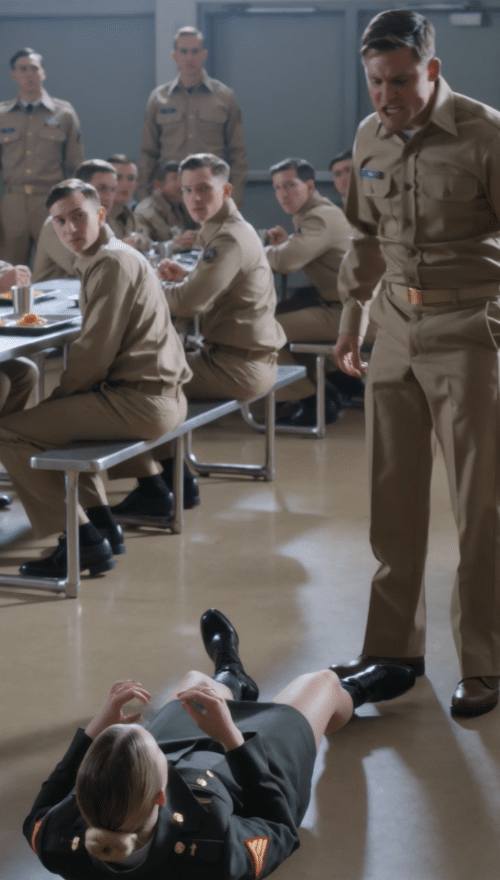
One second, she had been standing beside a long metal dining table, carrying her lunch and looking for an empty seat. The next, Ellis had driven a boot into her chest, sending her backward onto the mess hall floor as food, water, and silverware scattered across the tiles.
A cup struck the leg of a table.
Someone gasped.
Anna lay among the spilled meal, struggling to draw a comfortable breath. Her olive service uniform was smeared with food and water, and a thin trace of blood marked her forearm where it had scraped against the floor.
Ellis stood over her.
“Get up.”
Anna pressed a hand against the ground, wincing as she tried to sit upright.
“I was just finding a seat.”
Her voice was controlled, but pain had tightened her face. She had walked into the mess hall expecting an ordinary lunch between assignments. She had not expected to become the center of a spectacle.
Ellis glanced at the officer table behind him.
“This table is not for you.”
Anna looked at the empty chairs.
“There are open seats.”
“Not for you.”
She took a breath, trying to understand whether he was joking, confused about her assignment, or simply looking for a confrontation.
“Captain, I don’t believe there’s a seating restriction here.”
His jaw tightened.
“Don’t tell me how things work.”
Anna had been at the installation long enough to recognize an officer who confused confidence with authority. She also knew that arguing in a crowded dining hall would accomplish nothing.
“I’ll find another seat,” she said.
She began to move.
Ellis suddenly lunged forward and kicked her again.
The first follow-up blow struck her back. The second caught her side as she curled instinctively, trying to shield herself from the pain.
Chairs scraped backward.
A young lieutenant covered her mouth. Two cadets stared at the floor, their faces pale. An older officer rose halfway from his seat, then froze when Ellis turned toward the movement.
Nobody intervened.
The mess hall had been noisy only moments earlier. Now the clatter of trays and conversation had vanished, leaving the uncomfortable silence of people who knew they were witnessing something wrong and were afraid of becoming part of it.
Ellis looked down at Anna.
“Trash. This table is not for you.”
Anna’s hands trembled as she tried to pull herself away from the spilled food.
“Captain,” she said, forcing the words through the pain, “stop.”
He stepped over the overturned tray.
“Eat from the floor where you belong.”
The humiliation was almost worse than the physical pain.
Anna had earned her rank through years of training, evaluations, and assignments that demanded discipline under pressure. She had worked under officers who challenged her decisions and expected her to justify every recommendation.
She had never asked anyone to make her path easier.
Now a man who knew almost nothing about her had decided that he could define her worth by where she was permitted to sit.
Then the main doors swung open.
Base Commander Thomas Grant entered the mess hall at a brisk pace, accompanied by the silent authority of a man accustomed to taking responsibility for everything that happened under his command.
He stopped when he saw the overturned tray.
Then he saw Anna on the floor.
Finally, he looked at Ellis.
The captain’s posture changed, but he was still too angry to understand the danger of the moment.
Commander Grant crossed the room and positioned himself between Ellis and the injured major.
“Stand down. You just assaulted the wrong officer.”
The words carried across the dining hall.
Ellis went still.
Grant looked toward Anna, making sure she was protected before returning his attention to the captain. There was no theatrical rage in his expression, no need to shout. His face had settled into the severe calm of someone who had just witnessed a serious breach of the standards he was responsible for enforcing.
Anna looked up at him.
“Sir…”
“Don’t try to get up yet, Major,” Grant said. “Let the medical team assess you.”
Then he turned back to Ellis.
The captain’s eyes moved from the commander to the woman on the floor.
A moment earlier, he had treated her as someone who could be humiliated without consequence.
Now the base commander himself was standing over her.
Ellis swallowed.
“Wrong officer?”
He had no idea how much that question was about to cost him.
Act II
Major Anna Carter had learned long before joining the military that some people decided who she was before she had the chance to speak.
At twenty-nine, she had already served in demanding assignments where every recommendation required evidence, every mistake carried consequences, and every successful operation depended on people trusting one another.
She was not the loudest officer in a room.
She preferred preparation to performance and believed that authority was most useful when it made other people better at their jobs. Her reports were thorough, her briefings concise, and her standards for herself often stricter than those she applied to others.
That approach had earned her respect from people who worked closely with her.
It had also made her a target for people who believed an officer should prove authority through intimidation.
Anna had grown up in a military family, but she had never expected that connection to carry her career. She had seen how easily a famous surname could become a rumor, how quickly people could dismiss someone’s work as favoritism.
So she kept her personal life private.
She did not talk about family connections at lunch. She did not use a senior officer’s name to settle disagreements. When colleagues asked where she had grown up, she answered politely and moved the conversation back to work.
Her new assignment at the base had been demanding from the start. She was responsible for a complex set of coordination duties that required cooperation across several departments. She had to learn local procedures, understand existing tensions, and establish credibility with people who had been working together for years.
Most of her colleagues judged her by her work.
Captain Mark Ellis judged her differently.
Ellis was thirty-four, sharp-looking, and proud of his reputation as a hard-driving officer. He wore his uniform meticulously and carried himself as though every room were a place where rank had to be defended.
He was competent at many of his duties. That made his behavior more dangerous, not less. He had learned that people often overlooked arrogance when it came wrapped in confidence and a record of good performance.
Ellis liked to decide who belonged.
He had opinions about which officers deserved the best assignments, which junior personnel needed to be put in their place, and which traditions should remain untouched simply because he had grown comfortable with them.
He rarely described his judgments as prejudice.
He called them standards.
When Anna arrived, he noticed that she was new, female, and unwilling to perform the little rituals of deference he expected from people he considered beneath him.
She did not laugh at his jokes when they were cruel.
She did not retreat when he interrupted her in meetings.
And when he challenged her work, she answered with facts rather than anger.
Ellis found that infuriating.
During one coordination meeting, he had questioned a scheduling recommendation Anna had prepared. She explained the reasoning and pointed out a conflict in the existing plan. Her correction was accurate, and the meeting continued.
Ellis did not forget it.
Later, he made comments about how quickly new officers seemed to think they could change established routines. He asked colleagues whether Anna understood how things were done at the base. He framed ordinary professional disagreements as evidence that she lacked respect.
None of those remarks had been serious enough, on their own, to reveal the full extent of his hostility.
But together, they formed a pattern.
Anna recognized the pattern and chose to handle it professionally. She documented important decisions, kept communication clear, and avoided turning personal friction into a distraction from her responsibilities.
She assumed that if she remained consistent, Ellis would eventually have to judge her on her work.
The mess hall confrontation proved that assumption dangerously optimistic.
That afternoon, Anna had entered the dining room carrying a tray with a simple meal. The officer tables were crowded, but a few chairs remained open.
She had approached one of them without ceremony.
Ellis had stepped into her path and told her the table was not for her.
She could have walked away immediately. She could have avoided the confrontation entirely.
But she had asked a reasonable question about a rule that appeared not to exist.
Ellis answered with violence.
What made the incident especially disturbing was not only the attack itself, but the number of people who witnessed it. Officers and cadets had watched a major being kicked to the floor over a seat at a table.
Some were frightened of Ellis.
Others were unsure what they were permitted to do.
Still others had grown accustomed to his behavior and had mistaken his confidence for protection from consequences.
By the time Commander Grant entered, the room had become a silent record of that failure.
Grant had been the base commander for several years. He believed that discipline depended on consistency, not personal loyalty. He expected officers to disagree professionally, follow lawful orders, and treat the people under their authority with dignity.
He also knew that a commander’s reputation could become an excuse for people to hide problems rather than report them.
When he saw Anna on the floor, he did not first ask who she knew, how important her assignment was, or whether the captain had a history of conflict with her.
He saw an officer who had been assaulted.
That was enough to demand an immediate response.
But the moment Ellis asked, “Wrong officer?” the commander realized that the captain had misunderstood something fundamental about authority.
The issue was not that Anna had a powerful friend.
The issue was that she should never have needed one.
Act III
Commander Grant held his position between Ellis and Anna until medical personnel arrived.
The captain stood stiffly beside the overturned tray, his face shifting between disbelief and indignation. He seemed to be searching for a version of events that would allow him to regain control of the room.
“Sir,” Ellis began, “there’s been a misunderstanding.”
Grant did not turn away from Anna.
“What misunderstanding?”
“She approached a restricted table.”
“Is that why she’s on the floor?”
Ellis hesitated.
“She was being disrespectful.”
Grant finally faced him.
“Then you should have reported the issue through the appropriate channel. You do not get to kick another officer because you dislike her answer.”
Ellis’s jaw tightened.
“I was maintaining discipline.”
“No, Captain. You were exercising violence.”
The distinction silenced him.
Medical personnel reached Anna and began assessing her injuries. She was conscious, but her breathing remained shallow, and her side hurt when she tried to move. They asked her questions, checked the scrape on her forearm, and prepared to take her for further evaluation.
Grant stepped back to let them work.
Anna tried to sit up.
“Major, stay still for now,” one of the medics instructed.
She nodded, visibly embarrassed by the attention.
Grant noticed the expression.
“You don’t need to apologize for being injured,” he said quietly.
Anna looked at him.
“I wasn’t going to.”
“Good.”
It was a small exchange, but it mattered. She had spent the last several minutes being treated as though her presence had caused the disturbance. Grant was making it clear that the responsibility belonged elsewhere.
Then he addressed the dining hall.
“Everyone who witnessed this incident will provide an account through the appropriate process. Do not discuss or coordinate statements. If you saw what happened, report what you saw.”
Nobody answered.
Grant’s gaze moved across the room.
“I understand that people may have been surprised. But silence cannot become the standard response when an officer is being assaulted.”
A young lieutenant lowered her hand from her mouth. An older sergeant looked down, his expression heavy with shame.
Grant did not demand that anyone perform an instant display of courage. He knew that fear could freeze people in a crisis. But he would not allow the room to pretend that nothing had happened.
He turned back to Ellis.
“You will remain available for questioning. You will not approach Major Carter or contact witnesses about this incident.”
Ellis stared at him.
“You can’t be serious.”
“I am.”
“Sir, she’s a new arrival. She doesn’t understand how things work here.”
Grant’s expression hardened.
“Then explain the procedure. Show her the regulation. Ask a supervisor to resolve the disagreement. There were several lawful options available to you.”
He paused.
“None of them involved kicking her in the chest.”
The captain looked toward the surrounding tables as though he expected someone to support him.
No one did.
Grant then gave the medical team room to move Anna out of the dining hall. As they helped her onto a stretcher, she glanced once at the spilled food and the overturned tray.
“I can walk,” she said.
“Not until we’ve assessed you,” the medic replied.
She accepted the answer.
That, more than anything, seemed to frustrate Ellis. Anna had not tried to use the commander’s arrival to humiliate him. She had not shouted about her rank or demanded immediate punishment. Even injured, she was trying to follow instructions and preserve the professionalism he had denied her.
Grant watched her leave before addressing the officers responsible for the initial response.
The incident needed to be documented accurately. The medical assessment needed to be completed. Witnesses needed to be interviewed separately, and any available security footage needed to be preserved.
He also wanted to know whether Ellis had behaved this way before.
The captain’s confidence had not appeared out of nowhere. His reaction suggested that he expected people to accept his judgments without challenge and that he had little fear of being held accountable for crossing the line.
Grant would not assume a history of misconduct simply because Ellis had acted appallingly in one moment. But he would not ignore the possibility that this had been part of a larger pattern.
When the initial reports came in, several people described previous incidents involving Ellis’s treatment of junior personnel. Some were minor acts of public humiliation. Others involved intimidation that had left people reluctant to question his decisions.
Those accounts would need to be verified.
Still, they changed the questions investigators needed to ask.
This was no longer only about a fight over a dining table.
It was about whether an officer had used his position to make other people afraid to challenge him—and whether the culture around him had allowed that behavior to continue.
Meanwhile, Anna learned the truth about the commander’s warning.
She was not simply a new major whose work had brought her into conflict with a captain.
She had been assigned to a senior oversight role connected to an upcoming review of leadership practices, personnel accountability, and command climate at the installation. Her presence was official, and her authority came through established orders—not through personal favoritism.
Grant knew about her assignment.
Ellis apparently did not.
But Grant made one point clear to the officers handling the incident: Anna’s assignment would not determine whether the assault was taken seriously.
The facts would.
When Ellis finally learned the scope of the review, he understood why Grant’s arrival had changed the atmosphere so completely.
The woman he had tried to drive away from an officer table was connected to the very process that could expose the behavior he had spent years defending.
And now the investigation would examine not only what he had done in the mess hall, but the culture he had helped create.
Act IV
By the next morning, the story had spread across the installation.
Nobody needed to embellish it. The facts were already difficult enough to accept.
A captain had blocked a major from sitting at a dining table, attacked her when she questioned him, and continued kicking her after she fell. Dozens of people had witnessed the incident, and the base commander had intervened before the assault could continue.
Ellis was removed from his normal duties pending the formal review.
He objected immediately.
He argued that the response was excessive, that his reputation was being damaged, and that the commander had allowed personal feelings to interfere with discipline.
But Grant had taken steps to ensure that the investigation did not depend on his personal authority alone. The relevant officials were responsible for gathering the evidence, assessing the accounts, and applying the appropriate procedures.
Grant would not decide the outcome simply because he was angry.
He would ensure the matter was not buried.
Investigators reviewed the witness statements and the available security footage. They examined the sequence of events, the captain’s actions, and his conduct after the assault. They also considered whether his previous interactions with personnel showed a pattern of intimidation.
The evidence supported the central account of the incident.
Anna had approached the table carrying her meal. Ellis had blocked her path and told her she did not belong there. After she attempted to respond, he had kicked her to the floor and continued the assault.
No legitimate dining rule justified what he had done.
No interpretation of military discipline could transform the attack into an acceptable correction.
And no officer’s frustration gave him permission to treat a colleague as an object he could punish.
The review also exposed a quieter problem.
Several people had previously complained about Ellis’s treatment of junior personnel, but their concerns had not been handled with enough consistency. Some had been treated as personality conflicts. Others had been resolved informally, leaving little record of whether the underlying behavior had changed.
The institution had not created Ellis’s choices.
He was responsible for them.
But the failure to address warning signs had given him reason to believe he could continue.
Grant ordered a broader examination of how those concerns had been handled. He wanted a clear distinction between legitimate performance criticism and personal intimidation, and he required supervisors to reinforce the obligation to report serious misconduct.
The objective was not to make every disagreement a disciplinary case.
It was to ensure that people could disagree without fear of violence or retaliation.
Anna’s own response was more difficult.
After receiving medical attention, she was advised to rest and follow up on her injuries. She complied, though she was frustrated by how much time the incident had taken from her work.
She hated the thought that a violent man’s behavior might become the defining story of her arrival at the base.
When Grant visited her, he found her reviewing documents on a tablet.
“You should be resting,” he said.
“I am resting.”
“You’re reading a command review.”
“I’m sitting down while reading a command review.”
He almost smiled.
Then he noticed the tension in her face.
“How are you actually doing?”
Anna set the tablet aside.
“Angry.”
“That makes sense.”
“Not just at Ellis. At everyone who watched.”
Grant nodded slowly.
“I understand.”
“Do you?” she asked. “They knew it was wrong. I could see it on their faces. But nobody moved.”
He did not offer an easy defense.
“Some may have been frightened. Some may have frozen. Some may have believed someone else would act. We need to understand what happened without pretending their silence had no consequences.”
Anna looked down at her hands.
“I don’t want people stepping in because they know who my father is.”
“They shouldn’t have needed to know.”
“Exactly.”
Grant let the silence sit between them.
Then he said, “Your rank was enough. Your right to be safe was enough. Your name should never have been part of the calculation.”
For the first time since the assault, Anna felt that someone understood the part that had wounded her most deeply.
She had not wanted a room full of people to be frightened into respecting her.
She had wanted them to recognize that the captain’s behavior was wrong before a senior commander entered.
Grant continued, “We’re reviewing how the incident was handled, and we’re reviewing the earlier complaints. But I can’t promise that one investigation will change every person’s instincts overnight.”
“I know.”
“What I can promise is that the official response won’t depend on whether you are connected to someone senior.”
Anna studied him.
“And if I weren’t part of the oversight review?”
“The assault would still require a response.”
She held his gaze for a moment, then nodded.
That was the answer she needed.
The disciplinary process moved forward, with Ellis given the opportunity to respond to the allegations and the evidence considered through the appropriate channels. The findings established that his conduct was incompatible with his duties as an officer. Formal consequences followed under the applicable military procedures.
Grant did not announce a personal victory.
There was no celebration in the command office. Anna had been injured, the witnesses had been shaken, and the institution had been forced to confront behavior that should have been addressed earlier.
But accountability had begun.
And when Anna returned to her duties, she would face a different challenge: deciding how to continue her work without allowing the incident to make her suspicious of every person who approached her.
Act V
The mess hall was crowded when Anna returned for lunch several days later.
Metal trays clattered along the serving line. Water cups stood beside plates, and cadets leaned over their meals, talking in low voices beneath the cold cafeteria lights.
For a moment, Anna paused near the entrance.
The memory came back without warning.
The tray flying from her hands.
The impact against the floor.
Ellis standing above her while the room watched.
She took a steady breath and continued inside.
She was wearing a clean olive uniform, her dark-blond hair tied back neatly. Her forearm was healing, though the scrape remained visible. She carried her tray with both hands and walked toward the officer tables.
Conversation quieted as people noticed her.
Some looked away out of embarrassment. Others offered small nods. A young lieutenant who had witnessed the assault stood as Anna approached.
“Major Carter?”
Anna stopped.
The lieutenant swallowed.
“I was there that day. I should have done something.”
Anna studied her face.
The woman looked genuinely ashamed, but Anna knew an apology could not change what had happened.
“Why didn’t you?” she asked.
The lieutenant’s eyes dropped.
“I was afraid he would turn on me. And then I thought someone else would step in.”
Anna waited.
“I know that doesn’t excuse it,” the lieutenant added. “I’m sorry.”
For a moment, Anna considered telling her that everything was fine.
It would have been easier. The lieutenant was trying to make amends, and Anna did not want to spend the rest of her life carrying the anger of that day.
But she did not owe anyone an easy absolution.
“Next time,” Anna said, “don’t wait to find out whether someone else is brave enough.”
The lieutenant nodded.
“I won’t.”
Anna moved toward an empty chair.
This time, nobody blocked her path.
She placed her tray on the table and sat down. Her meal was ordinary, and the dining hall looked exactly as it had before the assault. Yet the room felt different—not because everyone was suddenly fearless, but because the incident could no longer be dismissed as a private dispute between two officers.
The academy and base had begun reinforcing reporting procedures, reviewing previous complaints, and clarifying the standards expected of people entrusted with authority. Those measures would need continued attention, but they represented a start.
Anna knew policies alone could not guarantee that every witness would act courageously.
People would still feel uncertain. They would still worry about retaliation or making the wrong decision in a chaotic moment.
But the expectation had become clearer: an officer’s authority did not give that person permission to humiliate or harm others, and witnessing serious misconduct was not something the institution could afford to ignore.
Commander Grant entered the mess hall later that afternoon.
He did not approach Anna’s table to make a public show of support. He greeted several officers, collected his own meal, and sat with personnel from another section.
Anna noticed.
She appreciated that he had not turned her return into a ceremony or made her injuries into a symbol for everyone else to discuss.
She wanted to do her job.
And she wanted to eat lunch without wondering whether the next person who approached her had decided she did not belong.
After the meal, she carried her tray to the return station. The metal clinked softly as she set it down.
Then she walked toward the doors.
Outside, the air was warmer than it had been the day Ellis attacked her. She stopped briefly on the steps, watching personnel cross the courtyard on their way to afternoon assignments.
Her life had not been transformed into something perfect.
She still had work to do. She still had difficult decisions ahead. And there would be days when she questioned whether the cost of standing her ground was worth it.
But she had learned something that no training manual could fully teach.
Rank mattered.
Experience mattered.
Discipline mattered.
Yet none of those things could replace the basic judgment required to recognize another person as deserving of dignity.
Ellis had looked at a woman searching for a seat and seen someone he believed he could push around. He had mistaken her calmness for weakness and her refusal to submit for an insult.
He had believed authority belonged to whoever could make the room afraid.
Commander Grant understood something different.
Authority was not the right to intimidate people.
It was the responsibility to protect the standards that made trust possible.
And Anna had never needed a famous name or a senior commander to make her worthy of respect. The revelation of her assignment had changed Ellis’s understanding of the consequences, but it had not changed the nature of what he had done.
He had assaulted a fellow officer over a chair.
That was enough.
As Anna crossed the courtyard, she straightened her shoulders and continued toward her next assignment.
She was not walking away from the mess hall as the woman who had been kicked to the floor.
She was walking away as the officer who had refused to let someone else’s contempt define her place.
And the next time someone entered that dining room believing that a person’s dignity depended on rank, reputation, or connections, the lesson would already be waiting for them:
No one should have to be the “wrong officer” for an assault to matter.