Act I
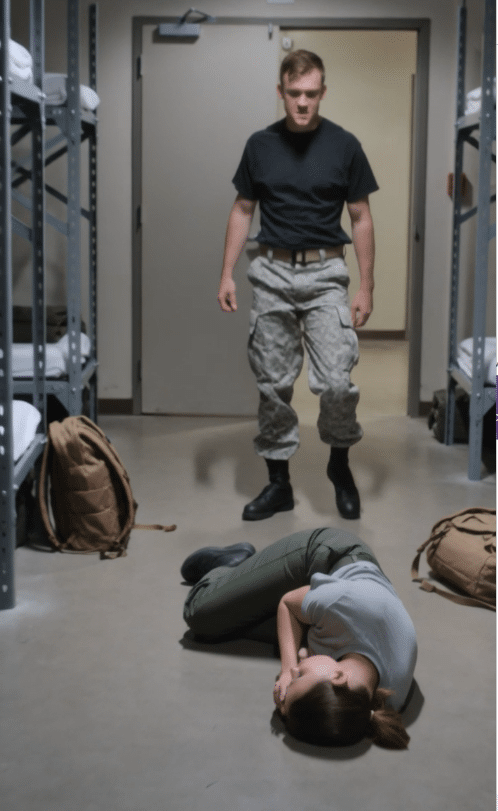
Lily Hayes was still clutching her folded military blanket when Ryan Cole kicked her to the floor.
Her backpack slid across the hallway, striking the base of a metal locker. The blanket spilled open beside her, its carefully folded corners spreading across the cold tiles as she landed hard on her back.
For one suspended second, nobody moved.
Then Lily gasped and tried to sit up.
Her forearm scraped against the floor, leaving a thin trace of blood. Pain tightened her face, but she reached instinctively for her backpack, as if gathering her belongings might somehow restore the dignity Ryan had just tried to take from her.
Ryan stood over her in his black training shirt, his broad shoulders squared and his expression filled with contempt.
“Trash. You don’t belong here.”
Lily looked up at him, struggling to catch her breath.
“This is my assigned room.”
“Not anymore.”
Ryan had blocked the doorway moments earlier, refusing to let her pass into the bunk area. Lily had arrived with her backpack and blanket after a long day of training, expecting to settle into the space listed on her assignment sheet.
Instead, the cadet who acted as the room leader had decided that she had no right to be there.
She had shown him the assignment.
He had barely looked at it.
Now she was on the floor, surrounded by cadets who watched from the open bunk rooms and the harshly lit hallway. Some stood beside their metal lockers. Others remained near their neatly folded blankets, their faces pale with shock.
Ryan took another step toward her.
“Pack up and crawl out.”
Lily tried to push herself onto one elbow.
“Ryan, I’m not trying to cause a problem.”
“Then leave.”
“I have nowhere else assigned to go.”
He answered by kicking her again.
The first follow-up blow caught her back. The second struck her side, forcing her to curl inward as pain spread through her body.
A cadet near the lockers covered his mouth.
Someone whispered, “Oh, my God.”
Nobody stepped forward.
The hallway was full of people trained to respond to pressure, follow instructions, and function in difficult circumstances. Yet the sight of Ryan towering over a woman who could barely get to her knees had left them frozen.
Lily pressed one hand against her side and reached toward the backpack with the other.
She was not reaching for a weapon or preparing to fight.
She was trying to collect the few things she owned before he destroyed them or threw them into the corridor.
Ryan watched her struggle.
“Stay down,” he snapped. “Maybe you’ll finally understand.”
Then the door at the far end of the hallway flew open.
Heavy boots struck the tiles.
Commander Sarah Bennett entered with a stride that made several cadets straighten instinctively. Her dark-green command uniform was immaculate, her dark hair secured in a tight bun, and her eyes fixed on the scene ahead.
She saw the scattered blanket.
The backpack lying near the lockers.
Lily on the floor.
And Ryan standing over her.
The commander’s expression changed.
She moved quickly down the corridor and planted herself between Ryan and the injured cadet, placing her body directly in the path of any further attack.
“On the ground,” she ordered.
Ryan blinked.
Bennett pointed toward the floor.
“Do you know who you just attacked?”
For the first time, Ryan’s confidence faltered.
He looked at the commander, then past her toward Lily, who was struggling to breathe through the pain.
He had expected a frightened newcomer to disappear quietly.
He had expected the other cadets to keep their heads down.
He had not expected Commander Bennett to arrive in the middle of his humiliation campaign.
His lips parted, but the words came out barely above a whisper.
“Who… is she?”
He was about to discover that the woman he had tried to throw out of her own bunk was the last person he should have underestimated.
Act II
Lily Hayes had never been the kind of person who needed an audience to prove herself.
At twenty, she had entered the military academy with a simple ambition: earn her place, complete the training, and become someone her younger self would have been proud to meet.
She wasn’t the strongest cadet in every physical event. She didn’t always finish first, and she had never pretended otherwise. What distinguished her was her ability to keep working after other people had decided a setback defined them.
During the first weeks of training, she had fallen behind on a timed obstacle course and stayed late to practice the difficult sections. When a teammate struggled with a navigation exercise, she had shared her notes instead of using the mistake to improve her own standing.
She believed that competence was built through repetition, not intimidation.
Some cadets admired that quality.
Others mistook it for weakness.
Ryan Cole belonged to the second group.
At twenty-two, Ryan had become an unofficial authority figure in his dormitory. He was physically strong, confident in his performance, and skilled at making uncertain people feel as though they needed his approval.
He had a way of speaking that turned ordinary instructions into personal challenges. If someone questioned him, he accused them of being disrespectful. If someone made a mistake, he made sure others heard about it.
His supporters called him tough.
The people who shared his hallway had learned to call him nothing at all.
Ryan’s influence depended on a quiet arrangement. He acted as though the dormitory belonged to him, and everyone else behaved as though challenging him would cost more than enduring him.
He decided when lights should go out, which lockers could be used, where people should leave their gear, and which newcomers deserved a difficult first week.
Some of his demands were disguised as traditions.
Others were simply cruelty.
When Lily received her room assignment, Ryan immediately objected.
He had expected the available bunk to go to a male cadet he knew from an earlier training group. The actual assignment placed Lily in the designated mixed-program accommodation area used by cadets participating in a specialized training track.
The arrangement was authorized.
The paperwork was clear.
Ryan simply didn’t accept it.
He told Lily that the room was unsuitable for her and suggested she had been assigned there by mistake. When she explained that her orders had been confirmed, he accused her of trying to force her way into a space she had not earned.
Lily offered to show him the documentation.
He waved it away.
“You think a piece of paper makes you belong here?”
“It means this is where I’m supposed to be.”
Ryan stepped closer.
“You’ve been here five minutes. You don’t know how things work.”
“I know how to follow an assignment.”
That answer was calm, factual, and impossible to twist into an insult without revealing what Ryan really wanted.
He wanted her to submit.
He wanted her to carry her belongings somewhere else, preferably in front of an audience, so the other cadets would understand who controlled the hallway.
Lily recognized the hostility, but she did not realize how far he was prepared to take it.
She had grown up believing that rules existed to settle disputes like this. If someone objected to a room assignment, there were officers who could check the records. If a cadet believed a procedure had been violated, there was a chain of command.
She had no reason to believe that a disagreement over a bunk would turn into an assault.
Ryan had a different understanding of power.
To him, the assignment sheet was not an answer. It was a challenge to his authority.
And when Lily refused to walk away, he decided to make her regret it.
The other cadets had seen smaller versions of this behavior before. Ryan had shoved gear off a bench, mocked people who struggled during training, and threatened to make life difficult for anyone who complained about him.
Most incidents had ended with the victim retreating.
That retreat had become part of Ryan’s routine. He pushed, someone yielded, and he interpreted the outcome as proof that he was entitled to push harder next time.
Lily’s refusal disrupted that pattern.
She did not shout at him.
She did not threaten to report him.
She simply repeated that the room was hers by assignment.
That should have ended the dispute.
Instead, Ryan attacked her.
By the time Commander Bennett reached the hallway, the difference between the two cadets was no longer a question of confidence or rank. It was a question of whether one person believed he could use violence to overrule another person’s legitimate place in the institution.
Bennett understood that distinction immediately.
She also understood something else.
Ryan had not merely attacked a cadet in a moment of anger.
He had done it in front of a hallway full of witnesses who were too frightened to stop him.
And that meant the consequences could not end with a private reprimand.
Act III
Commander Bennett remained between Ryan and Lily.
“Do not move,” she ordered.
Ryan’s face had lost its earlier arrogance, but he still seemed to believe he could explain his way out of what everyone had witnessed.
“Commander, she was refusing to follow dormitory instructions.”
“Which instructions?”
“She doesn’t belong in this section.”
“Who told you that?”
Ryan hesitated.
“I oversee this hallway.”
“That wasn’t my question.”
His eyes shifted toward the open bunk rooms.
Bennett followed the glance and looked at the cadets standing there.
“Everyone remain where you are. Medical personnel are being called. No one is to move or discard anything connected to this incident.”
Her voice was controlled and unmistakable.
Then she crouched beside Lily, keeping Ryan within sight.
“Lily, can you hear me?”
“Yes, Commander.”
“Don’t try to stand yet. Tell me where you’re hurting.”
“My side. My back.”
Lily’s voice shook despite her effort to control it. Her face was pale, and she had to pause between breaths.
Bennett signaled for assistance without leaving her position.
“Help is on the way. You don’t need to prove anything right now.”
Lily looked toward her scattered blanket.
“My things…”
“They can wait.”
The simple reassurance nearly broke Lily’s composure. She had spent the confrontation trying to keep control of her belongings because they were the only things she could still protect. Now someone had finally made it clear that her safety mattered more than a backpack or a folded blanket.
Bennett rose and turned back toward Ryan.
“Why did you kick her?”
“I didn’t—”
Several cadets looked up sharply.
The commander’s expression became colder.
“Choose your next words carefully, Cadet Cole. There are witnesses standing in every doorway.”
Ryan swallowed.
“She wouldn’t leave.”
“Was she assigned to that bunk?”
He said nothing.
“Answer me.”
“I hadn’t seen her paperwork.”
“Then you had no basis to order her out.”
“She was disrespecting me.”
Bennett stared at him.
“You are not the authority responsible for overriding a formal room assignment. And even if she had violated a rule, you had no right to assault her.”
Ryan’s shoulders stiffened.
“Commander, with respect, I was trying to maintain order.”
“No. You were trying to force obedience through fear.”
The words struck harder than a shout.
Bennett had spent years overseeing specialized training, where fatigue, competition, and high expectations could reveal both the best and worst in people. She knew the difference between a demanding environment and an abusive one.
Training required standards.
It did not require humiliation.
Leadership required accountability.
It did not grant anyone permission to become untouchable.
When the medical team arrived, Bennett gave them room to assess Lily. One medic checked her breathing and asked about the pain in her side. Another examined the scrape on her forearm and prepared to escort her for further evaluation.
Bennett stayed close until they were ready to move her.
Then she faced Ryan again.
“You will remain here under supervision. You will not approach Cadet Hayes. You will not contact the witnesses about what happened.”
Ryan stared at her.
“Cadet Hayes?”
The name seemed to catch in his mind, though he could not yet understand why.
Bennett did not answer immediately.
She turned toward the senior training officer who had just arrived at the hallway entrance and asked him to secure the relevant records, confirm the dormitory assignment, and begin the formal reporting process.
Then she gave an instruction that made Ryan’s expression change.
“Notify the special program office. I want the original assignment, the selection record, and the current evaluation file preserved.”
Ryan looked between them.
“Why does her file matter?”
Bennett turned toward him.
“Because you decided that your opinion mattered more than an official assignment. Now we are going to establish exactly what you chose to ignore.”
She did not raise her voice.
She did not reveal Lily’s status as a dramatic threat.
She simply insisted that the institution examine the facts.
But Ryan was beginning to understand that the room assignment had never been the full story.
Lily had been placed in the dormitory as part of a highly selective training program. Her file included assessments completed before arrival, recommendations from senior evaluators, and a record of performance that few cadets her age had achieved.
The details were restricted to personnel with a legitimate need to know. They were not gossip for the hallway, and Bennett would not expose them merely to frighten Ryan.
Yet one fact was clear.
Lily had not been assigned to that room by accident.
Her placement had been deliberate, approved, and tied to a training pathway that the command considered important.
Ryan had tried to force her out without checking any of it.
Worse, he had attacked her before anyone could verify the facts.
As the medics helped Lily away, she looked back once at the hallway.
Her blanket remained on the floor.
Her backpack lay near the lockers.
Ryan stood beneath the harsh lights, surrounded by the witnesses whose silence had protected him for too long.
For the first time, he looked less like the person who controlled the dormitory and more like someone who had just realized he had lost control of the story.
Act IV
By the following morning, Ryan’s unofficial authority over the dormitory had collapsed.
He was removed from his room-leader responsibilities while the incident was investigated. He was also directed to have no contact with Lily outside any formally authorized process.
The decision was procedural, not theatrical. Bennett wanted to protect the injured cadet, preserve the evidence, and prevent the investigation from becoming another opportunity for intimidation.
Ryan, however, treated the restrictions as a personal insult.
He insisted that the commander was overreacting. He claimed that Lily had provoked him by refusing to follow instructions and argued that the entire incident had been blown out of proportion.
But the witness accounts were consistent.
The assignment record confirmed Lily was authorized to occupy the bunk.
The medical assessment documented her injuries.
And the cadets who had watched the attack described the same sequence: Ryan blocked the doorway, Lily explained that the room was assigned to her, and he kicked her to the floor before striking her again.
The investigation did not depend on Lily’s reputation or the commander’s personal opinion.
It depended on what had happened.
As the inquiry widened, another issue emerged. Several cadets reported that Ryan had repeatedly used his informal position to intimidate people in the dormitory. They described threats, humiliating demands, and incidents in which he treated ordinary disagreements as challenges to his control.
The reports varied in detail and required separate evaluation. Not every accusation could simply be accepted because Ryan was now under investigation.
But the pattern justified further scrutiny.
Bennett asked the responsible officials to determine whether earlier complaints had been made, whether they had been documented, and whether anyone had dismissed them without proper review.
She did not want an easy villain story.
She wanted a reliable answer to a difficult question: how had a cadet become so comfortable behaving as though other people had no right to challenge him?
Meanwhile, Lily was receiving medical attention and following instructions to rest. She hated being away from training, but the pain made it difficult to move comfortably.
When Bennett visited her, Lily was sitting on the edge of a chair, her backpack beside her.
“Your belongings were recovered,” the commander said.
“Thank you, ma’am.”
“Your assigned bunk is still yours. The housing office has confirmed it, and arrangements are being made so you can return when you’re cleared to do so.”
Lily nodded.
For a few seconds, neither spoke.
Then Lily asked the question that had been bothering her since the hallway.
“Was I supposed to know who you were?”
Bennett looked at her carefully.
“No.”
“Because Ryan looked terrified when you arrived.”
“He was being confronted by the commander responsible for his training program. That should have been enough.”
“But you asked him if he knew who he’d attacked.”
Bennett accepted the challenge in the question.
“I wanted him to understand that his actions had consequences beyond the hallway. But let me be clear: you did not deserve protection because of your status. You deserved protection because you were being assaulted.”
Lily looked down at her hands.
“Then why did everyone wait?”
It was the question Bennett had expected and the one she could not answer with a simple promise.
“Fear,” she said. “Habit. Uncertainty. Sometimes people convince themselves that someone else will act first. None of those things makes what happened acceptable.”
Lily’s eyes glistened, though she fought to keep her voice steady.
“I kept thinking somebody would say something.”
“I know.”
“I wasn’t even asking them to fight him. I just wanted someone to tell him to stop.”
Bennett sat opposite her.
“That is exactly why we’re reviewing the witness response as well as the assault. Cadets must understand how to report misconduct and how to seek help without putting themselves unnecessarily at risk. But they also need to understand that pretending nothing happened is not a solution.”
Lily took a slow breath.
“I don’t want everyone to treat me differently now.”
“They shouldn’t.”
“I don’t want a special bunk or special rules.”
“You won’t get either unless the program requires a legitimate accommodation. Your assignment will be handled according to the same documented procedures as everyone else’s.”
That answer eased something in Lily’s expression.
She had worked too hard to earn her place to watch it become a privilege people resented. She wanted her evaluations to reflect her performance, not the fact that a commander had found her on the floor.
Bennett understood.
Lily’s evaluation record was impressive, but the commander refused to let it become a shield that only she could possess. The record explained why Lily had been selected for the special program. It did not determine whether Ryan’s actions were wrong.
That question had already been answered.
When the formal review concluded, the findings established that Ryan had committed a serious breach of conduct. His role in the dormitory was revoked, and disciplinary action followed through the academy’s established procedures. His continued participation in the program was reviewed separately, with the consequences determined according to the findings and applicable rules.
The witnesses were also required to provide formal accounts. Some acknowledged that they had been too afraid to intervene. Others admitted that Ryan’s previous behavior had made them believe resistance would only make things worse.
Their fear was understandable.
Their silence still mattered.
The academy began reinforcing its reporting procedures and clarifying that informal room leaders had no authority to override official assignments through intimidation. Supervisors were directed to address documented patterns of misconduct rather than allowing repeated incidents to be dismissed as personality conflicts.
Bennett knew that one investigation could not erase the habits that had formed in the dormitory.
But it could establish a boundary.
And this time, the boundary would be enforced.
Act V
When Lily returned to the dormitory, the hallway looked exactly as it had on the night she was attacked.
The metal lockers still lined the walls. Training backpacks sat beside the bunks, and black combat boots stood in uneven rows beneath the harsh lights. Someone had folded the spare blankets and stacked them neatly at the end of the room.
Her assigned bunk was waiting.
So was the memory.
Lily stopped just inside the doorway, her backpack hanging from one shoulder. She could almost see the blanket spread across the floor and hear Ryan telling her to crawl away.
For a moment, she wondered whether returning was a mistake.
Then she saw the empty space beside her bunk and remembered why she had refused to leave in the first place.
It was where she had been assigned to sleep.
She had followed the rules.
She had done nothing wrong.
She was not going to surrender her place simply because someone had tried to frighten her out of it.
Lily walked to the bunk and set down her backpack.
A cadet named Megan, who had witnessed the assault, approached slowly from the opposite side of the room.
“Lily?”
She turned.
Megan looked uncomfortable.
“I wanted to apologize.”
Lily waited.
“I saw what he was doing. I heard you tell him to stop. I should have done something.”
“Why didn’t you?”
Megan looked down at the floor.
“I was scared. He’d threatened people before, and I thought if I moved, he’d come after me too.”
Lily remembered the faces in the hallway. The hands covering mouths. The cadets pressed against lockers. The terrible stillness while she tried to protect herself.
“I understand being scared,” Lily said. “I was scared too.”
Megan raised her eyes.
“But next time, please don’t let someone stand there alone just because you’re hoping somebody else will be braver.”
Megan nodded, her eyes shining.
“I won’t.”
Lily did not tell her that the apology erased what had happened. It didn’t. But she could accept that someone had recognized the failure and might act differently in the future.
That was a beginning.
Over the following weeks, Lily returned to training at the pace recommended by her medical team. Some days were easier than others. The physical discomfort gradually faded, but the memory of the hallway stayed with her longer.
She sometimes caught herself looking toward a doorway when footsteps approached too quickly.
She sometimes hesitated before asking a question, then felt angry with herself for the hesitation.
She did not pretend those reactions made her weak.
Recovery, she learned, was not a performance. She did not need to prove she was unaffected in order to prove she belonged.
Commander Bennett continued to oversee the special training program. She checked that the dormitory assignment procedures were being followed and that cadets understood where to report intimidation or misconduct.
She did not make Lily a symbol or demand that she tell her story to every new arrival.
Instead, she made sure the systems that had failed that night were examined and corrected where necessary.
One afternoon, Lily met Bennett outside the training administration building.
“How’s the program?” the commander asked.
“Challenging.”
“Good answer.”
Lily smiled faintly.
Then she became serious.
“Ma’am, can I ask you something?”
“Of course.”
“Did you already know who I was before that night?”
Bennett considered the question.
“I knew your selection record. I knew your evaluations. I knew why you’d been assigned to the program.”
“So Ryan was right about one thing. I was important.”
“No,” Bennett said firmly. “He was wrong about the thing that mattered.”
Lily waited.
“Your record made your assignment important to the program. It did not make you more deserving of safety than the cadet standing in the next bunk. If Ryan had attacked someone with no special selection record, the response should still have been serious.”
Lily absorbed that.
For weeks, she had worried that the revelation of her standing had somehow distorted the meaning of the incident. She had not wanted people to respect her because they feared the commander’s reaction. She wanted the rules to mean what they said.
Bennett seemed to understand.
“Your job is to continue earning your place,” she said. “Our job is to make sure the standards apply to everyone.”
Lily nodded.
That evening, she returned to the dormitory and folded her blanket carefully. She placed it at the end of her bunk, lined up her boots beneath the frame, and secured her backpack beside the locker.
The movements were ordinary.
That was what made them meaningful.
Ryan had tried to turn a simple room assignment into a declaration that Lily did not belong. He had used violence to make his opinion seem like a rule, counting on the fact that other cadets would be too frightened to challenge him.
But he had never owned that hallway.
He had never possessed the authority he claimed.
And Lily had never needed a hidden status or a commander’s arrival to earn the right to stand there.
The revelation had changed Ryan’s understanding of the consequences, but it had not changed the truth.
She belonged because she had been assigned there.
She deserved respect because she was a person.
And no amount of arrogance could turn cruelty into leadership.
As the hallway settled into the quiet rhythm of evening, Lily sat on her bunk and opened the training manual she had brought with her. Somewhere down the corridor, a locker clicked shut. Someone laughed softly in another room.
Life was continuing.
For the first time since the assault, Lily allowed herself to believe that she could continue with it.
Not because the academy had promised that no one would ever mistreat her again, and not because a powerful commander had stepped in at the perfect moment.
But because the truth had finally been spoken aloud, recorded, and acted upon.
The most important question was never who Lily Hayes was. It was why anyone had needed to know before deciding that she deserved to be safe.