Act I
“Return to your position.”
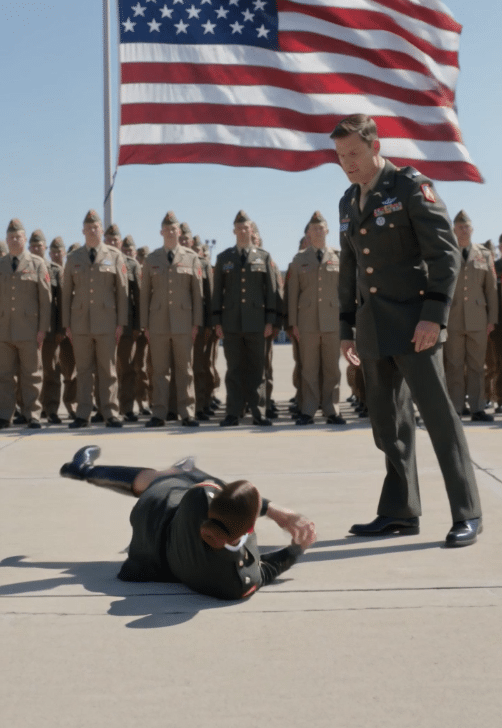
Captain Grace Miller stood in the inspection lane, her polished black boots planted firmly on the concrete parade ground. In front of her, Lieutenant Scott Harris remained several feet outside his assigned formation, staring at her as if her order were an insult he had no intention of accepting.
Behind them, rows of cadets stood motionless beneath the American flag. The morning inspection had been proceeding according to schedule until Harris decided that the woman correcting him had no right to do so.
He stepped toward her.
“Trash. You don’t command me.”
Grace’s expression barely changed. Her brown hair was secured in a tight bun, her olive service uniform immaculate, and her posture unmistakably that of an officer accustomed to being obeyed for the right reasons.
“Lieutenant, return to your position. We are in the middle of an inspection.”
Harris gave a short, contemptuous laugh.
“You think you can order me around?”
“I’m giving you a direct instruction.”
That was when his expression hardened.
Rather than return to the formation, Harris suddenly drove forward and kicked Grace squarely in the chest.
The impact knocked her backward onto the concrete. Her elbow struck the ground, scraping against the rough surface, and a thin trace of blood appeared along her skin.
A sharp gasp traveled through the formation.
Grace struggled to draw a full breath. Pain tightened her face, but even as she tried to steady herself, her eyes remained fixed on Harris.
He had just assaulted a superior officer in front of dozens of witnesses.
And he was not finished.
Harris stepped closer and delivered another forceful kick into her back. Then he struck her side with a second, sending a fresh wave of pain through her body.
The formation trembled with barely contained shock. Several cadets flinched, and one covered his mouth. Nobody stepped out of line.
Grace drew a strained breath and tried to push herself up on one arm.
“Return to your position,” she repeated.
The words were quieter now, but they had not changed.
Harris stared down at her as though her refusal to surrender were the most offensive thing he had ever witnessed.
“Trash. You don’t command me.”
Then he leaned forward.
“Give orders from the ground.”
The words carried across the concrete yard.
Grace’s face flushed with pain and humiliation. Her elbow burned where it had struck the ground, and she had to fight to keep her breathing controlled. She could hear the cadets around her, the faint movement of boots, the silence of people who knew they were witnessing something unforgivable but were afraid to act.
Harris had mistaken that silence for permission.
He stood over her with his shoulders squared, convinced that his defiance had made him powerful.
Then a command vehicle braked hard beside the parade ground.
Its tires stopped with a sharp crunch against the pavement.
The driver’s door flew open.
Colonel William Pierce stepped out, his dark-green command jacket moving as he strode toward the inspection lane. His gray hair caught the daylight, but it was his expression that made the nearest officers straighten.
He had seen enough to understand that something had gone terribly wrong.
When he reached Grace, he moved directly between her and Harris, positioning himself protectively over the fallen captain.
His eyes locked onto the lieutenant.
“Drop down,” Pierce ordered. “You just ended your career.”
Harris’s expression faltered.
The colonel’s voice was controlled, but the anger beneath it was unmistakable.
For the first time that morning, Harris seemed to notice the formation around him. Every cadet had seen what he had done. Every officer present had heard what he had said.
His confidence began to collapse.
“Ended my career?”
He spoke as if the words belonged to someone else’s nightmare.
But Colonel Pierce was not looking at the formation anymore.
He was looking directly at him.
And Harris was about to discover why Captain Grace Miller had been standing in that inspection lane in the first place.
Act II
Scott Harris had spent years learning how to look like a man destined for promotion.
His uniforms were always sharp. His boots were polished. He knew how to stand when senior officers approached, how to deliver a confident report, and how to turn a mediocre performance into a convincing story about his potential.
He was thirty-six, older than many of the officers and cadets around him, and he considered that difference proof that he deserved more influence.
In his mind, experience automatically translated into authority.
He had forgotten that military authority did not come from age, volume, or the ability to intimidate people who were younger or less established.
It came from position, responsibility, and the willingness to follow the same standards one expected others to obey.
Harris had never been particularly good at that last part.
He could accept orders when they came from someone he admired. He could show discipline when the consequences were obvious. But when he believed a person lacked the power to punish him, his behavior changed.
He became dismissive.
He challenged routine instructions.
And if someone refused to back down, he treated the disagreement as a contest he had to win.
Grace Miller had encountered that attitude before.
At thirty-one, she had earned her captain’s rank through years of demanding assignments and consistently strong evaluations. She was not the loudest officer in a room, and she did not need to be.
Her authority came from preparation.
She knew the inspection standards, understood the chain of command, and had little patience for officers who confused obedience with fear.
The morning’s inspection was particularly important. The base was preparing for a formal readiness review, and the parade ground had been organized into carefully marked lanes. Each officer was expected to maintain the assigned position so that the inspection could proceed without confusion.
Harris had stepped outside his designated place to speak with another officer, disrupting the line.
Grace had instructed him to return.
It was an ordinary correction.
There was no public accusation, no insult, no threat to his career. She had not singled him out for humiliation. She had simply expected him to follow the same instruction everyone else was following.
But Harris disliked being corrected by her.
He had questioned her decisions before, sometimes in front of other personnel. When she answered with regulations rather than emotion, he found ways to suggest that she was rigid, difficult, or overly concerned with appearances.
He had mistaken her restraint for uncertainty.
He had mistaken professionalism for weakness.
And on the parade ground, with dozens of witnesses nearby, he decided to make her retreat.
The moment Grace ordered him back into formation, Harris saw an opportunity to reassert himself. If she backed down, the other cadets would learn that he could challenge her without consequence.
If she stood firm, he could escalate the confrontation and force her into a public scene.
He had convinced himself that he controlled the outcome.
What he failed to consider was that Grace was not improvising her authority. She was acting within a defined role, following an established inspection procedure.
He had no legitimate reason to refuse her instruction.
And even if he had believed the order was wrong, there were formal ways to raise that concern.
Instead, he chose violence.
The assault was not an impulsive bump in a crowded lane or an accidental collision during a drill. Harris had stepped forward and kicked her deliberately. Then, after she fell, he had continued.
Every additional second made his position worse.
The witnesses understood that.
They also understood how dangerous it could feel to challenge an officer who had already shown that he was willing to use force against a colleague in public.
That fear had held them in place.
But when Colonel Pierce appeared, the entire balance of the situation changed.
Pierce was not simply another senior officer passing through the inspection. He was responsible for the base’s readiness standards and had spent years insisting that discipline must apply equally to every person wearing the uniform.
He had seen officers make mistakes.
He had seen tempers flare under pressure.
What he could not tolerate was someone using rank, position, or physical strength to make another person afraid to exercise legitimate authority.
As he stood over Grace, he recognized her immediately.
Captain Miller had been assigned a special responsibility for the upcoming readiness review, a role that required independent assessment of inspection procedures and command compliance.
Her assignment had been approved at a level well above the ordinary inspection team.
But Pierce did not need that information to know what he had witnessed.
Harris had assaulted an officer who had given him a lawful instruction.
The special assignment would make the consequences more significant, but it would not create the offense.
That distinction mattered.
Because the real question was no longer whether Harris respected Grace Miller.
It was whether he believed the rules applied to him at all.
And Pierce intended to find out.
Act III
“Captain Miller,” Colonel Pierce said, lowering himself beside her, “can you hear me?”
“Yes, sir.”
Grace’s voice was strained. She tried to sit up, but the movement made her wince.
“Don’t rush it,” Pierce told her. He signaled to the nearest personnel to summon medical support and directed the formation to remain in place until relieved by the appropriate officer.
Then he looked back at Harris.
“Stand where you are. Do not approach her.”
Harris’s jaw tightened.
“Sir, there has been a misunderstanding.”
Pierce did not blink.
“A misunderstanding?”
“She challenged me in front of the entire formation.”
“She gave you an instruction.”
“She was out of line.”
“On what basis?”
Harris opened his mouth, then stopped.
The colonel waited.
The silence grew uncomfortable.
Finally, Harris said, “She was acting as though she had authority over me.”
Pierce’s expression hardened.
“She was conducting an inspection. You were out of position. She corrected you. Explain which part of that gave you the right to kick her.”
Harris glanced toward the formation.
Nobody returned his look.
The cadets who had watched the assault were still standing where they had been ordered to stand, their expressions rigid and their attention fixed on the scene.
He had expected someone to support him. He had expected at least one witness to suggest that Grace had provoked him or that the situation had been misunderstood.
But the facts were too clear.
He had refused the instruction.
He had insulted her.
He had kicked her down.
Then he had kicked her again.
And when she tried to maintain her composure, he had mocked her from above.
Pierce stood.
“Lieutenant Harris, you will remain under supervision pending a formal investigation. You will surrender any inspection responsibilities assigned to you and have no contact with Captain Miller outside authorized procedures.”
Harris looked stunned.
“Sir, you can’t make a decision like that without hearing my side.”
“I have heard enough to secure the scene and protect the people involved. The investigation will hear your account.”
“I’ve served this base for years.”
“And Captain Miller was performing her assigned duty.”
Pierce turned toward the officers responsible for the inspection.
“Preserve the formation records, identify every witness, and document the sequence of events. I want the relevant duty assignments and inspection orders secured before anyone has an opportunity to alter or reinterpret them.”
The instructions were precise.
No threats. No theatrical speech.
Just the beginning of an official process.
When the medical team arrived, Grace was carefully assisted into a seated position and assessed. She remained alert, though her breathing was still uncomfortable and her arm needed attention.
Pierce stayed nearby until the medics were ready to escort her for further examination.
Harris watched, increasingly unsettled.
He had expected the colonel to order him away from the parade ground. He had not expected Pierce to request the documentation behind Grace’s assignment.
“What does her assignment have to do with this?” Harris demanded.
Pierce turned slowly.
“You seem very concerned with whether Captain Miller had enough authority to correct you.”
“She doesn’t—”
“Finish that sentence carefully.”
Harris stopped.
Pierce took a breath, then continued.
“Captain Miller is serving as the designated officer for an independent readiness assessment. Her responsibilities include evaluating compliance with inspection procedures and reporting irregularities through the appropriate channels.”
The words settled over the parade ground.
A few cadets exchanged glances.
Harris stared at the colonel.
“An independent assessment?”
“Yes.”
“Of this base?”
“Among other responsibilities.”
The realization arrived in pieces.
Grace had not been standing in the inspection lane merely because someone had asked her to help organize the formation. She had been assigned to evaluate whether procedures were being followed, whether the chain of command was functioning properly, and whether officers were carrying out their responsibilities as required.
Harris had not simply argued with a colleague.
He had assaulted the very officer responsible for examining the standards he had been expected to uphold.
But Pierce was not finished.
“Her role does not make the assault more wrong than it would have been against any other officer,” he said. “It makes your decision to ignore your obligations even harder to explain.”
Harris swallowed.
“Sir, I didn’t know.”
“You didn’t know her full assignment. You didn’t ask. You didn’t verify anything. You decided that your personal judgment outranked an official instruction.”
Pierce stepped closer, his voice dropping.
“And then you used violence to enforce that judgment.”
Harris looked at Grace as the medics helped her toward the waiting medical vehicle.
For the first time, he seemed to understand that her composure had not been an invitation to challenge her. It had been a choice to handle a routine correction professionally.
He had turned that choice into a test of her endurance.
Now the entire formation had witnessed the result.
Still, Harris clung to one desperate thought.
If the colonel knew how long he had served, perhaps there was a way to frame the incident as a momentary lapse. Perhaps his record would outweigh the evidence. Perhaps the right explanation could preserve the career he had spent years building.
He had no idea how much that hope depended on the very standards he had just violated.
Act IV
The formal investigation began that afternoon.
Harris was removed from his inspection duties while the responsible officials reviewed the evidence. The measure was temporary, intended to protect the process and prevent further contact with Grace while the facts were established.
He spent the first hours insisting that the incident had been exaggerated.
He described the exchange as a heated disagreement. He claimed Grace had embarrassed him in front of the formation and argued that his reaction had been misunderstood.
But the witnesses described the same sequence.
Grace had instructed him to return to his position. Harris had refused, insulted her, and kicked her down. After she fell, he had delivered two additional kicks while she remained on the concrete.
The medical report documented her injuries.
The inspection plan confirmed her assigned role.
And the duty roster established that Harris had been expected to follow the inspection procedures in place that morning.
No single document told the entire story. Together, they left little room for the version Harris wanted to present.
As the review continued, officials also examined his previous conduct. Reports from earlier assignments raised questions about his tendency to challenge instructions from officers he considered less influential or less experienced.
Those reports required their own verification. The command did not treat every past disagreement as proof of misconduct.
But the pattern was relevant.
Harris had repeatedly behaved as though an order could be ignored if he personally disliked the person giving it. The parade-ground assault was the first incident in which that attitude had escalated so visibly and violently.
It also exposed a deeper problem.
Several witnesses admitted that they had been reluctant to report earlier behavior because they feared retaliation or believed their concerns would be dismissed as personal conflict.
Pierce took those statements seriously.
He directed the appropriate officials to review whether earlier complaints had been handled properly and whether personnel understood how to report misconduct without having to confront the accused person directly.
The goal was not to punish everyone who had ever remained silent.
It was to understand why silence had become the safest option for so many people.
Meanwhile, Grace was undergoing medical evaluation and following instructions for recovery. Her injuries were painful, but she was determined not to let the incident define her work.
When Pierce visited her later that day, she was seated in a quiet room with her injured arm supported.
“How are you feeling, Captain?”
“Better than I looked on the parade ground, sir.”
Pierce gave a faint, tired smile.
“You don’t have to minimize it.”
Grace looked toward the window.
“I know. I just don’t want the review to become about me.”
“It won’t.”
“I was doing my job. I corrected an officer who was out of position. That should have been the end of it.”
“It should have.”
She paused.
“People saw him kick me, and they didn’t move.”
Pierce did not offer an easy defense.
“They were afraid.”
“I understand that. But if an entire formation can watch something like that happen and nobody believes they can act, then we have a problem beyond one officer.”
Pierce nodded slowly.
“That is why we’re reviewing the response as well.”
Grace had no interest in being treated as a symbol of courage. She did not want special attention or a ceremonial speech about resilience. She wanted to return to her duties and know that an officer could issue a legitimate correction without having to calculate whether the recipient might attack her.
She also wanted the cadets who had witnessed the assault to understand that fear did not have to become permanent silence.
Pierce agreed.
The investigation proceeded according to the applicable military procedures. Harris was given the opportunity to respond to the allegations, and the findings were based on the evidence rather than the colonel’s anger.
When the review was completed, the conclusion was unambiguous.
Harris had committed a serious breach of conduct by assaulting Grace and refusing to follow a legitimate inspection instruction. His behavior was incompatible with the responsibilities of his position.
The disciplinary process moved forward, including a review of his fitness to continue serving in his role. The final consequences were determined through the established chain of command, not through an improvised punishment on the parade ground.
Harris’s career was no longer protected by the polished uniform he wore or the years he had accumulated.
He had spent so long believing that authority was something he could take from others that he had forgotten it was also something he could lose through his own actions.
And this time, there would be no quiet hallway in which the incident could disappear.
Every witness would be heard.
Every relevant record would be examined.
And the standards Harris had dismissed would determine what happened next.
Act V
Several weeks later, Grace Miller returned to the parade ground.
The concrete had been cleaned, the inspection markers had been reset, and the American flag moved in the morning breeze above the formation.
From a distance, everything looked ordinary.
But the officers standing along the inspection lane knew what had happened there. They remembered the sudden violence, the terrible silence, and the moment Colonel Pierce stepped out of his command vehicle.
Grace walked into position with her uniform pressed and her hair secured in the same tight bun.
She did not arrive with an entourage.
She did not ask for a special introduction.
She simply reviewed the inspection plan and prepared to do her job.
Before the formation began, a young officer approached her.
“Captain Miller, may I speak with you?”
“Go ahead.”
He hesitated, visibly uncomfortable.
“I was there that morning.”
Grace waited.
“I saw what Lieutenant Harris did. I didn’t step forward. I told myself the colonel would handle it when he arrived, but that wasn’t why I stayed still. I was afraid.”
He swallowed.
“I keep thinking about it.”
Grace studied him for a moment.
“Being afraid doesn’t make you responsible for what he chose to do.”
The officer’s shoulders relaxed slightly.
“But what you do with that fear matters,” she continued. “You may not always be able to stop someone physically. You can call for help, report what you see, and refuse to help a person hide what happened.”
“Yes, ma’am.”
“Learn from it. Don’t turn it into another reason to look away next time.”
The officer nodded and returned to his position.
Grace watched him go, then looked down the line of personnel waiting for inspection.
She knew the incident had changed the way some people saw her. A few were more careful around her now. Others looked at her with an awkward mixture of admiration and discomfort, as if they were waiting for her to confirm that she had recovered completely.
She could not give them that certainty.
The physical pain had eased, but she still remembered the impact of the first kick and the shock of realizing that Harris intended to continue. She remembered trying to keep her face composed while lying on the concrete, knowing that the formation was watching.
She also remembered the moment Pierce arrived.
His presence had changed the situation immediately. But what mattered most was not that he had been more powerful than Harris.
It was that he had used his authority to protect someone who had been attacked and to ensure the incident would be examined properly.
That was what command was supposed to mean.
When Colonel Pierce joined her at the edge of the inspection lane, he looked across the assembled formation.
“Ready, Captain?”
“Yes, sir.”
He lowered his voice.
“The process is complete. The findings have been documented, and the appropriate disciplinary decisions have been made. The broader review of reporting procedures is continuing.”
“Thank you, sir.”
“You don’t need to thank me for doing my job.”
Grace glanced toward the cadets.
“Then let’s make sure they understand it’s their job, too.”
Pierce followed her gaze.
He knew she was not suggesting that every cadet should charge into every confrontation without thinking about the risks. She was asking for something more practical and more difficult: a culture in which people recognized misconduct, sought help, documented what they saw, and did not automatically protect the person who frightened them most.
“Agreed,” he said.
The inspection began.
Grace moved down the line, checking positions and correcting small errors with the same measured professionalism she had shown on the morning of the assault. When one cadet stood slightly outside the marked lane, she gave a brief instruction.
“Return to your position.”
The cadet corrected his stance immediately.
No argument followed.
No one treated the instruction as a challenge to personal pride.
The formation continued.
For Grace, that ordinary response meant more than any applause could have. It was proof that the purpose of the inspection had not been destroyed by what happened. Standards could still be enforced without humiliation, and authority could still be exercised without fear.
Harris had believed that forcing a superior officer to the ground would make him look powerful.
Instead, he had exposed the weakness beneath his confidence.
He had confused intimidation with leadership, obedience with respect, and silence with agreement. The moment he used violence to prove that he could not be challenged, he gave the institution a reason to examine whether he deserved the responsibility he had been given.
Colonel Pierce’s warning had sounded absolute on the parade ground.
“You just ended your career.”
But the deeper truth was more important than the threat of losing a rank, a position, or years of professional ambition.
Harris had not destroyed his future because he failed to recognize Grace Miller’s special assignment. He had destroyed the trust required of an officer when he decided that another person’s authority could be answered with violence.
Grace had never needed a hidden title to deserve respect.
She had never needed a colonel to stand over her before her orders mattered.
And she had never needed to win a confrontation to prove that she belonged on that parade ground.
As the American flag moved above the formation, she continued the inspection, one position at a time.
The lesson was not that a powerful officer could arrive and punish the right villain.
It was that a uniform meant nothing without the discipline to respect the people wearing one beside you.
Harris had asked whether his career was really over. The more important question was why he had believed he could kick another officer to the ground and still deserve to lead anyone.