Act I
“I’m here to see my son.”
Earl Hayes stood beside the VIP elevator of a luxury office tower, gripping his metal crutches while a faded army jacket hung loosely over his shoulders. His old prosthetic leg made every step deliberate, and the document envelope tucked beneath his arm had softened at the corners from years of handling.
Grant Miller, the building manager, looked him up and down.
The polished stone floor reflected Earl’s worn boots. Behind the premium reception desk, employees in tailored suits moved between appointments, their voices blending with the quiet hum of the elevators. Everything in the lobby had been designed to communicate wealth, efficiency, and exclusivity.
Earl looked like someone Grant believed did not belong there.
“You need an appointment,” Grant said, stepping directly into his path.
“I understand. But I need to speak with the building owner.”
Grant laughed.
“The building owner?”
“Yes, sir.”
“Do you have any idea how many people come through here claiming they know someone upstairs?”
Earl adjusted his grip on the crutches.
“I’m not asking to see anyone else. I’m here to see my son.”
Grant’s smile twisted into something cruel.
“Trash. Nobody upstairs knows you.”
A few employees turned toward them. A woman near the reception desk stopped typing. Two men waiting by the elevators exchanged uncomfortable glances.
Earl swallowed the humiliation but did not raise his voice.
“Please tell him Earl Hayes is here.”
Grant stepped closer.
“I already told you that you aren’t going upstairs.”
Earl tried to move around him, angling toward the elevator doors.
Grant’s expression changed instantly.
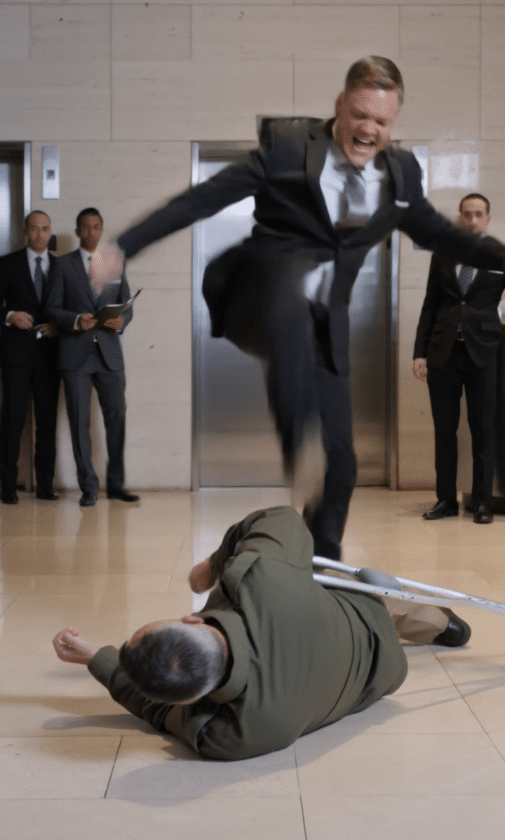
He moved behind the older man, took a short step to build momentum, and drove a forceful kick into Earl’s back.
Earl pitched forward.
His crutches flew sideways across the polished floor, and the document envelope slipped from his arm, scattering several papers as it skidded away. He hit the stone hard, catching himself awkwardly with one arm.
A thin trace of blood appeared where his elbow scraped the floor.
For a moment, Earl could not get his breath.
He grimaced, his body curling instinctively around the pain. Without his crutches, he struggled to find a stable position, his missing leg making it impossible to rise the way another man might.
“I’m here to see my son,” he gasped.
Grant stood over him.
“Trash. Nobody upstairs knows you.”
Earl reached toward the nearest crutch.
Grant kicked him again, striking his back. Then came a second heavy kick against his side, forcing Earl to recoil with a strained cry.
The lobby went still.
A receptionist covered her mouth. One businessman stepped backward. Another stared at the floor as if refusing to look might somehow make him less responsible for what he was witnessing.
Nobody moved to help.
Earl tried again to reach his crutch, his fingers stretching across the stone. His face was tight with pain, but there was something else in his expression too: the shame of being treated as less than human in a room full of people who had decided it was safer to watch.
Grant leaned over him.
“Crawl out before I call security.”
Earl looked up at him.
He did not beg.
He did not curse.
He simply held Grant’s gaze for a moment before turning back toward the crutch lying several feet away.
Then the VIP elevator doors opened behind the reception desk.
A man in an expensive navy suit stepped into the lobby, his white shirt open at the collar. He was moving quickly, already looking toward the reception area, when he saw the fallen veteran.
He stopped dead.
The color drained from his face.
“Dad!”
Daniel Hayes ran across the polished floor.
Grant turned, irritation still on his face, apparently ready to complain about the disturbance.
But Daniel never looked at him first.
He dropped to his knees beside Earl, placed himself between his father and the manager, and reached for the fallen crutch. He lifted it carefully toward Earl, one hand hovering protectively near his father’s shoulder.
“Dad, look at me. Are you hurt?”
Earl tried to answer, but the pain interrupted him.
Daniel’s eyes moved to the scrape on his father’s elbow, then to the papers scattered across the floor. Finally, he looked up at Grant.
The warmth vanished from his face.
“You did this?”
Grant stared at him.
Then he looked at Earl again, as if seeing the older man for the first time.
“Your dad?”
Daniel slowly rose to one knee, keeping himself between his father and the manager.
“Yes,” he said. “My father.”
And in that moment, Grant Miller realized he had just assaulted the one person in the building he should never have mistaken for someone disposable.
But what frightened him most was not that Earl Hayes had a powerful son.
It was the look on that son’s face.
Because Daniel Hayes was not about to let the matter disappear behind the reception desk.
Act II
Daniel Hayes had spent years building a company that occupied a significant portion of the tower bearing its corporate name.
At forty-five, he had learned how to negotiate difficult contracts, recognize hidden risks, and remain composed when people around him lost their tempers. He rarely raised his voice in meetings because he understood that a calm question could be more effective than a loud accusation.
But the sight of his father on the floor had stripped away every layer of executive composure.
Earl Hayes was sixty-eight years old.
He had raised Daniel largely on his own after Daniel’s mother died, working long hours and accepting jobs that demanded more from his body than they should have. When Daniel was young, he never understood why his father sometimes came home too tired to speak or why certain winter mornings made him move more slowly.
He understood more as he grew older.
Earl had served in the Army when he was young. He had lost his leg during an overseas deployment, then spent months learning how to walk again with a prosthetic. The physical recovery was difficult, but the transition to civilian life proved harder in ways he rarely discussed.
The world had become full of small obstacles that other people barely noticed.
Stairs without ramps.
Doors too heavy to manage while balancing on crutches.
Strangers who spoke to whoever accompanied him rather than to him.
People who mistook a disability for helplessness, then mistook his quiet refusal to accept pity for stubbornness.
Earl had learned to manage those indignities without making every encounter a battle.
He had never wanted his son to grow up believing the world owed them special treatment.
“Your name won’t open every door,” he once told Daniel. “But how you treat the person standing in front of you tells everyone who you are.”
Daniel had remembered those words long after his father’s voice grew quieter and his own responsibilities became larger.
As his company expanded, Daniel offered Earl financial security, a comfortable home, and every practical convenience he could provide. Earl accepted some help but refused to become a permanent fixture in his son’s office or a symbol of the family’s history.
He preferred his own routine.
He still polished his old Army jacket. He still carried important documents in a plain envelope rather than asking someone to arrange everything for him. He still wanted to arrive somewhere under his own power, even when that required more time and effort.
The visit to the tower had been his idea.
He was carrying documents Daniel needed for a family matter involving an old property and several records Earl had kept for decades. They had agreed to meet that morning, and Earl had chosen to bring the papers himself.
He had called ahead.
But the message had not reached the reception desk in a form Grant considered sufficient.
When Earl arrived, the manager had already been dealing with a difficult morning. A meeting had been rescheduled, a VIP visitor had complained about waiting, and an executive had questioned a recent service decision.
Grant was determined to restore what he called control.
In practice, that meant making sure nobody challenged him in front of the people he wanted to impress.
He had become skilled at deciding who deserved patience and who could be dismissed. Visitors in expensive suits received apologies and assistance. Delivery workers were hurried along. Anyone who looked uncertain or poorly connected was expected to explain themselves twice.
Earl’s faded jacket, worn shirt, and metal crutches had told Grant everything he thought he needed to know.
He saw a vulnerable old man.
He did not see a father who had crossed difficult years without losing his dignity.
He did not see the person Daniel trusted most when he needed an honest answer.
And he certainly did not see a man whose arrival had been expected by the owner of the building.
The cruelest part was that Earl had given Grant several opportunities to end the encounter peacefully.
He had asked for Daniel by name.
He had explained the reason for his visit.
He had remained calm when Grant laughed at him.
Even after being insulted, he had not threatened the manager or tried to force his way through the elevator doors.
Grant had chosen to escalate anyway.
Now Daniel was kneeling beside the very man Grant had treated as a nuisance, checking whether his father could move safely while the lobby watched in silence.
“Dad, can you take a deeper breath?” Daniel asked.
Earl tried.
His face tightened.
“Slowly,” Daniel said. “Don’t rush.”
“I can manage.”
“I know you can. Let me help anyway.”
Daniel retrieved the second crutch and placed both within his father’s reach. Then he gathered the scattered papers and set the envelope beside Earl, careful not to pull him upright before he was ready.
The gesture was small, but it changed the atmosphere around them.
The building’s owner was on the floor in an expensive suit, tending to an injured veteran with the same care another executive might reserve for a multimillion-dollar contract.
He did not appear embarrassed.
He appeared furious that his father had been left there alone.
Then Daniel looked toward the receptionist.
“Call medical assistance. Now, please.”
She moved immediately.
Grant took a nervous step forward.
“Mr. Hayes, I can explain—”
Daniel raised one hand without taking his eyes off his father.
“Not one more word until he’s been seen by a medical professional.”
Grant stopped.
For the first time in his career, the manager had been told to wait by someone whose authority he could not intimidate.
And the real explanation for Earl’s visit was about to become the least important part of what happened next.
Act III
When the medical team arrived, Daniel stayed beside his father while they assessed the injuries.
Earl was alert, but his back and side hurt, and the scrape on his elbow needed attention. The medics advised him not to rush to his feet. Daniel listened to every instruction, asking questions without trying to take over the examination.
Only after the medical team had made him comfortable did Daniel stand and turn toward Grant.
The lobby had become almost unnaturally quiet.
Employees who had been rushing between appointments now lingered near the reception desk. Several visitors stood by the elevator bank, watching with expressions of disbelief and discomfort.
Grant straightened his silver tie.
“Mr. Hayes, this is a terrible misunderstanding.”
Daniel looked at him.
“What part?”
Grant blinked.
“I was trying to enforce building access rules. He wanted to go directly to the executive floors, and he wouldn’t listen when I told him he needed authorization.”
“My father told you he was here to see me.”
“He didn’t have the proper appointment information.”
“And that gave you the right to kick him?”
Grant’s mouth opened, then closed.
“I didn’t mean for him to fall like that.”
Daniel’s eyes narrowed.
“Did you kick him?”
The question was quiet.
Grant glanced around the lobby, looking for someone who might interrupt or offer him an escape.
“I was trying to get him away from the elevator.”
“That wasn’t my question.”
A long silence followed.
Finally, Grant said, “Yes.”
Daniel nodded once, as though confirming something he already knew.
“And after he fell?”
Grant shifted his weight.
“I was frustrated.”
“You kicked him again.”
“I—”
“Twice.”
Grant’s face reddened.
Daniel took a breath and looked toward the reception desk.
“Preserve the lobby camera footage. All of it. The original files, not edited clips. Secure the visitor logs and the access records, and make sure the incident is documented.”
The receptionist nodded quickly.
“Of course, sir.”
“Notify the appropriate security supervisor. Mr. Miller is not to approach my father or interfere with the review.”
Grant stiffened at the instruction.
“You can’t remove me from my own lobby based on one side of the story.”
Daniel turned back to him.
“My father is on the floor because you assaulted him in front of witnesses. The cameras are there. The people standing around us saw what happened. There will be a review, and you will have the opportunity to provide your account through the proper process.”
He paused.
“But you will not use your position to intimidate witnesses or alter the record.”
The manager’s eyes darted toward the cameras mounted above the reception desk.
For several seconds, he said nothing.
Daniel’s father had taught him that a person’s character was clearest when they believed nobody important was watching. Now Daniel had an opportunity to see whether Grant understood what that meant.
He hoped the answer would be different from what the lobby suggested.
“Mr. Hayes,” Grant began, forcing a strained smile, “I’ve worked here for eleven years. I’ve protected this building’s reputation. I know how difficult it is to manage the people who come through these doors.”
“Then you know the difference between managing access and attacking a visitor.”
“I was under pressure.”
“So was my father, lying on this floor while you told him to crawl away.”
Grant flinched.
Daniel stepped closer, though he did not touch him.
“Did you ask him who he was?”
“He said he wanted to see the owner.”
“And you decided he was lying because of how he looked.”
Grant did not answer.
Daniel’s voice grew colder.
“You looked at an elderly veteran with one leg, saw a man you thought couldn’t fight back, and decided you could humiliate him without consequence.”
“That’s not fair.”
“Then explain what is fair about what you did.”
The manager looked toward the surrounding employees.
Nobody spoke for him.
A woman at the reception desk finally stepped forward.
“Mr. Hayes, I saw the whole thing,” she said, her voice trembling. “Your father was polite. He asked for you by name. Mr. Miller insulted him before the first kick.”
Grant turned sharply.
“You don’t need to get involved.”
Daniel’s gaze snapped toward him.
“Do not speak to her that way.”
The woman fell silent, but she did not step back.
Another employee quietly confirmed that he had witnessed the assault. A visitor near the elevators offered to provide a statement as well.
The room that had once protected Grant with its silence was beginning to speak.
Daniel looked at each witness in turn.
“Thank you. Please give your accounts independently to the people conducting the review. No one should feel pressured to change or soften what they saw.”
Then he turned back to Grant.
“You told my father that nobody upstairs knew him.”
Grant swallowed.
“Yes.”
“You were wrong.”
The words were simple, but the manager’s expression changed as their meaning settled in.
Daniel had recognized Earl instantly because he knew the way his father stood, the sound of his voice, the particular fold of the old Army jacket he had worn for decades.
No appointment record could have made Earl more recognizable to his son.
No access badge could have made him more welcome.
And no executive title could make the assault more serious than it already was.
Daniel glanced back at the medical team.
His father was being helped into a safer position, his face still strained with pain.
When Daniel looked at Grant again, his anger had not faded.
It had become something more deliberate.
“This review will not depend on whether my father is related to me,” he said. “It will depend on what you did.”
Grant stared at him.
He had been expecting the owner to become angry because the victim was family.
He had not expected the owner to make the distinction so clearly.
And that distinction threatened the excuse Grant had already begun constructing.
Act IV
By the end of the day, the lobby footage had been secured and the incident had been formally documented.
The review included the camera recordings, witness statements, visitor records, and accounts from the staff members who had been present. Daniel instructed the building’s appropriate management and security personnel to preserve the evidence and conduct the process without interference.
Grant was removed from his immediate duties pending review, with access and supervisory responsibilities adjusted to protect the investigation.
He was not allowed to decide which footage would be shared, which witnesses would be interviewed, or how the incident would be described in the official record.
For a man who had spent years controlling the lobby through small decisions and quiet intimidation, losing control of the narrative was almost as frightening as losing control of his job.
He had built his authority around the assumption that visitors would leave when he told them to.
He had relied on the idea that employees would avoid contradicting a manager in public.
He had mistaken the polished floors, the executive elevators, and the security desk for a stage on which he could decide who mattered.
But the cameras did not care about his title.
The witness statements did not care how long he had worked there.
And the footage showed Earl asking to see his son before Grant attacked him.
The review also examined how Grant had handled other visitors. Several complaints had previously described unnecessarily hostile treatment of people who lacked appointments or appeared unfamiliar with the building’s procedures.
Those complaints had not all been substantiated, and the review did not automatically treat them as proof of wrongdoing.
But they raised a reasonable question about whether Grant had confused firm access control with personal contempt.
Daniel wanted that question answered properly.
He met with the staff members who reported to Grant and made it clear that they were expected to provide truthful accounts. No one would be punished for cooperating with the investigation, and no one would be asked to defend a manager simply because he had held the position for years.
The employees listened carefully.
Some had witnessed Grant’s impatience before. Others admitted that they had learned to stay quiet whenever he singled out a visitor, even when his treatment seemed excessive.
They had not expected him to become violent.
But several realized that they had been uncomfortable with his behavior long before that morning.
The lobby’s silence had not begun with Earl.
It had been built from smaller moments in which people decided that challenging Grant was not worth the trouble.
Daniel did not blame the employees for his father’s assault. Grant alone was responsible for choosing violence. Still, Daniel understood that a workplace could not rely on the arrival of an owner to stop every act of cruelty.
A policy that existed only on paper would not protect the next visitor.
So he ordered a broader review of lobby conduct, complaint escalation, and the way security staff handled difficult encounters. The objective was not to make access rules meaningless or prevent employees from enforcing them.
It was to ensure that rules were applied professionally, that visitors were treated with dignity, and that concerns about a manager’s behavior could be reported without fear of retaliation.
Meanwhile, Earl recovered under medical supervision.
When Daniel visited him, his father was sitting comfortably with his crutches beside the chair. His expression was tired, but the sharpness in his eyes had returned.
Daniel pulled up a seat.
“How are you feeling?”
“Sore.”
“I know.”
Earl studied his son’s face.
“You looked like you wanted to tear the whole lobby apart.”
Daniel let out a breath that was almost a laugh.
“I was trying to decide whether I could do that without creating more paperwork.”
For the first time since the incident, Earl smiled faintly.
Then his expression grew serious.
“Don’t make this about getting revenge for me.”
Daniel looked down at his hands.
“He kicked you while you were on the ground.”
“I know what he did.”
“He told you to crawl away.”
“I heard him.”
Daniel’s jaw tightened.
Earl waited until his son looked at him again.
“I’m not asking you to pretend it didn’t happen,” he said. “And I’m not asking you to protect him. I’m asking you to do this properly.”
Daniel nodded slowly.
“The evidence will be preserved. The review will be independent of his personal authority. The consequences will follow the findings.”
“Good.”
Earl adjusted one of his crutches.
“Then make sure the next old man who walks in there doesn’t have to be your father to deserve decent treatment.”
Daniel looked at him for a long moment.
That was the part he could not forget.
If Earl had been a stranger with no connection to the building’s owner, the assault would still have been wrong. If no executive had witnessed the attack, the cameras would still have recorded it. If the victim had never learned the manager’s name, he would still have deserved help.
The review could not become a story about a powerful family punishing an employee for offending them.
It had to remain what it was: an investigation into an act of violence against an elderly visitor.
When the findings were completed, the evidence supported the witness accounts. Grant had deliberately kicked Earl, continued the assault after he fell, and ordered him to crawl away rather than seeking assistance.
The building’s management concluded that his conduct was incompatible with his responsibilities. Following the formal review, Grant was dismissed from his position.
The decision was documented, and the relevant records were retained.
No grand announcement was made in the lobby.
No one was asked to applaud.
The consequences were serious because the conduct was serious.
Grant had spent years believing that the building’s rules gave him power over the people who entered it. He had forgotten that his role existed to protect the building’s operations, not to satisfy his own contempt.
The moment he used that role to humiliate and assault a visitor, he had undermined the very trust he was employed to maintain.
And this time, the truth could not be pushed behind a closed office door.
Act V
Several weeks later, Earl Hayes returned to the tower.
He came on a clear morning, wearing his faded Army jacket and carrying a fresh document envelope. His prosthetic leg and metal crutches still made the journey slower than it would have been for other visitors, but he moved with the same quiet determination he had shown the first time.
The polished stone floor had been cleaned.
The reception desk stood beneath the same bright lights.
The VIP elevator doors opened and closed as employees passed through the lobby, their days moving forward with the ordinary urgency of office life.
But the atmosphere had changed.
The reception team had received clearer guidance on handling visitors who needed access assistance or had questions about appointments. Staff members had a defined way to escalate difficult situations, including concerns involving a supervisor.
The security process remained firm.
The cruelty had no place in it.
When Earl approached the desk, the receptionist looked up with a professional smile.
“Good morning, sir. How can I help you?”
“I’m here to see Daniel Hayes.”
“Of course. Do you have a meeting scheduled?”
“Yes. He knows I’m coming.”
“Thank you. I’ll let him know you’ve arrived. Would you like to sit while I contact his office?”
Earl glanced toward the elevators.
“I can wait here, thank you.”
“Certainly, sir.”
She did not question whether he belonged.
She did not inspect his jacket for clues about his financial status.
She did not treat his crutches as a reason to hurry him out of the way.
She simply helped him with the same courtesy she would have offered anyone else.
Daniel came down a few minutes later.
When he saw his father, his face brightened.
“Dad.”
“Daniel.”
They shook hands before Daniel leaned in for a brief embrace.
“How are you getting around?”
“Same as yesterday. One step at a time.”
“That’s your answer to everything.”
“It’s usually accurate.”
Daniel smiled.
Then his expression softened.
“I’m glad you came back.”
Earl looked around the lobby.
“I didn’t want that man to be the last thing I remembered about this place.”
“He won’t be.”
They stood together near the reception desk, talking quietly while employees continued their work around them.
Daniel had made sure the building’s response did not end with Grant’s dismissal. The management review had led to clearer expectations for professional conduct and more reliable channels for reporting complaints. The changes were intended to protect every visitor and employee, not just people whose names carried influence.
Earl was pleased to hear that.
But he was more interested in a small detail.
“Did you get the documents I brought that morning?”
Daniel looked at him.
“They’re safe. Everything was recovered.”
“Good. I didn’t want to make that trip twice.”
Daniel laughed softly, then grew thoughtful.
“You know what I keep thinking about?”
“That you need better lobby managers?”
“That, too.”
Earl waited.
Daniel looked toward the reception desk, where the staff continued helping visitors.
“I keep thinking about how easily I could have missed it. If the elevator had been delayed, if I had been on a different floor, if I hadn’t looked toward the entrance when I did.”
“But you saw it.”
“Yes. I did.”
Earl rested both hands on the tops of his crutches.
“And the people who were there before you?”
Daniel understood what he meant.
“They’ve been interviewed. The witnesses gave their accounts, and the evidence was preserved.”
“Good.”
“I wish someone had stepped forward sooner.”
“So do I.”
Earl did not pretend the silence had been harmless. He remembered the faces turned toward him, the people who had watched while he struggled to reach his crutch. He understood fear, but he also understood how lonely it could feel to realize that a room full of people had decided not to see you.
Still, he refused to let that moment become his entire memory of the day.
“Some people freeze when something terrible happens,” he said. “They have to decide what they’ll do the next time. That’s all any of us can do.”
Daniel nodded.
The lobby’s VIP elevator opened behind them, and a group of executives stepped out. One greeted Daniel, then offered Earl a respectful nod.
Earl returned it.
There was no dramatic pause. No whispered revelation. No sudden rush to prove that the elderly veteran deserved to be there.
He had always deserved to be there.
That was the truth Daniel wanted the building to remember.
Grant Miller had looked at an old man with one leg, worn clothes, and metal crutches and decided that he was insignificant. He had mistaken poverty of appearance for poverty of worth, disability for helplessness, and a quiet manner for permission to be cruel.
He had believed that the only people who mattered were the people whose names he recognized.
Then he discovered that Earl Hayes was the father of the building’s owner.
The revelation exposed Grant’s arrogance, but it did not create Earl’s dignity. It had been there before the elevator doors opened. It had been there while he was being insulted. It had been there when he tried to reach his crutch instead of begging the man who had kicked him.
Daniel’s power had made the consequences immediate.
It had not made the assault wrong.
The assault had been wrong from the first kick.
As father and son walked toward the elevators, Daniel slowed his pace to match Earl’s. He did not grab his arm or insist on carrying his belongings. He simply stayed beside him, ready to help if asked.
Earl noticed.
“You know,” he said, “you don’t have to walk this slowly just because I’m here.”
Daniel glanced at him.
“I know.”
“Then why are you?”
Daniel looked ahead at the elevator doors.
“Because I’m walking with my father.”
Earl’s expression softened.
For a moment, neither man spoke.
Then the doors opened, and they stepped inside together.
Behind them, the lobby continued its morning routine. People arrived, appointments were checked, and the building carried on with its work.
But one lesson remained, clear enough that no executive title could improve upon it.
Grant had asked Earl to crawl away because he believed the older man had no power to challenge him.
He had been wrong about the father, wrong about the people watching, and wrong about what it meant to serve a building full of human beings.
The most important revelation was not that Earl Hayes was the building owner’s father.
It was that even if Daniel had never come out of that elevator, Earl would still have deserved the same dignity, the same protection, and the same chance to stand back up.