Act I
“Keep your cheap flowers off me!”
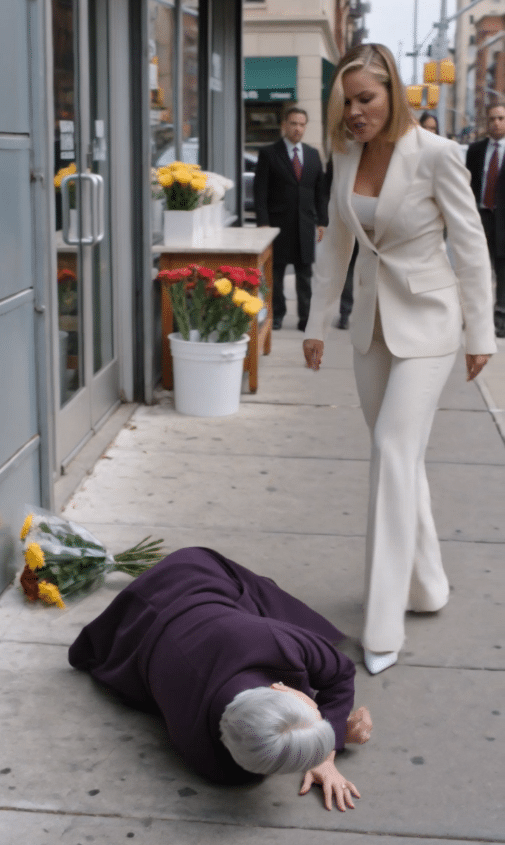
The woman in the white designer suit screamed so loudly that pedestrians on the sidewalk turned to stare. At her feet, a seventy-year-old flower seller lay crumpled beside the shop doorway, struggling to breathe, while a magnificent bouquet of roses and lilies lay scattered across the pavement.
The wealthy woman looked down at her as if she had just discovered something disgusting on the bottom of her shoe.
“You ruined my suit,” she snapped. “Do you have any idea how much this costs?”
The elderly woman tried to push herself upright. Her old purple coat had twisted beneath her, and a thin trace of blood marked her forearm where it had scraped against the sidewalk. Her face tightened with pain as she reached toward the flowers, instinctively trying to gather the stems before someone stepped on them.
“Please,” she whispered. “I am sorry. I could not see past the flowers.”
Only moments earlier, the accident had been so small that most people would have forgotten it within seconds.
The elderly woman, Eleanor Bennett, had stepped out of her little flower shop carrying a large bouquet wrapped in cream paper. The flowers were intended for a customer celebrating an anniversary, and the arrangement was wide enough to block most of Eleanor’s view.
As she maneuvered through the narrow doorway, the bouquet brushed lightly against the sleeve of a woman passing in the opposite direction.
That was all.
No glass shattered. No expensive accessory fell to the ground. No one was injured.
But a faint smear appeared on the pristine white fabric.
The woman stopped dead.
Her name was Vanessa Whitmore, a thirty-nine-year-old socialite known for expensive clothes, exclusive parties, and an extraordinary ability to turn minor inconveniences into public spectacles.
She examined her sleeve as if the bouquet had attacked her deliberately.
“Are you serious?”
Eleanor immediately lowered the flowers.
“Oh, I’m so sorry. I didn’t see you coming around the corner.”
Vanessa stared at her.
“Obviously.”
“I can get you a clean cloth. It may come right off.”
“Do you know what this suit cost?”
Eleanor glanced at the sleeve, then back at Vanessa’s face.
“No, ma’am. But I’m happy to help.”
That answer somehow made things worse.
Vanessa had expected panic, excuses, perhaps even an offer of money. Instead, the elderly woman stood before her with the quiet composure of someone who had spent a lifetime learning that accidents happened and people deserved patience.
Vanessa mistook that composure for weakness.
“Trash,” she said. “You just ruined my suit.”
Several pedestrians slowed down.
A man carrying a coffee looked over his shoulder. Two women near the flower shop window exchanged uncomfortable glances. Inside the shop, another customer moved toward the doorway but stopped when Vanessa raised her voice again.
Eleanor’s cheeks flushed.
“I truly am sorry.”
“Sorry doesn’t fix anything.”
“No, ma’am. But I can pay for cleaning if necessary.”
Vanessa laughed sharply.
“With what? The money you make selling those cheap flowers?”
Eleanor looked down at the bouquet.
The roses had cost her more than she liked to admit. She had ordered them from a small grower outside the city, choosing each bloom carefully because the customer who had commissioned them was celebrating forty years of marriage.
They were not cheap to her.
But she did not argue.
She simply bent slightly, trying to move around Vanessa and make room on the narrow sidewalk.
Vanessa grabbed the bouquet and yanked it aside.
The cream wrapping crumpled in her hand.
“Don’t walk away from me.”
Eleanor stumbled half a step, startled by the sudden movement.
“Please, I wasn’t—”
Vanessa kicked her hard in the chest.
Eleanor fell beside the shop doorway. The bouquet slipped from her hands, striking the pavement as roses and lilies spilled across the sidewalk.
Her forearm scraped against the ground.
She gasped, her face twisting with pain and disbelief. For a moment, she could not seem to understand what had happened. She had spent decades handling flowers, helping customers, and making small acts of kindness part of her daily routine.
She had never imagined that a stranger would answer an accidental brush of fabric with violence.
Before Eleanor could recover, Vanessa stepped closer and kicked her twice more in the back and side.
A woman in the crowd covered her mouth.
Someone whispered, “Oh, my God.”
But nobody moved quickly enough to stop it.
Vanessa stood over Eleanor, breathing hard, her white suit still immaculate except for the faint mark on the sleeve.
“Keep your cheap flowers off me.”
Eleanor curled slightly, grimacing as she tried to catch her breath. Her fingers reached weakly toward a rose lying just beyond her hand.
Then the sound of tires cut through the street noise.
A black official city car braked hard at the curb beside the flower shop.
The rear door opened.
A woman in a tailored navy suit stepped out, a small city insignia pinned near her lapel. She moved quickly toward the fallen woman, her expression changing the moment she recognized the silver hair and familiar purple coat.
She stopped between Eleanor and Vanessa.
Her voice was controlled, but something fierce burned beneath it.
“That… is… my mother.”
Vanessa’s expression faltered.
She looked at the black city car.
Then at the official pin.
Then at the woman standing before her.
The mayor of the city had just arrived.
And Vanessa was about to discover that the woman she had treated as worthless was the one person she should never have underestimated—not because of her daughter’s title, but because of the truth now lying in plain sight on the sidewalk.
Act II
Eleanor Bennett had never wanted to be important.
She wanted a small home with a garden, a shop where people felt welcome, and enough time to make something beautiful with her hands.
For nearly forty years, her flower shop had stood on the same downtown block, squeezed between a tailor’s studio and a narrow café. Its faded green awning had survived storms, construction work, and more than one attempt by property developers to replace the neighborhood’s older storefronts with glass towers.
Inside, buckets of fresh flowers lined the walls.
Roses stood beside sunflowers. Lilies shared space with daisies, tulips, and whatever seasonal blooms Eleanor could find from growers she trusted. The wrapping table was scratched from decades of use, and the little bell above the door rang whenever a customer entered.
To some people, the shop was old-fashioned.
To Eleanor, it was a living thing.
She had opened it with her husband, Thomas, when they were barely thirty. Thomas handled the books and deliveries, while Eleanor designed the arrangements. They had little money at the beginning, but they had something more useful than ambition: a willingness to work harder than they thought possible.
They slept badly during the first few years.
When business was slow, they skipped restaurant meals and repaired their own equipment. When a freezer failed during a heat wave, Thomas spent an entire night moving flowers into borrowed coolers while Eleanor called customers to explain the delays.
They learned that people rarely remembered every detail of an arrangement.
They remembered how they had been treated.
A nervous groom remembered Eleanor calming him down when he arrived hours before his wedding, convinced he had chosen the wrong flowers. A grieving daughter remembered Eleanor delivering a simple bouquet to her father’s funeral without charging her for it.
And every year, a couple returned to order anniversary flowers because Eleanor had once helped them recreate the arrangement from their wedding day.
The shop became a quiet part of the neighborhood’s life.
Then Thomas died, leaving Eleanor with the business, a house full of memories, and a daughter who had inherited far more determination than either parent knew what to do with.
Claire Bennett was twenty-two when she first entered public service.
She had grown up watching her parents solve problems without expecting recognition. Her father would repair a neighbor’s broken gate after work. Her mother would quietly add an extra bunch of flowers to an order if she sensed that a customer was buying them for someone who needed encouragement.
Claire learned early that the people who held a community together were not always the people whose names appeared in newspapers.
She studied public administration, worked on local campaigns, and spent years attending meetings in rooms where residents waited hours to speak about potholes, housing problems, unsafe intersections, and city services that seemed to work only for people who knew whom to call.
Her first campaign for city council was modest.
She had no famous family connections, no wealthy donors willing to bankroll her ambitions, and no glamorous political background. What she had was a reputation for listening carefully and returning calls when other candidates had moved on to the next event.
She lost her first major race.
Then she tried again.
By the time she became mayor at forty-four, Claire had learned that public office was less about delivering speeches than about earning trust from people who had every reason to doubt promises.
She still visited her mother whenever she could.
Sometimes she arrived in a city vehicle with an aide waiting outside. Other times she slipped into the flower shop after a long day, removed her jacket, and helped trim stems at the wrapping table.
Eleanor never treated her like a celebrity.
“You look tired,” she would say.
“I am tired.”
“Then sit down.”
“Mom, I have three calls to make.”
“Then make them sitting down.”
Claire would laugh and obey.
Their relationship remained rooted in ordinary affection. Eleanor was proud of her daughter, but she had no interest in using Claire’s office to gain advantages.
She never asked for special treatment from city departments. She never demanded that inspectors overlook a problem at the shop. When a sidewalk repair outside her storefront was delayed, she filed the same complaint as everyone else.
Claire respected her for that.
“You could call me,” she once said.
“And have people think I get things because I’m your mother? Absolutely not.”
“That’s not what I meant.”
“I know what you meant. And the answer is still no.”
Eleanor had spent her life believing that dignity was not something a person acquired through connections.
It was something they carried into every room, whether anyone noticed or not.
Vanessa Whitmore believed almost the opposite.
She had grown up in a wealthy family where appearances were treated as currency. Her father owned a chain of commercial properties, and her mother had spent decades teaching her how to recognize the people who mattered at a glance.
A person’s clothes mattered.
Their address mattered.
The names they knew mattered.
And the people who provided services were expected to remain pleasant, efficient, and invisible.
Vanessa learned to measure every encounter by what it could do for her.
As an adult, she moved through charity galas, private clubs, and fundraising dinners with practiced confidence. She donated money to public causes when the gesture brought attention, and she had a talent for turning minor social connections into opportunities.
She was not unfamiliar with city politics.
In fact, she had spent months preparing for a major civic gala scheduled for the following week, an event attended by business leaders, donors, and public officials. Her white suit had been chosen specifically for the occasion because she wanted to stand out in photographs.
She had planned every detail.
The tailor’s appointment. The accessories. The handbag. The car.
She had not planned for an elderly florist to brush a bouquet against her sleeve.
That small accident became, in Vanessa’s mind, a personal insult.
She could not imagine that Eleanor had been thinking only about the flowers, the customer waiting for them, and the narrow doorway she needed to navigate.
Vanessa saw the old coat and flat shoes.
She saw a woman who looked as though she had no influence.
And she assumed that meant she could do whatever she wanted.
What she did not know was that Claire Bennett had been on her way to the flower shop for a reason that had nothing to do with politics.
Her mother had called that morning to ask whether she could stop by before the end of the day.
There was something Eleanor wanted to show her.
Something that had been sitting in the back room for years.
Something connected to a promise Claire had made long before she became mayor.
And when Claire saw her mother lying on the sidewalk, she understood that the conversation they had planned would have to wait.
First, someone had to answer for what had happened.
Act III
“Move away from her,” Claire said.
Vanessa stared at the mayor, unable to decide whether to look offended or frightened.
“Excuse me?”
“You heard me.”
Claire knelt beside Eleanor, placing a steady hand near her mother’s shoulder without trying to move her.
“Mom, can you hear me?”
Eleanor blinked through the pain.
“Claire?”
“I’m here.”
“Oh, sweetheart.” Eleanor’s voice trembled. “The flowers.”
Claire looked at the roses scattered across the pavement.
“Forget the flowers. We need to make sure you’re all right.”
“But the customer—”
“Mom.”
Claire waited until Eleanor looked at her.
“You are the only thing that matters right now.”
For a brief moment, the composure Claire displayed at public meetings disappeared. She was no longer the city’s mayor. She was a daughter staring at her injured mother, trying to keep fear from overwhelming her.
Then she looked up at Vanessa.
“What happened?”
Vanessa drew herself straighter.
“She walked into me with that enormous bouquet. It got on my suit.”
“And then?”
“She was rude.”
A man standing near the café shook his head.
“That isn’t true.”
Vanessa turned sharply.
“Excuse me?”
“I saw the whole thing,” he said. “The woman apologized. You grabbed her flowers and kicked her.”
A woman beside him nodded.
“She was trying to help you clean the sleeve.”
Vanessa’s eyes flicked toward the growing crowd.
For the first time, she seemed to notice how many people were watching.
“You don’t understand,” she said quickly. “This suit is expensive.”
Claire rose slowly.
“My mother apologized to you?”
Vanessa hesitated.
“Yes, but—”
“And offered to help?”
“I didn’t ask her to touch me.”
Claire’s voice remained quiet.
“Did she threaten you?”
“No.”
“Did she strike you?”
“Of course not.”
“Did she try to steal from you?”
Vanessa’s cheeks reddened.
“No.”
“Then tell me why she is lying on the sidewalk.”
Vanessa opened her mouth.
Nothing came out.
A pedestrian near the curb raised a phone.
“I have part of it recorded,” he said. “I started filming when she began shouting.”
Vanessa looked at the phone as if it were a weapon.
“You can’t record me without permission!”
The man lowered it slightly but did not put it away.
“I recorded what happened in public.”
Claire did not ask him to post the footage. She asked him to preserve it for the authorities and give an accurate account of what he had seen.
Then she turned back to her mother.
Eleanor was trying to sit up.
Claire crouched beside her again.
“Please don’t move until help gets here.”
“I can get up.”
“I know you want to. Please wait.”
Eleanor’s eyes drifted toward the flowers.
“I had that bouquet just right.”
Claire felt her throat tighten.
Her mother had been assaulted, and she was still worried about the work she had promised someone she would finish.
“Who was it for?” Claire asked.
“The Wilsons. Forty years.”
Claire glanced at the fallen arrangement.
“Then we’ll make another one.”
Eleanor looked distressed.
“I don’t have time to—”
“Mom, stop.”
Claire took her mother’s hand.
“We’ll make another one. You don’t have to solve anything right now.”
A city employee who had been traveling with Claire approached and called emergency services. Claire remained with Eleanor, answering the paramedics’ questions when they arrived and stepping aside whenever they needed room to examine her.
Vanessa stood several feet away, growing more agitated by the minute.
“This is ridiculous,” she muttered.
Claire heard her.
She turned.
“Your concern right now is that you have been recorded assaulting an elderly woman?”
“I did not assault her.”
“You kicked her.”
“She was in my way!”
The words escaped before Vanessa could reconsider them.
The sidewalk fell quiet.
Even Vanessa seemed to hear how terrible they sounded.
Claire studied her for a moment.
“An elderly woman was standing outside her own shop. She accidentally brushed your sleeve with a bouquet. She apologized, offered to help, and you kicked her to the ground.”
Vanessa’s eyes widened.
“You can’t talk to me like that.”
“I am speaking to you about what happened.”
“Do you know who I am?”
Claire’s expression changed almost imperceptibly.
It was not anger that appeared on her face.
It was disappointment.
“Yes,” she said. “I do.”
Vanessa glanced toward the black city car. The official emblem on its side had been visible from the moment it stopped at the curb, but she had been too consumed by her own outrage to notice it.
Now she recognized the mayor’s insignia.
She looked back at Claire’s lapel.
Then at her face.
“You’re the mayor?”
“Yes.”
Vanessa’s lips parted.
For several seconds, she seemed unable to connect the woman in the navy suit with the elderly florist she had just attacked.
Then she looked toward Eleanor.
“The mayor’s mother?”
Claire did not answer.
She did not need to.
The truth had already spread through the crowd, passing from one shocked face to another.
But Claire was not interested in watching Vanessa unravel.
She turned to the paramedics as they prepared to transport her mother for further evaluation.
“Please make sure she’s examined thoroughly,” she said. “I’ll meet you there.”
Then she looked back at Vanessa one final time.
“Do not leave before the officers arrive.”
Vanessa stared at her.
“You can’t order me around.”
Claire’s gaze remained steady.
“No. But the law can require you to answer for what you did.”
And for the first time since the bouquet touched her suit, Vanessa had nothing to say.
Act IV
By the following morning, the story had spread far beyond the narrow downtown sidewalk.
Several witnesses had provided statements, and video footage captured key moments of the confrontation. The recordings showed Eleanor apologizing, Vanessa grabbing the bouquet, and the assault that followed.
The footage also showed something Vanessa could not explain away: Eleanor had never raised a hand against her.
She had not threatened her.
She had not attacked her clothing.
She had simply tried to make room on a crowded sidewalk while carrying flowers.
Vanessa’s attorney advised her to stop discussing the incident publicly while the investigation proceeded. But Vanessa had spent years managing her image through carefully chosen appearances and confident explanations.
Silence made her feel powerless.
She began calling acquaintances, insisting the encounter had been exaggerated. She described the bouquet as a deliberate provocation and claimed she had been defending herself.
Then someone asked the obvious question.
“Defending yourself from what?”
Vanessa had no credible answer.
The investigation continued through the appropriate channels. Claire did not direct the officers, select the evidence, or make promises about the outcome. She disclosed her relationship to the victim and allowed the case to proceed independently.
That decision frustrated some people who wanted the mayor to deliver an immediate public condemnation.
But Claire understood that the integrity of the process mattered.
If she wanted the city to believe that rules applied equally, she could not use her office to determine the fate of someone accused of harming her mother.
She could insist on accountability.
She could make sure witnesses were heard.
She could support her mother.
But she could not turn a criminal investigation into a personal campaign.
At the hospital, Eleanor was being treated for the injuries she had sustained. The doctors monitored her carefully and advised her to rest while she recovered.
Claire sat beside her bed, still wearing the navy suit she had worn during the incident.
Eleanor noticed the official pin on her lapel.
“You should take that off,” she said softly.
Claire looked down.
“Why?”
“Because you’re here as my daughter.”
Claire removed the pin and placed it on the bedside table.
For a moment, neither spoke.
Then Eleanor looked toward the window.
“Is the shop all right?”
Claire exhaled.
“Yes.”
“And the flowers?”
“Some were damaged. The owner of the café helped move the buckets inside.”
Eleanor closed her eyes.
“I should have been more careful.”
Claire leaned forward.
“No.”
“I couldn’t see past the bouquet.”
“Mom, you apologized. That should have been the end of it.”
Eleanor looked at her daughter.
“People get angry.”
“Yes.”
“Sometimes they say things they don’t mean.”
Claire’s voice softened.
“Sometimes. But what happened to you wasn’t just someone saying something cruel.”
Eleanor looked away.
Claire understood the hesitation. Her mother had spent decades smoothing over conflict, giving people room to recover from their mistakes, and refusing to make herself the center of attention.
She had learned to absorb discomfort rather than pass it along.
But forgiveness could not require pretending that harm had never happened.
“Mom,” Claire said, “you can be kind without taking responsibility for someone else’s cruelty.”
Eleanor’s eyes filled with tears.
“I don’t want her life ruined.”
“That’s not your responsibility either.”
“I know.”
Claire waited.
“I just don’t want all of this to become about revenge.”
“It won’t.”
Claire took her mother’s hand.
“This is about what happened. What happens next should be decided by the facts and the law.”
Eleanor studied her daughter’s face, then nodded.
For the first time since the attack, she seemed willing to let someone else carry the weight for a while.
Outside the hospital, the political consequences were beginning to unfold.
Vanessa had been scheduled to attend a high-profile civic gala the following week. The event was designed to bring together business leaders, nonprofit organizations, and city officials to raise funds for neighborhood improvement projects.
Her name appeared on the guest list as a sponsor.
Now the organizers were facing questions about whether they intended to continue presenting her as a representative of civic generosity while the assault investigation proceeded.
They issued a careful statement saying they would review the situation and would not interfere with the authorities.
Vanessa was furious.
She called the event coordinator and demanded that her name remain on the program.
“I’ve donated a significant amount of money,” she argued. “You cannot treat me like a criminal because of one unfortunate incident.”
The coordinator paused.
“An unfortunate incident is a bouquet brushing your sleeve. What happened afterward is a separate matter.”
Vanessa ended the call.
For years, money had allowed her to smooth over embarrassment. A donation could restore access. An apology could be negotiated through an assistant. A private conversation could make an unpleasant story disappear before it reached the people whose approval mattered.
But this time, the witnesses had already spoken.
The footage existed.
And the woman she had attacked had not used her daughter’s office to retaliate.
That left Vanessa facing the one thing she had spent much of her life avoiding.
A public judgment based on her own behavior.
She attempted one more strategy.
She sent a message through an intermediary, expressing a desire to apologize to Eleanor privately.
The message was carefully phrased. It described the encounter as an emotional misunderstanding and emphasized Vanessa’s regret that the situation had escalated.
Claire read it, then brought it to her mother.
Eleanor listened without interrupting.
When Claire finished, she asked, “Does she understand what she did?”
“I don’t know.”
“Does she say she was wrong to kick me?”
Claire looked at the message again.
The words were there, but only indirectly.
Eleanor shook her head.
“Then I don’t think she’s ready to apologize.”
Claire put the message away.
It was not the answer Vanessa wanted.
But it was the first time Eleanor had refused to make someone else comfortable at her own expense.
And that small act marked the beginning of a different kind of recovery.
Act V
Two weeks later, Eleanor returned to her flower shop.
The bruises had begun to fade, although she still moved carefully when lifting heavy buckets. Claire had offered to arrange temporary help, and this time Eleanor agreed to accept it.
She did not want to close the shop.
She also understood that recovering did not mean proving she could do everything alone.
On her first morning back, she stood just inside the doorway and looked at the wrapping table, the flower buckets, and the little bell above the entrance.
The shop smelled of fresh roses and damp stems.
For a moment, she could almost imagine that nothing had happened.
Then she saw the spot on the sidewalk where the bouquet had fallen.
Her breath caught.
Claire, who had accompanied her before heading to City Hall, noticed immediately.
“Do you want to go inside?”
Eleanor considered the question.
Then she shook her head.
“No. I want to stand here for a minute.”
They stood together in silence.
Cars passed along the street. A delivery truck stopped farther down the block. Someone laughed outside the café.
The city had continued moving while Eleanor was hurt, frightened, and uncertain whether she would ever feel comfortable stepping through that doorway again.
Now she was standing there by choice.
That mattered.
A young customer approached carrying a small card.
“I wanted to give you this,” she said.
Eleanor accepted it.
The card contained a short handwritten message thanking her for the kindness she had shown the neighborhood over the years. Other customers began stopping by that week, some to buy flowers, others simply to ask how she was feeling.
A few brought small gifts.
One customer ordered an arrangement for no particular occasion and asked Eleanor to choose whatever she thought was beautiful.
She selected yellow tulips, white roses, and a handful of delicate blue flowers.
When she finished wrapping the bouquet, she tied the ribbon slowly and carefully.
Her hands were steady.
Claire watched from the doorway.
“You’re smiling,” she said.
Eleanor glanced up.
“Am I?”
“Yes.”
“I suppose I am.”
She turned the arrangement so the flowers faced the light.
“It’s a lovely day for flowers.”
The investigation continued independently, and Vanessa remained responsible for answering the allegations against her. The public attention surrounding the incident did not erase the legal process, and Claire did not use her office to secure a particular outcome.
Vanessa’s position in the community, however, had changed.
Some organizations reconsidered their relationships with her. Invitations that once arrived automatically were quietly withdrawn or placed on hold. People who had previously laughed at her sharp remarks now remembered the footage of an elderly woman lying on the pavement.
For the first time, Vanessa discovered that a reputation built on status could collapse when people saw the behavior beneath it.
She eventually issued a public apology.
It was brief and formal, acknowledging that her conduct had been unacceptable and that Eleanor had not deserved to be treated that way.
The statement did not undo the assault.
It did not erase the fear Eleanor had felt or the pain she had endured.
And it did not entitle Vanessa to forgiveness.
Eleanor read the apology once, then folded the printed page and set it aside.
Claire asked whether she wanted to respond.
“No,” Eleanor said.
“Are you angry?”
“Sometimes.”
“Do you forgive her?”
Eleanor considered the question.
“I hope one day I won’t feel hurt when I think about it.”
“That isn’t quite the same thing.”
“No,” Eleanor agreed. “It isn’t.”
She returned to arranging flowers.
“I don’t want to spend the rest of my life carrying her around in my mind. But I don’t have to pretend she did nothing wrong.”
Claire smiled faintly.
It was the clearest answer her mother could have given.
A week later, the Wilsons arrived at the shop to collect their fortieth-anniversary bouquet. Eleanor had remade the arrangement with fresh roses and lilies, carefully selecting blooms that would open over the next several days.
The husband inspected the flowers with a smile.
“They’re beautiful.”
Eleanor handed him the bouquet.
“I hope they make the day special.”
His wife reached across the counter and took Eleanor’s hand.
“We heard what happened,” she said. “We’re very glad you’re back.”
Eleanor squeezed her fingers.
“Thank you.”
When the couple left, Claire came in from the sidewalk.
She had finished her morning meetings early and had decided to spend a few minutes with her mother before returning to City Hall.
Eleanor was tying a ribbon around a smaller bouquet.
“Who are those for?” Claire asked.
“A woman at the shelter down the street. She said they were celebrating a volunteer who has been helping people find housing.”
“You’re donating them?”
“Just a few flowers.”
Claire leaned against the wrapping table.
“That’s what you always say.”
Eleanor glanced at her.
“What?”
“Just a few flowers. Just a little help. Just something small.”
She looked around the shop.
“You’ve been doing this for forty years, Mom. You make it sound like none of it matters.”
Eleanor’s expression softened.
“I don’t do it to make it matter.”
“I know.”
“People come here because they’re happy, or sad, or frightened, or trying to say something they don’t know how to say. Sometimes flowers help.”
Claire looked at the bouquet.
“Sometimes people need more than flowers.”
“Of course they do.”
Eleanor tied the ribbon.
“But kindness is still worth offering.”
Claire reached across the table and hugged her.
For several seconds, the mayor who spent her days negotiating budgets, handling emergencies, and making decisions under public scrutiny held her mother as tightly as she had when she was a child.
“I was so scared when I saw you on the ground,” she whispered.
Eleanor rested her cheek against Claire’s hair.
“I know, sweetheart.”
“I kept thinking I should have been there sooner.”
“You came when you could.”
Claire pulled back.
“And if I hadn’t been your daughter? If I hadn’t been the mayor?”
Eleanor looked at her with quiet surprise.
“Then I would still have deserved help.”
Claire nodded slowly.
That was the truth she had needed to hear.
Her mother did not deserve dignity because she had raised a mayor. She deserved it because she was a human being, standing outside her own shop, trying to carry a bouquet through a crowded doorway.
The title on Claire’s business card had not changed that.
The black city car had not changed that.
And the shocked expression on Vanessa’s face had not changed that.
Those things had only revealed how easily some people confused status with worth.
Before leaving, Claire glanced at the old purple coat hanging near the back door.
“You know,” she said, “I could buy you a new one.”
Eleanor laughed.
“You could.”
“A very nice one.”
“I imagine you could afford that.”
“Then why won’t you let me?”
Eleanor folded the coat over her arm.
“Because I like this one.”
“It has seen better days.”
“So have I.”
Claire laughed despite herself.
Eleanor put on the coat and stepped toward the doorway. This time, she carried no bouquet large enough to block her view.
She paused on the threshold, looked down the sidewalk, and then turned back toward her daughter.
“Come by for dinner tonight?”
Claire checked the time.
“I have a meeting at six.”
“Then come after.”
“I might be late.”
“I’ll keep something warm.”
Claire smiled.
“Of course you will.”
Eleanor stepped outside.
A man passing with his young daughter moved aside to give her room. He held the door for her, and Eleanor thanked him before continuing down the sidewalk.
It was an ordinary moment.
No cameras flashed. No official vehicle stopped at the curb. Nobody announced the mayor’s name.
There was only an elderly woman walking through her neighborhood, carrying herself with the same quiet dignity she had possessed before anyone knew who her daughter was.
And that was how Claire wanted it.
Because the real lesson of the incident was not that Vanessa had attacked the wrong woman’s mother.
It was that she had attacked a woman who never should have needed protection from a title in the first place.
Eleanor deserved respect before the first apology.
Before the first witness spoke.
Before the mayor’s car arrived.
Before Vanessa understood the identity of the person standing in front of her.
The flowers had brushed a white sleeve.
That was the entire offense.
But in Vanessa’s mind, the accident had become an insult because the person responsible looked ordinary, elderly, and powerless.
She believed that a woman’s worth could be read from her clothes, her income, and the people who might answer her calls.
She was wrong.
The woman in the old purple coat had built a life around small acts of kindness. She had helped couples celebrate, families grieve, and strangers find the words to express what they felt. She had raised a daughter who believed public office was a responsibility, not a privilege.
And when cruelty finally reached her doorstep, she did not answer it by becoming cruel herself.
She recovered.
She returned.
She kept arranging flowers.
The city would remember the black car braking at the curb and the mayor stepping out with fury in her eyes. Vanessa would remember the moment she realized who Eleanor was, and the terrible silence that followed.
But Eleanor remembered something smaller.
The fresh roses on the wrapping table.
The anniversary couple who came back for their bouquet.
The young woman who brought her a card.
The stranger who held the door.
Those were the moments she chose to keep.
Because a person’s worth is not revealed by the title of the person who loves them. It is revealed by how they are treated when the world believes they have no power at all.