Act I
The bowl of soup had barely touched the counter when the man in the brown leather jacket began shouting.
“Are you kidding me? I asked for chicken soup!”
The elderly woman behind the serving station froze for half a second. She looked down at the bowl, realized her mistake, and immediately reached for a clean one.
“I am sorry. I will change it right now.”
Her voice was quiet, almost apologetic enough to disappear beneath the clatter of trays and the hum of the cafeteria refrigerators. At seventy-one, Eleanor Hayes had learned that the fastest way to survive a busy lunch shift was to keep her head down, do her work, and never let someone else’s bad day become her own.
But the man standing in front of her wasn’t interested in an apology.
“Trash. You cannot even serve soup right.”
Several people turned toward the counter. A nurse holding a paper cup stopped in the middle of a sentence. Two visitors exchanged uncomfortable glances, then looked away as if the confrontation were none of their business.
Eleanor swallowed the embarrassment rising in her throat. Her pale blue sweater was visible beneath her white apron, and her silver hair was neatly pinned back from a face marked by years of early mornings and long hours. She had worked in hospital cafeterias for nearly two decades, feeding people who were frightened, exhausted, grieving, or simply too overwhelmed to remember their manners.
She knew the difference between an honest mistake and a deliberate insult.
Still, she reached for another bowl.
“I’ll replace it,” she repeated. “There’s no need to—”
“Move before you waste another minute!”
The man’s voice cracked through the cafeteria.
Eleanor stepped sideways to give him room, but he moved closer instead. His jaw tightened, and his eyes narrowed as though her very presence were an obstacle he had been forced to endure.
She glanced past him at the crowded room. Doctors in white coats were passing between tables. A young mother held a sleeping child against her shoulder. An older man sat alone beside a wheelchair, staring at a tray he had barely touched.
Everyone seemed to be waiting for someone else to intervene.
The man took a hard step forward.
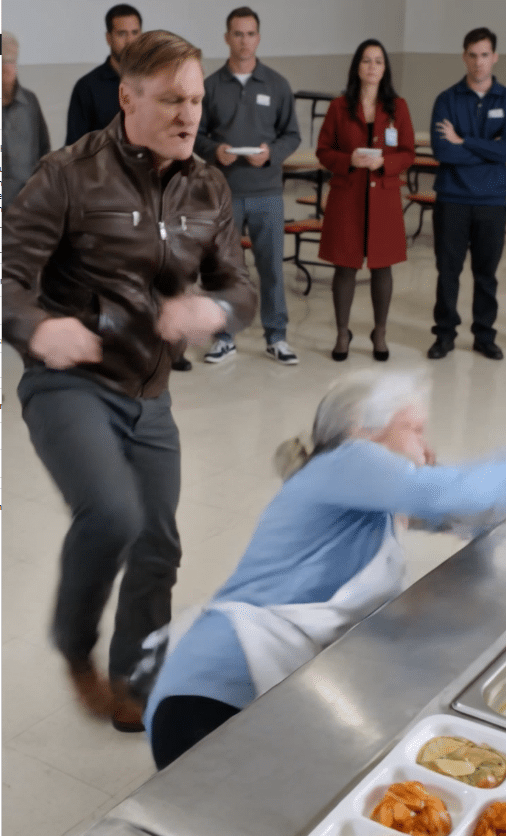
Then, without warning, he drove his foot into Eleanor’s chest.
The impact knocked her sideways into the edge of the counter. A sharp gasp escaped her as the metal struck her arm, and she crumpled toward the floor, one hand reaching instinctively for something to hold. Her forearm scraped against the counter’s edge, leaving a thin trace of blood.
For one terrible second, she couldn’t seem to draw a full breath.
She tried to brace herself with her palm, but pain shot through her side. Her eyes widened, and her mouth opened around another frightened gasp.
The man stepped around the counter area.
Before Eleanor could pull herself upright, he kicked her again, then once more into her side as she curled inward, trying to protect herself.
The cafeteria fell into a stunned silence.
A nurse covered her mouth. Someone dropped a fork. A doctor near the drinks station took one step forward, then stopped when the man turned sharply in his direction.
Eleanor lay on the floor, breathing hard, her face twisted with pain and disbelief.
She had spent years helping strangers through the worst days of their lives. She had carried extra meals to exhausted parents, found warm tea for patients waiting on difficult news, and quietly paid for food when she knew someone couldn’t afford it.
Now she was on the floor of the place where she worked, surrounded by people who had watched a man hurt her over a bowl of soup.
He stood over her, breathing heavily.
“Move before you waste another minute,” he said again.
Then the staff elevator beside the cafeteria opened with a sharp metallic chime.
And the man who stepped out was about to discover that the woman on the floor was the one person he should never have touched
Act II
The hospital director had not planned to visit the cafeteria that afternoon.
Dr. Michael Hayes was forty-nine years old, known throughout the hospital for his measured voice, demanding standards, and refusal to let his position become an excuse for arrogance. He wore a white doctor’s coat over a black suit, with his director’s badge clipped where no one could mistake his authority.
He had just finished a meeting about emergency department staffing when he heard the commotion from the elevator corridor.
At first, he assumed it was another disagreement over a delayed meal or an overcrowded waiting room. Hospitals were places where fear often disguised itself as anger. Michael had spent twenty years learning how to recognize that anger without allowing it to control the people around him.
But the sound that followed was different.
A heavy impact.
A woman’s gasp.
Then silence.
Michael moved faster.
The elevator doors opened beside the cafeteria, and he stepped into a room that seemed to have stopped breathing.
His eyes found the overturned serving bowl first. Then the scattered utensils, the frightened faces, and the elderly woman on the floor.
He recognized her before he saw her face clearly.
The pale blue sweater.
The silver hair.
The small gold ring she had worn for forty-six years.
His mother.
“Mom?”
The word left his mouth before he could stop it.
Eleanor tried to lift her head. When she saw him, the fear in her eyes changed into something even more painful: relief mixed with embarrassment.
“Michael,” she whispered.
She attempted to sit up, but a sharp breath caught in her throat. One hand pressed against her side.
Michael crossed the cafeteria in seconds.
The man in the brown jacket turned toward him, irritated by the interruption. He looked ready to complain about the service, the crowd, or the inconvenience of having to wait for his meal.
Then Michael stepped between him and Eleanor.
His face had gone frighteningly still.
“You… struck… my mother?”
Each word came slowly, controlled by an effort that seemed more dangerous than shouting.
The man blinked.
His gaze dropped to the white coat, then to the badge clipped over Michael’s chest. The hospital’s name appeared above the title he suddenly seemed unable to read.
HOSPITAL DIRECTOR.
The man’s lips parted.
“Director… your mother?”
Michael didn’t answer him.
He lowered himself beside Eleanor, careful not to move her more than necessary. His hand hovered near her shoulder, unsure where he could touch without causing pain.
“Don’t try to stand,” he told her softly. “Help is coming.”
“I spilled the wrong soup,” Eleanor murmured.
Michael looked at her.
Even now, hurt and struggling to breathe, she was trying to explain herself.
“He asked for chicken. I gave him vegetable by mistake. I was going to change it.”
Michael’s expression shifted, and for a moment the anger in his eyes gave way to something far more heartbreaking.
“Mom, you don’t have to explain that to me.”
Her eyes filled with tears, though she seemed determined not to let them fall.
“I didn’t want to cause trouble.”
Those five words struck him harder than anything the man had said.
His mother had spent her entire adult life teaching him that kindness was not weakness, that a person’s character was revealed by how they treated those who could do nothing for them, and that no title made anyone more deserving of respect than the person standing beside them.
Yet she was lying on the cafeteria floor, apologizing for the mistake that had supposedly justified her humiliation.
Michael rose just enough to address the room.
“Call emergency services within the hospital. Now. And secure the cafeteria entrance.”
This time, nobody hesitated.
A nurse rushed forward with a medical kit. Another employee called the hospital’s emergency response team. A doctor knelt near Eleanor, asking where she felt pain while Michael remained beside her.
The man in the brown jacket took a step backward.
“You need to understand,” he began. “My father is a patient here. We’ve been waiting for hours. Nobody has told us anything, and then she—”
Michael turned his head.
“Stop.”
The single word silenced him.
“My father is in critical condition,” the man insisted, his voice suddenly less certain. “I’ve been here all night. I haven’t eaten. Nobody cares what families are going through.”
Michael stared at him.
For the first time, he noticed the exhaustion beneath the man’s anger. The dark circles under his eyes. The tightness around his mouth. The hands that trembled slightly now that the violence had ended.
There was pain there. Fear, perhaps. Desperation.
But pain did not give him the right to hurt someone else.
“My staff will make sure your father receives appropriate care,” Michael said. “His condition has nothing to do with what you just did.”
The man looked toward the surrounding tables, searching for a sympathetic face.
No one met his eyes.
Then the medical team asked Michael to move so they could assess Eleanor properly.
As he stepped aside, something on the floor caught his attention.
A small silver locket had fallen from beneath her apron. Its chain had broken, and the locket lay open beside the spilled soup.
Inside was a faded photograph of a young boy standing next to a woman with silver-blond hair.
Michael knew that photograph.
He had carried the same image in his wallet for years.
But he had never seen his mother take it out at work.
And he had never told anyone why the woman in that photograph had kept it hidden for so long.
Act III
The locket had belonged to Michael’s father.
He had given it to Eleanor on their tenth wedding anniversary, when Michael was still a boy with scraped knees and a habit of falling asleep at the kitchen table. Inside the locket was a picture of the two people Eleanor loved most in the world: her husband, David, and their son.
David had died eleven years earlier.
For a long time, Eleanor could barely enter the hospital without remembering the final night of his life. He had been admitted after a sudden cardiac emergency, and Michael, then a young physician, had worked alongside the emergency team as they tried to save him.
They had done everything they could.
It had not been enough.
Afterward, Michael had thrown himself into his career with a determination that frightened his mother. He became an accomplished physician, then a department chief, and eventually the hospital’s director. He built his reputation on the belief that no family should feel abandoned inside the institution where they had come seeking help.
Eleanor, meanwhile, had found her own way to remain close to the place that had taken her husband and, in another sense, given her son his life’s purpose.
She worked in the cafeteria.
Michael had begged her to retire more than once. She could have lived comfortably on her savings and the support he offered, but she always refused.
“I spent years looking after people at home,” she would tell him. “Why should I stop now just because my hair turned gray?”
She didn’t work because she needed to prove anything. She worked because she believed a warm meal could make a frightening day feel a little less lonely.
And because, in the cafeteria, she was not the director’s mother.
She was Eleanor.
People trusted her with their stories because she didn’t carry the authority of a doctor’s office or the intimidating atmosphere of a consultation room. She listened to exhausted spouses, worried children, and patients who needed someone to ask whether they had eaten.
Michael knew all of this.
What he did not know was how often she had been forced to swallow insults.
The hospital’s cafeteria served hundreds of people every day. Most were grateful. Some were distracted or impatient. A few treated the workers as if the aprons they wore had somehow erased their right to dignity.
Eleanor rarely complained.
She had once told Michael that people sometimes became cruel when they were frightened, and that it was important not to confuse their worst moments with everything they were.
He admired her compassion.
He also worried that she used it to excuse too much.
Now, as the medical team examined her, Michael watched his mother’s fingers close around the broken locket.
“Please don’t make a scene,” she whispered when he leaned close.
He almost laughed at the absurdity of it, but the sound died before it reached his throat.
“You were attacked.”
“I know.”
“You were kicked on the floor.”
Her eyes shifted toward the watching staff.
“I don’t want everyone talking about me.”
Michael glanced around the cafeteria. Some employees looked ashamed. Others were visibly shaken. The man who had hurt her stood near the counter, his arms stiff at his sides, his confidence slowly collapsing.
“This isn’t about embarrassment,” Michael said quietly. “It’s about what happened to you.”
Eleanor swallowed.
“His father is sick, isn’t he?”
Michael paused.
“Yes.”
“Then he’s frightened.”
“Maybe.”
She searched her son’s face.
“Don’t let him frighten everyone else just because he’s frightened himself.”
For a moment, Michael couldn’t speak.
Even now, his mother was asking him to see the human being beneath the cruelty. She wasn’t asking him to excuse the assault. She was asking him not to become so consumed by anger that he forgot what justice was supposed to protect.
The medical team prepared to move her for further evaluation. Michael walked beside the stretcher, his hand resting lightly near hers.
At the elevator, Eleanor looked back toward the cafeteria.
The man was still standing there.
“Michael,” she whispered.
He leaned closer.
“Make sure the workers are safe.”
“I will.”
“Not just today.”
He looked at her, and something in her expression told him she had been carrying this concern for a long time.
The elevator doors closed.
For several seconds, Michael stared at his reflection in the polished metal. He could still hear the impact. He could still see the way his mother had curled inward on the floor, trying to protect herself.
But beneath the anger, another thought was beginning to form.
What if this wasn’t only about one violent man?
What if the hospital had grown so accustomed to protecting its reputation that people like his mother had learned to endure cruelty in silence?
And what if the first thing he needed to investigate was not the attacker—but the system that had taught everyone watching to step back?
Act IV
Eleanor’s injuries were painful but, after a thorough evaluation, did not reveal the catastrophic damage Michael had feared. She had significant bruising, tenderness along her side, and a painful injury to her arm. The medical team kept her under observation while they assessed her breathing and monitored her for complications.
Michael stayed until he knew she was stable.
Only then did he return to the cafeteria.
The man in the brown leather jacket was waiting beside a security officer. His anger had vanished, replaced by the frantic expression of someone who had suddenly realized that consequences were no longer an abstract possibility.
“My name is Ryan Mercer,” he said quickly. “My father is Thomas Mercer. He’s in the cardiac unit. He’s seventy-six, and he’s been waiting for a procedure. I haven’t slept in two days.”
Michael listened without interrupting.
“I lost control,” Ryan continued. “I know that. But I didn’t know she was your mother.”
The sentence landed between them.
Michael’s eyes hardened.
“You didn’t know she was my mother,” he repeated. “Would that have made it acceptable if she had been someone else’s mother?”
Ryan opened his mouth, then closed it again.
“I wasn’t thinking.”
“No. You weren’t.”
Michael motioned to the security officer.
“Preserve the cafeteria camera footage. Document the witnesses. Notify hospital security and the appropriate authorities. I want the incident handled according to policy, not according to my position.”
Ryan’s face tightened.
“Are you going to have me arrested?”
“I’m not going to use my office to determine that. The authorities will assess what happened.”
“But my father—”
“Your father will continue receiving medical care.”
Michael stepped closer, keeping his voice low enough that the conversation did not become another public spectacle.
“Your behavior will not affect his treatment. But neither will his condition erase what you did to my mother.”
For the first time, Ryan appeared to understand that Michael was not threatening him in a burst of personal rage. He was drawing a line that would not move.
Then Michael asked for the security footage to be reviewed by the hospital’s compliance team.
The video showed the entire confrontation.
It showed Eleanor immediately acknowledging the soup mistake and offering to replace the bowl. It showed Ryan moving into her personal space, insulting her, and attacking her with a force that sent her into the counter and down to the floor. It showed him delivering the follow-up kicks while the surrounding staff recoiled.
And it showed something else.
In the seconds after the assault, several employees had begun to move toward Eleanor. They stopped when Ryan turned toward them.
Their fear was visible.
Michael watched the footage twice.
He did not blame the frightened staff for being shocked. He knew that violence could make even trained professionals freeze. But he also knew the hospital needed a better response than hoping someone else would act.
The next morning, he met with the cafeteria manager, the security director, human resources, and the hospital’s patient-experience team.
He did not begin by announcing that the injured worker was his mother.
Instead, he asked a simple question.
“What would have happened if Eleanor Hayes had been a temporary worker whose name nobody in this building recognized?”
No one answered immediately.
Michael placed a copy of the incident report on the table.
“What would have happened if the person on that floor had been a cleaner, a dietary aide, a security guard, or a nurse working an overnight shift? Would we have treated the assault with the same urgency? Would we have preserved the footage? Would we have offered support—or would we have called it an unfortunate interaction and moved on?”
The cafeteria manager stared down at her hands.
“We have a reporting process,” she said.
“Then why did three employees tell the security officer they were afraid to intervene because they thought they would be blamed for escalating the situation?”
Silence filled the room.
The investigation uncovered a pattern of smaller problems. Employees had reported verbal abuse from patients’ relatives, but some incidents had been classified as routine service complaints. Staff members had been encouraged to remain polite, even when customers crossed clear boundaries. There was no consistent procedure for separating aggressive visitors from vulnerable workers, and training on responding to physical violence had been uneven.
No one had designed a policy that explicitly permitted abuse.
That was what made the failure so dangerous.
It had grown in the space between what the rules said and what people believed they were expected to tolerate.
Michael ordered an immediate review of every complaint involving threats or physical aggression. The hospital strengthened its procedures for reporting violence, clarified when security should be called, and arranged additional training for cafeteria workers and other nonclinical staff.
He also required managers to explain, in writing, how they would protect employees who reported abuse.
The changes would not erase what happened to Eleanor. They would not make the bruises disappear or restore the moment before Ryan’s foot struck her.
But they could prevent someone else from being left alone on a cafeteria floor while an entire room waited for permission to care.
As the investigation progressed, Ryan’s actions were referred to the appropriate authorities. Hospital security restricted his access to staff-only areas, and administrators reviewed the circumstances under which he could visit his father while maintaining safety for employees and other visitors.
His father’s care remained entirely separate from the investigation.
Michael made that distinction explicit to everyone involved.
A patient’s illness was not a bargaining chip. A relative’s violence was not a reason to compromise medical treatment. And no employee’s safety should depend on whether an aggressor had an influential family member—or whether the person being attacked happened to be related to the director.
Two days later, Michael visited Eleanor in her room.
She was sitting upright, wearing her own pale blue sweater, with a blanket over her legs. Her silver hair had been brushed neatly, and the broken locket rested on the bedside table.
He pulled a chair close to her bed.
“I made changes,” he told her.
She gave him a tired look.
“You always did like a committee.”
Despite himself, Michael smiled.
Then he explained the new reporting procedures, the security response, and the review of previous complaints.
Eleanor listened without interrupting.
When he finished, she reached for his hand.
“Good,” she said. “Now make sure they work when nobody important is watching.”
Michael lowered his eyes.
That was the hardest instruction she could have given him.
Because his mother was right.
It was easy to protect her now that the entire hospital knew who she was. The real test would come months later, when the memory of the assault faded, when the cafeteria returned to its usual noise, and when a worker with no powerful relative stood face-to-face with someone who believed the rules did not apply to him.
Michael promised he would remember.
But Eleanor wasn’t finished asking questions.
And the one she asked next would change the way he understood his own mother.
Act V
A week later, Eleanor returned to the cafeteria.
Michael had wanted her to take more time off. He had offered to arrange home care, hire someone to help with errands, and make sure she never had to lift another heavy tray.
She had rejected every suggestion.
“I’ve been working here for years,” she told him. “I’m not going to let one cruel man decide when I stop.”
So he accompanied her back on her first day, walking beside her through the staff entrance. He did not wear his director’s badge where everyone could see it. He wanted her to return to her job without feeling that every person who greeted her was doing so out of fear or obligation.
The cafeteria was quieter than usual when they entered.
Several employees approached Eleanor. One apologized for not coming to her aid sooner. Another admitted that she had been afraid the man would turn on her, too.
Eleanor listened to them both.
“I was frightened, too,” she said. “I’m not asking you to pretend you weren’t. I’m asking you to know what to do if it happens again.”
The words lifted some of the shame from their faces.
Then she tied on her white apron.
The soup counter had been cleaned, the serving bowls replaced, and the floor repaired where the equipment had been damaged. A small vase of yellow flowers stood beside the register, left by a group of nurses who had worked nearby during the attack.
Eleanor touched one of the petals.
“Those are lovely.”
Michael watched her for a moment.
He had spent his adult life believing he understood her. He knew how she took her coffee, how she folded the corners of newspaper pages, how she kept every birthday card he had ever sent. He knew that she could be stubborn, that she disliked asking for help, and that she cried more easily at old movies than at funerals.
But he had never fully understood the courage required to keep being kind in a world that sometimes mistook kindness for permission.
“Mom,” he said, “you don’t have to prove anything by coming back.”
She looked up from the flowers.
“I’m not proving anything.”
“Then why?”
Eleanor glanced toward the tables.
A young nurse was helping an elderly patient open a container of yogurt. A father stood in line with a little girl who was too tired to keep her eyes open. Near the window, a woman sat alone with a hospital bracelet around her wrist, staring at her untouched meal.
“Because people come through here on some of the worst days of their lives,” Eleanor said. “They may not remember what they ate. They may not remember who brought it to them. But sometimes they remember whether somebody treated them like they mattered.”
She adjusted the apron at her waist.
“And because the people who serve them matter, too.”
Michael had no answer.
He had built a career around improving patient care, measuring outcomes, expanding services, and ensuring that the hospital could respond when lives hung in the balance. He understood the importance of equipment, staffing, and protocols.
His mother had just reminded him of something no report could fully measure.
Dignity was part of care.
And it was not reserved for the person in the hospital bed.
Later that morning, a man approached the soup counter with a meal tray in his hands. He was middle-aged, exhausted, and still wearing the same brown leather jacket.
Ryan Mercer.
Michael, who had been standing near the entrance, immediately moved closer. Security had already been informed that Ryan might return to visit his father, and the hospital’s restrictions remained in place. Ryan stopped several feet from the counter, keeping his hands at his sides.
Eleanor looked at him.
For a long moment, neither spoke.
Ryan’s face seemed thinner than it had been during the confrontation. His anger had been replaced by a strained, uncomfortable seriousness.
“I came to apologize,” he said.
Eleanor did not rush to make it easier for him.
Ryan looked down at the tray.
“My father is still sick. I was terrified I was going to lose him. I kept thinking nobody was listening, and I decided that gave me the right to make someone else miserable.”
He swallowed.
“It didn’t.”
Michael remained silent.
Ryan lifted his eyes toward Eleanor.
“I don’t expect you to forgive me. I don’t expect you to tell the director everything is fine. I just wanted to say that what I did was wrong, and I’m sorry.”
Eleanor studied him.
She could still remember the impact against her chest. The shock of hitting the counter. The pain that had made breathing difficult. Most clearly, she remembered looking up from the floor and seeing people turn away.
Forgiveness was not a switch she could flip because a man had finally found the right words.
“I’m sorry your father is ill,” she said at last.
Ryan’s expression tightened, as if he had expected anger and did not know what to do with compassion.
“But you need to understand something,” Eleanor continued. “Being afraid does not make you the only person in the room who is hurting.”
He nodded, his eyes fixed on the counter.
“And an apology doesn’t erase what happened.”
“I know.”
“If you mean what you said, then don’t just be polite to me because you know whose mother I am. Be polite to the next person who can’t do anything for you. The next person who makes a mistake. The next person whose name you don’t know.”
Ryan’s eyes filled, but he did not ask her to comfort him.
“I will,” he said.
Eleanor gave a small nod.
That was all.
There was no embrace. No sudden friendship. No magical restoration of what had been broken.
Ryan stepped away from the counter, and Michael watched him leave without interfering. The consequences of the assault would continue through the proper process. His father’s treatment would continue according to medical need. Neither outcome depended on Eleanor offering forgiveness.
That distinction mattered.
For years, she had believed that being a good person meant finding a way to understand almost everyone. Now she understood that compassion could coexist with boundaries, and forgiveness did not require pretending the injury had never happened.
When the lunch rush began, the cafeteria filled with the familiar sounds of rolling carts, clattering trays, and hurried conversations.
Eleanor served soup.
She checked each bowl carefully, asked people whether they wanted crackers, and helped a nervous young woman find a table near the window. When a tired visitor apologized for spilling his drink, Eleanor handed him a cloth and told him not to worry.
Michael watched from the doorway.
For the first time since the attack, he allowed himself to breathe normally.
He had thought the most important moment of that terrible afternoon was the instant he stepped out of the elevator and saw the man who had hurt his mother. He had imagined that the director’s badge, the authority of his office, and the sight of his controlled anger had turned the situation around.
But standing there now, he realized that the real turning point had come earlier.
It was the moment Eleanor had looked at the man who kicked her and still remembered that his father was sick.
Not because the man deserved to escape accountability.
Not because her pain was unimportant.
But because cruelty had failed to take away the one thing that made her who she was.
Michael walked to the counter.
Eleanor looked up and raised an eyebrow.
“Are you here to supervise me?”
“No.”
“Good. Then get out of the way. You’re blocking the soup.”
He laughed, and she smiled.
For a brief moment, they were not a hospital director and his mother. They were simply a son and a woman who had spent her life teaching him how to be human.
Then a young employee approached Eleanor with a question about a meal order, and Michael stepped aside to let her work.
He had spent years trying to build a hospital where every patient could trust the people caring for them.
Now he understood that the promise had to extend further.
To the people who cleaned the floors. To the workers who carried the trays. To the elderly woman behind the soup counter who had apologized even while lying injured on the ground.
Because the measure of a hospital was not only how it treated the people who arrived in ambulances.
It was also how it treated the people who showed up every morning to help them.
And the man who had shouted at Eleanor because she served the wrong soup had learned a lesson he would carry long after his father’s hospital stay ended.
He had believed power belonged to the person who could frighten everyone else into silence.
But when the elevator doors opened, the director did not need to raise his voice, threaten anyone, or prove that his mother was important.
He only had to ask one question.
You struck my mother?
The answer had changed the room.
The truth behind it changed the hospital.
And Eleanor Hayes, the woman everyone had mistaken for powerless, returned to serving soup—not because she had forgotten what happened, but because she refused to let someone else’s cruelty decide what kind of person she would be.