Act I
“Trash. Move before you make me late.”
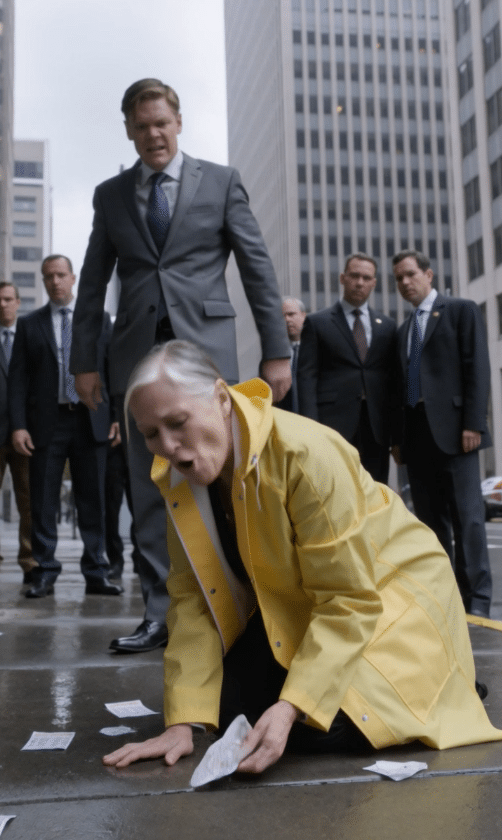
The man in the gray suit spat the words at the elderly woman crouching beneath the bus stop shelter, gathering lottery tickets from the rain-slick pavement.
She looked up at him, startled, her damp silver hair clinging to her forehead. A few tickets had slipped from her small stack when a passing commuter brushed against her, and she had bent down to collect them. It had taken no more than a few seconds.
“I dropped them. I am sorry.”
Her voice was soft, nearly swallowed by the patter of rain against the shelter roof.
The man glanced at his expensive watch. His black leather briefcase hung from one hand, and his polished shoes stood inches from the tickets she was trying to save. Behind him, the city’s administrative buildings rose in imposing rows of glass and stone, their windows reflecting a gray morning that seemed to have settled over everything.
“I don’t have time for this,” he snapped.
The woman tried to gather the last few tickets into her palm. Her old pale yellow raincoat was soaked at the shoulders, and the hem of her brown skirt had darkened with rainwater. Her worn shoes had begun to leak, leaving her feet cold inside them.
She was seventy-five years old. Her fingers were stiff from the weather, and bending down had become harder than she liked to admit.
But the lottery tickets mattered.
She sold them near the bus stop to supplement her modest income. Some days, she barely earned enough to cover groceries and transportation. Other days, she sold almost nothing. She had learned to measure time by small necessities: the price of bread, the next bus, the heating bill waiting on her kitchen table.
The man knew none of this.
He knew only that an elderly woman had interrupted his morning.
“People like you block the whole city,” he said.
Several commuters turned toward them. A young woman standing beneath the shelter lowered her phone. An older man holding a newspaper frowned, then glanced nervously at the suited stranger.
The elderly woman drew her hand close to her chest, clutching the tickets.
“I’m moving,” she promised. “Please, just give me a second.”
She began to rise.
The man stepped behind her.
Then he kicked her hard in the back.
The blow sent her sprawling face-first onto the wet pavement. Her palms struck the ground, but she couldn’t stop the rest of her body from hitting hard beside the shelter bench. A sharp cry escaped her as pain surged through her back and side.
One of her arms scraped against the pavement. When she pulled it toward herself, a thin trace of blood appeared along her forearm.
For a moment, she could do nothing but gasp.
Rainwater soaked through her coat. Her fingers trembled as she tried to push herself up, but pain forced her back down. She curled inward, shivering, her face twisted in shock and disbelief.
The man stepped closer.
He kicked her again, then a third time, striking her back and side as she struggled to protect herself.
A woman under the shelter gasped and covered her mouth. Someone whispered, “Oh my God.”
Yet nobody moved.
The man stood over the elderly woman as though she had dropped a piece of litter rather than fallen beneath his feet.
“People like you block the whole city,” he repeated.
The woman looked up at him through rainwater and tears. Her lips moved, but the words barely came.
She wasn’t asking for money.
She wasn’t demanding an apology.
She was simply trying to understand why a few dropped lottery tickets had turned into this.
Then a black official car braked hard beside the curb.
Its tires hissed against the wet road. The rear door flew open, and a woman in a long dark coat stepped into the rain.
She moved toward the shelter with such purpose that the commuters instinctively stepped aside.
The suited man turned, annoyed by the interruption.
Then he saw the official lapel pin on the approaching woman’s black suit.
And the color began to drain from his face.
Because the woman rushing toward the injured stranger was not just another government employee.
She was the United States Secretary of a powerful federal department.
And the woman lying on the pavement was her mother.
Act II
The secretary’s name was Catherine Whitmore.
At forty-seven, she had become one of the most respected figures in Washington’s administrative circles. She was known for her sharp questions, disciplined public appearances, and refusal to let powerful people hide behind polished language.
She had spent years navigating rooms where every smile concealed a calculation and every promise came with conditions.
But nothing in her career had prepared her for the sight of her mother lying in the rain.
“Mom!”
Catherine dropped to her knees beside the elderly woman.
Her mother’s eyes opened slowly. When she recognized her daughter, her expression changed—not into relief alone, but into a mixture of pain and embarrassment that made Catherine’s chest tighten.
“Catherine,” she whispered.
Catherine slipped off her dark coat and folded it beneath her mother’s shoulders as carefully as she could. Her hands trembled, but her voice remained controlled.
“Don’t try to get up. Help is coming.”
“I’m all right,” her mother murmured automatically.
“No, you’re not.”
The words came out sharper than Catherine intended. She immediately softened her tone, brushing wet hair away from her mother’s face.
“Just stay with me, okay? Look at me.”
The woman nodded faintly.
Catherine looked up at the man in the gray suit.
“Move… away… from… my mother.”
Each word was measured. There was no theatrical shouting, no grand speech, no need to announce who she was. Her anger was so tightly contained that it made the air around her feel colder than the rain.
The man opened his mouth.
Nothing came out.
Catherine turned back toward her mother and called for emergency medical assistance. Her security detail, following in a second vehicle, hurried toward the shelter. One agent immediately began directing people away from the immediate area while another contacted emergency services.
Only then did Catherine look at the man again.
He had taken two steps backward.
“Madam Secretary…?”
The title escaped him like a question he desperately hoped someone would deny.
Catherine did not answer.
She was looking at the tickets scattered across the pavement.
Some had stuck to the wet concrete. Others had been crushed beneath shoes. A few had blown toward the curb, their bright printed numbers fading beneath the rain.
Her mother had been collecting them because they were worth something to her.
The realization filled Catherine with a fresh wave of anger.
For years, she had watched her mother live quietly, refusing every offer to move into a larger house or accept financial help that would make her life easier. Catherine had sent money, arranged repairs, and begged her to stop working outside in bad weather.
Her mother had always refused.
“I know how to take care of myself,” she would say.
And she had.
After Catherine’s father died, Eleanor Whitmore had raised her daughter on a school secretary’s salary, working extra shifts when necessary and going without things she wanted so Catherine could have opportunities she had never imagined for herself.
She had packed lunches, repaired old coats, and spent evenings helping her daughter study at the kitchen table. When Catherine won a scholarship, Eleanor had cried in the parking lot before driving home in silence, afraid that if she spoke, her daughter would hear how proud she was.
She never taught Catherine to chase power for its own sake.
She taught her that power was useful only when it protected someone who had none.
Yet as Catherine looked at her mother’s trembling hands, she understood how easily that lesson could be forgotten inside the buildings where she worked.
Her mother did not look like a powerful person’s family.
She looked like an elderly woman who had been caught in the rain, whose coat was too old, whose shoes were worn, and whose time apparently mattered less than a stranger’s appointment.
The suited man cleared his throat.
“Madam Secretary, I think there’s been a misunderstanding.”
Catherine slowly raised her eyes.
“A misunderstanding?”
“She was blocking the walkway. I told her to move, and she—”
“She dropped some tickets,” Catherine interrupted. “She apologized. What happened after that?”
The man glanced toward the commuters.
No one spoke.
“I was under a lot of pressure,” he said. “I have a meeting in the government district. I’ve been dealing with urgent matters all morning.”
Catherine stared at him as if he had just spoken a language she no longer recognized.
“So you kicked a seventy-five-year-old woman because she delayed you?”
His jaw tightened.
“I didn’t know who she was.”
The sentence landed harder than any excuse could have.
Catherine’s expression changed.
For a moment, the rain was the only sound between them.
Then she leaned slightly forward, still kneeling beside her mother.
“You didn’t need to know who she was.”
The man looked away.
Catherine turned back toward Eleanor as emergency responders arrived. They examined her injuries, asked her questions, and prepared to transport her for further medical evaluation. Eleanor winced as they helped her onto a stretcher, trying unsuccessfully to hide how much pain she was in.
As they lifted her, she reached for Catherine’s hand.
“Don’t make this worse than it has to be,” she whispered.
Catherine bent close.
“He hurt you.”
“I know.”
“Mom, he kicked you while you were on the ground.”
Eleanor’s eyes filled with tears.
“I know, sweetheart.”
Catherine had faced hostile hearings, political pressure, and public attacks designed to make her lose her temper. She had learned to remain composed when people tried to provoke her.
But hearing her mother speak in that small, exhausted voice nearly broke her.
“Please,” Eleanor whispered. “Don’t let him turn you into someone you’re not.”
Catherine held her hand tighter.
She would not let her mother’s compassion become an excuse for injustice.
But she would honor the woman who had taught her that justice and revenge were not the same thing.
As the ambulance doors closed, Catherine stood beneath the dripping shelter and watched it pull away.
Then she turned toward the man in the gray suit.
“What’s your name?”
He hesitated.
“Richard Hale.”
“And where do you work, Mr. Hale?”
He swallowed.
“Office of Federal Administrative Services.”
Catherine recognized the name.
It was an office within the very government district she had come to visit that morning.
And when she heard his job title, she realized the assault might have exposed something far more troubling than one man’s cruelty.
Act III
Richard Hale was not a senior official.
He was a midlevel administrative manager, the sort of man whose name rarely appeared in public but whose signature could determine whether a request moved forward or disappeared into a pile of paperwork.
He supervised a small team responsible for processing applications, coordinating internal reviews, and preparing files for senior decision-makers. His job required patience, accuracy, and an ability to treat people fairly even when the workload became overwhelming.
According to the office’s official description, those qualities were essential.
According to several employees who had worked under him, they were the qualities Richard least often displayed.
Catherine learned this over the following days—not because she ordered anyone to investigate Richard personally, but because the incident was formally reported and a pattern of workplace complaints began to surface.
The distinction mattered.
She refused to use her position to dictate an employment decision. Instead, she asked the appropriate ethics and personnel offices to preserve relevant evidence, review the incident, and follow the established procedures without favoritism.
She wanted the truth documented properly.
Not exaggerated.
Not buried.
The bus stop had several security cameras, including one mounted on the administrative building across the street. The footage captured the confrontation from beginning to end.
It showed Eleanor bending to collect her tickets. It showed her apologizing. It showed Richard moving behind her and kicking her hard enough to send her face-first onto the wet pavement.
It showed the follow-up blows.
And it showed the commuters stepping away.
The footage became a central piece of evidence in the authorities’ investigation.
But the more disturbing revelations came from the people who worked with Richard.
One employee described how he routinely mocked members of the public who arrived with incomplete paperwork. Another recalled him referring to elderly applicants as “dead weight” when they needed additional help. A third had witnessed him shouting at a maintenance worker who asked him to move a briefcase blocking a corridor.
No one claimed those incidents were identical to the assault at the bus stop.
But together, they revealed a man who had come to regard inconvenience as an insult and authority as a license to punish anyone who challenged his schedule.
Richard had learned to behave differently around people he considered important.
He remembered the names of senior officials. He held doors for executives. He smiled at people whose decisions could influence his career.
With everyone else, the mask slipped.
His colleagues had noticed it for years. Some had tried to challenge him privately, only to be told they were too sensitive. Others had decided that avoiding conflict was safer than confronting him.
The result was a quiet culture in which people learned to look away.
Catherine knew that culture well.
She had seen it in offices where a junior employee was humiliated in a meeting while everyone else stared at their notes. She had seen it in public agencies where people with little influence were made to wait while those with connections were ushered through the door.
She had also seen how quickly institutions could turn a single incident into a public relations problem rather than a question of accountability.
This time, she refused to let the story become merely a spectacle about a secretary’s injured mother.
At a meeting with senior staff, she made her position clear.
“My mother’s relationship to me must not determine how this incident is investigated,” she said. “The evidence must be handled according to the same rules that would apply if nobody in this room had ever heard my name.”
One adviser suggested that the office release a brief statement and leave the matter to local authorities.
Catherine agreed that the criminal investigation belonged to the proper authorities.
But she rejected the idea that the government workplace could ignore what the incident revealed about its own responsibilities.
“If a person can treat an elderly woman this way in public and then return to an office where people are afraid to challenge him,” she said, “we need to ask what kind of behavior we’ve allowed to become normal.”
The personnel review proceeded independently.
Richard was placed on administrative leave while the relevant offices examined the evidence and considered the appropriate steps under workplace policy. The authorities continued their own investigation into the assault.
He was not dismissed by a personal order from Catherine. He was not granted special treatment because she knew the people who ran the government district.
For the first time in years, his actions were being examined without his ability to intimidate a colleague or rush someone out of a conversation.
And the more the evidence accumulated, the more difficult it became for him to portray himself as the victim of a misunderstanding.
Yet Catherine’s greatest concern was still Eleanor.
Her mother had suffered bruising and painful injuries to her back and side. Doctors continued monitoring her condition, and she needed time to recover. The physical pain was only part of the damage.
At night, Eleanor sometimes woke suddenly, convinced she could hear shoes striking the pavement behind her. She had begun to hesitate before stepping onto the sidewalk, watching strangers’ movements more carefully than she ever had before.
Catherine sat beside her bed during one of those difficult evenings.
“I should have made you stop working,” she said.
Eleanor turned her head.
“Would that have stopped him from hurting somebody else?”
Catherine fell silent.
Her mother adjusted the blanket over her knees.
“You keep thinking this happened because I was there,” Eleanor said. “But he could have done it to someone else. A cleaner. A delivery driver. Someone who couldn’t afford to miss a day’s wages.”
Catherine looked down at her hands.
“I know.”
“Then don’t make this only about me.”
Those words settled over the room.
Catherine had spent days thinking about the man who had kicked her mother. She had thought about the footage, the investigation, and the expression on Richard’s face when he recognized her official car.
But Eleanor was asking her to look beyond the man.
To look at the people who had witnessed the assault and frozen.
To look at the workplace where intimidation had become an accepted inconvenience.
To look at the thousands of people who passed through government buildings every year, hoping someone would listen to them without first deciding whether they were important enough.
The following morning, Catherine asked for a briefing on how public-facing staff were trained to respond when they witnessed violence or harassment. She also requested a review of reporting procedures and support available to employees who feared retaliation for speaking up.
She did not announce sweeping reforms before the review was complete.
She did not promise that one meeting would fix years of bad habits.
She simply insisted that the questions be asked and answered.
Meanwhile, Richard made a decision that would turn the case in an unexpected direction.
He contacted an attorney and submitted a statement claiming that Eleanor had deliberately obstructed him, provoked him, and caused him to lose control.
But the camera footage contradicted his account.
And there was one witness he had never expected to hear from.
A young government employee who had been standing beneath the shelter had recognized Richard from her office.
She had seen him lose his temper before.
This time, she had recorded part of the confrontation on her phone.
And she was finally ready to speak.
Act IV
The witness was named Emily Carter.
She was twenty-six years old, a junior analyst in the same administrative office where Richard worked. For nearly a year, she had watched him belittle colleagues, snap at support staff, and treat ordinary requests as personal challenges to his authority.
She had never considered herself brave.
When Richard shouted at people, she usually lowered her eyes and waited for the moment to pass. She had a student loan, a modest apartment, and a job she could not afford to lose. She had seen what happened to employees who openly disagreed with managers who knew how to make life difficult.
On the morning of the assault, she had been waiting for a bus to take her to an appointment across town.
She recognized Richard almost immediately.
At first, she thought the argument was going to be another unpleasant exchange. She had heard him speak that way to people before.
Then he kicked Eleanor.
Emily’s hands began to shake so badly that she nearly dropped her phone.
She had recorded only a portion of the assault, but her video captured Richard standing over Eleanor and shouting that people like her blocked the whole city.
For days, Emily had debated whether to come forward.
She worried that the recording might be dismissed as incomplete. She worried that Richard would discover her identity. Most of all, she worried that people would ask why she had not intervened physically.
She could still remember Eleanor lying on the pavement.
She could still hear the sound of the impact.
And she could still see herself standing beneath the shelter, frozen in place.
Eventually, Emily gave the recording to the authorities and agreed to provide a statement.
The additional footage supported the account already captured by the security cameras. It also established that Richard’s insults continued after Eleanor had fallen and was visibly struggling to move.
His claim that the encounter had been a brief, accidental altercation became even harder to sustain.
When Richard learned that Emily had come forward, he tried to contact her through a colleague.
The message was brief: he wanted to “clear up a misunderstanding” before it damaged both their careers.
Emily did not answer.
She forwarded the message through the appropriate reporting channel and asked that all further communication be documented.
For the first time, someone who had spent months fearing Richard was no longer willing to handle his behavior privately.
The investigation continued, and the workplace review expanded to examine earlier complaints about intimidation. Some employees were interviewed. Others submitted written accounts. The office reviewed its supervisory practices and how concerns had been handled.
The process did not turn every allegation into a proven fact, and Catherine made sure the distinction remained clear.
But the assault itself was no longer a matter of competing stories.
The evidence showed what had happened.
As the case moved forward, Richard’s public confidence disappeared. He stopped walking through the administrative district with the same careless stride. He no longer snapped his briefcase shut when someone interrupted him or checked his watch in the middle of a conversation as if everyone else were wasting his time.
The man who had once treated a few seconds of delay as an unforgivable offense now had to wait for procedures he could not control.
But Catherine refused to celebrate his discomfort.
She understood that the point was not to make him feel as powerless as Eleanor had felt. It was to ensure that the consequences followed the evidence and that his victim did not have to carry the burden of correcting the system alone.
Several weeks after the assault, Catherine visited her mother at home.
The raincoat had been cleaned and hung beside the door. Eleanor’s shoes sat beneath a small table, still scuffed from years of walking the same streets. On the kitchen counter lay a fresh stack of lottery tickets.
Catherine stopped when she saw them.
“You’re planning to go back?”
Eleanor looked up from her tea.
“Eventually.”
“Mom.”
“I said eventually.”
Catherine sat down across from her.
“You could stop. You don’t need the money.”
Eleanor’s expression softened.
“I know.”
“Then why keep doing it?”
For a moment, Eleanor watched the rain move down the window.
“Because I like knowing the people who pass through my neighborhood,” she said. “Because Mrs. Dawson from the bakery buys a ticket every Friday, even though she says the lottery is a foolish habit. Because the bus driver waits an extra moment when he sees me coming.”
She smiled faintly.
“Because this is my life, Catherine. Not a mistake you need to fix.”
Catherine felt her eyes sting.
She had wanted to protect her mother so badly that she had nearly turned protection into another kind of control. She had thought the answer was to remove Eleanor from the streets, from the rain, from the possibility of encountering another cruel stranger.
But Eleanor was not asking to live without risk.
She was asking to live without being treated as though she mattered less than everyone else.
Catherine reached across the table and took her hand.
“I can’t promise nobody will ever hurt you again,” she said.
“No,” Eleanor replied. “You can’t.”
“But I can promise that what happened won’t be ignored.”
Eleanor squeezed her fingers.
“That’s all I wanted.”
Then she looked toward the stack of tickets and added, with the stubbornness Catherine remembered from childhood, “Although I would appreciate it if you stopped treating my raincoat like a national emergency.”
Catherine laughed.
For the first time in weeks, the sound came easily.
But the most important confrontation was still waiting.
Because when the official proceedings reached their next stage, Richard would have to face more than the video of the assault.
He would have to face the woman he had decided was beneath him—and the truth he had revealed about himself.
Act V
The day Eleanor returned to the bus stop, the rain had finally stopped.
The sidewalk was still dark with moisture, and water dripped from the shelter roof in slow, uneven taps. City workers moved along the opposite pavement, while office employees hurried between buildings with coffee cups and briefcases.
Eleanor wore her pale yellow raincoat.
Catherine had suggested a warmer one. Eleanor had insisted the old one was perfectly good, although she had agreed to replace the shoes that had become uncomfortable after the assault.
She stood near the bench with a small stack of lottery tickets in her hand.
For a moment, she simply watched the street.
A bus approached the intersection. Someone hurried past, apologizing when their shoulder brushed hers. An office worker stopped to tie a loose shoelace. The city continued doing what cities always did: moving too quickly for anyone to notice how much each person carried.
Eleanor drew a breath.
Then she began arranging her tickets.
Catherine watched from several steps away. She had come with her mother, but she had promised not to hover. Her security detail remained nearby without crowding the shelter.
Eleanor noticed her watching.
“Go on,” she said. “I won’t disappear.”
“I know.”
“Then stop looking at me like I’m made of glass.”
Catherine smiled and stepped back.
A few minutes later, a woman approached the shelter and bought a ticket. She was a nurse finishing an overnight shift, her eyes tired and her hair tucked beneath a knit cap.
“Good morning, Eleanor,” she said.
Eleanor blinked in surprise.
“You remember me?”
“Of course. You always ask whether I’ve had breakfast.”
“And have you?”
The nurse laughed softly.
“Not yet.”
“Then you should fix that.”
The exchange was ordinary.
That was what made it beautiful.
Nobody asked Eleanor who her daughter was. Nobody treated her as a symbol or a headline. For a moment, she was simply a familiar woman at a bus stop, selling lottery tickets to people who knew her name.
Catherine watched her mother straighten the stack, and she finally understood why Eleanor had refused to stop working.
Her mother was not trying to prove she was strong.
She was trying to keep hold of the small, ordinary life that had belonged to her long before a powerful title became attached to her family.
Across the district, Richard Hale’s case continued through the appropriate legal and administrative channels. The available video evidence and witness statements remained central to the investigation, while the workplace review proceeded separately.
There was no secret order from the secretary’s office that erased due process. No private arrangement made to guarantee a particular outcome.
Catherine had insisted on that from the beginning.
The facts would determine the consequences.
The office also began implementing changes to strengthen its reporting procedures, clarify expectations for managers, and make it easier for employees to raise concerns without fear of retaliation. Staff members received updated guidance on documenting misconduct and directing threats or violence to the proper authorities.
The reforms were not a dramatic overnight transformation.
They were a series of practical steps, reviewed and adjusted as the office learned where its protections had failed.
Emily Carter remained at her job. Her statement was considered through the established process, and her supervisors were instructed not to retaliate against her for participating in the investigation.
Other employees who had once stayed silent began raising concerns through formal channels.
Some reports involved serious misconduct. Others revealed smaller failures that had been allowed to persist because nobody believed they were worth challenging.
The culture did not change in a day.
But it had begun to change.
And Eleanor’s assault was no longer being treated as an isolated inconvenience that everyone could forget once the pavement dried.
One afternoon, Catherine returned to the bus stop alone.
Her mother was at home, resting after a tiring morning. Catherine stood beneath the shelter where the attack had happened and looked down at the pavement.
There was nothing remarkable about it now.
No overturned tickets. No blood. No crowd frozen in shock. Only a damp sidewalk, a bench, and the ordinary movement of people trying to get somewhere on time.
She tried to imagine the scene from the perspective of someone who had never known Eleanor.
A small elderly woman in an old coat.
A few dropped tickets.
A man in a gray suit who believed his schedule mattered more than her dignity.
It would have been easy for the story to end there. Another cruel moment in a busy city. Another stranger hurt while other strangers looked away. Another incident people discussed briefly before returning to their own lives.
The only reason the world had paid attention was that the injured woman happened to be the mother of a senior government official.
That fact still troubled Catherine.
Her mother’s identity had exposed the cruelty. It had forced people to look at what they might otherwise have ignored. But Eleanor had not become worthy of protection when the black official car arrived.
She had been worthy of protection all along.
Catherine remembered the words Richard had spoken after seeing her.
“Madam Secretary…?”
He had said them as if her title had transformed the situation. As if the woman on the ground had suddenly become important because someone powerful had claimed her.
But the truth was the opposite.
Catherine’s title had not given Eleanor her dignity.
It had only revealed how easily others had failed to recognize it.
That evening, Catherine visited her mother with groceries and found her sitting at the kitchen table, sorting the remaining lottery tickets.
“You’re thinking too much again,” Eleanor said without looking up.
“Is it that obvious?”
“You’ve had that face since you were twelve.”
Catherine sat beside her.
“Do you ever wish you had done things differently? Stopped working outside. Accepted more help. Moved somewhere safer?”
Eleanor considered the question.
“Sometimes,” she admitted. “Especially when it’s cold.”
Catherine laughed quietly.
“But I don’t want fear to make every decision for me,” Eleanor continued. “What happened was terrible. I’m not pretending otherwise. I just don’t want that man to own every place I go afterward.”
She set the tickets into a neat pile.
“He took enough from that morning.”
Catherine looked at her mother for a long time.
There was no grand speech to make the pain disappear. No perfect sentence that could return the world to the way it had been before the assault.
There was only Eleanor, still stubborn, still compassionate, still determined to live a life that belonged to her.
Catherine leaned over and kissed her mother’s silver hair.
“I love you.”
“I know, sweetheart.”
“And I’m sorry I wasn’t there.”
Eleanor covered her daughter’s hand with her own.
“You came when you could.”
Outside, the last of the rain clouds moved away from the city. Streetlights flickered on, reflecting across the wet pavement.
The next morning, people would hurry past the bus stop again. Some would be polite. Some would be impatient. Most would never know what had happened there.
But a few things would be different.
A witness who had once been afraid to speak had learned that her voice mattered. An office had been forced to examine behavior it had tolerated for too long. A government official had been reminded that authority meant little if it protected only those close enough to touch it.
And a seventy-five-year-old woman had returned to the street where someone tried to convince her she was nothing.
She came back in the same pale yellow raincoat.
She carried the same small stack of lottery tickets.
She stood beneath the same shelter, waiting for the same ordinary people to pass.
The man in the gray suit had believed she was an obstacle because she had delayed him by a few seconds.
He had believed the city belonged to people like him—people with polished shoes, important meetings, and the confidence to make others move when they demanded it.
But the city did not belong to him.
It belonged to the nurse buying a ticket after a night shift. The driver waiting for a passenger who walked slowly. The clerk who had finally spoken up. The elderly woman bending down to collect what the rain had scattered.
And when Catherine Whitmore stepped from her black official car and stood between her injured mother and the man who had hurt her, she did not make Eleanor important.
She made it impossible for everyone else to pretend they had not seen her.
That was the real reversal.
Not that the bully had discovered his victim was connected to power.
But that, for one unforgettable moment, power had been forced to answer to the dignity of someone he had considered powerless.