Act I
“Trash. Do not touch million-dollar art.”
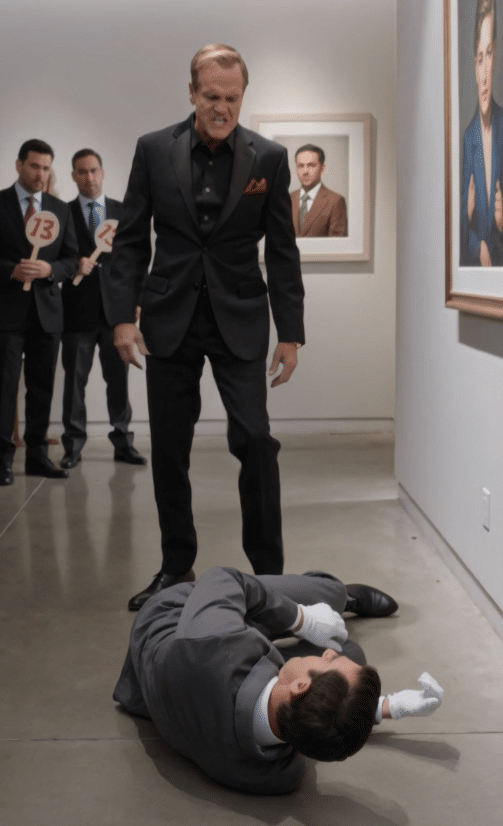
The collector’s voice cut through the auction room just as a dozen wealthy guests turned toward the illuminated painting on the wall. Beneath the warm spotlights, the artwork glowed in its gilded frame, surrounded by collectors in tailored suits, polished bidding paddles, and the quiet confidence of people accustomed to buying almost anything they wanted.
A man in a gray jacket stood beside the display, wearing white conservation gloves.
He was forty years old, with short brown hair and focused eyes. He had been examining the painting’s frame, carefully checking the lower corner where a tiny gap had appeared between the frame and its mounting bracket.
He wasn’t admiring the artwork.
He was making sure it wouldn’t fall.
“The frame is not secure,” he said.
The man blocking his path gave a contemptuous laugh.
His name was Richard Vance, a fifty-year-old investor and collector whose private collection included paintings, sculptures, and historical objects acquired at prices that made newspaper headlines. He wore a black suit with a red pocket square, and a gold watch flashed beneath his cuff whenever he moved his hand.
Richard had spent years cultivating the image of a man who knew the difference between priceless and merely expensive.
Yet he had never learned the difference between expertise and status.
He looked at the restorer’s gloves, his plain clothes, and the small tool case near the wall.
“Do you have any idea what that painting is worth?”
The restorer kept his eyes on the frame.
“That’s why I’m checking it.”
Richard stepped closer.
“I’m a registered bidder here. I’ve purchased work from this auction house for fifteen years. I don’t need some maintenance man putting his hands on a million-dollar painting.”
“I’m not touching the canvas,” the restorer replied. “I’m checking the mounting hardware.”
Richard’s face darkened.
He had heard the explanation, but he had already decided what kind of person was standing in front of him. In his mind, anyone wearing a simple jacket and white gloves near a valuable painting had to be a low-level employee who had wandered too close to something important.
He didn’t consider that the gloves might belong to a specialist.
He didn’t ask why the restorer had been assigned to the artwork.
He simply assumed that the man was beneath him.
“Move away from it.”
The restorer glanced at the frame again.
“I need to secure it before the bidding starts.”
That was enough.
Richard stepped in front of him and drove one hard kick into his chest.
The restorer fell beside the display wall, twisting at the last moment to avoid striking the painting. His elbow hit the floor, leaving a thin trace of blood along his skin. The gold frame trembled slightly on its mounting, but the artwork remained in place.
A collective gasp rippled through the room.
Then Richard stepped closer and delivered exactly two more forceful kicks, one into the man’s back and another into his rib side.
A woman in a cream-colored suit covered her mouth. An older collector froze with his bidding paddle still raised. Two auction staff members stood motionless near the front row, staring at the scene as if their minds had not yet caught up with what their eyes had witnessed.
The restorer curled slightly around his injured side, keeping his hands away from the painting.
Even on the floor, he was trying to protect the artwork.
Richard looked down at him.
“Touch it again and I will bury your career.”
The words carried across the room with humiliating clarity.
The restorer didn’t answer. He was breathing carefully, one gloved hand pressed against the floor as he tried to orient himself.
Richard straightened his jacket and glanced at the crowd, apparently expecting the incident to reinforce his authority.
Instead, the room had gone unnaturally quiet.
Then the door to the appraisal room opened.
A woman with silver hair arranged in a neat bun stepped into the auction room. She wore a black suit, pearl earrings, and low heels, and she moved with the composed authority of someone who had spent decades making decisions under pressure.
Her name was Eleanor Whitaker.
At fifty-eight, Eleanor owned the auction house.
She had been reviewing the final condition reports when the disturbance reached the appraisal room. Now she stepped into the main gallery and saw the loose frame, the injured restorer, and Richard standing above him.
Her expression changed instantly.
She hurried toward the painting, placing herself between the artwork and Richard before looking down at the man on the floor.
“Daniel?”
The name came out with alarm.
Then Eleanor turned toward Richard.
“Without him, that painting is worthless.”
Richard stared at her.
For a moment, he seemed to believe he had misheard.
He looked at the painting, then at the man in the gray jacket, whose white gloves were now marked by the thin trace of blood on his elbow.
“Worthless?”
Eleanor’s gaze never left him.
And in that single word, Richard began to understand that the person he had just attacked was not merely an employee standing too close to a valuable object.
He was the reason the painting had become valuable in the first place.
Act II
Daniel Mercer had spent most of his adult life working with damaged things.
He was not wealthy, and he had never been interested in appearing important. He drove an aging sedan, wore practical clothes, and carried a battered notebook in which he recorded every detail of the paintings entrusted to him.
But in the world of art conservation, Daniel’s name commanded a level of respect that money alone could not buy.
He had trained at a respected conservation program, apprenticed under specialists in Europe, and spent years learning how to distinguish genuine age from deliberate distress, original pigment from later retouching, and authentic construction from clever imitation.
His work demanded patience rather than spectacle.
A restorer could spend weeks examining a painting without touching its surface. He might use magnification, specialized lighting, imaging techniques, and microscopic analysis to understand what had happened to an artwork over centuries.
The goal was not to make old things look new.
It was to preserve what was real.
Daniel had learned that principle from his grandmother, Margaret Mercer, who raised him after his parents died in a car accident when he was twelve. Margaret had been a school art teacher with a small collection of prints and a habit of saving damaged picture frames from yard sales.
She couldn’t afford original masterpieces.
But she treated every object with care.
When Daniel was a boy, he once asked why she spent so much time repairing a cracked wooden frame that had cost almost nothing.
“Because something doesn’t have to be expensive to deserve attention,” she told him.
He remembered those words long after she was gone.
At university, Daniel discovered that conservation combined the things he loved most: art, history, chemistry, and the detective work of finding truth beneath appearances.
He learned that a painting could carry several histories at once. There was the story its owner told, the story recorded in the catalog, and the story hidden in the materials themselves.
Sometimes those histories agreed.
Sometimes they did not.
And occasionally, the difference between them could change the value of an artwork by millions of dollars.
That was how Daniel had become involved with Eleanor Whitaker’s auction house.
Eleanor had inherited the business from her father, who had built it from a modest gallery into a respected international auction firm. She had preserved its reputation by refusing to let sales pressure override professional judgment.
Several years earlier, she had hired Daniel to investigate a collection of paintings whose provenance records were incomplete. His findings had prevented the auction house from selling two misattributed works and had helped return a stolen painting to its rightful owner.
Eleanor had expected competence.
She had not expected Daniel to become the person she trusted most when a work’s history was uncertain.
He never promised a result before the evidence supported it. He never inflated an appraisal to please a client. And when he discovered a problem, he documented it even if the truth threatened a profitable sale.
That integrity had once cost him a lucrative contract.
A wealthy collector had demanded that Daniel certify a painting as an original by a celebrated nineteenth-century artist. The evidence suggested that it was a later copy, possibly produced by someone in the collector’s own network.
Daniel refused to sign the certificate.
The collector threatened to destroy his reputation.
Daniel stood by his report.
The contract disappeared, but his professional standing grew stronger among the people who understood the work.
Eleanor remembered the incident.
“Most people think honesty is easy when it costs nothing,” she told him later. “It’s more useful to know what someone does when honesty becomes expensive.”
Daniel had never forgotten that, either.
The painting in the auction room was called The Blue Orchard.
It was a landscape believed to have been created in the late nineteenth century by a painter whose surviving works were rare. The scene showed a small orchard beneath a deep blue sky, with a narrow path disappearing behind a line of trees.
At first glance, it seemed modest compared with the enormous portraits and dramatic historical scenes displayed elsewhere in the gallery.
But its history was unusual.
The painting had disappeared from public records decades earlier, resurfacing only after the death of a private collector. The catalog description was cautious, noting that questions remained about its authorship and the alterations it had undergone over the years.
If the attribution was confirmed, the work could be worth several million dollars.
If it was not, its value would be dramatically lower.
Daniel had spent months examining the painting, studying old photographs, comparing pigments, and tracing ownership records. He had discovered evidence that a previous restorer had covered part of the original signature during an overzealous cleaning decades earlier.
Beneath the later retouching, the original mark appeared to be intact.
The discovery was important, but it was not enough on its own. Daniel had also identified an unusual feature in the wooden frame: an old mounting arrangement that matched photographs of the painting taken before it vanished from public view.
The frame had been altered, but not replaced.
That detail helped connect the artwork to a historical inventory from a private European collection.
Eleanor had delayed the auction until Daniel completed his final condition report.
Richard Vance, meanwhile, had been pursuing the painting for months.
He wanted The Blue Orchard because he believed it would become the centerpiece of his collection. He also wanted the prestige of acquiring a work whose attribution had recently attracted serious attention.
He had studied the catalog, attended previews, and spoken with other collectors about its potential value.
But he had never taken the time to understand the conservation process behind the revised assessment.
To Richard, the painting was a financial opportunity.
To Daniel, it was a fragile piece of history whose story had been obscured by time, careless repairs, and incomplete records.
And on the morning of the auction, Daniel had discovered one final problem.
The lower mounting bracket had shifted.
It was a small defect, nearly invisible unless someone examined the frame from the correct angle. The painting was still hanging securely enough to remain upright, but the loosened hardware needed to be corrected before the room filled with bidders.
Daniel had put on his gloves and approached the display to make the final check.
That was when Richard arrived.
And the collector’s impatience would turn a technical precaution into a public disaster.
Act III
Eleanor Whitaker did not raise her voice.
She didn’t need to.
“Get medical assistance,” she instructed an auction staff member. “And have security preserve the footage from every camera covering this gallery.”
The employee hurried away.
Eleanor remained near Daniel, watching carefully as he tried to shift his position without putting pressure on his injured side. She had seen him work through long hours without complaint, but she had never seen him so much as raise his voice at someone who disrupted his concentration.
Now he was on the floor because a collector had mistaken professionalism for servitude.
Eleanor looked toward the painting.
The lower edge of the frame had shifted just enough to expose the loosened bracket. Daniel had been right. If the hardware failed while the gallery was crowded, the painting could have fallen from the wall.
The consequences would have been devastating.
A canvas of that age could be damaged by a single impact. Even without tearing, the vibration could disturb fragile paint layers or compromise earlier conservation work. The frame itself had historical significance, and replacing its original components would not be a simple matter.
Eleanor looked back at Richard.
“Do you understand what he was doing?”
Richard straightened his red pocket square.
“He was touching a painting that doesn’t belong to him.”
“He was inspecting a mounting fault that could have caused the painting to fall.”
Richard gave a short, dismissive laugh.
“Then he should have called someone qualified.”
Eleanor stared at him.
“He is the qualified person.”
The words seemed to pass through Richard without finding a place to land.
He looked at Daniel again, taking in the white gloves, the gray jacket, and the tool case near the wall.
“That man?”
“Yes. That man.”
Eleanor’s voice grew colder.
“Daniel Mercer is the conservation specialist who investigated the painting’s history, documented its condition, and identified the evidence supporting its attribution. He is the reason we were able to present this work with the confidence required for tonight’s auction.”
Richard’s expression shifted.
He had read Daniel’s condition report.
He had seen the conservator’s name in the catalog notes, though he had never bothered to learn what the work involved. To Richard, the report had been another document produced by someone who worked behind the scenes.
Now Eleanor was telling him that the man he had kicked was the expert whose conclusions had helped transform The Blue Orchard from a disputed painting into a serious auction prospect.
Richard’s eyes moved toward the artwork.
“How much of the valuation depends on his report?”
Eleanor did not answer immediately.
That hesitation frightened him more than a direct accusation would have.
“The auction estimate depends on several factors,” she said. “The attribution, the provenance, the condition, the market, and the quality of the supporting research. Daniel’s findings are a critical part of that assessment.”
“So you’re saying the painting isn’t worth anything without him?”
“I’m saying that a valuation without reliable evidence is just a number someone wants you to believe.”
Richard’s jaw tightened.
He had built his reputation by buying assets others could not afford and selling them when their value rose. He understood leverage, scarcity, and the power of a good story.
But he had never considered that a painting’s story might depend on a specialist who had no interest in flattering its owner.
Eleanor continued.
“Without Daniel’s work, we would not be offering this painting under the attribution described in the catalog. We would have to reconsider the estimate, the terms of the sale, and whether the auction should proceed at all.”
Richard glanced at the bidding paddles arranged on the chairs.
He had intended to make a major bid that evening. He believed the painting would become the crown jewel of his collection and a symbol of his judgment.
Now the entire sale was in question.
“You can’t cancel the auction over a disagreement.”
“This isn’t a disagreement.”
Eleanor looked toward Daniel, whose injuries were being assessed by the medical team.
“You assaulted a member of our professional staff. You also interrupted a safety check on a valuable artwork. Those are separate issues, and both will be documented.”
Richard’s face reddened.
“He provoked me.”
“How?”
“He put his hands on something I intended to buy.”
“You have not purchased it. The auction has not started.”
Richard looked around the room, perhaps expecting one of the other collectors to support him. Several guests had already lowered their eyes. Others stared at him openly, no longer interested in concealing their disgust.
He had believed the auction room was a place where wealth created authority.
But money did not make him the owner of the painting, the room, or the people who worked in it.
Eleanor stepped closer to the display, positioning herself between Richard and the artwork.
Then she looked down at Daniel.
“Don’t worry about the painting,” she said quietly. “We’ll secure it.”
Daniel gave a small nod.
His face was pale, and he was breathing carefully, but he seemed more concerned about the loosened bracket than the fact that he had been attacked.
“Use the temporary support from the appraisal room,” he said. “The original mounting needs to be inspected before anyone tightens it.”
Eleanor’s expression softened.
“Understood.”
She turned toward the staff and issued instructions to secure the painting safely and suspend preparations until the condition could be reassessed.
Then she faced Richard again.
“You wanted to know why the painting is worth millions?”
Richard said nothing.
“Because its value is not determined by the amount of money someone is willing to spend on it. It depends on what it is, where it came from, what survives of its history, and whether the evidence can withstand scrutiny.”
She paused.
“Daniel is the person who helped establish that evidence.”
For the first time, Richard seemed to understand that his attack might threaten far more than his reputation in a single room.
It might undermine the very confidence he had hoped to purchase.
But the most damaging revelation had not yet arrived.
Because Eleanor knew something about The Blue Orchard that even Richard had never learned.
And the final piece of evidence was sitting in the appraisal room behind her.
Act IV
The medical team recommended that Daniel be taken for a more thorough evaluation.
Before he left, he gave Eleanor one final instruction.
“Don’t let anyone remove the lower bracket until you’ve photographed it.”
Eleanor nodded.
“We won’t.”
The staff secured the immediate area, and the auction house temporarily halted the event. The painting remained on the wall only long enough for the conservators to document its condition and prepare a safe removal.
Richard watched from several feet away, his earlier confidence replaced by restless calculation.
He had spent months negotiating access to The Blue Orchard. He had spoken with advisers, reviewed the auction estimate, and made arrangements to bid aggressively. His plan depended on the painting being offered under the current attribution.
Now the auction house was treating the sale as uncertain.
And the person whose work underpinned the catalog was leaving the room injured.
Richard approached Eleanor.
“Let’s be reasonable.”
She turned toward him.
“I’m listening.”
“I understand that things got out of hand.”
“You kicked him three times.”
Richard’s eyes flickered.
“I was angry.”
“That explains your emotion. It doesn’t excuse your decision.”
He lowered his voice.
“I can cover his medical expenses.”
Eleanor’s expression hardened.
“This is not a matter of buying your way out of an assault.”
“I could make a substantial donation to the conservation department. A million dollars, if that’s what it takes to resolve this.”
The offer was revealing.
Richard still believed every problem could be reduced to a price. He assumed that if he made the number large enough, the people around him would stop asking questions.
Eleanor looked at him for a long moment.
“Daniel did not risk his professional reputation for money. He certainly won’t trade his dignity for yours.”
Richard’s mouth tightened.
“You’re going to let one employee destroy a relationship worth millions?”
“No,” Eleanor replied. “You are responsible for your own actions. Do not blame him for the consequences.”
She turned toward the appraisal room.
A senior catalog specialist had been waiting there with a folder of documents and several enlarged photographs. Eleanor motioned for the specialist to bring them out.
Richard watched as the folder was placed on a table near the display.
Inside were archival photographs of The Blue Orchard, including one taken decades earlier in the private residence where the painting had hung before disappearing from public view. The image showed the painting in its original frame, with a distinctive mark near the lower corner.
Daniel had matched that mark to a feature revealed during his examination.
The connection was one of the strongest pieces of evidence linking the painting to the historical inventory.
There was more.
A conservator’s analysis had identified a small section of original pigment beneath a later layer of overpainting. Its composition and aging pattern were consistent with the artist’s known work. The findings did not make every question disappear, but they supported an attribution that had once been considered uncertain.
The auction house had prepared to release a more detailed research note after the sale.
Now Eleanor placed the photographs on the table where Richard could see them.
“This is why we waited for Daniel’s final report,” she said.
Richard leaned over the documents.
He recognized the archival photograph from the catalog. He had seen the painting’s unusual frame in person, but he had never asked why it mattered.
Eleanor pointed to the lower corner.
“The frame is not simply decoration. Its construction and history helped establish that this was the same work recorded in the earlier collection.”
Richard studied the image.
“And the mounting fault?”
“A separate issue. One that Daniel identified before the auction opened.”
She let the silence settle.
“You attacked the person responsible for protecting the painting, preserving its physical condition, and verifying the evidence on which your planned purchase depended.”
Richard looked up.
“I’m not the only person who values this painting.”
“No. But you are the only person who attacked him today.”
A member of the auction house’s legal team arrived and spoke quietly with Eleanor. Security footage had been preserved, and witnesses were being interviewed. The incident would be referred to the appropriate authorities, and the auction house would review Richard’s status as a bidder under its established procedures.
No one promised him a particular outcome.
No one threatened to ruin him.
They simply began documenting what had happened.
That was more frightening to Richard than an argument would have been. An argument could be manipulated. A private apology could be negotiated. A disagreement over money might be settled by changing the terms.
But a documented assault, witnessed by a room full of people, was not something he could make disappear by declaring himself important.
Eleanor closed the folder.
“The sale will not proceed until the artwork’s condition has been reassessed. We will also review whether the auction can continue under the current terms.”
Richard stared at her.
“You’re willing to lose millions because of this?”
“I’m willing to protect the integrity of the sale.”
“And if I withdraw my bid?”
“That is your decision.”
Richard searched her face for some sign that she was bluffing.
There was none.
For years, he had believed his wealth made him indispensable. Auction houses wanted his bids. Galleries wanted his patronage. Advisers competed for his attention.
He had mistaken being courted for being respected.
Now Eleanor was willing to delay a multimillion-dollar sale rather than pretend that his behavior was acceptable.
And the man he had called worthless had become the only person in the room whose professional judgment could determine whether the painting should be offered at all.
Richard looked once more at the framed landscape.
The blue sky, the orchard, the narrow path disappearing between the trees.
He had wanted to own it because he believed the painting would increase his status.
But without the evidence Daniel had painstakingly assembled, the artwork’s story could not be told with the same confidence. Without that story, the price he had planned to pay became far less certain.
Eleanor watched him absorb the truth.
Then she spoke the words that would follow him long after the auction room emptied.
“Money can buy the painting, Mr. Vance. It cannot buy the truth about it.”
Act V
Daniel’s injuries required rest and follow-up medical care, and Eleanor made certain he was given the time he needed to recover.
She visited him two days later, carrying a folder of reports and a small box of food from a restaurant near the hospital.
Daniel looked embarrassed by the attention.
“You didn’t have to come all this way.”
“Yes, I did.”
She placed the food on the table beside him.
“The painting is safe. We documented the mounting fault, and the conservators have completed the initial inspection. There was no damage to the canvas.”
Daniel exhaled slowly.
“Good.”
Eleanor shook her head with a faint, incredulous smile.
“You were assaulted, and the first thing you ask is whether the painting survived.”
“It took years to establish its condition. I didn’t want a preventable accident to undo that work.”
“I know.”
She sat down.
“That’s why we trust you.”
Daniel looked away, uncomfortable with praise.
Eleanor understood that discomfort. Daniel had never been motivated by applause. He cared about getting the work right, even when the right answer was inconvenient or unprofitable.
That was why she had delayed the auction.
The painting’s condition needed to be reassessed, the documentation reviewed, and the incident investigated before the auction house could determine its next steps. Richard’s intended purchase no longer controlled the schedule.
The painting would be sold only when the auction house could stand behind the catalog and the work could be displayed safely.
Richard faced consequences through the appropriate legal and professional processes. The footage and witness statements formed part of the record, and the auction house reviewed his bidding privileges under its policies. His attempt to settle the matter with a large donation did not replace the investigation or erase what he had done.
For the first time in years, he discovered that there were doors his wealth could not automatically open.
His advisers warned him that the incident had damaged his standing among other collectors. People who had once competed for his attention became cautious about being associated with him. Some questioned whether his celebrated knowledge of art had ever been more than an expensive performance.
The humiliation was not that he had been outbid or denied a purchase.
It was that he had revealed how little he understood about the work that made the purchase meaningful.
Several weeks later, the auction house announced that The Blue Orchard would return to the market after the frame had been stabilized and its condition fully reviewed. The revised documentation included a clearer explanation of the painting’s provenance and the conservation evidence supporting the attribution.
Daniel reviewed the final report from his home before approving its release.
He insisted on careful language, noting which findings were conclusive and which remained subject to scholarly debate. Eleanor supported every correction.
The painting eventually sold at a later auction, after the house completed its review and the work was deemed safe to display. The final price reflected the strength of the evidence, the rarity of the artist’s work, and the interest of several serious collectors.
The result was substantial.
But Eleanor never described the sale as a triumph over Richard.
The real achievement was that the artwork’s history had been treated honestly, the conservation work had been respected, and the sale had proceeded without sacrificing professional standards for the sake of a wealthy bidder.
When Daniel returned to the auction house, his first visit was to the appraisal room.
He examined the painting’s mounting, checked the frame, and reviewed the new support system. The gallery was quiet, and the work hung under soft lights while staff prepared the space for its next public viewing.
Eleanor stood nearby.
“Everything secure?” she asked.
Daniel checked the lower bracket one final time.
“Everything secure.”
She smiled.
“Good. Then let’s keep it that way.”
He removed his gloves carefully and placed them beside his notebook.
For a moment, they stood looking at the painting together.
The orchard seemed peaceful, its narrow path leading toward a point hidden beyond the trees. It had survived decades of changing ownership, questionable repairs, incomplete records, and years of uncertainty.
Its value had never rested solely in its frame or the price written in an auction catalog.
It rested in the evidence that allowed people to understand what they were looking at.
Daniel thought of his grandmother and the cracked picture frame she had repaired when he was a boy.
He remembered her words: something did not have to be expensive to deserve attention.
He had spent his life learning how to preserve objects that other people valued. Over time, he had also learned that the work required more than technical skill. It demanded patience, humility, and the courage to say no when someone wanted a convenient answer instead of a truthful one.
The painting was worth millions.
Daniel’s work had helped establish why.
But his worth did not come from the price of the artwork, the respect of wealthy collectors, or the approval of an auction house owner.
He had deserved dignity before anyone knew his name.
He had deserved it when he stood beside the painting in a gray jacket and white gloves. He had deserved it when Richard mistook him for an ordinary worker. And he had deserved it when he was lying injured on the floor, still trying to protect the artwork from harm.
Eleanor seemed to understand what he was thinking.
“Do you know what I told the staff after you left?” she asked.
Daniel shook his head.
“I told them that the most important person in a room isn’t always the one holding the bidding paddle.”
He looked at her.
“That’s a good line.”
“It’s also true.”
Daniel smiled faintly.
Outside the appraisal room, the auction house continued its work. Catalogs were printed, appointments were scheduled, and collectors called to ask about the next sale.
The business moved forward, as it always did.
But among the people who had witnessed Richard’s attack, something had changed. They had seen how quickly status could collapse when it depended on treating others as inferior. They had watched a wealthy man mistake money for authority and an expert mistake neither for a reason to abandon his responsibilities.
And they had learned that the quietest person in the room might be the one carrying the greatest responsibility.
Richard had looked at Daniel’s gloves and seen someone who did not belong near a million-dollar painting.
Eleanor had looked at those same gloves and seen the hands that had protected its history.
The difference was never the painting.
It was the person doing the looking.
A priceless work of art can lose its value when the truth behind it is lost. But a person’s worth was never something a wealthy collector had the power to decide.