Act I
“Pull the dog.”
The woman’s voice was calm, almost unnervingly calm, considering the situation unfolding in front of her.
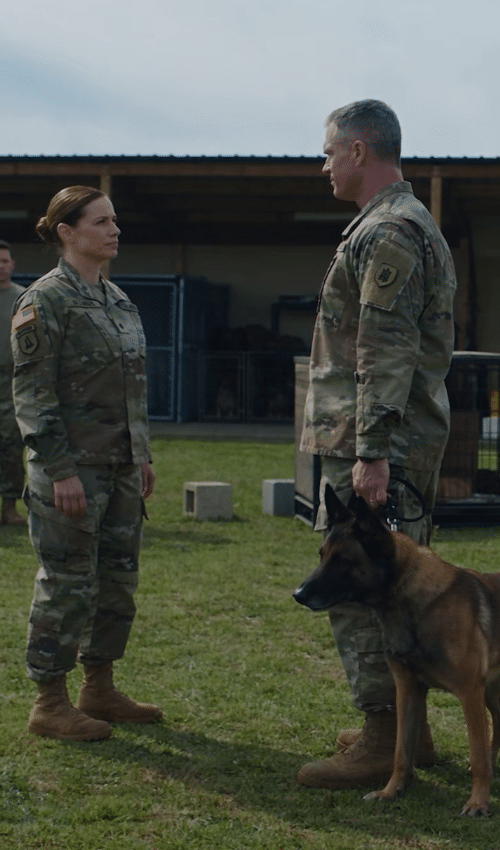
Across the training yard, a military working dog stood beside a towering Army Colonel. Its leash was tight, its muscles tense, and its injured paw barely touching the turf. Several handlers watched nervously as the animal struggled to obey commands that were clearly causing it pain.
The woman took one step forward.
She was thirty-nine, with brown hair tied neatly behind her head, tan combat boots, and an ordinary-looking Army OCP uniform. There was nothing particularly intimidating about her appearance. No entourage. No security detail. No visible indication that she was anyone important.
But she had noticed something the others were afraid to mention.
The dog was injured.
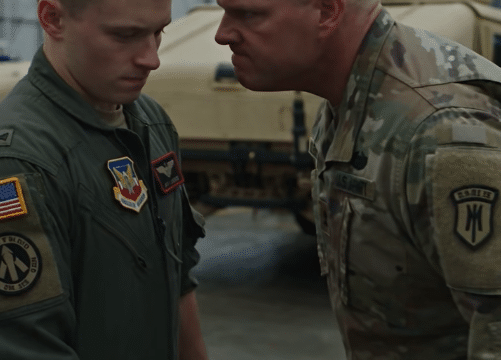
The Colonel turned toward her, his silver eagle insignia catching the afternoon sunlight.
“It works until I say stop,” he snapped.
She didn’t move.
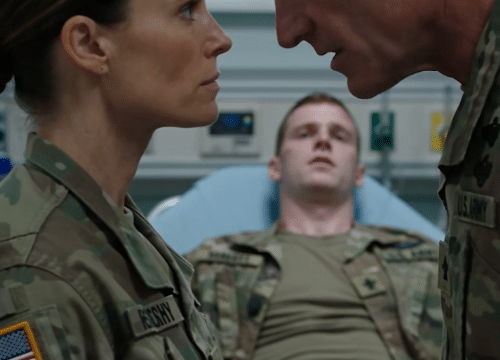
“That dog is hurt. You’re pushing it beyond its limits.”
The Colonel gave a humorless laugh. He had spent years building his reputation around discipline, toughness, and absolute obedience. He considered disagreement a personal insult, especially when it came from someone he believed had no authority to challenge him.
“Stay out of my unit.”
The handlers exchanged uncomfortable glances.
Nobody spoke.
The woman looked directly at him. She wasn’t intimidated by his rank, his reputation, or the audience watching them.
That was precisely what made him furious.
And within seconds, he would make the biggest mistake of his military career.
Act II
The slap came without warning.
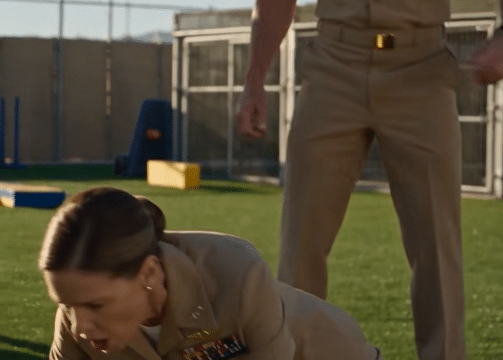
The Colonel swung his hand across her face with enough force to knock her sideways. A sharp impact echoed across the training yard.
Her cheek immediately reddened.
Before she could regain her balance, he drove a boot into her abdomen, sending her crashing onto the artificial turf. A gasp escaped one of the handlers.
She tried to push herself upright.
He kicked her again, this time into her side.
For a moment, the entire facility seemed to freeze.
The woman curled slightly around her injured ribs, fighting to recover her breath. A thin trace of blood appeared at the corner of her mouth.
Nobody moved.
The Colonel stood over her, breathing heavily, apparently satisfied with what he had just accomplished.
“Stay out of my unit,” he repeated.
To him, the matter was settled.
He had publicly reminded everyone who controlled the training yard. He had humiliated someone who questioned his authority, and he expected the witnesses to remember the lesson.
But something about their expressions bothered him.
They weren’t looking at him with admiration.
They were staring at the woman on the ground.
The lead handler had gone unusually still. Another soldier slowly lowered his training clipboard. Even the dog seemed to have stopped responding to the Colonel’s commands.
The woman placed one hand against the turf and slowly raised herself.
Her cheek was swollen. Her breathing was guarded. Yet her eyes had changed.
The pain was still there, but the uncertainty was gone.
She looked at the Colonel without saying another word.
Then she glanced toward the dog.
And the next thing that happened would expose how little the Colonel actually understood about the unit he commanded.
Act III
The lead handler noticed the woman’s eyes.
He had seen that expression before.
Not in a photograph or on a television screen, but during a series of classified K9 evaluation exercises that had changed the way his entire team approached military working-dog standards.
Months earlier, the facility had received instructions that a senior Army officer would personally oversee an assessment of its K9 program.
The officer’s identity had been kept restricted to personnel who needed to know.
The handlers had been told only that this person would evaluate the animals’ welfare, operational readiness, and the conduct of the command staff.
The Colonel had dismissed the inspection as another bureaucratic inconvenience.
He had no idea that the quiet woman he had just assaulted was the very officer responsible for reviewing his program.
But there was another reason the handlers recognized her.
The dog.
The military working dog had previously participated in an advanced rehabilitation and behavioral assessment program. During those evaluations, the woman had repeatedly worked with the animal, establishing a level of trust that went beyond ordinary obedience.
She had never forced the dog to perform through pain.
She had never treated hesitation as disobedience.
And when the animal had struggled with its injured paw, she had been the person who insisted that its condition be properly assessed before returning to duty.
The dog remembered.
The Colonel, however, remembered only that the animal was supposed to obey him.
He tightened the leash, preparing to move the dog away.
The lead handler looked at the woman.
She gave him the smallest nod.
It was all the permission he needed.
He loosened the leash.
And the dog made its choice.
Act IV
The animal immediately pulled away from the Colonel.
For one brief second, he seemed to believe it was simply another training failure.
Then the dog ran.
Straight across the turf.
Past the obstacles.
Past the handlers.
Past the man who had been holding its leash.
It stopped beside the injured woman and sat protectively against her, positioning its body between her and the Colonel.
The entire yard watched in disbelief.
The woman slowly lowered one hand toward the dog’s head.
The animal leaned into her touch.
Its injured paw remained carefully lifted from the ground.
The Colonel stared.
“What the hell?”
Nobody answered.
Then the lead handler stepped forward.
He straightened his uniform, brought his heels together, and raised a crisp salute.
“Ma’am.”
The single word changed everything.
Every handler in the yard immediately straightened.
One by one, soldiers who had previously stood frozen in uncertainty came to attention. The recognition spread through the unit like a silent command.
The Colonel’s expression began to collapse.
He looked at the lead handler.
Then at the woman.
Then at the dog, which had completely abandoned his side and was now sitting protectively beside her.
He knew that salute.
He knew what it meant when an entire military team recognized someone without hesitation.
The woman slowly rose, one hand briefly guarding her abdomen.
Despite her swollen cheek, she returned the lead handler’s attention with absolute composure.
There was no need for an announcement.
No dramatic entrance.
No officer arriving in a black vehicle.
The truth was already standing in front of him.
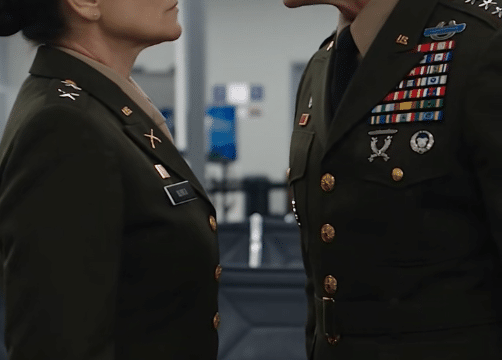
The woman was Brigadier General, a one-star Army officer overseeing K9 standards.
And the Colonel had just assaulted the very person responsible for evaluating the program he had spent years controlling.
His silver eagle insignia suddenly seemed a lot less impressive.
Act V
The Colonel took a half-step backward.
His mouth opened, but no words came out.
The woman stood beside the dog, her expression cold and controlled. Around her, the handlers remained at attention.
She didn’t need to shout.
She didn’t need to remind anyone of her rank.
The dog had already done something the Colonel’s authority could never accomplish.
It had demonstrated where trust actually belonged.
For months, the Colonel had mistaken fear for respect. He believed that the loudest voice controlled the strongest unit, that punishment created discipline, and that questioning his decisions was a sign of weakness.
But the animal had just exposed the difference between command and leadership.
A military working dog could be trained to follow commands.
It could be conditioned to respond to authority.
But the moment its leash loosened, it had chosen the person it trusted.
And every soldier in that yard had witnessed it.
The Colonel looked around desperately, searching for someone who might explain what was happening.
Instead, he found a wall of silent recognition.
His eyes returned to the woman.
For the first time since taking command of the training exercise, he seemed genuinely afraid.
His voice came out quieter than before.
“Why does the whole unit know you?”
The question hung in the air.
The woman didn’t answer.
She simply rested her hand on the dog’s head while the entire unit stood at attention.
And the Colonel finally understood that the most dangerous mistake he had made that day wasn’t striking a subordinate.
It was believing that the woman he had knocked to the ground was someone who could be ordered to stay there.