Act I
The first strike split the silence in half.
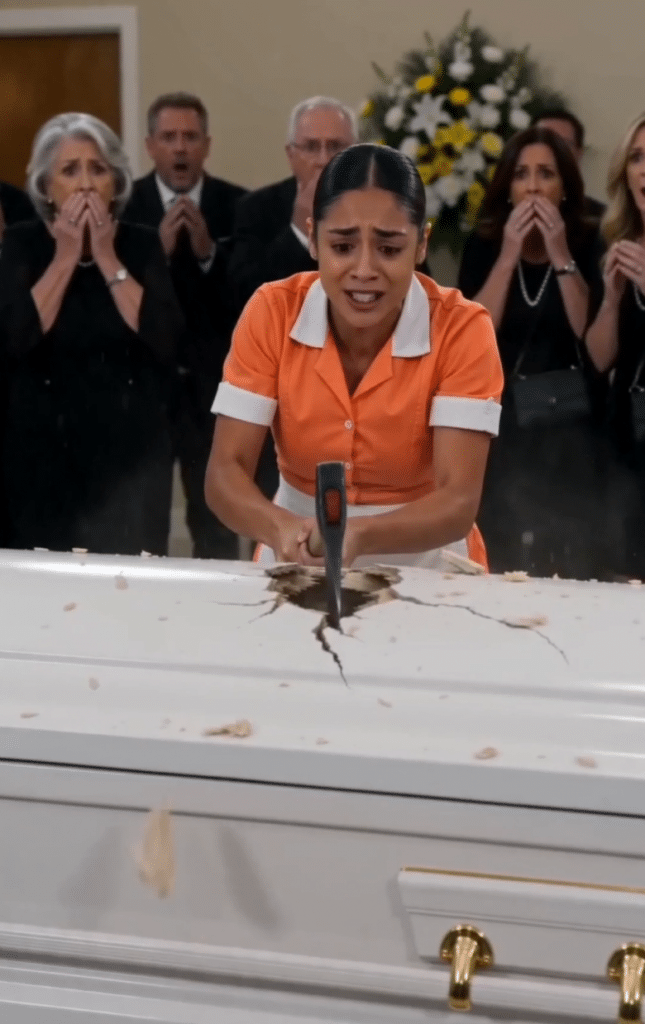
No one in the funeral home saw the young woman run in until the axe was already above her head. She came through the viewing room doors in an orange uniform and white apron, dark hair coming loose from its pins, her face wet with panic.
The white coffin sat in the center of the room, polished and perfect beneath the funeral wreaths.
Then the blade came down.
Wood cracked with a sound so violent that every mourner recoiled at once. A jagged break opened across the coffin lid. Splinters scattered across the dark wooden stand and skidded over the pale floor.
Someone screamed.
Someone dropped a prayer card.
The young woman lifted the axe again, both hands shaking around the handle.
“Stop the funeral!” she cried. “She’s not dead!”
The room froze.
For one impossible second, grief itself seemed to stop breathing.
The father of the dead girl stepped forward from the front row. Victor Harrow was dressed in a black suit, his silver hair combed neatly back, his face carved by exhaustion and rage. Just hours earlier, he had stood beside that coffin receiving condolences for his daughter, Emma, the only child he had left.
Now a stranger in a cafeteria uniform was destroying her coffin.
“Have you lost your mind?” he roared.
The young woman flinched, but she did not step back.
Her name was Nora Vale. She was twenty-two years old, a kitchen server at Harrow House for almost three years, the kind of employee wealthy families barely noticed unless a tray was late or a glass went empty.
But Emma had noticed her.
Emma had spoken to her in hallways. Smuggled her leftover pastries after charity dinners. Asked her real questions and waited for real answers.
And that morning, Nora had washed Emma’s hair for burial because the funeral home’s usual attendant was ill, because the family was desperate, and because Nora had begged to help.
She had thought it would be her final act of kindness.
Then she heard the sound.
A thin, broken whimper from inside the coffin prep room.
At first, she thought grief had done something cruel to her mind.
Then she heard it again.
Not a memory.
Not the wind.
A person.
Now she stood in front of the mourners with an axe in her hands and terror in her eyes, staring at the father who wanted to drag her away.
“She’s not dead,” Nora said again, but this time her voice cracked.
Victor’s hands curled into fists.
“You disgusting little—”
“Victor,” the grandmother whispered.
The word came from the front row.
Eleanor Harrow, Emma’s grandmother, rose slowly in her black dress and pearls. She was eighty-one, thin as a flame, but the entire room shifted when she moved. Even Victor stopped.
Her eyes were fixed on the coffin.
Nora turned back to it, breathing too fast.
“I heard her,” she said. “I heard her crying.”
A murmur passed through the mourners.
Victor’s face went dark.
“This is hysteria.”
Nora leaned over the splintered lid, tears falling from her chin onto the white wood.
“No,” she whispered. “No, don’t do this to me.”
The room watched as if trapped in a nightmare.
Nora brushed a shaking hand along the broken edge.
“I washed her hair this morning,” she said. “Her hands were warm.”
Eleanor stepped closer.
Her pearls trembled against her throat.
“Did you hear that?” she asked.
No one answered.
The room became so quiet that the chandeliers seemed loud.
Eleanor reached the coffin, placed one trembling hand on the splintered wood, and lowered her face toward the dark opening Nora had made.
“My God,” she breathed. “Emma?”
And from inside the coffin came the faintest sound.
Act II
Before that day, Nora Vale had spent most of her life learning how invisible a person could become.
She grew up above a laundromat on the east side of town, raised by an aunt who loved her but had no softness left after too many double shifts. Nora left school early, worked wherever someone would pay cash, and learned that rich people had two kinds of voices.
The bright one they used at charity events.
And the cold one they used when no one important was listening.
Harrow House taught her that.
The mansion sat on twelve acres behind iron gates, all white columns and old money wrapped in ivy. Nora started there as a weekend server and became useful enough to keep. She knew which guests drank too much, which board members shouted at staff, and which silver trays were only for family dinners.
She also knew Emma Harrow was different.
Emma was twenty-four, pale and thoughtful, with a laugh that appeared rarely but changed her whole face when it did. She had grown up under the weight of the Harrow name, but she never wore privilege comfortably. She apologized to staff when other people snapped. She remembered Nora’s birthday after hearing it once. She once spent an entire winter quietly paying for the medicine of a gardener’s wife and never told anyone.
People called Emma fragile.
Nora thought they were wrong.
Emma was not fragile.
She was trapped.
After her mother died, Victor Harrow became obsessed with protecting the family image. He controlled the guest lists, the interviews, the donations, the doctors, the schedule. Emma smiled at galas and vanished afterward. She looked thinner every month. Quieter.
Then came the engagement announcement.
Emma was to marry Charles Pembroke, the son of a banking family whose money had survived every scandal by buying silence before it became necessary. He was handsome in the way portraits are handsome. Perfect from far away. Empty up close.
Nora saw how Emma changed around him.
Her shoulders tightened. Her voice became smaller. Once, after a dinner party, Nora found Emma standing alone in the pantry, clutching a broken champagne flute in a towel.
“I don’t want this,” Emma whispered.
Nora had no right to ask what she meant.
But Emma looked at her with desperate eyes.
“My grandmother left me the trust,” she said. “Not my father. Me. When I turn twenty-five, I can stop the sale.”
“What sale?”
Emma looked toward the hallway before answering.
“Harrow House.”
That was how Nora first learned the truth.
Victor was nearly bankrupt.
The family fortune, so admired by outsiders, had been hollowed out by bad investments and quiet debts. Harrow House was the last jewel. Eleanor had placed it in a trust for Emma years earlier, fearing Victor would sell it to save his pride.
But Emma’s birthday was three weeks away.
Once she turned twenty-five, she would control the estate.
Unless she married Charles first.
Unless something happened.
Nora told herself not to connect those thoughts.
Then Emma died.
That was what they said, at least.
The story moved through the staff before dawn. Miss Emma had been found unresponsive in her bedroom. The private doctor came. The family lawyer came. Victor ordered that no one speak to reporters. The funeral was arranged with shocking speed.
No autopsy.
No delay.
No questions.
The official explanation was a sudden heart event caused by a rare condition Emma had apparently hidden from everyone who loved her.
Nora did not believe it.
Neither did Eleanor.
But grief and power are not equal weapons.
Victor kept his mother away from the body until the viewing. Charles Pembroke arrived with red eyes and dry cheeks. The housekeeper sobbed in a linen closet. The staff were warned that anyone spreading rumors would lose not only their job, but every reference they might ever need.
Nora stayed quiet.
Until the funeral home called Harrow House that morning.
They needed someone who knew Emma to help with final preparations. The usual attendant had been delayed. Victor refused. Charles said it was too painful. Eleanor was told she was too old.
Nora volunteered.
She thought Emma deserved one gentle hand in a room full of arrangements.
So she went.
The funeral home was small, cream-walled, overly clean, heavy with the scent of lilies. The white coffin waited open beneath soft lights. Emma lay inside in a pale dress, her dark hair arranged too perfectly around her face.
Nora nearly broke at the sight.
Then she touched Emma’s hand.
Warm.
Not warm like life, she told herself at first.
Not possible.
But not cold.
Nora whispered Emma’s name.
Nothing happened.
She washed Emma’s hair with trembling fingers. She brushed a strand away from her cheek. She noticed faint moisture at the corner of Emma’s eye and told herself it was product, condensation, anything else.
Then, as the lid was being prepared, Nora heard it.
A weak, trapped sound.
So faint it might have disappeared under a breath.
Nora dropped the comb.
“Emma?”
No answer.
Then another sound.
A cry.
Small.
Human.
By the time Nora found the axe in the maintenance hallway, the mourners had already begun entering the viewing room.
And the coffin had already been sealed.
Act III
Eleanor’s whisper entered the coffin like a prayer.
“My God… Emma?”
Everyone waited.
Victor stood frozen, his anger fighting something he refused to name. Charles Pembroke had gone pale near the back wall. The mourners pressed close and away at the same time, drawn by horror, repelled by fear.
Then it came again.
A sound from inside the coffin.
Not loud.
Not clear.
But real.
A faint scraping. A breath. A soft, broken whimper.
Eleanor staggered.
Nora dropped the axe and grabbed the broken lid with both hands.
“Help me!” she screamed.
For half a second, no one moved.
Then the grandmother did.
Eleanor, old and trembling, placed her hands on the splintered wood and pulled.
That shamed the room awake.
Two men rushed forward. A funeral director ran in with tools. Someone shouted for an ambulance. Someone else began crying openly. Victor stood motionless until Eleanor turned on him with a fury that made her look suddenly young.
“Victor, help your daughter!”
That broke him.
He lunged forward and helped pry the damaged lid away. The white wood groaned, then split open enough for the funeral director to remove the rest.
Emma lay inside.
Her eyelids fluttered.
Her lips parted around a shallow breath.
Nora covered her mouth with both hands, a sob tearing through her.
“She’s alive.”
The words moved through the room like fire.
Alive.
Alive.
Alive.
Victor reached for Emma, but Eleanor slapped his hand away.
“Do not touch her until the paramedics arrive.”
He stared at his mother in disbelief.
Eleanor looked at him as if he had become a stranger.
“You buried her too quickly.”
Victor’s face collapsed.
“I thought—”
“No,” Eleanor said. “You didn’t think. You obeyed men who wanted this finished.”
Charles Pembroke stepped forward.
“That is a cruel thing to imply.”
Nora turned toward him.
For the first time, she saw fear under his polished grief.
Not shock.
Fear.
Charles noticed her looking and rearranged his expression.
“We need to remain calm,” he said. “Emma has clearly suffered some kind of medical episode. This poor girl has caused enough chaos.”
Nora’s eyes narrowed.
“This poor girl heard her crying.”
Charles smiled thinly.
“And nearly destroyed a coffin in front of grieving family.”
“She saved her life,” Eleanor said.
That silenced him.
The paramedics arrived minutes later. They moved quickly, professionally, asking questions no one answered well. Emma was lifted from the coffin and placed onto a stretcher. Her eyes opened once, unfocused and frightened.
Nora leaned close.
“Emma, it’s Nora. You’re safe.”
Emma’s fingers moved.
They caught the edge of Nora’s apron.
Weakly.
Desperately.
Then Emma whispered one word.
“Don’t.”
Nora bent closer, heart hammering.
“Don’t what?”
Emma’s eyes shifted.
Not to her father.
Not to her grandmother.
To Charles.
Then she lost consciousness again.
The room understood.
Charles stepped back.
“No,” he said immediately. “She’s confused.”
Victor turned toward him slowly.
“What did she mean?”
Charles lifted both hands.
“Victor, grief is making everyone irrational. She was barely conscious.”
But Eleanor was already watching him.
The old woman had lived long enough to recognize guilt when it dressed itself as concern.
“Where is Dr. Latham?” she asked.
Victor blinked.
“What?”
“Your private doctor,” Eleanor said. “The man who signed her death certificate.”
Charles answered too quickly.
“He was called away.”
Nora looked at him.
“How do you know?”
Charles stopped.
The question hung there.
Victor’s expression shifted from grief to suspicion.
Before anyone could speak, a phone rang.
It was Eleanor’s.
Her hand shook as she answered. She listened for only three seconds before her face turned white.
Then she looked at Victor.
“The hospital says Dr. Latham never filed the emergency report.”
Victor’s breath caught.
Eleanor lowered the phone.
“And the death certificate was submitted by courier before Emma was found.”
The funeral home seemed to tilt around them.
Nora looked from Eleanor to Victor to Charles.
Suddenly, the sealed coffin was not the only thing in the room that had been forced shut.
A whole conspiracy had been buried with Emma.
And now she had come back breathing.
Act IV
The ambulance took Emma through the front doors under flashing lights, leaving the viewing room destroyed behind it.
No one cared about the broken coffin anymore.
The mourners stood in stunned clusters among the flowers, speaking in whispers as if afraid the walls might confess next. The funeral director kept repeating that he had followed the paperwork. Victor kept asking the same questions and receiving no answers that made sense.
Charles tried to leave.
Nora saw him first.
He moved toward the side hallway while everyone watched the ambulance doors close. His grief had vanished. In its place was calculation.
Nora stepped into his path.
“Where are you going?”
Charles looked down at her orange uniform, as if even now he could not believe she had the right to block him.
“Move.”
“No.”
His voice lowered.
“You have no idea what you’ve involved yourself in.”
Nora felt fear climb her spine, but she did not move.
“I know Emma looked at you when she said don’t.”
His eyes hardened.
Victor appeared behind him.
“So do I.”
Charles turned, smoothing his face too late.
“Victor, listen to me—”
“For once,” Victor said, voice shaking, “I am done listening to everyone except my daughter.”
Charles’s mask cracked.
“Your daughter was going to destroy you.”
The words landed with a force colder than shouting.
Victor stared at him.
Charles realized there was no graceful way back, so he chose arrogance instead.
“She was going to stop the sale. She was going to expose the debts, the forged board approvals, the trust restructuring. You would have lost the house, the foundation, everything.”
Eleanor stepped forward from the doorway.
“And you would have lost your marriage contract.”
Charles smiled bitterly.
“Marriage is a contract.”
Nora’s hands curled.
Victor looked sick.
“What did you do to her?”
Charles’s silence was answer enough, but Eleanor wanted words.
“What did you do?”
Charles glanced toward the exit.
Then toward the mourners.
Too many witnesses.
His confidence dimmed.
“I did not kill anyone,” he said.
“No,” Nora replied, voice trembling. “You just made everyone believe she was gone.”
Victor grabbed him by the lapels before anyone could stop him.
Charles did not fight. Men like him rarely expected hands on them.
“What was in the tea?” Victor demanded.
Nora froze.
Tea.
She remembered the night before Emma died. A silver tray sent upstairs. Charles insisting he would take it himself. Emma at the top of the staircase, pale and reluctant.
Charles said nothing.
Eleanor turned to one of the mourners.
“Call the police.”
A woman already had.
They arrived before Charles could invent a new story.
By then, Nora had remembered something else.
The laundry chute.
That morning, before the funeral home called, Nora had been asked to clear Emma’s bedroom. She had found the teacup missing from the tray, though the saucer remained. At the time, she thought nothing of it.
Now she ran to Victor.
“The cup,” she said. “Emma’s cup from last night. It wasn’t in her room.”
Charles’s eyes flickered.
Nora saw it.
So did Eleanor.
“Where is it?” Victor demanded.
Charles laughed under his breath.
“You people are insane.”
But Nora was already thinking like a servant.
Rich people hid things in drawers, safes, locked cabinets.
Staff hid broken things where no one important looked.
“The service pantry,” she whispered.
Victor stared at her.
“At Harrow House?”
Nora nodded.
“There’s a disposal bin for chipped china. If he wanted the staff to throw it out without asking…”
Charles moved.
Not far.
A police officer stopped him.
The next hours unfolded like a storm breaking over old stone.
At Harrow House, investigators found the cup wrapped in a linen cloth beneath broken plates in the service pantry. They found messages between Charles and Dr. Latham. They found draft contracts transferring control of Emma’s trust upon marriage or certified death. They found a payment from a Pembroke shell company to the doctor who had declared Emma dead without hospital confirmation.
And in Victor’s study, behind a locked cabinet, they found something Eleanor had feared most.
A letter from Emma.
Addressed to Nora.
Nora stood in the hallway when Eleanor handed it to her.
The envelope was sealed, her name written in Emma’s careful hand.
Nora opened it with shaking fingers.
Nora,
If anything happens before my birthday, don’t believe the first story they tell. I know you may wonder why I trust you. It is because you listen when people speak softly.
There is a copy of my evidence hidden where my mother kept her music.
Please help my grandmother.
Please forgive me for involving you.
I am scared.
Nora pressed the letter to her chest.
Victor covered his face.
Eleanor closed her eyes, grief and rage passing through her like weather.
“The piano,” Nora whispered.
They found the evidence inside the old grand piano in the east parlor.
Bank records. Trust amendments. Copies of emails. A note in Emma’s handwriting documenting every threat Charles had made and every pressure Victor had ignored because he wanted to believe the marriage would save the family.
Victor read the pages with a face older than it had been that morning.
He had not planned his daughter’s burial.
But he had built the silence that made it possible.
And that truth would follow him longer than grief.
Act V
Emma woke two days later in a hospital room guarded by police.
The first thing she asked for was her grandmother.
The second was Nora.
Victor stood in the hallway when Nora arrived, still wearing the same orange uniform because she had not gone home long enough to change. He looked as if he had spent two nights being carved out from the inside.
“Nora,” he said.
She stopped.
For years, he had never used her name.
Not once.
He seemed to realize it at the same time she did.
“I owe you my daughter’s life,” he said.
Nora did not know what to do with that.
So she answered honestly.
“You owe her the truth.”
Victor lowered his eyes.
Inside the room, Emma looked impossibly small against the white pillows. But when she saw Nora, her mouth trembled into something almost like a smile.
“You broke my coffin,” Emma whispered.
Nora laughed once, then cried.
“I’m sorry.”
“Don’t be,” Emma said. “I was very attached to being alive.”
Eleanor, sitting beside the bed, let out a sound between a sob and a laugh.
For the first time in days, the room breathed.
The recovery was slow. Emma’s body had survived a dangerous deception, but her mind had to wake into the horror of how close the world had come to burying her story along with her. She spoke to investigators in pieces. She told them about Charles’s threats, Dr. Latham’s visits, the pressure to marry quickly, the way everyone dismissed her fear as anxiety.
Victor listened from outside the room because Emma was not ready to let him in.
That was her right.
He did not argue.
Charles Pembroke was arrested before the week ended. Dr. Latham followed. The scandal consumed the city by Monday morning. Headlines spoke of forged papers, illegal certification, trust fraud, and a funeral stopped by a young server no one had thought important enough to notice.
But headlines could not capture the sound Eleanor heard through the broken coffin lid.
They could not capture Nora’s hands shaking around the axe.
They could not capture the way Emma clung to the edge of life with no one listening until the least powerful woman in the house refused to be quiet.
Three months later, Harrow House opened its gates again.
Not for a gala.
For a hearing.
Emma appeared in the main hall wearing a simple cream dress, her hair loose around her shoulders. Nora stood beside Eleanor near the front, uncomfortable in a borrowed black blazer that Emma had insisted she keep.
Victor sat across the room.
He looked at his daughter like a man waiting for a sentence.
Emma did not give him one.
Not the kind he expected.
When the court confirmed Emma’s control of the trust, she rose slowly and faced the room.
“Harrow House will not be sold,” she said. “But it will not remain what it was.”
Her voice shook, but it carried.
“This family protected its reputation better than it protected its people. That ends now.”
She turned toward Nora.
“The east wing will become a legal aid center for domestic workers, caregivers, and household staff. People who hear things. See things. Save lives. People who are too often ignored because of the uniforms they wear.”
Nora’s eyes filled.
Emma smiled gently.
“And it will be named the Vale Center.”
Nora shook her head, stunned.
“I can’t accept that.”
Emma’s smile deepened.
“You already accepted harder things.”
Eleanor reached for Nora’s hand.
Victor stood then.
Every eye turned toward him.
For a moment, the old pride returned to his face out of habit. Then it disappeared, leaving only a father who had been forced to see the wreckage of his own blindness.
“I failed my daughter,” he said. “I mistook control for care. I mistook silence for dignity. I let men near her because they promised to save what I was afraid to lose.”
He looked at Emma.
“I will spend the rest of my life answering for that. Publicly.”
Emma did not forgive him that day.
But she listened.
Sometimes, after great harm, listening is the first honest thing left.
Weeks later, Nora returned to the funeral home.
The viewing room had been repaired. The cream walls repainted. The floor polished. There was no white coffin in the center now, only sunlight falling across empty space.
The funeral director had asked if she wanted the axe discarded.
Nora said no.
Emma agreed.
They placed it in a glass case at the Vale Center, not as a weapon, but as a reminder. Beside it, a small plaque told the truth plainly:
When no one believed the quiet sound, someone made enough noise to save a life.
On the anniversary of the day that should have been Emma’s burial, the family gathered in the garden behind Harrow House.
No black clothes.
No wreaths.
No coffin.
Emma stood barefoot in the grass, breathing in the late afternoon air as if every breath was still a gift she did not intend to waste. Eleanor sat beneath a white rose arbor, watching her granddaughter with tears she no longer tried to hide.
Nora carried a tray of lemonade out of old habit, then stopped when Emma gave her a look.
“You are not serving today,” Emma said.
Nora smiled.
“I know.”
She set the tray down anyway, and this time everyone reached for their own glass.
Victor approached last.
He did not try to hug Emma. He did not ask for absolution. He simply stood a few feet away and said, “I’m glad you’re here.”
Emma looked at him for a long time.
“So am I.”
It was not forgiveness.
Not yet.
But it was life.
And life, they had learned, could begin again in the strangest ways.
With a whisper.
With a crack in white wood.
With an old woman brave enough to hope.
And with a young server in an orange uniform who heard someone crying from inside a coffin and chose to shatter the silence before the silence could bury the truth.