Act I
The shove came before anyone asked for proof.
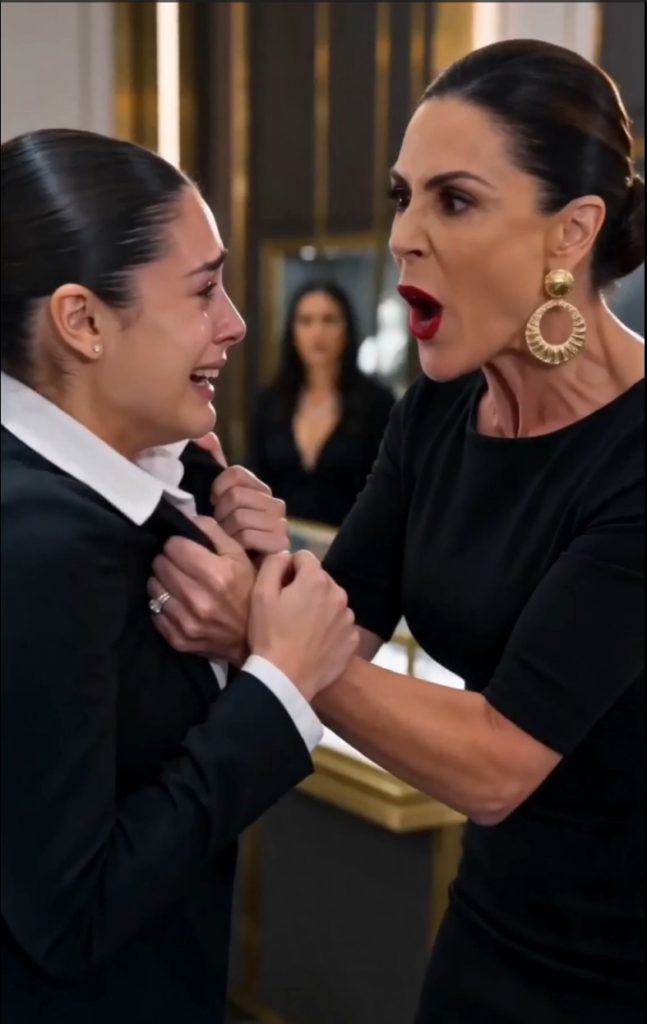
In the middle of Maison Aurelle’s marble showroom, beneath chandeliers bright enough to make diamonds look alive, Vivian Cross pushed the young saleswoman so hard she stumbled between two gold-trimmed display cases.
“You pathetic thief!”
Phones rose almost instantly.
That was what wealthy people did now when scandal appeared in public. They recorded first. They understood later.
The saleswoman caught herself on the edge of a glass case, her black blazer twisting in Vivian’s grip. Her name tag flashed under the warm spotlights.
MIA.
Her face was flushed. Tears streaked down her cheeks. She looked barely twenty-two, too young to be surrounded by women in evening gowns filming her humiliation like entertainment.
Vivian Cross lunged forward and grabbed Mia by both lapels.
“Where is my diamond bracelet?”
Mia shook her head, sobbing.
“I don’t have it. I swear I don’t have it.”
Vivian’s red lips curled with disgust.
“Girls like you always swear.”
The manager, Charles Beaumont, pushed through the gathering crowd.
“Mrs. Cross, release her.”
Vivian ignored him. Her eyes dropped to Mia’s clenched hand.
“What are you hiding?”
“Nothing,” Mia said, panic rising.
Vivian pried open her fist.
Silver coins spilled across the black marble floor, clinking loudly as they bounced and rolled beneath the display lights. A crumpled white paper fell with them.
The crowd murmured.
Someone whispered, “Oh my God.”
Vivian snatched up the paper, triumphant.
“Look at this. She was hiding something.”
But Charles took the paper from her before she could tear it open.
He unfolded it carefully.
The showroom fell into a strange, breathless silence as he tilted it toward the chandelier light.
His face changed.
First confusion.
Then disbelief.
Then something very close to fear.
“Impossible,” he whispered.
Vivian crossed her arms. “What is it?”
Charles did not answer her.
He looked at the handwritten signature at the bottom of the paper, the ink faded but unmistakable. His hand trembled.
“This is the original collection note for the bridal set,” he said. “That signature was from our records twenty years ago.”
Mia lifted her tear-streaked face.
For the first time, she stopped looking frightened.
She looked cornered.
“Then tell them,” she said, voice shaking. “Tell them my mother told me never to show that name.”
Charles stared at her.
Mia’s breath hitched.
“One of you accused me first.”
Vivian’s expression faltered.
Because the missing diamond bracelet was no longer the most dangerous thing in the room.
Act II
Mia Laurent had been taught never to say her mother’s full name inside a jewelry store.
Not because it was shameful.
Because it was dangerous.
When Mia was little, her mother, Elise Laurent, repaired broken clasps at the kitchen table under a yellow lamp. Their apartment always smelled faintly of metal polish, jasmine tea, and rain leaking through old windows. Elise had hands that could make ruined things beautiful again.
She could reset a loose stone without scratching the prongs.
She could identify an imitation pearl by touching it once.
She could sketch a necklace from memory after seeing it for only a few seconds.
But whenever Mia asked why someone with such talent lived above a laundromat and took cash jobs from pawn shops, Elise would close the velvet box in front of her and say, “Some doors don’t close by accident, darling. Some are slammed.”
Years earlier, Elise had worked for Maison Aurelle.
Not as a cleaner. Not as a clerk.
As a junior designer.
Her first collection had been called The Aurora Bridal Set: a necklace, earrings, hair comb, and bracelet made with white diamonds arranged around tiny moonstones. It was delicate, luminous, and unlike anything the boutique had displayed before.
The collection was supposed to launch Elise’s career.
Instead, it ruined her life.
Two weeks before the public unveiling, the bracelet disappeared.
The owner of Maison Aurelle accused Elise of stealing it. There were whispers that she had debts, that she was ambitious, that she had grown too proud of her place. No charges stuck in court, but reputation does not require a conviction to destroy a woman.
Elise was fired.
Her design credit vanished.
The bridal set launched without her name.
And the missing bracelet became a private legend inside the boutique, mentioned only when staff wanted to warn new employees what happened to those who forgot their place.
Mia grew up with the silence left behind.
She grew up watching her mother cross the street rather than pass Maison Aurelle’s front window. She grew up knowing that Elise still kept one piece of paper wrapped in silk inside a tin box beneath her bed.
The original collection note.
The only surviving proof that Elise Laurent had designed the Aurora set before the boutique erased her.
“Why don’t you show them?” Mia asked once.
Elise smiled sadly.
“Because men who steal names are rarely afraid of paper unless someone powerful is holding it.”
Then she made Mia promise something strange.
“If you ever work near diamonds, never show that signature unless they accuse you first.”
Mia did not understand then.
She understood after Elise got sick.
Medical bills took everything. The pawn jobs slowed. Mia left school, took retail shifts, and applied anywhere that paid enough to keep the lights on. When Maison Aurelle posted an opening for a junior sales associate, she stared at the listing for three nights before applying.
Her mother begged her not to.
“That place took my name,” Elise said. “Don’t give them yours.”
But Mia was desperate.
And part of her wanted to stand where her mother had been destroyed, just once, and survive it.
So she entered Maison Aurelle with a neat ponytail, a pressed white shirt, and her mother’s collection note folded small inside her pocket.
Not to reveal.
To remember.
For three months, she kept her head down. She helped brides choose earrings. She polished display cases. She smiled when clients spoke to her like a servant in a blazer.
Then Vivian Cross came in for the private anniversary preview.
Vivian was not merely rich.
She treated wealth like proof of superiority.
She arrived in a black dress, gold earrings, and a cloud of perfume, demanding to see the Aurora Bridal Set before anyone else. Her husband’s family had owned shares in Maison Aurelle for years. Her name opened doors even when her manners should have closed them.
And when the diamond bracelet vanished from the velvet tray, Vivian did not hesitate.
She turned on the youngest woman in the room.
Mia.
Just as someone had once turned on Elise.
Only this time, there were cameras.
And this time, the paper survived the fall.
Act III
Charles Beaumont had worked at Maison Aurelle long enough to know which ghosts were allowed to be mentioned.
Elise Laurent was not one of them.
When he first joined the boutique twenty-one years earlier, he was an assistant manager with more ambition than courage. He remembered Elise vividly: quiet, brilliant, always sketching in the margins of inventory sheets. She had a way of looking at stones as if they were waiting to confess what they wanted to become.
Charles also remembered the day she was accused.
He had not accused her.
That was the excuse he used for twenty years.
He had only stood there.
He had only watched the owner, Gerald Aurelle, empty Elise’s locker in front of staff. He had only listened when Gerald said, “Talent without breeding always becomes theft eventually.”
He had only remained silent when Elise looked around the room for one person brave enough to object.
Silence had promoted him.
That was the ugly truth.
Now he stood in the same showroom, holding the same woman’s signature, while her daughter trembled beneath the chandeliers.
“What is your mother’s name?” he asked, though he already knew.
Mia wiped her face with the back of her hand.
“Elise Laurent.”
A gasp moved through the older staff.
Vivian looked irritated.
“Who cares who her mother is? My bracelet is missing.”
Charles turned toward her.
“The bracelet you claim is yours was part of the Aurora Bridal Set.”
“It is mine,” Vivian snapped. “My husband purchased access to the anniversary sale. I was going to buy it tonight.”
“You were going to buy the restored set,” Charles said carefully. “Not the original bracelet.”
Vivian froze.
Mia stared at him.
Charles lowered his voice.
“The original bracelet disappeared twenty years ago.”
The crowd shifted closer.
A woman near the pearl counter kept recording.
Vivian laughed, but it came out too sharp.
“This is absurd.”
Charles looked at the paper again.
“This note describes the original hidden clasp design. A crescent hinge beneath the third moonstone. That detail was never included in public records.”
Mia whispered, “My mother designed it that way because she said brides should be able to open it themselves. She hated jewelry that trapped women inside someone else’s hands.”
Charles closed his eyes.
The line was too specific.
Too Elise.
Vivian’s face tightened.
“Search her bag,” she demanded. “Search her pockets. Stop letting this girl perform some tragic little family drama.”
Mia flinched.
Charles turned to security.
“No one touches her.”
Vivian’s eyes flashed.
“Have you forgotten who I am?”
“No,” Charles said. “That is precisely the problem.”
He looked past her toward the private viewing room.
“Mrs. Cross, when the bracelet went missing tonight, you were the last client to hold the tray.”
Vivian’s mouth opened.
Then shut.
Her husband, standing near the doorway with a glass of champagne, went pale.
Charles gestured to the security guard.
“Bring the viewing room footage.”
Vivian laughed again, louder this time.
“You would humiliate me over the word of a salesgirl?”
Mia stepped forward.
Her voice was still shaking, but something had hardened beneath it.
“My mother lost everything because people like you thought being poor made her guilty.”
Vivian leaned toward her.
“And maybe she was.”
The room went cold.
Mia’s tears stopped.
Charles saw it then.
The same look Elise had worn twenty years ago.
Not fear.
Recognition.
The wound had repeated itself perfectly.
But this time, Charles could still choose differently.
Act IV
The security footage appeared on the boutique’s wall screen.
No one spoke.
The video showed the private viewing room from above: velvet table, champagne glasses, Vivian Cross, her husband, two staff members, and Mia standing respectfully near the door.
The Aurora set glittered under the lights.
Vivian lifted the bracelet first. She fastened it around her wrist and turned her hand, admiring how the diamonds caught the room. Mia stepped closer and offered to remove it before the next piece was presented.
Vivian waved her away.
Then her husband leaned in to whisper something.
Vivian smiled.
With her left hand hidden beneath the edge of her black clutch, she opened the crescent hinge beneath the third moonstone and slipped the bracelet inside.
The room exploded.
Vivian shouted, “That is not what it looks like!”
Her husband backed away from her as if distance could save him.
Charles paused the footage on the image of the bracelet vanishing into the clutch.
The gold and marble showroom seemed to tilt around Vivian.
Mia stood perfectly still.
All the terror in her face had been replaced by something more painful.
Vindication that had arrived too late to save her mother.
Charles faced Vivian.
“Open your clutch.”
She clutched it to her side.
“You have no authority.”
A security guard stepped forward.
“Ma’am.”
Vivian looked around for allies.
She found phones.
Cameras.
Faces that had once admired her now hungry for the collapse.
Slowly, violently, she opened the clutch and turned it upside down.
Lipstick. A compact. A black cardholder.
And the Aurora bracelet.
It landed on the glass counter with a soft, final sound.
Mia’s hand went to her mouth.
Charles stared at the bracelet.
For twenty years, Maison Aurelle had displayed a replacement piece, quietly recreated from incomplete sketches after the original vanished. The public never knew. Clients were told the set had been preserved.
But the bracelet in Vivian’s clutch was not the replacement.
It was the original.
The moonstones were older.
The clasp was Elise’s.
Charles looked at Vivian.
“How did you get this?”
Vivian’s face crumpled, then hardened.
“My mother bought it.”
“From whom?”
She did not answer.
Charles already knew.
Gerald Aurelle had died five years earlier, leaving behind a family archive no one had fully opened because profitable lies are often mistaken for tradition.
But Vivian’s family had been close to Gerald. Her mother had attended the original launch. Her father had funded the boutique’s expansion. And now the missing bracelet had appeared in Vivian’s possession on the very night she accused Elise Laurent’s daughter of stealing.
Mia’s voice was low.
“My mother didn’t steal it.”
Charles looked at the bracelet like it had become a body returned from a grave.
“No,” he said. “She didn’t.”
He turned to the staff.
“Lock the doors.”
Vivian took a step back.
“You cannot detain me.”
“No,” Charles said. “But police can question you. And our legal department can open Gerald Aurelle’s private sale records.”
Mia looked at him sharply.
“Private sale records?”
Charles swallowed.
“Gerald kept handwritten ledgers for pieces sold outside inventory.”
“And you knew?”
The question struck harder than Vivian’s accusations.
Charles did not defend himself.
“I suspected.”
Mia’s face twisted.
“You suspected for twenty years?”
The showroom fell silent again.
Charles had no answer large enough.
Mia bent down and began picking up the scattered coins from the floor.
One by one.
The gesture broke something in the room.
A young woman in a gown knelt to help her. Then another. Soon, coins were being gathered by people who minutes earlier had only filmed her humiliation.
Vivian stood alone beside the exposed bracelet.
But Mia did not look at her.
She looked at Charles.
“My mother died thinking no one in this store would ever say her name out loud.”
Charles’s eyes filled.
Then Mia placed the last coin on the counter beside the bracelet.
“So say it.”
Act V
Charles Beaumont stood beneath the chandeliers of Maison Aurelle and did what he should have done twenty years earlier.
He said her name.
“Elise Laurent designed the Aurora Bridal Set.”
No one moved.
He said it again, louder.
“Elise Laurent designed the Aurora Bridal Set. She was falsely accused by this house. Her work was erased, her reputation destroyed, and her daughter was nearly subjected to the same disgrace tonight.”
Mia closed her eyes.
For most people in the showroom, it was a dramatic sentence.
For her, it was a grave opening.
Her mother had spent two decades carrying a theft that was never hers, working in shadows while her designs brought prestige to the very people who had buried her.
Vivian was escorted to a private office by security while the police were called. Her husband followed at a distance, already speaking into his phone with the desperate calm of a man trying to separate himself from scandal.
But scandal had already chosen its shape.
The videos spread before midnight.
Not just Vivian shoving Mia.
Not just the accusation.
The footage of the bracelet slipping into the clutch.
The image of the twenty-year-old note.
Charles saying Elise Laurent’s name.
By morning, Maison Aurelle was no longer selling luxury.
It was explaining history.
Reporters gathered outside the boutique. Former employees came forward. One retired gem setter admitted he had been ordered to recreate the missing bracelet after Elise was fired. A bookkeeper’s daughter produced old letters suggesting Gerald Aurelle had privately sold the original to a wealthy investor’s wife and blamed Elise to avoid scandal before the launch.
That investor’s wife had been Vivian Cross’s mother.
Vivian had inherited more than jewelry.
She had inherited the lie that came with it.
Mia did not return to work the next day.
Or the day after.
Charles sent flowers.
She refused them.
He sent a handwritten apology.
She read it once and placed it beside her mother’s tin box.
The apology was not enough.
But truth rarely arrives fully grown. Sometimes it comes as a document, a confession, an investigation, a name restored in public after a lifetime of silence.
Weeks later, Mia entered Maison Aurelle again.
Not through the employee entrance.
Through the front doors.
She wore a simple black dress and her mother’s silver locket. Her hair was tied back, but not in the severe style required by uniform policy. She came as herself.
The boutique had changed.
The Aurora Bridal Set had been removed from sale. In its place, a single framed note stood inside the central case.
Original design by Elise Laurent, 2004.
Beside it lay the bracelet, no longer priced.
No longer available.
Evidence first.
History second.
Jewelry last.
Charles met Mia near the display.
“You don’t have to forgive me,” he said.
“I know.”
“I should have spoken then.”
“Yes,” she said. “You should have.”
He accepted that.
Mia looked at the bracelet.
“My mother used to say diamonds remember pressure.”
Charles said nothing.
“She meant it as a joke,” Mia continued. “But I think she was right.”
Her eyes moved over the crescent clasp, the moonstones, the work of a woman who had been robbed twice: once of credit, once of belief.
“What happens to the collection now?” Mia asked.
Charles took a careful breath.
“The board wants to relaunch it under your mother’s name. With compensation to her estate. Publicly.”
Mia almost laughed.
“The board wants to save itself.”
“Yes,” Charles admitted. “It does.”
That honesty mattered more than the flowers.
“And you?” she asked.
“I want to build a foundation in Elise’s name for young designers without family connections. Real funding. Real credit. Legal protection for their work.”
Mia looked at him.
“Do you want me to thank you?”
“No,” he said. “I want you to control it.”
For the first time, Mia looked surprised.
Charles slid a folder across the display counter.
Not a contract demanding silence.
Not a settlement hidden behind polite language.
A proposal granting Mia authority over the Elise Laurent Design Fund, the use of her mother’s name, and the future of the Aurora collection.
Mia did not sign that day.
Her mother had taught her better than to trust papers placed quickly under beautiful lights.
She took the folder to a lawyer.
Then another.
Then she rewrote half of it.
Six months later, Maison Aurelle hosted an exhibition.
No champagne tower. No private client preview. No Vivian Cross standing beneath chandeliers like wealth made her untouchable.
The central wall displayed Elise Laurent’s sketches, restored from archives and from the drawings Mia had kept under her bed. Beside them were photographs of the tiny apartment where Elise continued designing long after the industry closed its doors.
At the center of the room stood Mia.
Not as a saleswoman.
As the director of the foundation bearing her mother’s name.
When she spoke, her voice trembled once, then steadied.
“My mother told me never to show her name unless I was accused first,” she said. “She lived in a world where talent could be stolen by people who owned the room.”
She looked toward the display case.
“But she also taught me that a signature is more than ink. It is a witness. It says, I was here. I made this. You do not get to erase me.”
In the front row, Charles lowered his eyes.
Mia did not spare him.
She did not need to.
The truth had already done that.
After the speech, a young design student approached Mia with a worn sketchbook clutched to her chest.
“My family says jewelry is for people who can afford to dream,” the girl said shyly.
Mia thought of her mother at the kitchen table, polishing broken clasps beneath a cheap lamp.
Then she smiled.
“Then we’ll make sure you dream with paperwork.”
The girl laughed.
So did Mia.
And for a moment, under the same chandeliers that had once lit her humiliation, the room felt different.
Not softer.
More honest.
The black marble floor still gleamed. The gold cases still shone. Diamonds still caught the light and threw it back beautifully.
But now, inside the most important case, beside the Aurora bracelet, lay a crumpled white paper with a faded handwritten signature.
Elise Laurent.
The name Vivian Cross had nearly exposed by cruelty.
The name Charles Beaumont had once failed to defend.
The name Mia had carried in her pocket like a secret flame.
Twenty years earlier, that name had been stolen to protect a lie.
Now it stood in the center of the room.
And everyone who entered had to see it.