Act I
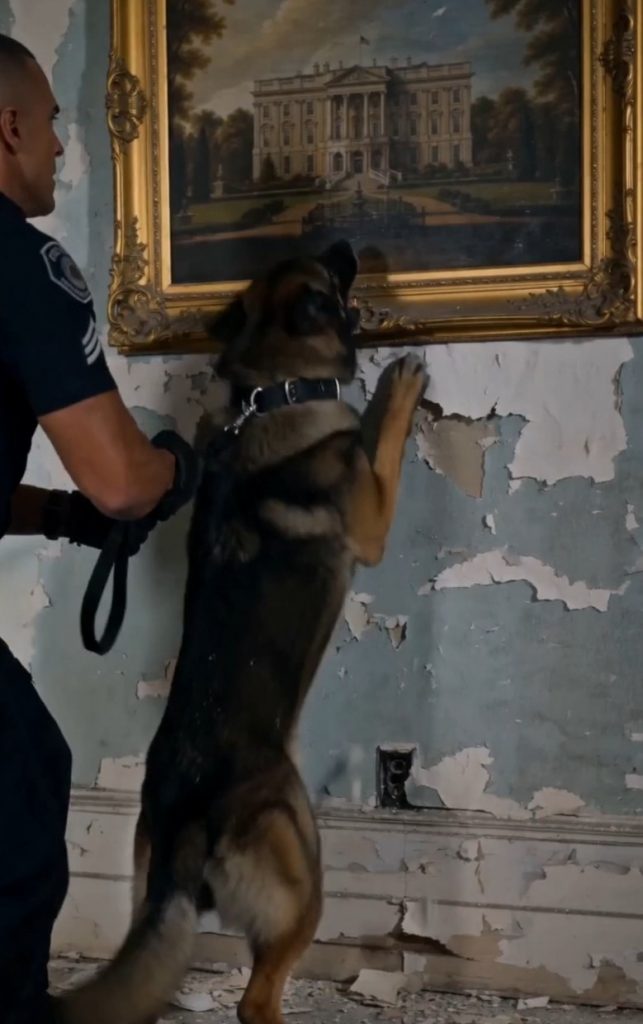
Bobby hit the wall so hard the old house seemed to flinch.
His claws scraped against the peeling white paint beneath the gold-framed painting, tearing loose brittle flakes that drifted to the dirty wooden floor. He barked again and again, deep and violent, his body rising onto his hind legs as if something behind the wall had called him by name.
“Bobby!” Officer Rowe shouted. “Stop!”
The command did nothing.
Rowe leaned back with both hands locked around the black leash, boots sliding over scraps of paper and broken plaster. He was strong, trained, used to handling K9 units in alleys, warehouses, and midnight raids. But this was different.
Bobby was not excited.
He was desperate.
The room smelled of damp wood, dust, and old secrets. Paint peeled from every wall in curling strips. The ceiling sagged slightly near one corner. A half-open closet showed shelves full of yellowed newspapers, cracked jars, and forgotten boxes.
And on the main wall hung the only beautiful thing in the house.
A large oil painting in a heavy gold frame.
It showed a grand estate under a blue sky: white columns, sweeping lawns, a fountain catching sunlight. The kind of house that belonged to another world entirely.
Bobby lunged again, teeth bared, eyes fixed not on the painting itself, but on the wall behind it.
“Rowe,” said Officer Tan from the doorway, one hand near his belt. “That dog knows something.”
Rowe already knew.
He had worked with Bobby for five years. The German Shepherd had found missing children, hidden narcotics, discarded weapons, and once a wounded man under a collapsed porch. He alerted with discipline. He obeyed commands. He never lost himself like this.
Rowe pulled him back step by step until Bobby’s paws hit the floor.
“Stay,” Rowe ordered.
Bobby trembled, panting hard, eyes still locked on the painting.
Rowe approached the wall.
His gloved hand reached for the bottom corner of the frame. The painting was heavier than it looked. When he pulled, the frame dragged against the old paint with a rough, ugly sound.
Then it shifted.
Behind it was not flat plaster.
It was a narrow hidden panel, cracked open just enough for darkness to breathe through.
Rowe raised his flashlight.
The beam entered the hollow space.
His body went still.
Officer Tan saw the color leave his face.
“Rowe?”
Rowe did not answer.
From inside the wall, something small moved.
Then a child’s voice whispered, barely alive with fear.
“Is the dog still there?”
Act II
Thirty-six hours earlier, the whole county had been searching for Lily Ashford.
She was seven years old, with brown eyes, a gap between her front teeth, and a habit of wearing one yellow rain boot and one red rain boot because she said matching shoes were boring. Her picture had been on every local news channel by sunrise.
Missing from Ashford Manor.
That was how the reports said it.
But everyone in town knew Ashford Manor was not just a house.
It was the house.
The estate in the painting.
Three generations of wealth sat behind its iron gates: law firms, shipping contracts, private trusts, charity boards, and old portraits of people who had never once worried about rent. Lily was the only child of Grace Ashford, who had died the year before after a short illness that left the town shocked and the family silent.
After Grace’s death, Lily had been raised by her uncle, Victor Ashford.
Victor was polished, wealthy, and cold in the way old money often confused with dignity. At every press conference, he stood beside the sheriff with a grief-stricken expression and asked the public to help bring his niece home.
“She is the last piece of my sister,” he told the cameras. “I will not stop until she is found.”
People believed him.
Rowe did not know if he believed him. Not at first.
He only knew Bobby had hated him.
The dog had been brought to the estate the morning after Lily vanished. The grounds were searched. The woods behind the stable were searched. The pond was searched. Every gardener, housekeeper, driver, and tutor was questioned until their stories blurred together.
Victor watched from the terrace.
When Rowe led Bobby past him, the German Shepherd stopped.
Not alerted.
Stopped.
He stared at Victor with a low sound in his throat, the kind of warning Rowe had learned never to ignore.
Victor smiled thinly.
“Is that necessary, officer?”
Rowe tightened his hand on the leash.
“Sometimes he reacts to stress.”
Victor looked at Bobby.
“Then perhaps he is in the right house.”
That answer stayed with Rowe.
So did the painting.
In the mansion’s east hallway hung the original Ashford estate portrait, painted almost a century earlier. Rowe had noticed it only because Lily’s nanny, Mrs. Bell, mentioned that the child used to talk to it.
“She said there was another house with the same picture,” the nanny told him, wringing a tissue in her hands. “I thought she meant a dollhouse.”
“Another house?” Rowe asked.
Mrs. Bell nodded.
“She said Uncle Victor took her there once. She called it the broken house.”
Victor denied it immediately.
He said Lily had an imagination. He said children created stories after trauma. He said Mrs. Bell was elderly, emotional, unreliable.
But Bobby kept pulling toward the service road behind the estate.
That service road led into town, past shuttered storefronts, past a church with a leaning steeple, and finally to a row of abandoned houses on Merrow Lane.
The broken house was the third one.
White paint rotting off the walls.
Windows boarded.
Front porch sinking.
And inside, hanging like a cruel joke, was the same estate portrait.
That was when Bobby lost control.
Not because he smelled old dust.
Because somewhere behind that painting, Lily Ashford was still breathing.
And someone had put her inside a wall.
Act III
Rowe tore the panel open with both hands.
The wood gave way in splinters, revealing a narrow storage space hidden between the interior wall and an old chimney shaft. It was barely wide enough for a grown man to crawl into.
Lily sat curled inside with her knees tucked to her chest.
Her face was pale beneath smudges of dust. A child’s cardigan hung loose around her shoulders. One hand clutched a stuffed rabbit so tightly its ear had nearly torn. Her eyes were open, but distant, as if she had spent too many hours convincing herself not to scream.
Bobby whined.
The sound changed her face.
“Bobby?” she whispered.
Rowe glanced back.
“You know him?”
Lily nodded.
“He came to the big house once. He licked my hand.”
Rowe swallowed hard.
He turned to Officer Tan.
“Medical. Now.”
Tan was already on the radio.
Rowe crouched near the opening, keeping his voice low.
“Lily, my name is Officer Rowe. We’re going to get you out.”
She shook her head quickly.
“No. He said if I made noise, no one would believe me.”
“Who said that?”
Her lips trembled.
“Uncle Victor.”
The name landed in the room like a cold hand.
Bobby growled from behind Rowe, not at Lily, but toward the door, toward the world outside, toward the man who had stood before cameras begging for the return of a child he had hidden himself.
Rowe reached gently into the compartment.
“You’re safe now.”
Lily looked at the painting leaning against the wall.
“He told me Mommy was bad,” she whispered. “He said she tried to steal the house from him.”
Rowe said nothing.
He did not want to feed her questions before specialists arrived. He did not want to contaminate anything. But the room, the hidden panel, the missing child, the duplicate painting—every piece had begun arranging itself into something uglier than kidnapping.
Lily lifted one shaking hand and pointed deeper into the compartment.
“There’s a box,” she said. “He came for it.”
Rowe turned his flashlight.
At the back of the hollow space sat a small metal lockbox wrapped in oilcloth. It was old, scratched, and marked with a faded Ashford crest.
Officer Tan stepped closer.
“Rowe, don’t touch it yet.”
“I see it.”
But Lily kept whispering.
“Mommy said if I ever got scared, I should remember the painting. She said the truth was behind the house.”
Rowe stared at her.
Behind the house.
Not the mansion.
The painting.
Grace Ashford had not left her daughter a bedtime riddle.
She had left a map.
Act IV
Victor Ashford arrived before the ambulance left.
Of course he did.
Men like him always seemed to know where trouble had found their name.
His black car stopped at the curb outside the abandoned house, tires hissing against wet pavement. He stepped out in a long wool coat, face arranged into concern before he reached the porch.
“Lily?” he called. “Where is she?”
Rowe met him at the doorway.
Behind Rowe, Bobby stood stiff and silent, ears forward, body blocking the hall.
Victor’s eyes flicked toward the dog.
Then toward the gold-framed painting leaning against the wall.
For a fraction of a second, his face betrayed him.
Not fear of Lily’s condition.
Fear of the painting being moved.
“She’s alive,” Rowe said.
Victor exhaled dramatically, one hand pressed to his chest.
“Thank God.”
Rowe did not move aside.
“She said you put her there.”
Victor’s face hardened, then softened again with practiced speed.
“She is a frightened child. She lost her mother. She invents things. Officer, you should know better than to repeat trauma babble as fact.”
Bobby’s growl returned.
Low.
Controlled.
Victor stepped back.
Officer Tan emerged from the room holding an evidence bag. Inside was the oilcloth-wrapped lockbox. The box had not been opened yet, but the Ashford crest was clear.
Victor’s eyes locked onto it.
That was enough.
Rowe saw the truth pass through him like lightning.
“You came back for that,” Rowe said.
Victor smiled without warmth.
“I own that. Everything connected to the Ashford estate belongs to me.”
“No,” said a voice from behind him.
Everyone turned.
Lily’s nanny, Mrs. Bell, stood at the porch steps, soaked from rain, her coat buttoned wrong, her face white with shock. She must have followed the police chatter from the estate. Or maybe she had followed the guilt that had been burning inside her since Victor dismissed her warning.
“She belongs to Grace,” Mrs. Bell said.
Victor’s jaw tightened.
Mrs. Bell looked at Rowe.
“Grace told me once there were duplicate paintings. One at the manor. One here, where her grandmother used to hide papers during a family lawsuit. I thought she was joking.”
Victor snapped, “Be quiet.”
Mrs. Bell did not.
“Grace was afraid of you.”
The porch fell silent.
Victor looked at the officers, at the dog, at the house, at the evidence bag holding the box he had failed to retrieve before Bobby found the wall.
For the first time, he looked less like a grieving uncle and more like a man cornered by his own arrogance.
The warrant came fast after that.
The lockbox was opened at the station under camera, with attorneys and child advocates present. Inside were documents Grace Ashford had hidden months before her death: trust papers, medical authorizations, recordings, and a handwritten letter addressed to her daughter.
In the letter, Grace wrote that Victor had been pressuring her to change the family trust. She wrote that if anything happened to her, Lily’s inheritance was not to be touched by him. She wrote that the estate, the foundation, and all controlling shares were to be protected until Lily became an adult.
Most importantly, she had named a different guardian.
Not Victor.
Mrs. Bell.
The old nanny broke down when they told her.
Victor had not taken Lily because he loved her.
He had taken her because the child stood between him and everything he believed should have been his.
And he had hidden her in the one place he thought no one would search.
Behind the painting of the life he wanted to steal.
Act V
Lily spent two nights in the hospital.
Not because the doctors expected the worst, but because everyone who loved her needed time to understand that she had truly been found. Mrs. Bell stayed beside her bed. She read the same story six times because Lily kept asking for the beginning again, as if beginnings were safer than endings.
Rowe visited once with Bobby.
The nurses said no at first.
Then Lily asked.
That changed everything.
Bobby entered the room like he understood the holiness of quiet places. No barking. No pulling. No fury. He walked to Lily’s bed and rested his head on the blanket beside her hand.
She smiled for the first time since the rescue.
“You were loud,” she told him.
Rowe stood by the door, arms folded, throat tight.
Bobby’s tail moved once.
Lily rubbed the soft fur between his ears.
“I was trying to be brave,” she said.
Mrs. Bell took her hand.
“You were brave.”
Lily looked up.
“Was Mommy brave too?”
Mrs. Bell’s eyes filled.
“Yes, darling. Your mother was very brave.”
The investigation into Victor Ashford did not remain quiet for long.
It could not.
A missing child found hidden in an abandoned house tied to the Ashford estate was already enough for headlines. But the documents made the story bigger. They revealed pressure, forged signatures, concealed records, and a quiet campaign to paint Grace Ashford as unstable before her death.
Victor denied everything.
He blamed grief.
He blamed staff.
He blamed lawyers.
He blamed the child’s imagination until the recording from Grace’s lockbox was played in court. In it, Grace’s voice was calm and tired as she described her brother’s threats, his obsession with control, and her fear that he would use Lily as leverage if she refused him.
The courtroom went silent.
Victor’s polished grief finally had nowhere left to stand.
He was removed from every trust position before the criminal proceedings even began. The estate was placed under independent protection. Mrs. Bell was appointed Lily’s temporary guardian according to Grace’s wishes, and for the first time since her mother’s death, Lily slept in a room where no one lied to her about love.
As for the broken house on Merrow Lane, the city wanted to tear it down.
Rowe understood the urge.
Some places seemed too stained by what had happened inside them. People wanted clean endings. Empty lots. Fresh paint. A way to pretend darkness disappears when the walls do.
But Mrs. Bell objected.
So did Lily.
“That’s where Bobby found me,” the little girl said.
So the house was not demolished.
It was repaired.
The peeling walls were stripped. The broken floorboards replaced. The hidden compartment sealed behind glass, not as a spectacle, but as a reminder. Grace’s second estate painting was restored and hung in a small public room dedicated to child advocacy and emergency response.
The Ashford Foundation funded it under Lily’s name.
Not Victor’s.
Never Victor’s.
Months later, Officer Rowe returned for the opening ceremony.
He hated ceremonies. He hated speeches even more. But Lily had drawn him a picture of Bobby standing under the gold-framed painting, and at the bottom, in careful uneven letters, she had written:
HE HEARD ME.
So Rowe came.
Bobby sat beside him, older around the eyes than he had been that night, but still alert. Children from the neighborhood gathered around the dog, asking if they could pet him. Rowe looked at Bobby first.
Bobby allowed it with solemn patience.
Mrs. Bell stood near the doorway, one hand on Lily’s shoulder. The girl wore two different rain boots again, yellow and red, because some parts of her had survived untouched.
When the ribbon was cut, everyone clapped.
Rowe did not think about applause.
He thought about the sound of Bobby’s claws against the wall. The command that failed. The frame scraping loose. The small voice from behind the dark.
Is the dog still there?
That question stayed with him more than anything.
Because to Lily, Bobby had not been a police dog in that moment.
He had been proof that the world had not completely forgotten her.
After the ceremony, Lily walked over to Rowe and held up the stuffed rabbit she had carried out of the wall.
“I named him Bobby,” she said.
Rowe glanced down at his K9 partner.
“Careful,” he said. “He might get jealous.”
Lily giggled.
Bobby leaned forward and gently sniffed the rabbit, then sat back as if granting approval.
Mrs. Bell laughed through tears.
For a moment, the broken house did not feel broken anymore.
Light moved through the repaired windows. Fresh paint covered the walls, but one section near the painting had been left untouched beneath glass: cracked, old, peeling white, marked by the scratches of a dog that refused to obey because obedience would have meant leaving a child in the dark.
Rowe looked at those scratches for a long time.
People would tell the story for years.
They would say Bobby went wild.
They would say Officer Rowe pulled down a painting and found the missing Ashford girl.
They would say a wealthy man’s plan collapsed because a police dog would not stop barking at a wall.
All of that was true.
But Rowe knew the deeper truth.
Evil often hides behind beautiful things. A gold frame. A family name. A mansion painted under a perfect sky.
And sometimes, justice arrives covered in dust, snarling at the wall until someone finally listens.