Act I
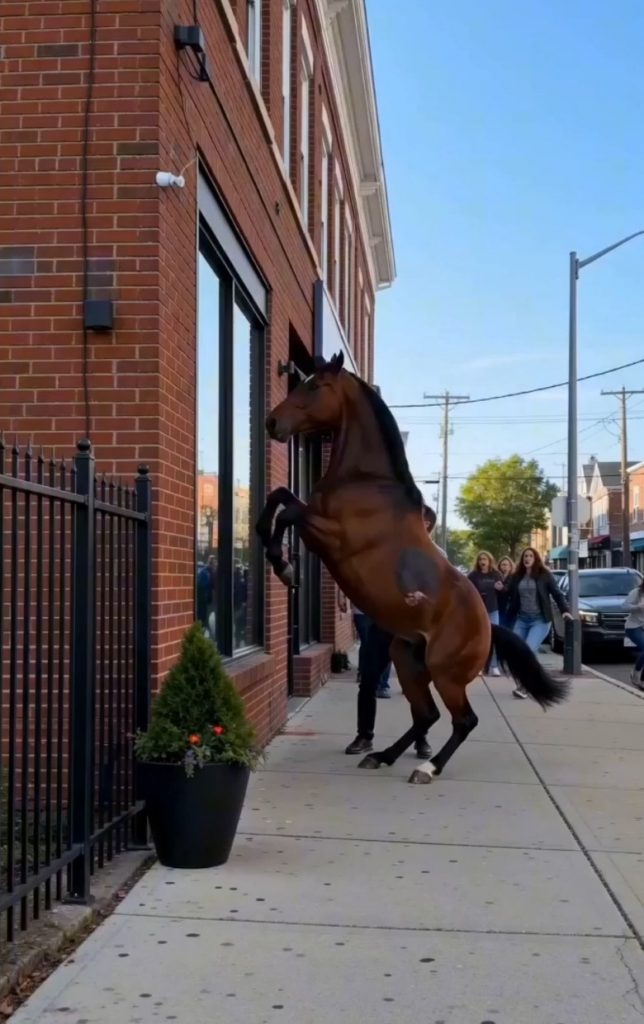
The first crash stopped the entire sidewalk.
Glass exploded outward from the brick storefront in a glittering wave, scattering across the asphalt as people screamed and stumbled backward. A woman dropped her shopping bag. An elderly man nearly fell against a street sign. Someone shouted for everyone to move.
In the center of the chaos stood a brown horse.
Massive. Muscular. Wild-eyed.
A white star marked his forehead, bright against his dark coat as he reared again beneath the afternoon sun. His front hooves struck the pavement with a force that made the crowd flinch. Broken glass crackled under him.
To anyone watching, he looked dangerous.
To Nathan Price, he looked desperate.
“Stop!” Nathan shouted, both hands raised. “Enough! Stop!”
His light gray dress shirt was already damp with sweat. His sleeves were rolled unevenly. He looked less like a man in control and more like someone trying to hold back a storm with his bare hands.
The horse tossed his head and snorted hard.
His name was Apollo.
And Apollo had never behaved like this in his life.
He had been trained for parades, city crossings, therapy visits, noisy crowds, school fairs, and sirens. He could stand calm while children touched his nose. He could walk beside wheelchairs. He could ignore traffic, barking dogs, honking cars, even fireworks.
But now he turned on the sidewalk like something inside the storefront had called to him.
The crowd retreated as Apollo stepped toward them, ears pinned back. A man with a phone kept recording even as he backed away, his hands shaking around the device.
“Get that thing away!” someone yelled.
Nathan moved between Apollo and the people.
“Apollo,” he said, lower now. “Look at me. Look at me, boy.”
For one second, the horse did.
His huge dark eye locked onto Nathan’s.
And Nathan saw something that froze him colder than fear.
Recognition.
Not of Nathan.
Of the shop.
Apollo spun back toward the broken window.
He stomped once, then again, gathering himself. Glass clinked around his hooves. Nathan lunged forward, but Apollo shoved his head through the shattered opening before anyone could stop him.
The sign above the storefront read Voss & Vale Antiques.
A respectable shop.
A beautiful shop.
A shop Nathan had passed a hundred times without ever stepping inside.
Apollo pressed deeper toward the dark interior, breathing hard, nostrils flaring. His body trembled as if every muscle in him was fighting to get through that window.
Nathan’s arms dropped to his sides.
Helpless.
Defeated.
The bystanders thought he had given up.
They were wrong.
Nathan had finally seen what Apollo was reaching for.
Hanging inside the shop, half-hidden behind a velvet curtain, was an old leather bridle with a silver star on the browband.
Nathan knew that bridle.
He had buried it with his sister’s things two years ago.
Act II
Before the city knew Apollo as a frightened animal destroying a storefront, he had belonged to a girl named Rosie Price.
Rosie was Nathan’s younger sister.
She had been all fire and freckles, the kind of girl who climbed fences before she learned the word permission. Their parents bought Apollo when Rosie was fourteen and he was still too young, too nervous, and too proud to let anyone pretend he was easy.
Everyone said the horse was too much for her.
Rosie laughed at them.
“He’s not too much,” she said. “He just hates being misunderstood.”
That became the story of both of them.
Rosie trained Apollo with patience so stubborn it looked like faith. She sat in the pasture for hours without touching him. She sang old country songs off-key while he grazed nearby. She taught him to lower his head for children, to stop when someone cried, to move only when asked.
By the time she was nineteen, Apollo followed her like a shadow.
Then came the accident.
At least, that was what everyone called it.
A trailer crash on a wet county road. Rosie had been hauling Apollo back from a charity event when the trailer came loose, jackknifed, and went off the shoulder. Apollo survived with cuts, bruises, and terror that took months to settle.
Rosie did not come home.
Nathan had never forgiven himself for that night.
He was supposed to drive with her. He had promised. Then work ran late, his phone died, and Rosie left alone with a text he did not see until hours later.
Don’t worry. Apollo and I have done harder things.
After the funeral, Nathan sold the family farm.
Not because he wanted to.
Because grief had bills.
His father’s debts surfaced. His mother stopped leaving her room. Insurance delayed payment. Contractors wanted money. Everyone had advice. Nobody brought a solution.
Only one thing Nathan refused to sell.
Apollo.
Rosie’s horse stayed with him.
Nathan moved him to a boarding stable outside the city and visited every morning before work. At first, Apollo would not let him close. He stood at the far end of the paddock, staring through Nathan as if blaming him too.
Nathan accepted that.
He brought carrots anyway.
Months passed before Apollo lowered his head to Nathan’s chest and breathed against him with a sadness so human that Nathan nearly broke.
From then on, they belonged to each other in a quiet, wounded way.
Apollo was all Nathan had left of Rosie.
Or so he thought.
The bridle changed everything.
Rosie’s favorite bridle had been custom-made by their grandfather. Brown leather, hand-stitched, with a silver star on the browband that matched the mark on Apollo’s forehead.
It had vanished after the crash.
Nathan had assumed it was lost in the wreckage.
But there it was.
In a polished antique shop window on a bright afternoon, displayed like a collectible for strangers with money.
And Apollo had recognized it before Nathan did.
That was why he broke the glass.
Not madness.
Not aggression.
Memory.
Act III
The police arrived within minutes.
So did the owner of the shop.
Gideon Voss stepped out through the front door in a charcoal suit, his silver hair slicked neatly back, his face arranged into outrage before he had even reached the sidewalk.
“What is wrong with that animal?” he snapped.
Nathan turned toward him slowly.
Apollo still stood near the shattered window, breathing hard but no longer striking. His head remained pointed toward the bridle inside, his whole body locked in place.
Voss pointed at the destruction.
“I want that horse removed. Immediately. And I want him put down if necessary.”
Nathan stepped forward.
“Don’t say another word about my horse.”
Voss blinked, surprised by the coldness in his voice.
A police officer raised a hand. “Sir, step back.”
Nathan ignored him and pointed through the broken glass.
“That bridle belongs to my family.”
Voss gave a tight, dismissive laugh. “This is an antique shop. We acquire items legally.”
“Where did you get it?”
“I don’t discuss private inventory with hysterical strangers.”
Nathan’s eyes narrowed.
Apollo stomped once, as if answering for him.
The crowd had gone quieter now. Phones were still raised, but the mood had changed. People who had been terrified moments earlier were leaning in, watching Voss instead of the horse.
An elderly man near the stop sign spoke up.
“I saw the horse look straight at that thing.”
A woman beside him nodded. “He wasn’t going after people. He wanted the window.”
Voss’s face tightened.
Nathan moved closer to the shattered opening.
Inside, the bridle hung from an iron hook beside old riding crops, tarnished trophies, and framed photographs of racehorses nobody in the city cared enough to recognize.
But beneath the bridle, on a small shelf, sat something worse.
A cracked leather journal.
Rosie’s journal.
Nathan knew the pale blue ribbon tied around it. He knew the burned corner from the summer she dropped it near a campfire. He knew the way she used to tuck it into the truck door before every trip.
His throat closed.
“That’s hers too,” he whispered.
Voss stepped in front of him. “You are not entering my store.”
Nathan looked at the officer.
“My sister died two years ago. Those items disappeared from the crash scene.”
The officer’s posture shifted.
Voss noticed.
“Ridiculous,” he said. “This man is emotional. His animal caused thousands in damages, and now he is inventing some dramatic story to avoid responsibility.”
Nathan stared at him.
Then a voice came from the crowd.
“He’s not inventing it.”
Everyone turned.
A teenage girl stood near the edge of the sidewalk, wearing an oversized hoodie and gripping her phone so hard her knuckles had gone white. Her face was pale, but her eyes were fixed on Voss.
The shop owner went still.
“Lena,” he said softly. “Go inside.”
The girl did not move.
Nathan looked from her to Voss.
“You know something.”
Lena swallowed.
Voss’s voice sharpened. “Go inside.”
The girl shook her head.
“No.”
Apollo lifted his head.
For the first time since the glass broke, he let out a low, aching sound.
Lena flinched as if it had touched something inside her.
Then she looked at Nathan and said the sentence that turned the whole sidewalk silent.
“My father brought those things here the night your sister died.”
Act IV
Voss moved fast.
Too fast for an innocent man.
He grabbed Lena’s arm and pulled her toward the door, but the officer stepped between them.
“Let go of her.”
Voss released her immediately, raising both hands with a false little smile.
“She’s confused. She was a child.”
“I was thirteen,” Lena said, voice shaking. “I remember.”
Nathan could barely breathe.
The sidewalk, the police, the phones, the broken glass—all of it blurred around the girl standing under the shop sign with tears in her eyes.
Lena pointed toward the display.
“My dad worked recovery towing back then. He was called to the crash. He came home late with a box in the truck. He said nobody would miss what was inside because the girl was gone.”
Nathan’s face twisted.
Voss spoke through clenched teeth. “That is enough.”
But Lena was no longer looking at him.
She was looking at Apollo.
“He kept saying the horse made too much noise,” she whispered. “He said the horse wouldn’t leave the trailer. It kept screaming every time they moved the box.”
Nathan closed his eyes.
For two years, he had imagined Apollo alone in the dark after the crash, frightened and injured, calling for Rosie while strangers picked through what was left.
The thought nearly took him to his knees.
The officer turned to Voss.
“Open the store.”
“My lawyer—”
“Open it.”
Voss looked around at the phones recording him, at the crowd no longer afraid, at Nathan standing beside the horse who had dragged a buried secret into daylight.
Then he made his second mistake.
He ran.
Not far.
He shoved through the doorway and tried to disappear into the back of the shop. Two officers followed. The crowd erupted into shouts. Apollo tossed his head, but Nathan caught his lead rope and held firm.
“Easy,” Nathan whispered. “Easy. We’ve got it now.”
Apollo trembled beneath his hand.
Inside the shop, something crashed.
Then came the sound of a door being forced open.
Minutes later, officers brought Voss out in handcuffs.
He shouted about illegal searches, damage, slander, stolen property, anything that might turn the world’s eyes away from the truth. But nobody looked away.
Not anymore.
A detective arrived and entered the shop with gloves.
The back room held more than Rosie’s bridle and journal.
There was a box labeled with dates. Several personal effects from old accident scenes. Watches. rings. wallets. medals. photographs. Things too intimate to belong in a store window. Things taken from people at the worst moments of their families’ lives.
And beneath Rosie’s journal, tucked inside a plastic sleeve, was a memory card.
Nathan did not understand its importance until two days later.
The card came from Rosie’s dashboard camera.
The crash had not been caused by rain.
The footage showed another vehicle following too close on the county road. A tow truck. Its headlights high. Its front bumper nearly touching the trailer.
Rosie’s voice could be heard, tense but steady.
“Back off,” she said once.
Then louder.
“Back off!”
The truck did not.
The trailer swayed.
The screen jolted.
The road vanished.
Nathan watched the footage only once.
He did not need to see it again.
The driver of the tow truck had been Lena’s father.
He had died the year before the horse shattered the storefront, taking the first half of the secret with him. Gideon Voss had kept the second half because stolen grief made profitable merchandise.
He had not caused the crash.
But he had sold pieces of it.
And in doing so, he had preserved the proof that Rosie had not simply lost control.
Apollo had known the smell of the bridle.
He had known the leather.
He had known the memory of the last night his girl touched it.
And when every human walked past the window without understanding, the horse did the only thing left.
He broke through.
Act V
The city wanted a simple headline.
Horse Goes Wild Downtown.
Then, after the truth came out, the headline changed.
Horse Exposes Stolen Evidence in Fatal Crash.
Nathan hated both versions.
Apollo had not gone wild.
And he had not exposed evidence like some trained detective in a story people could share over breakfast before forgetting.
He had remembered Rosie.
That was all.
That was everything.
The investigation widened quickly. Gideon Voss was charged for possession and sale of stolen property, obstruction, and trafficking in items connected to multiple accident scenes. Families came forward after seeing the news. Some recognized watches, lockets, military pins, photographs.
The antique shop closed within a week.
Its elegant sign came down.
The broken window stayed boarded over for months, not because the city was slow to repair it, but because people kept leaving flowers there.
Not for Voss.
For Rosie.
For strangers.
For all the small pieces of love that had been stolen and priced.
Lena testified.
She did it with her hands shaking and her voice breaking, but she did it. She told the court about the box her father brought home, the arguments she overheard, the items Voss bought in cash, the way adults told her to stay quiet because good girls did not destroy families by telling ugly truths.
Nathan sat in the courtroom with his mother on one side and an empty space on the other.
He could not bring Apollo into court, though part of him wished he could.
The horse had earned the right to stare Voss down.
When the judge ordered Rosie’s belongings returned, Nathan drove straight from the courthouse to the boarding stable.
He did not go home first.
He did not call anyone.
He carried the bridle and the journal into Apollo’s stall and stood there in the soft smell of hay and dust, unable to move.
Apollo stepped toward him slowly.
The horse lowered his head.
Nathan lifted the bridle with both hands.
For a moment, Apollo only breathed over it.
Then he pressed his muzzle against the silver star and closed his eyes.
Nathan broke.
He buried his face against Apollo’s neck and sobbed with an old, exhausted grief that had finally found a place to land. Apollo stood perfectly still, the way he had stood for Rosie, the way he had stood after the crash, the way he had stood at the window until the world understood.
“I’m sorry,” Nathan whispered. “I’m so sorry I didn’t see it.”
Apollo breathed against his shoulder.
No blame.
No answer.
Just warmth.
Later, Nathan opened Rosie’s journal.
Most of it was ordinary in the way sacred things often are. Feed schedules. Training notes. Half-finished sketches of Apollo’s head. Complaints about Nathan being bossy. A page full of names she wanted for a future foal she did not own and never would.
Near the end, she had written one paragraph that Nathan read until the paper softened under his fingers.
Apollo listens harder than most people. That’s why people think he’s difficult. He doesn’t ignore things just because they’re inconvenient. I hope I learn to be that brave.
Nathan had the line copied onto a small plaque and mounted outside Apollo’s stall.
A month later, he returned to the old storefront.
Not alone.
The city had asked whether he wanted to speak at a small public safety event. Nathan almost refused. He did not want cameras. He did not want strangers turning Rosie into a symbol too clean to be true.
But then Lena called.
She asked if she could come.
So Nathan said yes.
The sidewalk looked different that day. The glass was gone. The asphalt had been cleaned. A new business had not yet moved in, leaving the brick facade empty and raw.
Lena stood beside Nathan, eyes down.
“I should have said something sooner,” she whispered.
Nathan looked at her.
She was seventeen. Old enough to carry guilt. Too young to deserve the weight of adults’ crimes.
“You said it when it mattered,” he told her.
She shook her head, crying. “Your sister might still—”
“No.”
The word was gentle but firm.
Nathan waited until she looked at him.
“You don’t get to punish yourself for what grown men chose.”
Lena covered her mouth and nodded, but the tears came anyway.
Nathan did not try to stop them.
Some grief needed witnesses more than comfort.
When Apollo arrived, led carefully by a mounted therapy volunteer, the crowd parted in silence.
The horse walked calmly down the same sidewalk he had once filled with terror. His coat gleamed in the sunlight. The white star on his forehead seemed brighter than Nathan remembered.
People stepped back, but not in fear this time.
In respect.
Apollo stopped in front of the boarded window.
For a long moment, he stared at it.
Then he lowered his head.
Nathan placed one hand on his neck.
“This is where they finally listened,” he said softly.
Apollo flicked one ear toward him.
The crowd stayed quiet.
No one shouted. No one shoved a phone too close. Even the traffic seemed to soften around them.
Nathan looked at the boarded storefront and thought of Rosie’s laugh, her muddy boots, her impossible confidence, the way she used to say Apollo hated being misunderstood.
She had been right.
About the horse.
About people too.
The world had seen a violent animal and a shattered window.
It had taken a horse to reveal a stolen past, a hidden crime, and a girl whose final moments deserved more than a careless word like accident.
Nathan reached into his jacket and took out the silver-star bridle.
He did not put it on Apollo.
Not yet.
Instead, he held it up in the sunlight so the silver caught fire for one brief, beautiful second.
Then he carried it back to the trailer.
Rosie’s things were going home.
And Apollo, who had broken a window because no one else would open a door, walked beside him calmly through the crowd.