Act I
The dead bride still wore her veil.
That was the first thing Mara Bennett could not understand.
In twelve years of night shifts, she had seen grief arrive in many forms. Hospital gowns. Emergency blankets. Wedding rings taped carefully into plastic bags. Families refusing to leave hallways because walking away felt like betrayal.
But never this.
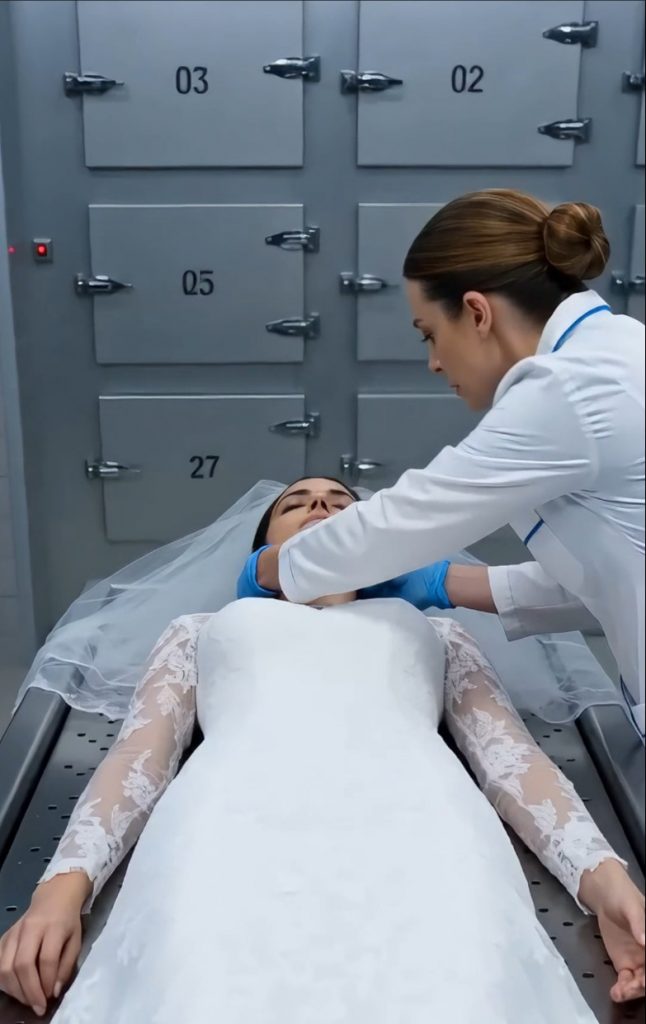
Never a young woman lying motionless on a stainless steel examination table in a full lace wedding gown.
The morgue was cold enough to make the overhead lights feel cruel. Gray tiled walls. Numbered metal drawers. Stainless steel cabinets with tools arranged too neatly for a night when nothing made sense.
Mara stood beside the table in her white lab coat and blue gloves, trying to remain professional.
The woman on the table looked no older than twenty-eight. Dark hair spilled beneath the veil. Her eyes were closed. Her face was pale and still, the kind of stillness people in hospitals learn to fear.
The paperwork said her name was Isabel Harrow.
Declared dead at 10:42 p.m.
Cause pending.
No family present.
Mara frowned at that.
No family present?
A bride did not vanish from her wedding reception and arrive alone in a morgue unless someone powerful wanted the night to move quickly.
She leaned over and adjusted the lace near Isabel’s neck. The gown was expensive, hand-beaded, with tiny pearls stitched along the bodice. Whoever dressed her had wanted tragedy to look beautiful.
Mara lowered the veil from the young woman’s cheek.
Then her gaze drifted to Isabel’s left wrist.
Something about the hand bothered her.
Not the color.
Not the position.
The tension.
Mara stepped closer and took the wrist gently between her gloved fingers. She turned it inward, pressing two fingers against the pale skin.
At first, there was nothing.
Only the hum of fluorescent lights.
Only the cold room.
Only the dull sound of her own breathing.
Then she felt it.
A pulse.
Weak.
Slow.
But there.
Mara’s entire body went rigid.
She checked again, harder this time, praying she had imagined it and praying she had not.
There it was.
The dead bride had a heartbeat.
Mara’s head snapped toward the door.
“Doctor!” she screamed. “Doctor!”
Her voice shattered the morgue silence.
She ran for the heavy stainless steel door, her shoes striking the tile, her heart pounding so hard she could feel it in her throat.
“Quickly!”
Behind her, the door swung shut.
The room went quiet again.
And on the table, beneath the ruined veil, Isabel Harrow’s fingers moved once.
Because she had not died at her wedding.
Someone had sent her to the morgue before she could wake up.
Act II
Six hours earlier, Isabel Harrow had stood beneath a ceiling of white orchids and tried not to tremble.
The wedding was held at Harrow House, an old family estate outside the city with marble staircases, gilded mirrors, and portraits of dead ancestors staring down from every wall. Guests called it elegant. Isabel had always thought it felt like a museum built to trap ghosts.
Her fiancé, Julian Vale, loved it.
He loved the history, the money, the attention, the cameras flashing whenever he touched the small of her back. He loved saying “my wife” before the vows were even finished.
Most of all, he loved what marrying Isabel would mean.
Harrow Medical Foundation controlled three hospitals, two research centers, and a trust worth more than most people could imagine. Isabel had inherited her mother’s controlling share after a car accident seven years earlier.
She had been twenty-one then.
Too young, too grieving, and too surrounded by men in suits telling her what her mother would have wanted.
Julian entered her life two years later.
He was charming in the expensive way. Soft voice. Perfect manners. The ability to remember small details and use them like keys. He knew when to send flowers, when to step back, when to call her brave.
By the time Isabel realized his tenderness always led her toward a signature, she was already engaged.
Her mother’s old attorney, Ruth Calder, warned her quietly.
“Do not sign anything on your wedding day,” Ruth said. “Not a trust adjustment. Not a hospital voting proxy. Not even a napkin if Julian hands you the pen.”
Isabel laughed then, but the laugh had no joy in it.
“You think he’d do that?”
Ruth’s face did not soften.
“I think men who want control often wrap it in romance first.”
That morning, Isabel found the papers.
They were hidden inside a leather folder in Julian’s dressing room, beneath a handwritten vow card he had probably never intended to read. A postnuptial transfer. A medical proxy. A voting authority document giving Julian control of her shares if she became “incapacitated.”
Incapacitated.
The word stayed with her as her bridesmaids fastened the back of her gown.
At the altar, Julian smiled.
Isabel smiled back because hundreds of people were watching.
She said the vows.
She took the ring.
But when Julian’s lawyer approached her during the reception with a silver pen and a quiet smile, Isabel refused.
Not loudly.
Not dramatically.
She simply closed the folder and said, “Tomorrow.”
Julian’s expression did not change.
That frightened her more than anger would have.
Twenty minutes later, she felt dizzy.
The ballroom blurred. Voices stretched and folded. Julian’s hand tightened around her elbow as if he were supporting her, but his mouth was close to her ear.
“You should have signed,” he whispered.
Those were the last words she remembered before waking for half a second in a moving elevator.
Her veil was over her face.
Someone was crying, but not from grief.
From fear.
A man’s voice said, “The certificate is done. Move her before Ruth Calder gets here.”
Then darkness took her again.
And when Isabel opened her eyes the next time, she was in the morgue.
Act III
Dr. Lionel Graves reached the morgue in less than a minute.
He was sixty-two, sharp-eyed, and too experienced to waste questions during a crisis. Mara had worked with him long enough to know that if he looked scared, the situation was worse than it seemed.
He did not look scared.
He looked furious.
“She has a pulse,” Mara said, breathless.
He was already beside the table.
The next minutes became a blur of urgent voices and controlled motion. Isabel was moved from the morgue to an emergency bay under a false name to keep her location from appearing in the hospital system. Dr. Graves called only two people: the head of security and Ruth Calder.
Mara stayed with Isabel.
She did not know why at first.
Maybe because she had found her. Maybe because every instinct in her body said that whoever brought a living bride to the morgue would come back if they realized the mistake.
Isabel’s eyelids fluttered near dawn.
Mara leaned closer.
“Isabel? You’re in the hospital. You’re safe.”
The young woman’s lips parted, but no sound came.
Mara touched her hand carefully.
“Don’t try to sit up.”
Isabel’s eyes opened.
They were dark, unfocused, and full of terror.
“My dress,” she whispered.
“It’s here.”
“The pocket.”
Mara frowned. “What pocket?”
Isabel’s fingers twitched weakly toward the side of her gown.
Mara searched the layers of lace and tulle until she found a hidden seam beneath the skirt, stitched so carefully it looked decorative. Inside was a small folded envelope.
The paper was soft from being carried too long.
Ruth Calder arrived just as Mara opened it.
The attorney stopped in the doorway, her face pale.
“Where did you get that?”
Mara looked at Isabel.
“She told me.”
Ruth stepped forward and took the envelope with trembling hands.
Inside was a letter written in Isabel’s mother’s handwriting.
My darling girl,
If you are reading this, it means someone has tried to make you doubt your own judgment.
Do not let them.
Your father did not die from illness. My accident was not an accident. And the Vale family has wanted Harrow since before you were born.
Trust Ruth. Trust no proxy. Trust no husband who asks for control before he offers truth.
Beneath the letter was a key.
Small.
Brass.
Marked with a number.
Drawer 17.
Mara looked up slowly.
The morgue drawers had numbers.
But so did the archive vaults beneath Harrow House.
Ruth closed her eyes.
“She found it,” she whispered. “Your mother knew.”
Isabel tried to speak, but her breath shook.
“Julian…”
Ruth bent close.
“He doesn’t know you’re alive.”
Isabel’s eyes filled.
Mara watched something change in the room.
Until that moment, the story had been a medical emergency.
Now it was something darker.
A bride had been declared dead too quickly. A hospital file had been manipulated. A groom had documents ready for her incapacity. And hidden inside the wedding dress was a letter from a dead mother warning her daughter that this had been coming for years.
Then the security guard entered.
“Someone is asking for the body,” he said.
Mara went still.
Ruth turned.
“Who?”
The guard swallowed.
“Her husband.”
Act IV
Julian Vale arrived dressed in black.
Not wrinkled. Not panicked. Not destroyed by grief.
Black suit. Black tie. Perfect hair. Perfect sorrow arranged on his face like a mask he had practiced in the mirror.
He came with two lawyers, Isabel’s uncle, and Dr. Adrian Keller, the physician who had signed the death declaration.
They did not go to the emergency bay.
They went to the morgue.
That was their mistake.
Mara had insisted the original room be left untouched.
The stainless steel table remained empty beneath the lights. The wedding veil lay folded where she had placed it. The numbered drawers stood silent along the back wall.
Julian entered and stopped.
His eyes went first to the empty table.
Then to Dr. Graves.
Then to Mara.
For one fraction of a second, the mask slipped.
Mara saw fear.
“What is this?” Julian asked.
Dr. Graves did not answer.
Ruth Calder stepped from the corner of the room.
“This is a very good question.”
Julian recovered quickly.
“Ruth. I don’t know what you think you’re doing, but Isabel’s body is to be released to my family.”
“She is not your family,” Ruth said.
“She is my wife.”
“No,” Ruth replied. “The marriage certificate was never legally filed.”
Julian’s jaw tightened.
“That is a technicality.”
Mara looked at him and felt cold all over.
A man whose bride had died hours earlier should not care about technicalities.
Dr. Keller moved forward, face damp with sweat.
“There may have been a clerical issue. In cases of sudden collapse, it is possible—”
Dr. Graves cut him off.
“You sent a living woman to my morgue.”
The words landed like metal.
Julian’s uncle cursed under his breath.
Julian did not move.
Then Ruth held up Isabel’s mother’s letter.
“Drawer 17,” she said.
For the first time, Julian looked truly shaken.
The police arrived before he could answer.
Not local officers who might be impressed by the Vale name. Ruth had called state investigators and a judge she had known for thirty years.
The archive vault beneath Harrow House was opened under warrant that afternoon.
Drawer 17 held three things.
A sealed medical report from Isabel’s father’s final week. A private investigator’s file about the crash that killed her mother. And copies of old correspondence between Julian’s father and members of the Harrow board discussing how to “secure influence” over the foundation through marriage, proxy, or incapacity.
There was also a photograph.
Isabel’s mother standing beside a much younger Dr. Keller.
On the back, she had written one line.
He will sign anything for them.
By evening, Dr. Keller had confessed enough to save himself from being the only man left holding the lie. He admitted Julian had pressured him to declare Isabel dead quickly after her collapse. He claimed he believed she was beyond help. He claimed panic. Confusion. Bad judgment.
Mara did not believe him.
Neither did Dr. Graves.
Neither did Ruth.
The wedding photographer provided the final blow.
A camera in the reception hall had captured Julian leaning toward Isabel moments before she collapsed. Another angle showed his lawyer already waiting near the side exit with documents in hand. A third showed Dr. Keller entering the service elevator before any official emergency call had been made.
The timeline was not grief.
It was choreography.
Julian was arrested before midnight.
As officers led him through the hospital corridor, he saw Isabel alive behind a glass door.
For the first time all night, his face broke.
Not with love.
With rage.
Isabel saw it.
And understood fully that the man she had almost given her life to had been furious only because she had survived.
Act V
The world learned her name by morning.
Dead Bride Found Alive.
Heiress Survives Wedding Horror.
Harrow Foundation Scandal Deepens.
Reporters crowded outside the hospital while Isabel recovered in a private room under guard. They wanted photographs of the wedding gown, interviews with the morgue technician, quotes from anyone who had seen Julian’s face when the lie collapsed.
Mara refused them all.
She returned to work three nights later.
People called her brave. She hated how simple that sounded. Brave made it seem clean, as if she had known what to do without fear. The truth was that her hands had shaken so badly she could barely open the morgue door.
But she had checked the wrist.
That was what stayed with her.
Not the headlines.
Not the arrest.
Not even Julian’s face when he realized Isabel was alive.
Just two fingers on a pulse everyone else had been too eager to ignore.
Isabel stayed in the hospital for nine days.
On the tenth, she asked to see the morgue.
Dr. Graves said no.
Ruth said absolutely not.
Mara said nothing.
Isabel looked at her and asked again.
So Mara took her.
Not at night. Not alone. Not as a spectacle.
They went in the afternoon, when light from the corridor softened the room and made it look less like a place for endings.
Isabel stood beside the stainless steel table for a long time.
She wore a pale blue sweater now, her hair loose around her shoulders. No veil. No diamonds. No heavy gown built to make her look like someone else’s dream.
“I was here?” she asked.
Mara nodded.
Isabel touched the edge of the table.
“I don’t remember it.”
“That might be a mercy.”
Isabel gave a faint, tired smile.
“I’m not sure I believe in mercy anymore.”
Mara looked at her.
“I do.”
Isabel turned.
Mara swallowed, suddenly embarrassed by her own certainty.
“Mercy was your mother hiding that letter. Mercy was Ruth not giving up. Mercy was Dr. Graves answering when I screamed.” She paused. “Mercy was your pulse still being there.”
Isabel’s eyes filled.
For a moment, she looked younger than she had on the table.
Then she whispered, “And you checking.”
Mara looked away first.
The trial came months later.
Julian’s defense tried to paint him as a grieving groom trapped in a terrible misunderstanding. That failed the moment prosecutors played the reception footage. It failed again when Ruth read Isabel’s mother’s letter aloud. It failed completely when Dr. Keller testified to the pressure, the forged timeline, and the documents Julian planned to file as soon as Isabel was beyond objection.
The marriage certificate was voided.
Julian was convicted on multiple charges tied to fraud, conspiracy, and the attempt to unlawfully control Isabel’s medical and financial affairs. Dr. Keller lost his license and faced charges of his own. Several Harrow board members resigned before they could be removed.
Isabel did not celebrate.
Survival, she discovered, did not feel like victory at first.
It felt like waking every day in a life someone else had tried to close.
But slowly, she returned to herself.
She took control of the foundation. She replaced half the board. She opened an independent patient advocacy office inside every Harrow hospital, with direct reporting outside hospital administration.
The first policy she signed required mandatory secondary review before any sudden death declaration moved to release.
She sent a copy to Mara with a handwritten note.
Because you checked.
The wedding gown remained in evidence for nearly a year.
When it was finally returned, Isabel did not burn it.
People expected her to.
Instead, she brought it to a seamstress who worked quietly for three months. The stained hem was removed. The heavy train was cut away. The pearls were taken from the bodice and stitched into small white ribbons.
Those ribbons were given to women leaving unsafe marriages, families fighting medical neglect, and patients whose voices had been dismissed.
Isabel kept one.
Mara kept one too, though she never told anyone.
One evening, almost a year after the night in the morgue, Isabel returned to Harrow House for the first public foundation gala under her leadership.
No white gown.
No Julian.
No Vale family smiling from the front row.
She wore deep green, her mother’s favorite color, and stood beneath the old staircase where she had once nearly signed away her future.
When she began her speech, the room fell silent.
“A year ago,” Isabel said, “someone tried to turn me into a beautiful tragedy.”
Her voice did not tremble.
“They dressed me for mourning before I was gone. They counted on silence, speed, money, and fear. They counted on people seeing a wedding dress and accepting the story they were told.”
Her eyes found Mara in the crowd.
“But one person looked closer.”
Mara’s throat tightened.
Isabel smiled softly.
“So tonight is not about my survival alone. It is about the lives saved when someone refuses to treat a person like paperwork.”
The applause came slowly, then rose until the chandelier seemed to shake with it.
Later, away from the cameras, Isabel stood with Mara near a balcony overlooking the garden.
“Do you ever think about it?” Isabel asked.
“The morgue?”
Isabel nodded.
Mara looked out at the dark trees.
“Every shift.”
“I’m sorry.”
“I’m not.”
Isabel looked surprised.
Mara turned to her.
“That room used to feel like the end of every story. Now I know better.”
Below them, guests moved through the garden lights.
Isabel touched the white ribbon tied around her wrist.
“What does it feel like now?”
Mara thought of the cold table, the numbered drawers, the quiet hum of fluorescent lights, and the impossible beat beneath her fingers.
“A warning,” she said. “And a promise.”
Isabel nodded.
Neither woman needed to explain.
Some doors close too soon.
Some stories are buried before the truth has taken its first breath.
And sometimes, in the coldest room in the hospital, one faint pulse is enough to bring an entire kingdom of lies back to life.