Act I
The ballroom glittered like nothing painful had ever happened inside it.
Crystal chandeliers spilled light over white tablecloths, gold chairs, tall floral arrangements, and mirrors framed in ornate gold. Guests in tuxedos and evening gowns sat beneath the glow, waiting for the next speech, the next toast, the next polished memory.
Then the woman in red stepped onto the stage.
Her name was Mara Bennett.
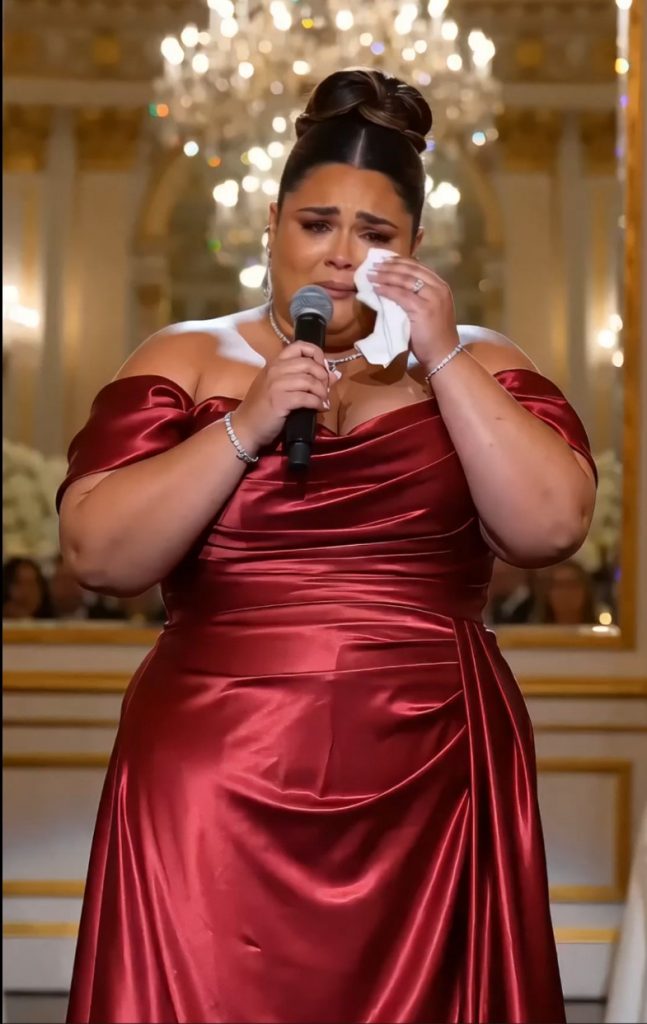
She wore a shimmering off-the-shoulder satin gown, deep red under the chandelier light, with teardrop earrings trembling beside her cheeks. Her dark hair was pinned in an elegant updo, but her hands gave her away.
One held the microphone.
The other held a white tissue, already damp.
In the front row, the bride went still.
Lila Bennett, radiant in white lace and a tiara, had been smiling seconds earlier. Her groom, Daniel, sat beside her in a black tuxedo. His parents sat on his other side, watching with polite warmth.
Then Mara lifted the microphone.
Her voice trembled, but it carried.
“My sister almost didn’t invite me to her wedding.”
The room shifted.
A fork touched a plate with a tiny sound. Someone’s breath caught. Lila’s hands flew to her mouth.
Mara wiped one tear from beneath her left eye.
“She said she was ashamed people would know I’m her sister.”
The silence became unbearable.
“She told me my body would ruin the wedding photos.”
Lila lowered her hands slowly, her eyes filling with tears. Daniel turned toward her, stunned, as if he had just discovered a locked room inside the woman he had married.
Mara stood alone on the raised black stage, red gown catching every crystal reflection, her face open and wounded in front of two hundred people.
Nobody laughed.
Nobody whispered.
Even the waiters froze along the walls.
Mara looked down at her sister.
“But tonight,” she said, her voice growing stronger, “I came anyway.”
Her right hand clutched the fabric of her red skirt.
“I came to finally see who truly loves you.”
That was when the bride began to cry.
Not delicately.
Not for attention.
She bent forward as if the words had struck something buried so deep inside her that shame had mistaken itself for survival.
And Mara had not even reached the part that would break the room open.
Act II
For most of Lila’s life, Mara had been the person standing just outside the frame.
Not because she wanted to be.
Because everyone else kept placing her there.
When they were little, Mara was the older sister who tied Lila’s shoes, packed her lunches, fixed her hair for school picture day, and slept on the floor beside her bed during thunderstorms.
Their mother worked double shifts at a hotel laundry. Their father disappeared slowly, first from dinner, then from birthdays, then from their lives entirely.
Mara became the spare parent before she became a teenager.
She learned to stretch grocery money. She learned which bills could wait. She learned how to smile when Lila asked why other girls had fathers at school plays and she did not.
“You have me,” Mara would say.
And Lila would wrap both arms around her waist and say, “That’s better.”
Back then, she meant it.
Then the world got louder.
Middle school taught Lila that cruelty could dress itself as advice. Girls told her Mara was embarrassing. Boys made jokes when Mara picked her up after school. Adults said things in gentle voices that cut deeper because they sounded concerned.
Mara heard them all.
Such a pretty face.
So confident for someone her size.
It must be hard for the younger one.
Lila began to notice people noticing.
At first, she defended Mara fiercely. Then quietly. Then not at all.
By college, Lila had learned the language of image. Filters. Angles. Guest lists. Brand partnerships. The careful curation of a life that looked effortless because every vulnerable thing had been edited out.
Mara watched from a distance and tried not to take it personally.
She failed.
When Lila got engaged to Daniel Whitaker, the wedding became less a celebration and more a production. Daniel came from a wealthy family, the kind with summer homes and foundation dinners and women who never seemed to sweat under chandeliers.
Daniel himself was kind.
That made everything worse.
He loved Lila in a way that appeared steady and real. But Lila did not trust steady things. She kept waiting for someone in his world to decide she did not belong.
So she tried to become perfect before they could.
Perfect dress. Perfect flowers. Perfect hair. Perfect seating chart. Perfect photographs.
And then came the call.
Mara had been in her apartment, hemming the red gown herself because she wanted to look beautiful for her sister’s wedding and could not afford the tailor Lila recommended.
Lila’s voice was tight from the first word.
“Mara, please don’t be mad.”
That sentence never brought anything gentle.
She said the photographer had a “visual concept.” She said the front family portraits would be limited. She said Daniel’s relatives were traditional. She said the wedding planner thought symmetry mattered.
Mara listened until the lies ran out.
Then she asked, “Do you want me there?”
Lila went quiet.
Mara already knew the answer.
Finally, Lila whispered, “I just don’t want people focusing on your body instead of my wedding.”
There are insults that shout.
And there are insults that sit quietly in your chest and unpack their bags.
Mara did not yell.
She said, “I see.”
Lila cried then, but not enough to take it back.
That night, Mara hung the red dress on her closet door and stared at it until morning.
She almost did not go.
Then Daniel’s mother called.
Act III
Eleanor Whitaker did not speak like the women Mara expected from Daniel’s world.
She was elegant, yes. Polished, yes. But her voice held a tired kindness that did not ask permission before entering the room.
“Mara,” she said, “I understand there has been some confusion about your attendance.”
Mara nearly laughed.
“Is that what Lila called it?”
“No,” Eleanor replied softly. “That is what I am calling it so I don’t say something unkind about a bride three days before her wedding.”
That startled Mara into silence.
Eleanor continued.
“Daniel told me Lila said you might not come. He was upset. He said you raised her.”
Mara closed her eyes.
“I helped.”
“That is not how he described it.”
Mara sat on the edge of her bed, looking at the red gown.
Eleanor’s voice softened.
“I lost a sister when I was young. We had not been speaking. I thought I had time to repair a foolish hurt. I did not.”
Mara said nothing.
“I won’t tell you what to do,” Eleanor said. “But I will tell you this. If your sister is making a cruel choice from fear, then someone needs to love her enough not to let fear win quietly.”
Mara looked up.
“She humiliated me.”
“Yes,” Eleanor said. “And you are allowed to protect yourself from that.”
The silence after those words was the first mercy Mara had felt all week.
Then Eleanor added, “But if you come, you will sit in the front as family. And if anyone objects, they can object to me.”
Mara cried after the call ended.
Not because everything was fixed.
Because someone in that glittering world had seen her clearly and had not looked away.
On the morning of the wedding, Mara put on the red gown.
Her hands shook as she fastened the necklace. She almost took it off twice. She stood in front of the mirror and heard Lila’s sentence again.
My body would ruin the wedding photos.
Then she remembered another sentence.
You have me.
That’s better.
So Mara went.
At the ceremony, Lila saw her from the aisle.
For one second, the bride’s perfect face cracked. Her eyes widened. Her lips parted. She looked less like a woman entering a marriage and more like a little girl caught stealing from the one person who would have given her anything.
Mara smiled at her.
Small.
Sad.
But real.
Lila nearly stumbled.
Daniel noticed.
By the reception, the guilt had settled over the bride like a second veil. She avoided Mara’s eyes. She laughed too brightly. She held Daniel’s hand too tightly.
Then the speeches began.
The best man joked.
The maid of honor cried.
Daniel’s father gave a warm, dignified toast that made half the room smile.
Then Eleanor stood and walked to Mara’s table.
She bent down and whispered, “It is your turn, if you still want it.”
Mara looked at the stage.
Then at Lila.
Then at the guests who had no idea they were about to become witnesses.
“Yes,” she said.
Act IV
Lila wanted to disappear before Mara finished the first sentence.
Not because she was angry.
Because every word was true.
She had almost not invited her sister. She had said the unforgivable sentence. She had chosen photographs over the woman who once skipped meals so Lila could have lunch money.
And now Mara stood under chandeliers, wounded but unbowed, telling the truth Lila had tried to hide behind flowers and gold chairs.
Daniel leaned toward her.
“Is this true?”
Lila could not answer.
That was answer enough.
His face changed, not with disgust, but with grief. The kind that arrives when someone you love reveals the part of themselves they hoped marriage would erase.
Mara looked at him, then at Eleanor and Robert Whitaker sitting beside him.
Daniel’s mother wiped tears beneath her glasses. His father stared up at Mara with such compassion that she had to pause before continuing.
“I was going to stay home,” Mara said. “I was going to let my sister have the perfect wedding she thought she needed.”
Lila pressed both hands to her face.
“But then I remembered something.”
Mara’s voice steadied.
“When Lila was six, she refused to go to school because a girl told her our family was poor. She cried on the bathroom floor and said she wanted a different life.”
A few guests lowered their eyes.
“I told her she could want more without being ashamed of where she came from.”
Mara swallowed.
“I wish I had reminded her of that sooner.”
Lila looked up through tears.
Mara’s gaze did not punish her.
That made it worse.
“I don’t believe my sister is cruel at her core,” Mara said. “I believe she is terrified. Terrified of being judged. Terrified of not fitting in. Terrified that love can be withdrawn if the picture isn’t beautiful enough.”
The ballroom was silent.
“But fear makes people dangerous when they dress it up as taste.”
The wedding planner, standing near the wall in black, went pale.
Mara looked across the room.
“I came tonight to see who truly loves Lila. Not the perfect bride. Not the edited version. Not the woman who never embarrasses anyone.”
Her voice broke slightly.
“The real Lila. The one who came from a small apartment and shared cereal with me for dinner. The one who used to fall asleep holding my hand. The one who forgot that love is not proven by making yourself acceptable to people who would only love you smaller.”
Lila stood suddenly.
Her chair scraped against the floor.
All eyes turned to her.
For a moment, she looked trapped inside the gown, the tiara, the veil, the entire shining machine she had built to protect herself.
Then she walked to the stage.
Daniel stood too, but Eleanor gently touched his arm.
“Let her go,” she whispered.
Lila climbed the steps slowly.
Mara lowered the microphone.
The sisters faced each other beneath the chandeliers.
Lila’s makeup had begun to run. Her perfect wedding face was gone. What remained was younger, messier, more honest.
“I’m sorry,” Lila whispered.
Mara’s face trembled.
Lila shook her head, crying harder.
“No, not like that. Not a wedding apology. Not because everyone is looking.”
She turned toward the microphone in Mara’s hand.
Mara hesitated, then gave it to her.
Lila faced the room.
“My sister raised me,” she said, voice breaking. “She protected me when I had no idea what protection cost. She loved me when I was selfish, scared, embarrassed, and cruel.”
She looked back at Mara.
“And I repaid her by treating her like something that needed to be hidden.”
A sob moved through the guests.
Lila took a shaking breath.
“I was wrong. Not stressed. Not pressured. Wrong.”
Mara closed her eyes.
That was the sentence she had needed.
Not an excuse.
Not a softening.
A truth.
Lila reached for her sister’s hand.
“Mara, you would never ruin my wedding photos. But I almost ruined my marriage by showing everyone I didn’t understand what family means.”
Daniel’s eyes filled in the front row.
Then Eleanor stood.
Robert stood beside her.
One table rose next.
Then another.
Then the whole ballroom rose into a thunder of applause.
Not for humiliation.
Not for spectacle.
For the woman in red who had told the truth without becoming cruel herself.
And for the bride who finally stopped hiding behind beauty long enough to become honest.
Act V
The photographer took the most important picture of the night ten minutes later.
It was not the staged portrait under the floral arch.
It was not the first dance.
It was not the chandelier shot the planner had obsessed over for months.
It was a photograph of Mara and Lila standing on the stage, arms wrapped around each other, both crying, both imperfect, both alive in the truth.
Mara’s red gown shimmered beside Lila’s white lace.
Their faces were blotchy. Lila’s tiara sat crooked. Mara’s tissue was crushed in one hand.
It became the photograph everyone remembered.
Not because it was flawless.
Because it was real.
Daniel joined them after the applause faded. He did not rush Lila into comfort. He did not try to smooth over the damage for the guests.
He looked at Mara first.
“I’m sorry,” he said. “I should have known.”
Mara shook her head.
“She hid it well.”
Daniel looked at Lila.
Lila nodded through tears.
“I did.”
That honesty hurt him.
But it also gave him something to hold.
“If we’re going to be married,” he said quietly, “this can’t be buried under the reception.”
“I know,” Lila whispered.
“No more performing for my family.”
Eleanor gave a soft, tearful laugh from below the stage.
“My dear,” she said, “my family has survived far worse than honesty.”
The guests laughed gently, and the tension finally cracked.
Not vanished.
Cracked.
That was enough.
The reception changed after that.
The perfect schedule collapsed. The cake was cut late. The band missed its cue. The planner looked like she might faint when Lila asked the photographer to redo every family portrait with Mara at her side.
Front row.
Center.
Unhidden.
In one photo, Lila held Mara’s hand.
In another, Daniel stood beside them both.
In the last, Eleanor insisted on joining, placing one arm around Mara’s waist as if she had belonged there all along.
The next morning, Lila came to Mara’s hotel room without makeup, wearing sweatpants and the exhausted face of someone who had cried herself into clarity.
Mara opened the door.
For a few seconds, neither spoke.
Then Lila said, “I don’t deserve coffee, but I brought it.”
Mara looked at the tray in her hands.
“You brought the wrong kind.”
“I know,” Lila said. “I panicked.”
Mara tried not to smile.
Failed.
They sat on the floor because the room only had one chair and neither of them wanted to claim it. Lila apologized again, this time without witnesses. She did not blame the planner, Daniel’s world, social media, wedding pressure, or fear.
She named what she had done.
Then she asked how to repair it.
Mara did not make it easy.
She did not offer instant forgiveness because the apology was pretty. She did not pretend one public speech could undo years of being pushed to the edge of frames.
But she did say, “Start by never asking me to shrink so you can feel safe.”
Lila nodded.
“I won’t.”
“And start therapy.”
“I already texted someone.”
Mara looked at her.
Lila gave a small shrug. “Eleanor sent me three names before breakfast.”
That time, Mara laughed fully.
It surprised them both.
Months passed.
The wedding video went viral after a guest posted a short clip of Mara’s speech. Some people turned it into gossip. Some tried to make Lila a villain forever. Others called Mara brave in ways that felt too simple.
Mara ignored most of it.
What mattered happened quietly.
Lila began showing up.
For dinner without cameras. For Mara’s birthday without making excuses. For family photos where she did not check angles before smiling. For hard conversations that ended with tears but not silence.
Daniel stayed too.
Not blindly. Not passively. He and Lila worked through what the wedding revealed. He learned the difference between loving someone and loving the version of her that felt easy. Lila learned that being chosen did not require becoming perfect.
A year later, Mara received a package in the mail.
Inside was a framed photograph from the wedding.
The stage photo.
Red gown. White dress. Crooked tiara. Crushed tissue. Two sisters holding each other like the truth had knocked them down and lifted them at the same time.
A note was tucked behind it.
Mara,
This is my favorite wedding photo.
I spent so long trying to make that day look perfect that I almost missed the only moment when it became beautiful.
Thank you for coming anyway.
I love you.
Lila
Mara stood in her kitchen reading it twice.
Then she hung the photo in the hallway.
Not because the wound had vanished.
Because healing deserved proof too.
Years later, when people asked about the famous wedding speech, guests remembered the applause. They remembered the chandeliers. They remembered the bride crying and the sister in red standing under the lights with a microphone in her hand.
But Mara remembered something smaller.
Before the applause, before the apology, before the whole ballroom stood, there had been one moment when Lila looked up at her from the front row.
Not as a bride.
Not as a woman ashamed.
As her little sister.
Lost.
Terrified.
Still reachable.
That was why Mara had come.
Not to ruin the wedding.
Not to punish Lila publicly.
But to tell the truth loudly enough that love could no longer hide behind shame.
And in the end, the photograph Lila feared most became the one that saved her.