Act I
The wheelchair wheels rattled over the wooden planks like a warning no one heard.
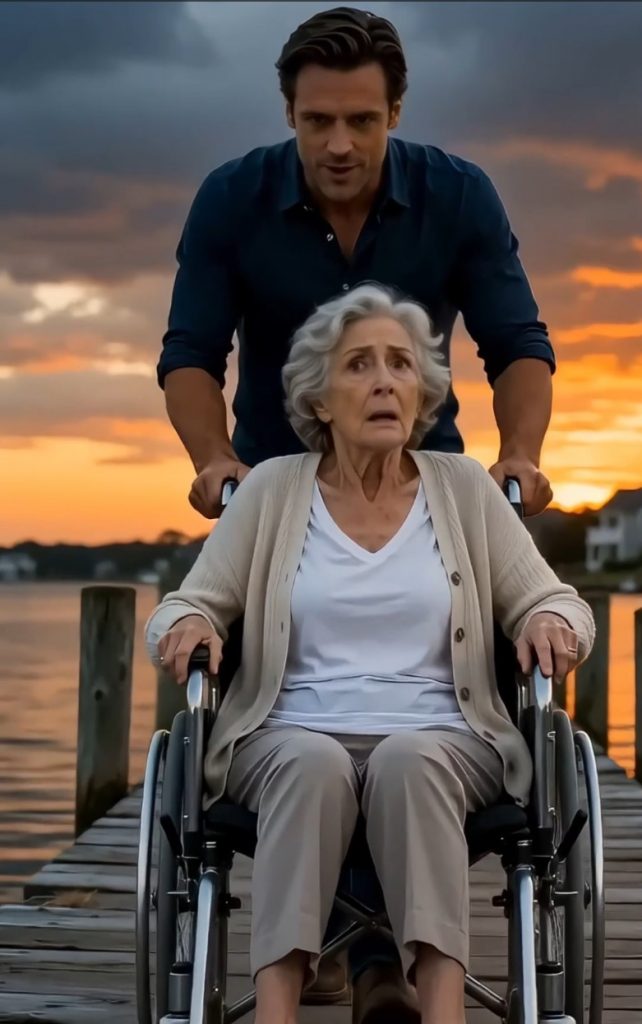
Evelyn Whitmore gripped the armrests until her knuckles turned white. The pier stretched ahead without railings, narrow and weathered, reaching into dark water beneath a sky split between sunset gold and storm-cloud black.
Behind her, Adrian Vale pushed steadily.
He had one hand on each handle. His sleeves were rolled to his forearms. His dark shirt snapped lightly in the wind as if the evening itself were trying to pull him back.
But Adrian kept walking.
“Soon all your money will belong to me,” he said softly. “You really thought anyone cared about you?”
Evelyn’s heart lurched.
For months, she had suspected greed behind his kindness. She had heard it in the way he spoke to lawyers when he thought she was asleep. She had seen it in the new papers, the missing checkbooks, the sudden concern about her “capacity.”
But hearing him say it beneath the open sky felt different.
It turned suspicion into fact.
“Adrian,” she whispered. “Stop.”
He leaned closer to her ear.
“After tonight, everything becomes mine.”
The end of the pier came into view.
Evelyn screamed.
“Stop! Oh my God!”
Across the water, the white coastal houses reflected the last orange light. Curtains glowed. Balconies stood empty. The whole shoreline looked expensive, peaceful, and impossibly far away.
Adrian did not stop.
He gave the wheelchair one final shove.
For a second, Evelyn saw only sky.
Then the chair tipped off the edge, her gray loafers lifting as the dark water rushed up to meet her. The splash swallowed her scream. White foam burst against the pilings, then broke apart into ripples.
Adrian stood at the edge of the pier.
Motionless.
He looked down at the place where she had vanished, breathing evenly, his face empty of shock, regret, or fear.
Then he lifted his head toward the storm clouds and smiled.
He thought the water had taken the last witness.
He was wrong.
Act II
Evelyn Whitmore had not always needed anyone to push her chair.
At seventy-eight, she had once been the woman who opened her own windows during storms because she liked the smell of rain on saltwater. She ran the Whitmore Foundation with a fountain pen, a sharp mind, and a reputation for remembering every name in a room.
Her husband, Thomas, used to say she could spot a liar by the way he accepted tea.
Then Thomas died.
A quiet heart attack in the garden, quick enough that the doctor called it merciful and lonely enough that Evelyn never forgave the word.
Three months later, she had a stroke.
It weakened her left side, took some of her balance, and placed her in the wheelchair she hated with a dignity that made everyone around her pretend not to notice the hatred.
That was when Adrian arrived.
He was her late sister’s son, charming in a polished way, with expensive shoes and sorrow that always appeared when someone important was watching. He told people he had moved into the guesthouse to care for his aunt. He drove her to appointments. Managed household repairs. Answered emails.
At first, Evelyn was grateful.
Loneliness can make even intelligent people accept the wrong hands.
Then small things changed.
Her old housekeeper was dismissed for “misplacing jewelry.” Her attorney’s calls were delayed. Her accounts were consolidated. Nurses came and went too quickly to learn the house.
Adrian began speaking for her.
“She’s tired.”
“She doesn’t understand.”
“She gets confused in the evenings.”
Evelyn understood plenty.
She understood that her signature appeared on documents she did not remember signing. She understood that her foundation board had begun receiving instructions she had never approved. She understood that Adrian’s patience thinned whenever she asked questions.
Most of all, she understood the pier.
Thomas had built it forty years earlier, back when they were young enough to believe a house by the water could hold every future they wanted. It had no railings because Thomas loved unobstructed views, and Evelyn used to tease him that romance should not be allowed to violate building codes.
After her stroke, Adrian took her there often.
Too often.
Always at sunset.
Always when the wind was rising.
Always with one hand too firm on the handles.
One afternoon, Evelyn asked him why he liked the pier so much.
Adrian smiled.
“You always seem peaceful there.”
That was when she became afraid.
Not the nervous fear of an old woman imagining shadows.
A clear, cold fear.
The kind that arrives when a person finally understands she has let danger into her house and given it a key.
So Evelyn called the one person Adrian had not managed to drive away.
Her granddaughter, Claire.
Act III
Claire Whitmore was supposed to inherit nothing.
At least, that was the story Adrian preferred.
She was Thomas’s granddaughter from his first marriage, a woman Evelyn had helped raise after Claire’s mother died too young. Blood did not connect them, but love had never cared much for paperwork.
Evelyn had written Claire into every version of her will.
Not because Claire asked.
Because Claire was the one who came when there was no audience. She brought soup without announcing sacrifice. She fixed the porch light. She listened when Evelyn raged about the wheelchair instead of telling her to be positive.
Adrian hated her.
He called her opportunistic.
Then he blocked her number from Evelyn’s phone.
That would have worked if Evelyn had not hidden an old landline in Thomas’s study behind a row of gardening books.
The call lasted eleven minutes.
Evelyn told Claire everything: the forged papers, the missing statements, the pier, the way Adrian looked at the water when he thought she was not watching.
Claire did not dismiss her.
She did not say, “Are you sure?”
She said, “I’m coming.”
But Evelyn had one more call to make.
Her attorney, Ruth Calder, arrived the next morning under the excuse of reviewing foundation tax papers. Ruth was sixty-five, severe, and famous for making powerful men feel underdressed even in tailored suits.
She listened without interrupting.
Then she placed a small silver pendant in Evelyn’s hand.
“A recorder,” Ruth said. “Water-resistant. Press once to start. Twice to send the file.”
Evelyn stared at it.
“You think he’ll say it out loud?”
“Men like Adrian always do,” Ruth replied. “They confuse cruelty with victory.”
That evening, Evelyn changed her will.
Again.
Adrian was removed entirely.
Claire became the executor of the estate. The foundation shares were locked into a trust no relative could control alone. If anything happened to Evelyn under suspicious circumstances, all authority would pass immediately to Ruth and a court-appointed guardian.
Evelyn signed every page with a steady hand.
Then she tucked the pendant under her cream cardigan.
“What if I’m wrong?” she whispered.
Ruth looked at her gently.
“Then we’ll all be relieved.”
But nobody was relieved.
Because the next evening, Adrian insisted on a walk to the pier.
And as he pushed Evelyn toward the water, the pendant recorded every word.
Act IV
Adrian waited until the ripples smoothed.
That was his second mistake.
His first was speaking.
His third was believing nobody had seen.
Across the inlet, a teenager named Maya Bell had been filming the sunset from her parents’ balcony. She had zoomed in on the pier because the sky behind it looked dramatic, all orange fire and black cloud.
She captured the wheelchair.
The man.
The shove.
Maya screamed so loudly her father came running from the kitchen.
Within seconds, 911 was called.
Within minutes, a harbor patrol boat turned hard across the darkening water.
Adrian did not know any of this.
He walked back down the pier slowly, wiping his hands on his jeans as if the act had left a stain he could feel but not see. When he reached the shore, he pulled out his phone and made his voice shake.
“My aunt,” he said. “She rolled too close to the edge. I tried to stop her.”
He even cried.
Not much.
Just enough.
But the water had not finished with him.
Evelyn survived because the chair hit the water at an angle and loosened one of the arm supports. She had been terrified, trapped for moments that felt endless, but the current pushed the chair against the pilings instead of out toward the deeper channel.
The harbor patrol reached her before the storm broke.
They pulled her from the water shaking, gasping, alive.
Claire arrived at the dock barefoot, still in the clothes she had driven in, her face white with panic. When she saw Evelyn wrapped in a rescue blanket, she dropped to her knees beside the stretcher.
“Grandma?”
Evelyn’s eyes opened.
Her voice was faint, but clear.
“Did it send?”
Claire looked at Ruth.
Ruth held up her phone.
The file had arrived.
Adrian was still giving his statement to police when Ruth walked up the dock.
He looked annoyed to see her.
Then he saw Claire.
Then he saw the stretcher.
The color drained from his face.
Evelyn turned her head toward him.
For the first time since he moved into her home, Adrian looked afraid of her.
Not because she could walk.
Not because she was young.
Not because she was physically strong.
Because she was alive, and the truth was alive with her.
Ruth played the recording for the officer.
Soon all your money will belong to me.
You really thought anyone cared about you?
After tonight, everything becomes mine.
The officer’s expression hardened.
Adrian stepped back.
“This is insane,” he said. “She’s confused. She’s always confused.”
Maya’s father came running down from the road with his daughter’s phone in his hand.
“No,” he said. “She’s not.”
The video played next.
This time, Adrian did not speak.
There are moments when a lie dies without drama.
No thunder.
No confession.
Just a screen in someone’s hand and the face of the person who thought darkness would protect him.
The handcuffs clicked before the storm finally broke.
Act V
The trial was not quick.
Men like Adrian make sure nothing is quick. They build delays into their lives the way others build fences, hoping exhaustion will do what innocence cannot.
His lawyers argued Evelyn was unreliable.
They argued the recording lacked context.
They argued Maya’s video was too distant.
They argued Adrian had been trying to save her and slipped.
Then prosecutors played the full audio.
No one moved in the courtroom as Adrian’s voice filled the room, low and smug over the sound of wheelchair wheels rattling across wood.
Soon all your money will belong to me.
Evelyn sat in the front row beside Claire, wearing a navy dress and the same silver pendant on a chain around her neck.
Adrian would not look at her.
That hurt more than she expected.
Not because she wanted remorse. She had stopped hoping for that.
Because some part of her still remembered the boy he had been at ten years old, running through her sister’s garden with grass stains on his knees, asking for another slice of peach cake.
Greed had not been born in him fully grown.
It had been fed.
Excused.
Polished.
Allowed to call itself ambition until it no longer recognized cruelty in the mirror.
But pity did not erase consequence.
The forged documents came next. Bank transfers. Emails. Deleted texts recovered from Adrian’s laptop. A draft press release announcing his new leadership of the Whitmore Foundation, prepared two days before Evelyn was pushed into the water.
The jury needed less than four hours.
Guilty.
Evelyn did not smile when the verdict came.
Claire cried beside her.
Ruth closed her eyes.
Adrian stared straight ahead, jaw clenched, as if even conviction was an insult done to him by people too small to understand his brilliance.
Evelyn watched him taken away.
Then she turned to Claire and said, “Take me home.”
Whitmore House changed after that.
The guesthouse was emptied. The locks were replaced. The staff Adrian had dismissed were invited back with apologies, raises, and the option to say no.
Evelyn moved her bed to the room facing the water.
People told her that was brave.
It was not bravery, exactly.
It was refusal.
She refused to let Adrian make the view belong to him.
The pier was repaired.
Not removed.
Claire wanted it torn down. Ruth agreed. Half the town offered names of contractors who could have it gone by morning.
But Evelyn said no.
“Thomas built that pier,” she said. “Adrian doesn’t get to be the last story it tells.”
So they added railings.
Strong ones.
Simple white posts with rope between them, sturdy enough to lean on and graceful enough that Thomas would not have complained for too long.
At the end of the pier, Claire placed a bench.
On a calm evening three months after the trial, Evelyn asked to go there.
Claire pushed her slowly over the wooden planks. This time, the sound of the wheels did not feel like a warning. It felt like a return.
The sunset burned gold over the houses across the water.
Maya and her father waved from their balcony.
Evelyn lifted one hand.
When they reached the end, Claire locked the wheels and sat beside her on the bench.
For a long time, neither woman spoke.
Then Evelyn said, “I was so ashamed.”
Claire looked at her.
“Of what?”
“For being fooled. For needing help. For letting him make me afraid in my own home.”
Claire’s eyes filled.
“You survived him.”
Evelyn stared at the water.
“I know.”
“No,” Claire said softly. “I mean it. You survived him. You called me. You called Ruth. You made a plan. You were terrified, and you still told the truth.”
Evelyn’s mouth trembled.
The wind moved gently through her gray hair.
“I thought he was right,” she whispered. “For one moment. When he said no one cared.”
Claire knelt beside the wheelchair and took both of Evelyn’s hands.
“He was never right.”
The old woman looked at her granddaughter.
Then she began to cry.
Not the frightened tears from the pier. Not the shocked tears from the hospital. These were older, heavier, carrying months of isolation and every small humiliation Adrian had used to make her feel like a burden.
Claire held her hands through all of it.
When the tears passed, Evelyn looked back at the water.
The dark surface was calm now, reflecting the last fire of sunset.
Adrian had believed the water would erase her.
Instead, it returned her.
It carried his words, his crime, and his mask back to shore.
Years later, people in town would still point to the Whitmore pier and tell the story.
They would talk about the shove, the splash, the recording, the girl across the water with the phone.
But Evelyn remembered something different.
She remembered opening her eyes on the dock and seeing Claire’s face above her.
She remembered Ruth’s hand on her shoulder.
She remembered strangers wrapping her in blankets.
She remembered learning, in the coldest moment of her life, that Adrian’s cruelest sentence had been his most foolish.
Someone did care.
Enough to answer the phone.
Enough to watch the water.
Enough to make sure the truth did not sink.