Act I
The diner door opened with the sound of rain and fear.
A boy stumbled inside, soaked from the storm, one arm wrapped around a gray bundle pressed tightly to his stomach. His gray T-shirt was darkened with rain, sweat, and a spreading stain that made every adult in the room go still.
He could not have been older than eleven.
For one second, nobody moved.
The red vinyl booths, the chrome counter, the humming ceiling lights, the sugar shakers lined up beside napkin dispensers — all of it looked suddenly unreal around him. Outside, rain lashed against the wide glass windows, turning the neon signs into red and blue smears.
The boy’s eyes swept the room.
Not like a lost child.
Like someone being hunted.
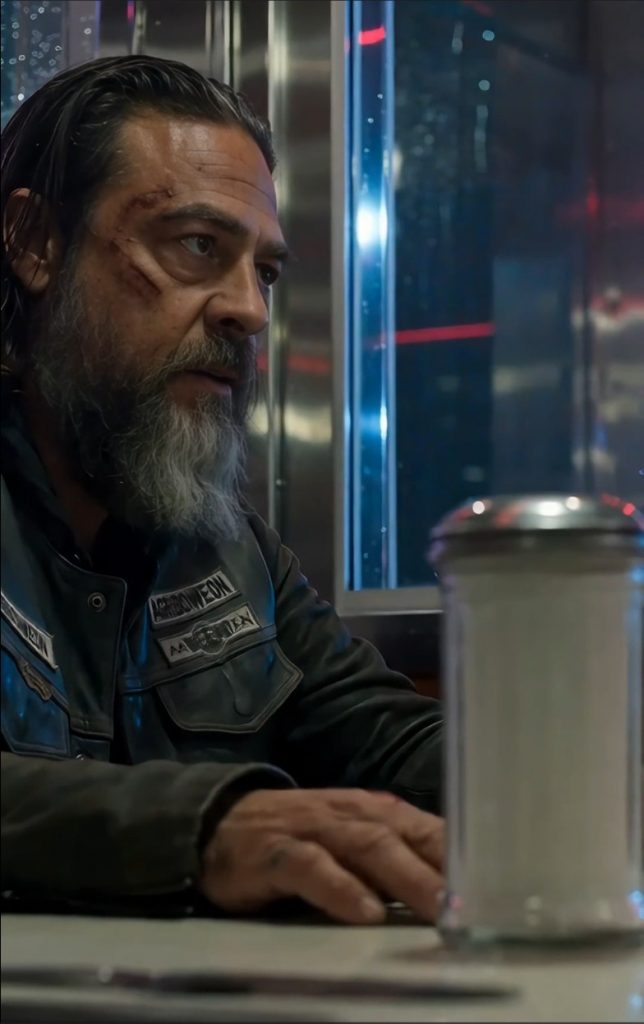
In the back booth sat a man most people avoided looking at for too long. He had a thick gray beard, old scars near his cheekbone, and a black leather motorcycle vest heavy with patches. One patch across the chest read AGRIBOWEON in faded white thread.
His name was Hank Mercer.
The boy saw him and froze.
Hank lowered his coffee cup.
He looked at the boy’s face first. Then the bundle. Then the door.
“Stay right there,” Hank said.
His voice was low, rough, and calm enough to cut through the storm.
The boy obeyed for half a second, then staggered toward the rear exit table like his legs were barely listening to him. He slid into the booth, shoulders hunched, one hand still holding the bundle against himself.
The waitress behind the counter whispered, “Oh my God.”
Hank lifted one hand without looking away from the boy.
“Call 911. Quietly.”
The boy’s lips trembled. He looked toward the front windows, then down at the table.
With his free hand, he tapped the tabletop.
Once.
Twice.
Three times.
Deliberate.
Not random. Not panic.
A signal.
Hank’s eyes narrowed.
The boy swallowed hard and whispered, “Near the exit.”
Hank’s gaze moved to the glass doors.
Outside, the rain blurred the street into silver streaks.
Then three dark shapes appeared beyond the diner entrance.
Hooded men.
Standing still in the storm.
Hank set his coffee down.
“They are here,” he said.
Then, beneath the table, his hand moved slowly toward the old revolver he had sworn he would never use unless someone gave him no other choice.
Act II
Hank Mercer had spent half his life trying not to become the man people saw when they looked at him.
The beard. The scars. The vest. The heavy boots. The motorcycle parked outside under the neon sign.
People assumed things.
They assumed he liked trouble. They assumed he was dangerous. They assumed a man sitting alone in a diner at midnight with hands like damaged leather must have chosen violence before violence chose him.
They were not entirely wrong.
But they were not right either.
Years ago, Hank had been a paramedic in Kansas City. Not a hero. Not a saint. Just a man who could keep his hands steady when other people were screaming. He knew how fear sounded. He knew the difference between drunken panic, angry panic, and the kind of panic that came from someone trying very hard not to die.
The boy had the third kind.
That was why Hank did not ask stupid questions.
That was why he watched the door.
And that was why the three taps on the table hit him harder than the stain on the boy’s shirt.
Three taps.
Hank had taught that signal once.
Not in a class. Not officially.
To a girl named Cassie.
His daughter.
She had been twelve when he taught her that if she ever could not speak, if she ever felt watched, if she ever needed help without making a scene, she should tap three times.
Three meant danger.
Two meant wait.
One meant safe.
Cassie had rolled her eyes because children believe danger is something adults invent to ruin freedom.
Then, one rainy night years later, she had tapped three times on the kitchen counter while standing beside a man Hank had trusted.
Hank had missed it.
He had been tired. Distracted. Angry about work. He had seen his daughter’s small fingers touch the counter and thought she was fidgeting.
By the time he understood, it was too late.
Cassie survived what happened, but something in her changed, and something in Hank never forgave itself. She grew up. Moved away. Called on holidays. Loved him from a distance that he had earned.
After that, Hank left emergency work. He joined a riding club full of men who had also failed at being ordinary. They delivered supplies after storms, escorted missing-kid search teams, watched parking lots outside shelters when someone needed quiet protection.
They looked like trouble.
Sometimes that helped.
Tonight, Hank had stopped at the diner because his bike hated rain and his knees hated cold. He had planned to drink coffee until the storm passed. Maybe eat pie. Maybe avoid the memories that always grew louder when rain hit glass.
Then the boy walked in.
The boy’s name, though Hank did not know it yet, was Noah Bell.
Eleven years old.
Straight-A student. Bad at lying. Good at drawing spaceships. The kind of kid who apologized when adults bumped into him.
Noah had not been supposed to be outside that night.
He had been waiting in the back office of his mother’s laundromat while she finished closing. Rain hammered the alley. The dryers thumped. The fluorescent lights buzzed. Noah was drawing on receipt paper when he heard men arguing near the service door.
His mother told him to hide.
That was the last calm instruction she gave him.
Noah crawled under the desk with his backpack and saw enough through the gap to understand two things.
The men were not there for money from the register.
They were there for a gray jacket hanging in the lost-and-found bin.
Inside that jacket was a small flash drive Noah had found earlier in the parking lot and slipped into the pocket because he thought someone might come back for it.
Someone did.
Three men.
They searched the laundromat. Threatened his mother. Demanded the jacket. When Noah panicked and ran with it, one of them grabbed him near the alley. He twisted free, fell hard against a broken metal edge, and kept running because his mother screamed his name.
He ran through rain.
Through alleys.
Across traffic.
Past closed shops and dark windows.
Until he saw the diner lights.
And a man in a biker vest sitting alone in a booth like the last wall between him and the men following.
Noah did not know Hank.
But he knew what his mother had once told him.
If you are in trouble, find the person who is already watching the exits.
So he did.
And Hank Mercer, who had missed three taps once in his life, did not miss them twice.
Act III
The three men entered without speaking.
Rain came in with them, blowing across the tile floor in cold gusts. Their hooded coats dripped onto the entrance mat. Their faces were half-hidden, but their posture said enough.
They were not customers.
They scanned the diner.
Counter.
Booths.
Back hallway.
Rear exit.
Hank stayed seated.
The revolver remained low beneath the table, pointed at nothing yet, visible to no one except maybe the boy if he knew where to look.
“Evening,” Hank said.
The tallest man turned his head toward him.
“We’re looking for a kid.”
The waitress, Marla, stood frozen by the coffee machine with the phone hidden near her hip. Hank did not look at her. Looking would give her away.
“No kids here,” Hank said.
A small sound came from the rear booth.
Noah pressed himself lower.
The shortest man heard it.
His head tilted.
Hank’s voice dropped.
“Do not move.”
The diner fell silent except for rain.
The three men looked at him then.
Really looked.
The leather vest. The scars. The old calm. The hand under the table.
The tall man gave a humorless laugh.
“You don’t know what this is.”
Hank nodded once.
“That makes two of us.”
“We just need the jacket.”
From the back booth, Noah’s fingers tightened around the gray bundle.
Hank heard the cloth shift.
The men heard it too.
Everything in the room tightened.
The tallest man stepped forward.
Hank lifted the revolver just enough for the chrome to catch the diner light.
Not high.
Not dramatic.
Enough.
The man stopped.
Marla made a tiny sound behind the counter.
Hank’s eyes did not leave the men.
“You take one more step toward that boy,” he said, “and the next sound in this room will change all our lives.”
The tallest man smiled, but it failed near the eyes.
“You going to shoot three men in a diner?”
“No,” Hank said. “I’m going to keep three men still until the police arrive.”
That answer unsettled them more than a threat would have.
Because it sounded like a plan.
Outside, faint sirens began to rise beneath the rain.
One of the men cursed.
The shortest one reached into his coat.
Hank’s thumb shifted.
“Don’t.”
The man froze.
Noah was crying silently now, his face buried against the gray jacket. His shoulders shook, but he did not run. He stayed exactly where Hank had told him to stay.
The sirens grew louder.
Red and blue light flickered across the rain-streaked windows.
The three men looked at one another.
Then the side door near the kitchen opened.
A second biker stepped in from the rear entrance.
Then another.
Then a third.
All wearing soaked leather vests.
All silent.
All standing between Noah and the exit.
Hank did not smile.
He had tapped his own signal under the table after Noah’s warning. Not three.
Two.
Wait.
Marla had seen it. She knew Hank’s club. Half the town did. She had called 911, then the emergency number taped under the register for riders who helped during storms.
The tall man realized too late that the old biker had not been alone.
He had only looked alone.
Police flooded the entrance seconds later.
“Hands where we can see them!”
The men obeyed slowly.
But Noah’s fear did not ease.
Not until one officer pulled back the hood of the tallest man and whispered a name that made Hank understand this was bigger than a chase through the rain.
“Caleb Ross,” the officer said. “We’ve been looking for you.”
Noah lifted his head.
“The flash drive,” he whispered. “They hurt my mom for it.”
And the gray jacket suddenly became the most important thing in the diner.
Act IV
An ambulance arrived with its lights washing the diner windows red.
Noah refused to let go of the jacket until Hank crouched beside the booth.
“Kid,” Hank said gently, “you did what you came to do.”
Noah looked at him, eyes glassy with fear and exhaustion.
“My mom.”
“I know.”
“They were at the laundromat.”
“I know.”
“She told me to run.”
Hank’s voice softened.
“Then you honor that by letting these people help you stay alive.”
Noah swallowed.
His fingers loosened.
Inside the jacket pocket, the officers found the flash drive wrapped in a receipt from Bell’s Laundry.
The detective on scene, a woman named Price, went very still when she saw it.
“Where did you get this?”
Noah’s voice was barely audible.
“Parking lot. I thought someone dropped it.”
Detective Price looked toward the three arrested men being led outside.
“Someone did.”
The flash drive was not explained fully to Noah that night, and that was right. Children do not need every adult darkness translated for them while they are bleeding through a shirt in a diner booth.
But Hank heard enough.
A city contractor.
Bribery records.
Payments tied to condemned buildings that had somehow passed inspection.
Witness intimidation.
Caleb Ross was not just a street thug. He was the man who made problems disappear for people rich enough not to get their hands wet.
And Noah, by accident, had picked up the thing that could expose them.
The paramedics moved carefully around him. They checked the injury, wrapped him, kept their voices calm. Noah asked for Hank every time they tried to guide him toward the stretcher.
“I’m right here,” Hank said.
The boy’s eyes moved to the door. “What if they come back?”
Hank looked outside.
The three men were being placed into separate police cars now. Rain ran down the windows. Flashing lights turned the street into a trembling red-blue river.
“They’re not coming back tonight.”
“Do you promise?”
Hank hesitated.
He had learned not to make promises the world could break.
Then he thought of Cassie.
He thought of three taps.
He thought of a boy who had run through a storm with evidence in one hand and fear in the other because his mother told him to survive.
“I promise I’m not leaving until your mom is found,” Hank said.
That was a promise he could control.
Noah nodded once.
At the hospital, they found Mrs. Bell alive in a storage room at the laundromat, shaken and frightened but able to speak. An officer had followed Noah’s route backward and found the side door forced open, the lights still on, one washer spinning endlessly with nothing inside.
Noah was told only that his mother was safe.
The moment he heard it, his whole body gave up trying to be brave.
He cried into Hank’s vest like the child he had not had permission to be all night.
Hours later, when Mrs. Bell was brought into the hospital room, Noah reached for her with both hands.
She crossed the room so fast a nurse had to catch the IV pole trailing behind her.
“My baby,” she sobbed. “My brave boy.”
Noah clung to her.
“I ran like you said.”
“I know.”
“I didn’t leave you.”
“Oh, honey.” She held him tighter. “You saved us.”
Hank stood near the doorway, suddenly aware of how large and out of place he looked under hospital lights.
He started to leave.
Noah saw him.
“Wait.”
Hank turned.
The boy reached one shaking hand toward him.
Not for rescue now.
For gratitude.
Hank stepped back into the room and took it carefully.
Noah squeezed his fingers once.
Three times.
Hank looked down.
Once.
Twice.
Three.
This time, the signal meant something else.
Not danger.
Thank you.
And Hank Mercer had to turn his face away.
Act V
The diner reopened two days later.
Marla insisted.
She said storms came and went, bad men came and went, but pie had to be served or the whole town would surrender to darkness. So the lights came back on, the booths were wiped down, the coffee burned in the pot, and the red EXIT sign glowed above the door like nothing had happened.
But everyone knew.
People came in just to ask where the boy had sat.
They pointed at the rear booth. They whispered about the bikers. They repeated the story badly, as people always do when fear becomes legend.
Some said Hank had drawn on the men the second they entered.
He had not.
Some said Noah had been carrying diamonds.
He had not.
Some said the three men were part of something so powerful the case would vanish.
That part almost happened.
For a week, pressure came from places that preferred silence. Attorneys appeared. Statements changed. A local official denied knowing Caleb Ross. A contractor called the flash drive “fabricated.” Someone leaked Hank’s old arrest from twenty years earlier, as if a young man’s bar fight could make a child’s terror less true.
Then Mrs. Bell testified.
So did Noah, through a child advocate, without facing the men.
So did Marla.
So did Hank.
He wore a clean shirt under his vest and answered every question without decoration.
“What made you believe the boy was in danger?” the prosecutor asked.
Hank looked toward Noah, who sat beside his mother in the back row.
“He tapped the table three times.”
The prosecutor frowned slightly.
“And what did that mean to you?”
Hank took a slow breath.
“It meant someone had taught him how to ask for help without screaming.”
“Did he say who was following him?”
“No.”
“Then why intervene?”
Hank’s eyes hardened.
“Because children don’t come into diners at midnight, hurt and soaked, carrying a jacket like it’s evidence, unless adults have failed somewhere.”
The courtroom went quiet.
The defense tried to make him look unstable. Dangerous. A man eager for confrontation.
Hank let them try.
Then the flash drive was entered into evidence.
Names followed.
Payments.
Messages.
Records nobody could explain away.
By the end of the month, Caleb Ross and the two men with him were charged in connection with the laundromat attack, witness intimidation, and a larger corruption case that pulled half the city into the light.
Noah became famous for three days.
He hated it.
His mother changed their phone number, moved apartments, and took a job at a different laundromat across town. Hank’s riding club quietly fixed the locks, installed lights, and took turns parking motorcycles nearby until the trial ended.
Noah returned to the diner only once before leaving the neighborhood.
It was raining that night too.
Not as hard.
Just enough to make the windows glow.
Hank sat in the same booth.
Noah walked in with his mother, wearing a clean jacket and carrying a sketchbook instead of a gray bundle. He looked healthier, though still thinner than a child should after fear has passed through him.
He slid into the booth across from Hank.
For a while, they said nothing.
Then Noah opened his sketchbook.
He turned it around.
The drawing showed the diner in the rain. The red booths. The EXIT sign. The three hooded men at the door. A boy near the back. A biker at the table, one hand hidden, eyes forward.
But behind the biker, Noah had drawn wings.
Hank stared at it.
“I don’t have wings, kid.”
Noah shrugged. “I know.”
“Then why draw them?”
“Because you stayed.”
Hank’s throat tightened.
He looked away toward the rain-streaked glass.
Outside, his motorcycle waited under the neon light. Inside, Marla pretended not to watch while wiping the same spot on the counter for the fourth time.
Noah tapped the table.
Once.
Twice.
Three times.
Hank looked back at him.
The boy smiled faintly.
“Safe,” Noah said.
Hank shook his head. “That’s not what three means.”
“It can now.”
For a long moment, Hank said nothing.
Then he tapped back.
Once.
Twice.
Three times.
“Safe,” he agreed.
Years later, people still told the story of the boy who ran into the diner and the biker who stopped three men without firing a shot. They made it louder than it was. Cleaner than it was. They left out the shaking hands, the rainwater on the floor, the waitress hiding the phone, the child trying not to pass out from terror.
But Hank remembered the truth.
A boy came in carrying proof that powerful men wanted buried.
A mother told her son to run.
A diner full of ordinary things became the only shelter left.
And an old biker, haunted by a signal he once missed, heard three taps on a table and finally answered in time.