Act I
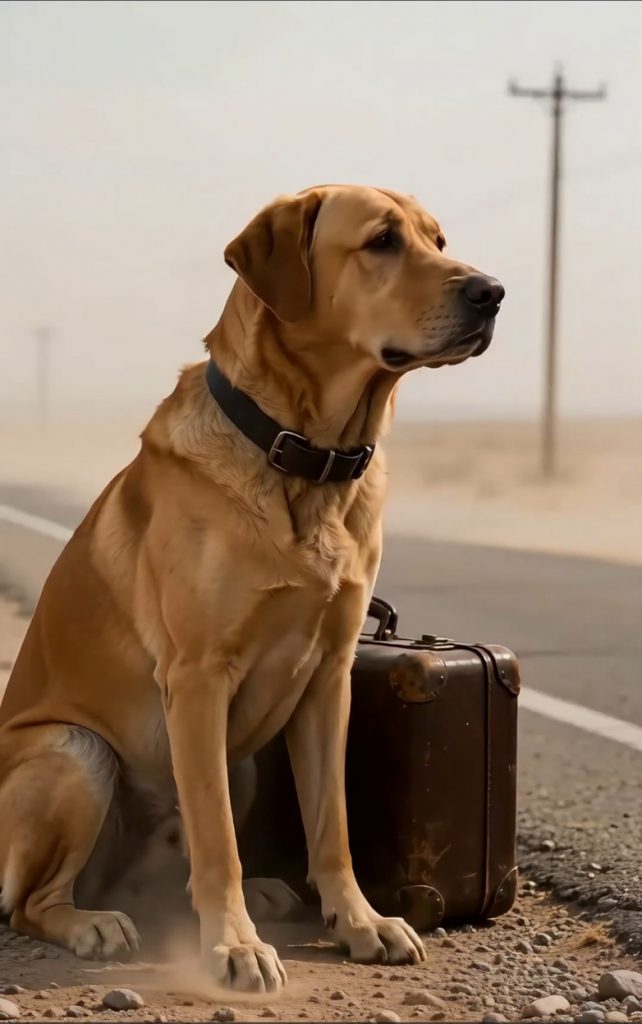
The dog was sitting where no living thing should have been waiting.
Miles of desert highway stretched in both directions, pale and empty beneath a hard blue-white sky. Utility poles leaned along the shoulder. Dust moved in thin waves over the gravel. Every few minutes, a truck tore past and shook the air, but the dog did not run.
It sat beside a worn brown leather suitcase.
Still.
Patient.
Guarding it.
Jack Moreno saw the dog in his side mirror after he had already passed.
At first, his mind tried to dismiss it. A stray. A ranch dog. Somebody’s animal wandered too far from a turnout. But then the image settled in his head: golden-tan fur, black collar, old suitcase, no person anywhere near it.
He eased his truck onto the shoulder.
The brakes hissed. Dust rolled past the cab. Jack sat there for a second with both hands on the wheel, staring at the mirror.
The dog had not moved.
That was what made him open the door.
“Hey, buddy,” Jack called as he walked back along the road. “What are you doing out here?”
The dog watched him approach.
It did not bark. Did not bare its teeth. Did not step away from the suitcase. Its eyes were tired and dark, the kind of eyes that looked less like an animal’s and more like someone who had been waiting too long for the right human to arrive.
Jack slowed.
He was a truck driver, not a rescuer. He hauled produce, machine parts, furniture, whatever paid. He knew highways better than he knew most people, and he had learned one rule early: lonely roads were full of things that looked simple until they weren’t.
He lowered himself to one knee.
The dog glanced at the suitcase.
Then back at Jack.
The leather was old, the corners scuffed, the handle cracked. It looked like something a person had carried for years, maybe decades. Not trash. Not luggage abandoned by accident.
The dog lifted one dusty paw and placed it carefully in Jack’s open palm.
Jack swallowed.
“All right,” he whispered. “You want me to understand.”
The dog gave a soft whine.
Jack looked down the empty highway again.
No broken-down car. No footprints he could see. No body near the ditch. Nothing but the dog, the suitcase, and the wind.
He loaded both into his truck.
The dog climbed in only after Jack lifted the suitcase first.
That told him everything.
Whatever was inside mattered.
By the time Jack reached his small house outside Mesa Flats, dusk had turned the windows gold. He set the suitcase on the parquet floor of his living room. The dog sat beside it, watching.
Jack clicked open the latches.
Inside were old clothes.
A tan jacket. A faded shirt. Folded trousers. A cotton scarf that still smelled faintly of lavender.
He lifted the jacket.
A small yellow note slipped from the fabric and landed in the center of the suitcase.
Jack picked it up.
The dog stopped breathing.
Jack read the first line.
Then the second.
By the time he reached the bottom, his hand was shaking.
Because the note did not say goodbye.
It said, He told everyone I left willingly. I did not.
Act II
Jack had spent most of his adult life avoiding other people’s emergencies.
Not because he was cruel.
Because the last one had swallowed him whole.
His younger sister, Rosa, had called him twelve years earlier from a gas station outside El Paso. Her voice had been too bright, too fast. She said she was fine. She said her boyfriend was just angry. She said Jack did not need to come.
Jack had been three states away with a delivery deadline and a boss who treated compassion like a scheduling problem.
He told her he would call in the morning.
By morning, she was gone.
The official story was simple: she left with the boyfriend. Maybe willingly. Maybe not. No one had enough proof to say otherwise. Jack spent months chasing rumors and years replaying the last phone call until every word became a blade.
After that, he became careful.
Careful meant quiet. Careful meant alone. Careful meant stopping for no one unless the danger was obvious enough to force his hand.
But the dog on the highway had not been obvious.
It had been worse.
It had been familiar.
Someone silent, asking to be believed.
The note was written in shaky cursive, pressed hard enough into the paper that the words dented the back.
My name is Evelyn Hart. I am seventy-six years old. The dog’s name is Cooper. If he is with my suitcase, please do not leave him. He will stay where he last saw me.
Jack’s eyes moved to the dog.
Cooper stared back.
Jack kept reading.
My nephew, Grant, brought me out here after he made me sign papers I could not read. He told people I wanted to move away. That is a lie. He took my phone, my purse, and my medication. He said no one would look for an old woman who had already become a burden.
Jack’s jaw tightened.
The room seemed to grow colder.
The note continued.
If I am alive, he took me to the old Desert Star Motel on Route 16 before dark. If I am not, please tell my daughter Claire that I did not abandon Cooper, and I did not stop loving her. Grant knows where she lives. Do not trust him.
At the bottom was a phone number.
Jack sat back on his heels.
Cooper stood.
Not eagerly.
Not with joy.
With terrible expectation.
Like he had finally brought the suitcase to someone who could read what he could not.
Jack reached for his phone, then stopped.
He looked at the note again.
Do not trust him.
He did not call the number first.
He called the sheriff.
Then he called the second number written on the back of the note in smaller letters.
Claire Hart answered on the fourth ring.
“Hello?”
Jack tried to speak carefully.
“Ma’am, my name is Jack Moreno. I’m a truck driver. I found a dog on Highway 88 with a suitcase.”
There was silence.
Then a sharp inhale.
“What color dog?”
“Golden. Black collar.”
Her voice broke.
“Cooper?”
The dog lifted his head at the name.
Jack closed his eyes.
“Yes,” he said. “And I found a note from Evelyn.”
Claire made a sound that was not a word.
Jack knew that sound.
It was the sound of hope arriving too late to be gentle.
Act III
Claire Hart had been told her mother walked away.
Grant had said it with tears in his eyes and one hand pressed to his chest.
“Aunt Evelyn wanted a fresh start,” he told police. “She was embarrassed about needing help. She said she didn’t want Claire to see her decline.”
Claire had not believed him.
Not fully.
But disbelief was not evidence, and Grant had prepared too well.
He had power of attorney documents. Bank access. A signed statement saying Evelyn planned to relocate to a senior community out of state. He had neighbors who remembered seeing him load a suitcase into his SUV. He had even brought Cooper’s empty leash to Claire and said, “She must have let him loose. I’m sorry.”
That was the one detail that made Claire scream at him.
“My mother would never abandon that dog.”
Grant lowered his eyes.
“I know grief makes people angry.”
The police called it a family dispute.
The bank called the documents valid.
The senior community Grant named said Evelyn had never arrived, but Grant claimed she changed her mind on the road.
For nine days, Claire had been living inside a nightmare made worse by paperwork.
Then Jack called.
Within an hour, Claire was at his house with two sheriff’s deputies behind her.
She ran to Cooper before she said hello.
The dog made one broken sound and collapsed against her knees.
Claire fell with him, both arms around his dusty neck, sobbing into his fur.
“You stayed with her,” she cried. “You stayed, didn’t you?”
Cooper pressed his head into her chest.
Jack stood back, holding the yellow note in a plastic sleeve one deputy had given him.
Sheriff Dana Holt read it twice.
Her face hardened more each time.
“This motel still operating?” Jack asked.
“Barely,” the sheriff said. “Mostly long-term rooms and cash guests.”
Claire looked up. “We have to go.”
The sheriff nodded. “We will.”
Jack expected to be told to stay behind.
Instead, Cooper stood and walked to the door.
Everyone looked at him.
The dog did not bark.
He simply waited.
Claire wiped her face. “He knows where she was taken.”
The sheriff hesitated.
Jack understood the hesitation. A dog was not a warrant, not proof, not procedure. But the note was enough for urgent welfare concern, and the motel was within county reach.
“I’ll drive,” Jack said.
Claire looked at him.
“You’ve done enough.”
“No,” Jack said, surprising himself. “I haven’t.”
He thought of Rosa then. Of a phone ringing in a gas station. Of all the years he had spent arriving too late in his own memory.
This time, he had a road, a dog, and a chance.
They followed the sheriff’s cruiser into the desert night.
Cooper sat upright in Jack’s passenger seat, eyes fixed ahead.
When they turned onto Route 16, the dog began to tremble.
Not from fear.
From recognition.
Act IV
The Desert Star Motel looked like a place the world had stopped expecting to survive.
Half the sign was out. The pool was empty. Yellow porch lights buzzed above a line of chipped blue doors. A soda machine leaned near the office, glowing weakly in the dust.
Cooper began whining before Jack parked.
Claire reached for the door, but Jack caught her wrist.
“Let the sheriff go first.”
“My mother is in there.”
“I know.”
That was the only answer that mattered.
Sheriff Holt and two deputies moved room to room while the night clerk pretended not to know anything. Then Cooper lunged toward the far end of the motel, dragging against the leash Claire had clipped to his collar.
Room 12.
The last room before the old laundry shed.
The curtains were closed.
No sound came from inside.
Claire covered her mouth.
One deputy knocked.
“Sheriff’s office. Open up.”
Nothing.
Cooper barked once, sharp and desperate.
The deputy tried the handle.
Locked.
Sheriff Holt stepped back and nodded.
The door came open on the second kick.
The smell hit first.
Stale air. dust. medicine. fear.
Evelyn Hart was lying on the bed beneath a thin motel blanket, pale and disoriented, but alive.
Claire screamed her mother’s name.
Cooper broke free and jumped onto the bed before anyone could stop him. He pressed his body carefully against Evelyn’s side, licking her hand, whining like his heart had been held shut for days and had finally torn open.
Evelyn’s eyes fluttered.
“Cooper?” she whispered.
Claire reached the bed and took her mother’s face between her hands.
“Mom. Mom, I’m here.”
Evelyn blinked slowly, trying to focus.
“Claire?”
“Yes. It’s me.”
Evelyn began to cry.
“He said you wouldn’t come.”
Claire shook her head, tears falling fast.
“I never stopped looking.”
Jack stood in the doorway, unable to move.
The motel room blurred into another place, another call, another woman who had needed someone to believe her before the story was sealed by people who lied better.
This time, the story had not sealed.
Because a dog had stayed beside a suitcase until a stranger stopped.
Paramedics arrived within minutes. Evelyn was dehydrated, weak, and missing medication she needed daily. She kept asking for Cooper, and Cooper kept trying to climb into the ambulance until the paramedic gave up and let Claire hold him close beside the stretcher.
Grant was arrested two hours later at Evelyn’s house.
He was packing jewelry into a duffel bag.
The signed documents were found in his car. So were Evelyn’s phone, her purse, and a bottle of pills with the label scratched off. In his messages, deputies found drafts of emails he had planned to send from Evelyn’s account after transferring her property.
He had built a disappearance out of paper.
But he had not planned for Cooper.
And he had not planned for the yellow note hidden inside the old tan jacket.
Act V
Evelyn spent eleven days in the hospital.
The doctors said she had been found just in time.
Claire stayed beside her bed, sleeping in a chair, waking every time her mother moved. Cooper slept on the floor beneath the window after hospital staff officially agreed to call him a service animal “for practical purposes,” which everyone understood meant no one had the heart to remove him.
Jack visited once.
Then again.
By the third visit, Evelyn was strong enough to sit up and scold him for bringing grocery-store flowers instead of “the wild yellow ones that grow by the highway.”
Jack laughed for the first time in a way that did not surprise him.
“I’ll know for next time.”
Evelyn studied him.
“You stopped.”
He looked down.
“Anyone would have.”
“No,” she said. “They wouldn’t.”
The truth of that filled the room.
Evelyn reached for Cooper, her fingers sinking into the dog’s fur.
“I told him to stay,” she said softly.
Claire wiped her eyes.
“At the highway?”
Evelyn nodded.
“Grant pulled me from the car at the motel, but I managed to push the suitcase out before he saw. Cooper jumped after it. Grant tried to call him back.” Her mouth trembled. “I told Cooper, stay. Guard.”
Jack looked at the dog.
Cooper’s eyes were half-closed under Evelyn’s hand.
“He waited there three days,” Claire whispered.
Evelyn nodded. “I knew he would.”
Jack felt something tighten behind his ribs.
Three days on a desert shoulder.
No shade except the suitcase.
No certainty anyone would understand.
Just loyalty and one command.
The case against Grant moved quickly once the evidence was uncovered. Elder abuse. kidnapping. fraud. theft. Forgery. The list sounded almost too clean for the ugliness of what he had done.
In court, Grant’s attorney tried to suggest Evelyn was confused.
Evelyn arrived wearing a blue dress, her silver hair pinned back, Cooper sitting at her feet in a red service vest Claire had bought him.
When asked if she understood why she was there, Evelyn looked directly at Grant.
“I understand perfectly,” she said. “He mistook my age for absence.”
The courtroom went silent.
Jack sat in the back row.
He had only meant to attend one hearing. Somehow, he came to every one.
Afterward, Claire found him outside the courthouse.
“You don’t have to keep showing up,” she said.
Jack looked toward the steps, where Evelyn was feeding Cooper a piece of biscuit from her purse.
“I know.”
Claire smiled faintly. “Then why do you?”
He took a long breath.
“My sister called me once,” he said. “A long time ago. I didn’t stop in time.”
Claire did not ask for more.
That was kindness.
Instead, she touched his arm.
“You stopped this time.”
Jack looked away.
For the first time in years, the sentence did not feel like forgiveness.
But it felt like the beginning of something near it.
Months later, Jack passed the same stretch of Highway 88.
The gravel shoulder was empty now.
No suitcase.
No waiting dog.
Just wind, utility poles, and the endless line of road pulling west.
He slowed anyway.
For a moment, he saw Cooper there again in memory: dusty fur, tired eyes, one paw placed into his hand like a plea.
Jack pulled over.
Not because anything was wrong.
Because something had changed.
He got out and stood beside the road, listening to the desert.
A truck rushed past, shaking the air.
Jack reached into his cab and pulled out a small wooden marker he had made in his garage. Nothing fancy. Just a piece of sanded pine with words burned carefully into it.
COOPER WAITED HERE.
SOMEONE LISTENED.
He placed it near the fence post, far enough from the road to survive the wind.
A week later, Claire sent him a photograph.
Evelyn sat in her living room with Cooper’s head in her lap. The old brown suitcase rested in the corner, cleaned now but still scuffed, the yellow note framed above it. Evelyn was smiling. Cooper looked half-asleep and deeply proud.
On the back of the photo, Evelyn had written:
A suitcase can hold clothes. A dog can hold the truth.
Jack set the photo on his own mantel.
For years, he had believed some roads only taught loss. Empty roads. Late roads. Roads where the right decision came too late to matter.
But one desert afternoon, a dog sat beside a suitcase and refused to abandon the last proof of a woman everyone else was ready to call gone.
Jack almost drove past.
Then he looked in the mirror.
That was where the miracle began.
Not with a shout.
Not with a chase.
With one lonely dog on the shoulder, guarding a suitcase full of old clothes, a hidden yellow note, and the truth that loyalty can wait longer than lies can stand.