Act I
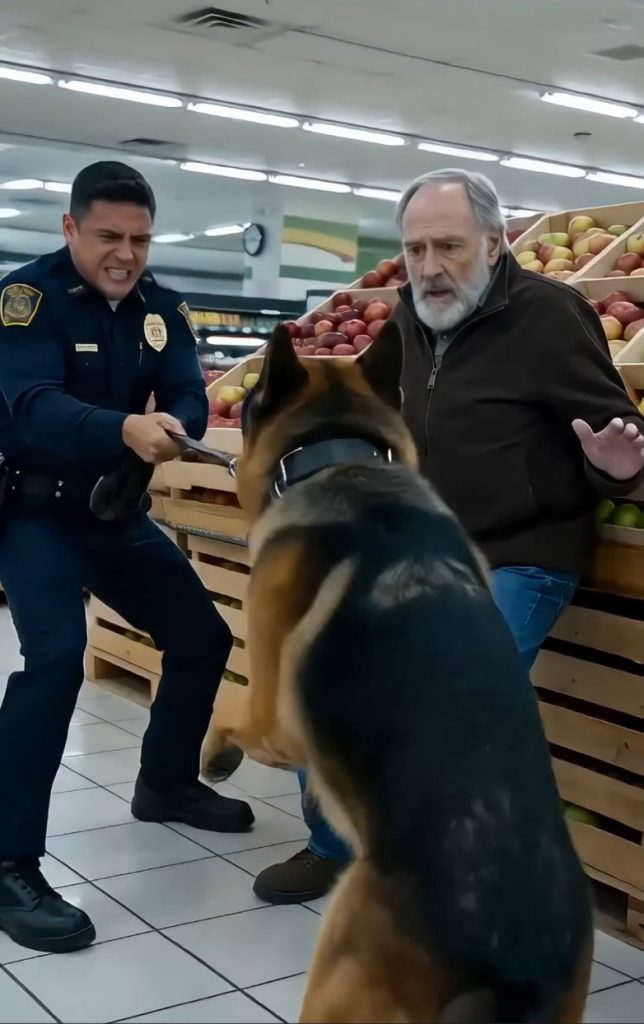
The German Shepherd hit the end of the leash so hard the officer nearly lost his footing.
Apples jumped in their wooden crates.
A woman near the bananas screamed and backed into a display of oranges. Somewhere down the aisle, a shopping basket hit the tiled floor with a plastic crack.
“Calm down, Rex!” Officer Mark Ellison shouted, both hands locked around the thick black leather leash.
But Rex did not calm down.
The dog lunged again, black-and-tan body twisting with raw force, claws scraping white tile as he barked directly at the elderly man trapped against the apple display.
The old man raised both hands.
“Please,” he gasped. “Please, get him away from me.”
He looked harmless.
That was what made the moment so horrifying.
He was gray-bearded, thin, and stooped, wearing a dark brown jacket over a faded green shirt. His eyes were wide behind the harsh fluorescent light. One trembling hand clutched the wooden edge of the produce crate as if it were the only thing keeping him upright.
Rex barked again.
Not at the crowd.
Not at the officer.
Only at him.
Officer Ellison planted his boots and pulled back. His arms shook from the strain. Rex had been trained for discipline, obedience, and restraint. Rex did not lose control in public. Rex did not terrify elderly shoppers in grocery stores for no reason.
And yet here he was, snarling so hard the leash stretched tight like a cable.
“Sir, don’t move,” Ellison said, breathless.
“I’m not moving!” the old man cried. “He’s going to attack me!”
A few shoppers lifted phones.
Others froze behind carts stacked with cereal, milk, and bread. The whole store seemed to hold its breath between Rex’s barks.
Then the old man’s expression changed.
Only for a blink.
His panic thinned.
His eyes sharpened.
Rex saw it.
The dog lunged harder.
“Rex!” Ellison shouted.
The old man’s fingers tightened on the apple crate. Beneath the cuff of his brown sleeve, something dark and wet gathered near his wrist.
A single drop slipped free.
It fell in slow silence.
Down past his trembling fingers.
Down onto a yellow-green apple.
Plink.
The sound seemed too small for the chaos around it.
Then the wall-mounted store television above the produce section crackled with static.
The cheerful grocery advertisement vanished.
A red emergency bulletin flashed across the screen.
The broadcaster’s voice broke through the store speakers.
“Breaking news: a homicide has just occurred nearby. Police are searching for an elderly man wearing a brown jacket…”
Every sound in the aisle seemed to die at once.
The old man stopped trembling.
He lifted his head and looked straight at Rex.
This time, he did not look afraid.
And Officer Ellison finally understood his dog had not been attacking.
He had been warning them.
Act II
Rex had never been wrong before.
That was what haunted Officer Ellison in the half-second after the emergency bulletin began to play.
In six years together, Rex had found missing children, tracked suspects through rain, located evidence in places human eyes would have missed, and once refused to leave a locked storage room until firefighters discovered a frightened store clerk hiding inside after a robbery.
He was not just a police dog.
He was Ellison’s partner.
But that morning, Ellison had doubted him.
The day had started with a call two blocks away from the grocery store. A report of a violent crime near a small apartment building behind the old pharmacy. Dispatch had been frantic, details incomplete, witnesses contradicting each other.
All Ellison knew was that someone had been killed, the suspect had fled on foot, and the first description was vague enough to be almost useless.
Older male.
Gray beard.
Brown jacket.
Possible injury.
The city went tense.
Schools went into soft lockdown. Patrol cars spread through nearby streets. Store managers received alerts to watch exits and report suspicious behavior.
Ellison and Rex were sweeping the area when the grocery store manager waved them in.
“There’s a man in produce,” she whispered near the sliding entrance doors. “He came in breathing hard. Bought nothing. Keeps looking at the exits.”
Ellison had expected a confused senior citizen. Maybe someone scared by the police activity outside. Maybe a man who needed help.
Then Rex crossed the threshold.
The dog stopped cold.
His ears lifted.
His whole body hardened.
Ellison felt the change before he understood it. Rex’s leash went taut. His nose moved once, twice, pulling in the scent of the store: fruit, tile cleaner, wet cardboard, plastic bags, coffee from the bakery counter.
Then Rex turned toward the produce section.
And exploded.
Ellison had never seen him react like that in a grocery store.
Not even during training.
The old man had backed into the apples with both hands raised, crying that he had done nothing. Shoppers gasped. A mother pulled her child behind a cart. Ellison’s first instinct was to protect the civilian from the dog.
That was the rule.
Control the K9.
Prevent harm.
Ask questions after.
So he pulled Rex back.
But Rex kept lunging, not wildly, not blindly, but with terrifying certainty. His eyes stayed locked on the old man’s sleeve.
That sleeve.
Ellison saw it now.
The cuff was darker than the rest of the jacket.
At first, it could have been rainwater. Juice from produce. Mud. Anything.
Then the drop landed on the apple.
Dark red.
Fresh enough to shine under the fluorescent lights.
Ellison’s stomach tightened.
The old man saw him notice.
The fear on his face drained away like a curtain being pulled aside.
For one second, Ellison glimpsed the person beneath the performance.
Cold.
Calculating.
Patient.
The television continued above them, red light flickering across apples and uniforms.
“…suspect should not be approached. He may be dangerous.”
The old man’s right hand began to lower.
Slowly.
Not toward the crate.
Toward his jacket pocket.
Rex growled so deep the sound vibrated through the tile.
Ellison’s voice dropped.
“Hands where I can see them.”
The old man smiled faintly.
And the whole grocery store realized the most dangerous person in the aisle had never been the dog.
Act III
His name was Harold Grayson.
The news stations would repeat it later with photos from better years: Harold at a city council fundraiser, Harold volunteering at a veterans’ luncheon, Harold smiling beside his late wife in front of a church Christmas tree.
People would say they couldn’t believe it.
They always did.
He looked so polite.
So ordinary.
So harmless.
But Officer Ellison had learned long ago that evil did not always arrive shouting. Sometimes it walked into a grocery store, picked up an apple, and pretended to be frightened of the one creature honest enough to recognize it.
“Sir,” Ellison said, “raise both hands.”
Grayson’s smile faded.
Around them, phones stayed lifted, though no one spoke. The shoppers had become statues. A teenage cashier stood near the end of the aisle with both hands over her mouth. The store manager was crying silently beside a display of onions.
Rex’s growl deepened.
The dog’s body was low now, controlled but ready.
Grayson looked at Rex first.
Then at Ellison.
“You have no idea what you’re doing,” he said quietly.
His voice no longer shook.
That was the worst part.
Ellison kept the leash wrapped tight around his left hand and moved his right toward his radio.
“Dispatch, this is Ellison. I have a male matching the bulletin description inside Miller’s Market. Produce section. Possible evidence visible. Need backup and medical support.”
The radio crackled.
Grayson glanced toward the front doors.
Two automatic glass panels. One entrance. One exit.
Too far.
Too many witnesses.
Too much dog.
His eyes shifted again, this time toward a woman standing frozen beside her cart.
She was elderly too, wearing a blue cardigan, clutching a loaf of bread against her chest.
Grayson took one small step in her direction.
Rex barked once.
A single explosive warning.
Grayson stopped.
Ellison’s grip tightened.
“Do not move toward her.”
“I’m just trying to leave,” Grayson said.
“No, you’re not.”
The words came from behind Ellison.
The store manager had stepped forward, her face pale but determined.
“He came in through the back,” she said, voice shaking. “Through the loading door. I thought he was a delivery driver at first.”
Grayson’s jaw worked.
The manager pointed toward the sleeve.
“He washed his hands in the employee sink.”
A murmur moved through the aisle.
Ellison did not look away from Grayson.
“Is that true?”
Grayson sighed.
Not like a trapped man.
Like an inconvenienced one.
“That dog is making everyone hysterical.”
Rex snarled.
Ellison finally understood what Rex had smelled beneath the apples and floor cleaner.
Not panic.
Not age.
Not confusion.
Evidence.
The bulletin on the television shifted to a photograph.
Harold Grayson’s face appeared beside the red emergency banner.
The image was older, cleaner, more respectable.
But it was him.
The woman in the blue cardigan whimpered.
Grayson’s eyes flicked to the screen.
Then the mask broke.
Not into rage.
Into contempt.
He looked at the shoppers as if they had disappointed him by becoming real.
“You people believe anything a screen tells you,” he said.
Ellison stepped closer.
“On your knees.”
Grayson laughed softly.
Rex lunged half a step, and Ellison held him back.
“No,” Ellison said to Rex, low and steady. “Not yet.”
The dog obeyed.
Barely.
Grayson watched that exchange, and for the first time, something like fear returned to his face.
Not fear of police.
Fear of Rex.
Because the dog had seen him from the beginning.
Not as a grandfather.
Not as a victim.
As a threat.
And Rex was still waiting for permission.
Act IV
Backup arrived in less than three minutes.
It felt like thirty.
Until then, Officer Ellison had to hold a grocery aisle full of fear together with one hand on a leash and one eye on a man who kept trying to become invisible again.
Harold Grayson began to talk.
That was another tactic.
“I’m a retired accountant,” he said. “I have a heart condition. If that animal comes any closer, this city will pay for it.”
Ellison said nothing.
“I was walking home.”
Nothing.
“I found this jacket near the alley.”
Nothing.
“That isn’t mine on the sleeve.”
Still nothing.
The silence worked against him.
Grayson’s calm began to curdle.
The store television kept replaying the emergency bulletin. The red light washed over the produce section again and again, turning apples, tile, and faces into something unreal.
Then Rex shifted.
His nose angled down.
Ellison followed the dog’s focus.
A folded paper towel had slipped from beneath Grayson’s jacket hem. It landed near his shoe, stained dark and crumpled tight.
Grayson saw it too.
His foot moved.
Rex barked.
Ellison snapped, “Don’t touch it.”
Grayson froze.
Two patrol officers entered through the front doors with weapons lowered but ready, voices firm and controlled. Shoppers were guided back. The woman in the blue cardigan was moved behind a display. The manager was escorted away from the aisle.
Grayson’s world shrank to one apple crate, one officer, and one German Shepherd.
“Hands on top of your head,” Ellison ordered.
For a moment, Grayson did nothing.
Then he smiled again.
“You don’t know what happened.”
“No,” Ellison said. “But you do.”
Something ugly crossed Grayson’s face.
Not guilt.
Pride.
“They should have left me alone,” he muttered.
One of the backup officers moved in.
Grayson suddenly twisted toward the apple display, grabbing a loose wooden divider from the crate. The movement was fast enough to startle everyone.
But Rex was faster.
Ellison released just enough slack.
Rex surged forward and slammed his body into Grayson’s legs, knocking him off balance without closing his jaws on flesh. Grayson hit the tile hard, the wooden divider skidding away under the apple crates.
“Hands!” Ellison shouted.
The backup officers were on him in seconds.
Grayson fought once, then stopped when Rex stood over him, teeth bared, growling inches from his shoulder.
Not touching.
Not attacking.
Holding.
The handcuffs clicked shut.
The store exhaled all at once.
Someone began crying.
Someone else whispered, “The dog knew.”
Ellison crouched beside Rex and placed a steady hand on his collar.
“Good boy,” he said, voice rougher than he intended.
Rex’s growl faded, but his eyes stayed on Grayson until officers lifted the old man to his feet.
As they walked him past the apple crates, Grayson turned his head toward the dog.
“You’re just an animal,” he said.
Ellison looked at the red drop on the apple.
Then at the crumpled paper towel.
Then at the shoppers who were still alive because Rex had refused to be ignored.
“No,” Ellison said. “He’s a witness.”
Grayson’s face went blank.
For the first time, he had no answer.
Act V
The apple became evidence.
That was what the young cashier remembered most.
Not the barking. Not the shouting. Not even Harold Grayson’s face on the television.
The apple.
Yellow-green, ordinary, bright under grocery store lights, with one small dark drop on its skin that changed everything.
Detectives placed it in a clear evidence container. They took the paper towel too. They photographed the crates, the floor, the route from the back loading door to the produce section. They pulled security footage showing Grayson slipping inside minutes before Officer Ellison and Rex arrived.
The footage showed what the shoppers had missed.
Grayson was not panicked when he entered.
He was careful.
He checked the exits. He moved toward the restroom hallway. He tried to clean his sleeve. He chose the produce section because it was crowded enough to make him look like just another customer.
Then Rex arrived.
And the entire disguise collapsed.
The victim, police later said, was a local woman named Teresa Monroe, a retired nurse who lived two streets away. She had known Grayson for years. The full details stayed in court records and family grief, where they belonged.
But the motive became clear enough.
Money.
A forged document.
A confrontation Grayson thought he could silence.
He had expected confusion to protect him. Age to protect him. Respectability to protect him.
He had not expected Rex.
At the trial, Grayson’s lawyer tried to suggest the dog had caused panic and contaminated the scene.
The prosecutor played the grocery store footage without commentary.
Rex entering.
Rex stopping.
Rex fixing on Grayson before the broadcast, before the drop, before any human saw what mattered.
Then the prosecutor paused the video on one frame.
Rex straining toward the brown sleeve.
Grayson’s hand gripping the crate.
The drop forming.
A jury can ignore a lot of noise.
It is harder to ignore timing.
Officer Ellison testified for nearly two hours. He admitted he first thought Rex was overreacting. He admitted his priority was restraining the dog. He admitted he did not understand until the evidence appeared.
Then the prosecutor asked, “In your professional opinion, what was Rex doing?”
Ellison looked toward the gallery, where Teresa Monroe’s daughter sat holding a tissue in both hands.
“He was alerting,” Ellison said. “And he was protecting everyone in that aisle.”
The jury convicted Grayson.
When the verdict was read, Teresa’s daughter lowered her head and cried quietly. No celebration. No cheering. Justice did not bring her mother back.
But it did stop Grayson from vanishing behind the mask he had worn so well.
Weeks later, Miller’s Market reopened the produce section after replacing the crates and repainting the wall beneath the television.
For a while, shoppers avoided the apples.
Then life returned in the strange, stubborn way it always does.
Children begged for cereal. Couples argued over avocados. Elderly customers compared tomato prices. The television went back to playing cheerful ads for discount strawberries.
But near the entrance, the manager placed a framed photograph.
Officer Ellison kneeling beside Rex.
The German Shepherd alert, proud, ears forward.
Below it was a small plaque:
For Rex, who saw what we could not.
Ellison hated the attention at first.
Rex did not seem to care.
He cared about his ball, his handler, and the butcher at Miller’s Market who started saving him plain cooked chicken after the case ended.
But Ellison changed.
He stopped saying “just a dog” even jokingly. He noticed how often people underestimated Rex until they needed him. He noticed how quickly appearances fooled humans.
A trembling old man.
A harmless jacket.
A crowded store.
A normal day.
That was the frightening lesson.
Danger did not always announce itself with a raised voice or a weapon in plain sight. Sometimes it hid in politeness. In gray hair. In a carefully practiced expression of fear.
And sometimes truth arrived barking so loudly everyone tried to pull it back.
On the anniversary of the arrest, Teresa Monroe’s daughter came to the precinct.
She brought a small paper bag.
Inside was a yellow-green apple.
Not the evidence apple. That one remained sealed in storage.
This one was fresh, polished, tied with a blue ribbon around the stem.
“I didn’t know what else to bring,” she said.
Ellison accepted it gently.
Then she knelt in front of Rex.
The dog sniffed her hands, then rested his head against her shoulder as if he understood grief better than anyone had given him credit for.
She closed her eyes and held him.
“Thank you,” she whispered.
Rex stayed still.
No barking.
No lunging.
No chaos.
Just quiet.
Later, Ellison placed the apple on his desk. He looked at it for a long time, remembering the sound of that single drop in the produce aisle. Remembering the red bulletin. Remembering Grayson’s stare when the fear disappeared.
Most of all, he remembered how close he had come to dismissing the one partner who already knew the truth.
That was the story people told afterward.
Not that a police dog went wild in a grocery store.
That was the rumor.
The truth was sharper.
A killer walked into a store full of ordinary people and almost became ordinary himself.
Almost.
But Rex saw through him.
And when everyone else heard only barking, the dog was saying the one thing no human had yet understood.
Look closer.