Act I
The airport terminal was too bright for a man who had spent months learning how to survive pain in silence.
Specialist Ryan Canney moved slowly across the polished tile, each step measured by the sharp clank of silver crutches. His Army uniform sat neatly on his shoulders, but nothing about the way he walked felt easy. His left leg was wrapped heavily from knee to ankle, the bandage stark against the camouflage fabric, and every movement forced him to tighten his jaw before the pain could show.
People noticed him.
They always did.
Some looked with respect. Some with pity. Some looked away too fast, embarrassed by their own curiosity. Behind blue stanchions, passengers slowed with rolling suitcases and coffee cups in hand, watching the young soldier make his way through arrivals like every foot of tile had to be conquered.
Canney kept his eyes forward.
He had survived the flight. He had survived the hospital. He had survived the ceremonies where officers used careful words and folded flags for men who had not come home.
He had survived everything except the memory of the bark that never came back.
Then he heard it.
One sharp bark.
Excited. Desperate. Familiar.
Canney stopped so suddenly that one crutch skidded half an inch on the tile.
His head lifted.
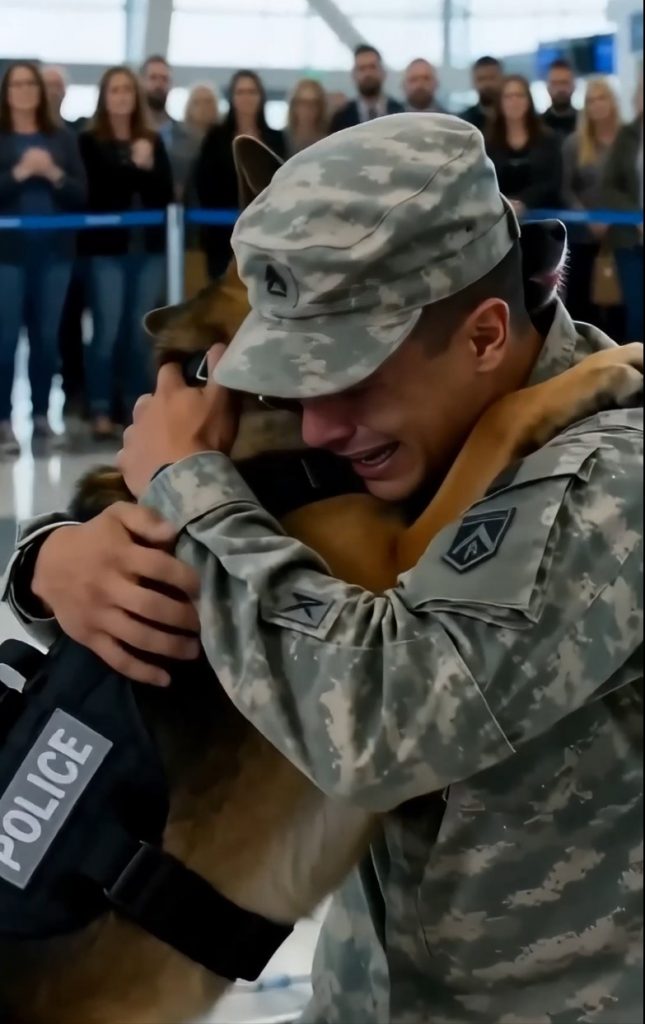
Across the terminal, near a line of airport security officers and waiting families, a German Shepherd in a black tactical K9 vest strained against a leather leash. Its tan-and-black body trembled with recognition. Silver patches on its vest flashed under the airport lights.
POLICE.
K9.
The dog barked again.
Canney’s mouth opened, but no sound came out.
The handler braced himself, both hands locked around the leash, trying to hold the powerful animal back. But the dog was not angry. It was not confused. It was trying to get to him.
Only him.
Canney’s breath broke.
“No,” he whispered.
The German Shepherd’s paws scraped against the floor as it lunged forward, tail whipping, ears high, eyes fixed on the soldier like the rest of the world had vanished.
Canney’s hands began to shake.
The crutches slipped from his fingers.
They hit the tile with a hollow, metallic clatter that silenced half the terminal.
A woman gasped. Someone whispered, “Oh my God.”
Canney barely heard them.
The handler loosened the leash.
The dog launched forward.
And the name Canney had not spoken aloud in seven months tore out of him like a wound reopening.
“Ranger.”
Act II
Before the airport, before the crutches, before the bandaged leg and the polite military escorts, there had been a dusty road outside a remote checkpoint and a dog who believed every command was a promise.
Ranger had been assigned to Canney two years earlier.
At first, Canney thought the German Shepherd hated him.
The dog stared too long. Ignored half his jokes. Refused treats from his hand unless he inspected them first like a suspicious customs officer. During training, Ranger obeyed commands perfectly, but he did it with the attitude of a veteran judging a rookie.
Canney had laughed about it with the other soldiers.
“He thinks he outranks me.”
His sergeant had looked at Ranger, then at him, and said, “He probably does.”
But one night, during a storm that shook the barracks windows, Ranger climbed onto the floor beside Canney’s cot and pressed his back against the soldier’s hand.
After that, they were inseparable.
Canney learned the language of Ranger’s ears. The slight shift when he sensed movement. The low breath before a warning. The impatient huff when Canney took too long lacing his boots.
Ranger learned Canney’s silences.
He knew when the soldier was joking too loudly because fear was sitting behind his ribs. He knew when Canney’s hand shook after a long patrol. He knew when to work, when to wait, and when to lay his heavy head across Canney’s boots until the young man remembered he was not alone.
The last mission had begun like any other.
Routine movement. Short convoy. Dust hanging low. Radio chatter in their ears.
Then Ranger froze.
It happened so fast that Canney would replay it for months and still never understand how the dog knew.
One second, Ranger was beside him.
The next, the dog lunged across Canney’s path, slamming into his legs with enough force to knock him sideways.
Canney hit the ground hard.
A flash tore through the air behind him.
After that, memory came in pieces.
Dust.
Shouting.
His own voice calling Ranger’s name.
His leg refusing to move.
A medic dragging him backward.
And through all of it, one image burned deeper than the rest: Ranger standing between him and the smoke, barking once before vanishing into the chaos.
Canney had tried to crawl after him.
Two soldiers held him down.
“He’s gone,” someone shouted.
Canney did not believe it.
Not at first.
Not when they loaded him onto the evacuation vehicle.
Not when a medic cut away his boot.
Not when he woke days later in a hospital bed and asked for his dog before he asked about his leg.
The answer came gently.
Too gently.
Ranger had not been recovered.
The area had been searched. There was no sign of him. No collar. No vest. No body.
“Sometimes,” the chaplain said, “not knowing is its own kind of mercy.”
Canney hated him for that.
Because not knowing was not mercy.
It was a door left open in a burning room.
For seven months, Canney carried that door inside him.
And now the impossible was running across an airport floor.
Act III
Ranger hit him like a memory with paws.
Canney dropped carefully to one knee, but the dog reached him before he was fully steady. The German Shepherd pressed into his chest, whining, barking, turning in frantic circles as if checking every part of him at once.
Canney wrapped both arms around Ranger’s neck and held on.
The dog licked his face, his jaw, his ear, his collar. The vest shifted under Canney’s fingers. Ranger whined again, high and broken, and pushed his head under the soldier’s chin the way he used to do after long patrols.
Canney folded over him.
The airport disappeared.
There were no strangers. No rolling luggage. No fluorescent lights. No crutches on the floor.
Only fur. Breath. Warmth.
Alive.
“How?” Canney sobbed into the dog’s neck. “I thought you died that day. How did you make it?”
Ranger answered by pressing closer.
The handler approached slowly, giving them space until Canney finally lifted his tear-streaked face.
The man in the green tactical uniform removed his cap. His expression was professional, but his eyes were wet.
“Specialist Canney?”
Canney nodded, still gripping Ranger like someone might take him away.
“I’m Officer Hale. He’s been with our department for four months.”
Canney stared at him.
“Four months?”
Hale crouched near them. Ranger glanced at him once, then returned immediately to Canney, refusing to lose contact.
“He was found outside a medical supply convoy station overseas,” Hale said quietly. “Underweight. exhausted. Still wearing part of a damaged harness. No readable tag.”
Canney swallowed hard.
“But his microchip—”
“Damaged reader results at first. The local team couldn’t pull a clear match. He was transferred through a working-dog rehabilitation program. Eventually he came stateside with our unit.”
Canney looked down at Ranger’s vest.
Police. K9.
“He became a police dog?”
Hale gave a small, emotional smile.
“For about three weeks, he tried. But he wasn’t really ours.”
Ranger licked Canney’s cheek again, as if agreeing.
Hale reached into his vest pocket and pulled out a folded plastic evidence sleeve.
“We knew something was different about him. He ignored most handlers unless they used military commands. He slept facing doors. He reacted to helicopters. And every time someone said the word ‘Canney’ during background checks, he lost his mind.”
Canney’s face crumpled.
Hale handed him the sleeve.
Inside was a torn strip of camouflage fabric.
A black name tape.
CANNEY.
The letters were faded, dirty, but clear.
Canney touched the plastic with trembling fingers.
“He had that with him when they found him,” Hale said. “Wouldn’t let anyone take it for weeks.”
Canney closed his eyes.
Ranger had carried his name.
Through dust. Through confusion. Through months of strangers and cages and transport kennels. Through every place that was not home.
He had carried the only piece of Canney he had left.
Canney pressed his forehead to Ranger’s.
“I’m sorry,” he whispered. “I’m so sorry I left you.”
Ranger’s tail thumped once against the tile.
Officer Hale looked away, giving the soldier room to break.
But the truth had not finished arriving.
Act IV
“There’s something else,” Hale said.
Canney looked up slowly.
The handler hesitated, then pulled a small envelope from inside his uniform jacket.
“When we finally confirmed his original military file, we contacted your recovery coordinator. They told us you were flying home today. We wanted this reunion to happen properly.”
Canney nodded, unable to speak.
“But before we transferred him, one of the rehabilitation vets found something embedded in the lining of his old harness.”
Canney’s stomach tightened.
Hale opened the envelope and removed a small, battered memory card sealed in plastic.
Canney stared at it.
“What is that?”
“We think it came from his harness camera.”
Canney’s fingers tightened in Ranger’s fur.
During certain operations, Ranger had worn a small camera unit. Canney barely remembered whether it had been active that day. Everything after the blast had become smoke and noise in his head.
“The footage was damaged,” Hale said. “But enough survived.”
Canney shook his head faintly. “Enough for what?”
Hale’s voice softened.
“To show what he did.”
The terminal around them seemed to hold its breath.
Hale glanced toward the crowd, then lowered his voice further.
“The official report said you were found by the second recovery team near the roadside.”
Canney nodded slowly.
“That was incomplete.”
Ranger leaned against him, quiet now.
“The footage shows Ranger came back to you after the blast. He pulled at your vest. Barked until he drew attention. Then he ran toward the medics and back to you twice.”
Canney’s eyes filled again.
“He led them to me?”
Hale nodded.
“And after that?”
“He stayed until the evacuation started. Then there was another disturbance nearby. The footage cuts out when he runs toward it.”
Canney looked at Ranger, stunned.
For seven months, he had believed Ranger died because Canney failed him.
For seven months, he had lain awake hearing that last bark, imagining the dog waiting for a command that never came.
But Ranger had not been abandoned.
He had been saving him.
The weight of guilt shifted inside Canney so violently that he almost lost his balance. Hale reached out, but Canney steadied himself against Ranger’s shoulders.
The dog stood firm.
Like always.
“I thought…” Canney’s voice broke. “I thought I left him behind.”
Hale shook his head.
“No, Specialist. From what we saw, he left only after making sure you were found.”
Canney lowered his face into Ranger’s fur again.
This time, the sob that came out of him was different.
It was not only grief.
It was release.
Behind them, a little boy clutched his mother’s sleeve and whispered, “Mom, is that his dog?”
The mother wiped her eyes.
“Yes,” she whispered back. “That’s his dog.”
The crowd stayed silent, not because they did not know what to say, but because some moments are too sacred for applause.
Then Ranger shifted, nosed Canney’s fallen crutch, and gave a soft huff.
Canney laughed through tears.
“You bossy old man.”
Ranger pushed the crutch again.
Even after everything, he was still telling him to stand.
Act V
The airport staff offered a wheelchair.
Canney refused at first.
Then Ranger gave him a look so familiar that Hale almost smiled.
It was the look of a K9 who had seen his human do something stupid many times and had limited patience left for pride.
Canney accepted the chair.
Not because he felt weak.
Because Ranger walked beside it.
The German Shepherd stayed close as they moved through the terminal, his shoulder brushing Canney’s knee, his leash loose in Officer Hale’s hand. Bystanders stepped aside. Some placed hands over their hearts. Others filmed quietly, though many lowered their phones after a few seconds, realizing the moment belonged to the soldier and the dog more than it belonged to the world.
At baggage claim, an older veteran in a Navy cap stood and saluted.
Canney looked overwhelmed.
Ranger looked at the man, then back at Canney, as if checking whether this was allowed.
Canney smiled weakly.
“At ease, buddy.”
Ranger sat.
For the first time that day, laughter rippled gently through the crowd.
Outside the terminal, the evening air was cool. Airport lights glowed against the darkening sky. Hale helped load Canney’s bag into the waiting vehicle, then stood beside the open door with Ranger’s leash in his hand.
The dog stared at Canney.
Canney stared at the leash.
Hale held it out.
“He’s retired now,” the handler said. “Officially as of this morning.”
Canney’s lips parted.
“What?”
“He never bonded with anyone the way he bonded with you. We all knew why.” Hale swallowed. “Department signed the release. Military working dog liaison approved it. Medical team cleared him for civilian placement.”
Canney looked from Hale to Ranger.
“You’re saying…”
“He’s going home with you.”
For a second, Canney could not move.
Then Ranger stepped forward, placed both front paws carefully on the edge of the vehicle floor, and waited for permission like the disciplined soldier he had always been.
Canney covered his mouth with one shaking hand.
“Come on,” he whispered.
Ranger climbed in slowly, then turned and pressed himself against Canney’s side.
The soldier wrapped an arm around him.
Not as a handler.
Not as a patient.
As family.
In the weeks that followed, Canney’s recovery changed.
Not easily. Not magically.
Pain still came. Nightmares still found him. Some mornings, the bandage around his leg felt like a reminder of everything he had lost. Some nights, he woke reaching for a dog that was already there, sleeping beside the bed with one ear lifted toward every sound.
Ranger had changed too.
His muzzle had more gray. He limped slightly after long walks. Loud noises made him tense, though he always recovered faster when Canney put a hand on his back.
They learned each other again.
Slowly.
Canney learned how to walk with one crutch and one hand resting lightly on Ranger’s harness.
Ranger learned that home had soft rugs, quiet mornings, and a kitchen where chicken was sometimes dropped “by accident.”
The memory card footage was later added to Ranger’s official record.
Not as evidence in a trial.
As truth.
The report was amended.
Ranger had not disappeared in panic. He had located his wounded handler, alerted medics, and remained in the area until further danger separated him from the unit.
At a small retirement ceremony six months later, Canney stood with Ranger at his side.
He still used a crutch, but only one.
His uniform was pressed. His name tag shone. Ranger wore no police vest that day, no tactical gear, no patches.
Only a simple red-patterned collar beneath a new brass tag.
RANGER
K9 PARTNER
FOUND HIS WAY BACK
When the commander finished speaking, Canney looked down.
Ranger looked up.
The crowd waited for a speech.
Canney had prepared one. A full page folded in his pocket. Words about service, sacrifice, loyalty, survival.
But when the time came, he could not read it.
He knelt carefully, one hand braced against his crutch, the other on Ranger’s neck.
The German Shepherd leaned into him.
Canney pressed his forehead to the dog’s.
“I thought I lost you,” he said, voice breaking.
Ranger gave one soft whine.
Canney smiled through tears.
“But you were the one who found me.”
No one moved.
No one needed to.
Because everyone standing there understood.
Some heroes come home on crutches.
Some come home wearing fur and scars nobody can see.
And sometimes, in the middle of a crowded airport, a bark can reopen the past just enough to let love walk through it alive.